第29章脊椎動物
Evolution of Birds鳥類の進化
Thanks to amazing new fossil discoveries in China, the evolutionary history of birds has become clearer, even though bird bones do not fossilize as well as those of other vertebrates. As we’ve seen earlier, birds are highly modified diapsids, but rather than having two fenestrations or openings in their skulls behind the eye, the skulls of modern birds are so specialized that it is difficult to see any trace of the original diapsid condition.
英語のヒント
中国で驚くべき新化石が発見されたおかげで、鳥類の進化史はより明確になった。鳥の骨は、ほかの脊椎動物の骨ほど化石になりやすくないにもかかわらずである。すでに見たように、鳥類は大きく変化した双弓類である。しかし現生鳥類の頭骨は非常に特殊化しているため、眼の後ろの二つの開口部という、もともとの双弓型の状態の痕跡を見いだすことは難しい。
Birds belong to a group of diapsids called the archosaurs, which includes three other groups: living crocodilians, pterosaurs, and dinosaurs. Overwhelming evidence shows that birds evolved within the clade Dinosauria, which is further subdivided into two groups, the Saurischia (“lizard hips”) and the Ornithischia (“bird hips”). Despite the names of these groups, it was not the bird-hipped dinosaurs that gave rise to modern birds. Rather, Saurischia diverged into two groups: One included the long-necked herbivorous dinosaurs, such as Apatosaurus. The second group, bipedal predators called theropods, gave rise to birds. This course of evolution is highlighted by numerous similarities between late (maniraptoran) theropod fossils and birds, specifically in the structure of the hip and wrist bones, as well as the presence of the wishbone, formed by the fusion of the clavicles.
英語のヒント
鳥類は主竜類という双弓類の群に属する。主竜類には、ほかに現生のワニ類、翼竜、恐竜という三つの群が含まれる。圧倒的な証拠が、鳥類は恐竜類という系統群の内部で進化したことを示している。恐竜類は、さらに竜盤類(「トカゲの腰」)と鳥盤類(「鳥の腰」)の二群に分かれる。これらの名前にもかかわらず、現生鳥類を生んだのは「鳥の腰」をもつ恐竜ではなかった。竜盤類が二つの群に分岐し、その一方には、アパトサウルスのような首の長い草食恐竜が含まれた。もう一方は獣脚類という二足歩行の捕食者の群で、そこから鳥類が生じた。この進化の道筋は、後期の獣脚類(マニラプトル類)の化石と鳥類の間の、多数の類似点によって裏づけられる。具体的には、骨盤や手首の骨の構造、さらに鎖骨の融合によってできる叉骨の存在などである。
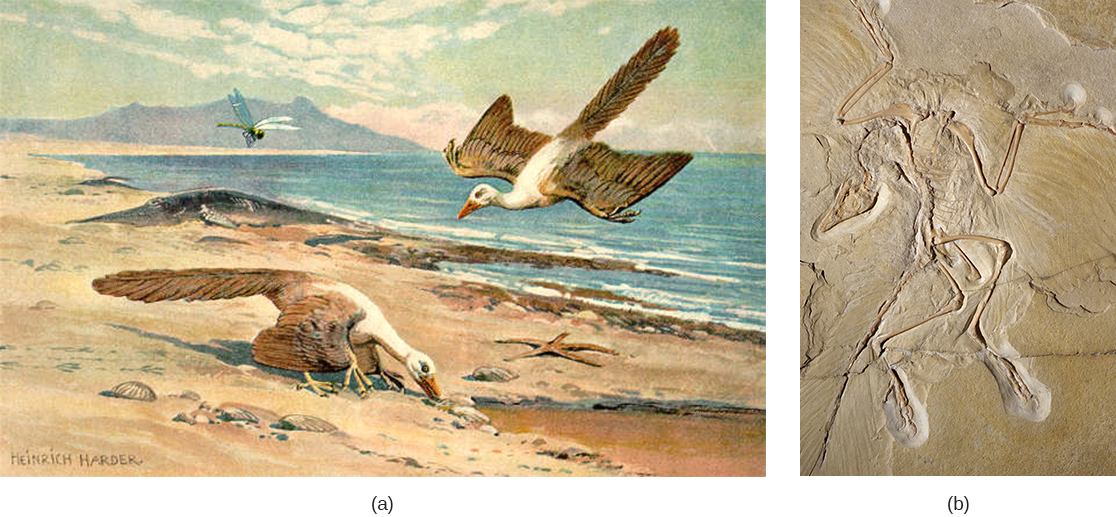
The clade Neornithes includes the avian crown group, which comprises all living birds and the descendants from their most recent common maniraptoran ancestor. One well-known and important fossil of an animal that appears “intermediate” between dinosaurs and birds is Archaeopteryx (Figure 29.35), which is from the Jurassic period (200 to 145 MYA). Archaeopteryx has characteristics of both maniraptoran dinosaurs and modern birds. Some scientists propose classifying it as a bird, but others prefer to classify it as a dinosaur. Traits in skeletons of Archaeopteryx like those of a dinosaur included a jaw with teeth and a long bony tail. Like birds, it had feathers modified for flight, both on the forelimbs and on the tail, a trait associated only with birds among modern animals. Fossils of older feathered dinosaurs exist, but the feathers may not have had the characteristics of modern flight feathers.
英語のヒント
新鳥類(Neornithes)という系統群には、現生の鳥類すべてと、それらの最も最近の共通祖先であるマニラプトル類から生じた子孫すべてを含む、鳥類のクラウングループが含まれる。恐竜と鳥類の「中間」に見える動物の、よく知られた重要な化石の一つが、ジュラ紀(2億〜1億4500万年前)の始祖鳥(Archaeopteryx)である(図29.35)。始祖鳥は、マニラプトル類の恐竜と現生鳥類の両方の特徴をもつ。鳥類に分類することを提案する科学者もいれば、恐竜に分類するほうを好む科学者もいる。始祖鳥の骨格には、歯のある顎や長い骨性の尾など、恐竜に似た特徴があった。一方、鳥類と同様に、前肢と尾の両方に、飛行用に変化した羽毛があった。この形質は、現生動物では鳥類だけに見られる。より古い羽毛恐竜の化石もあるが、その羽毛には現代の風切羽の特徴がなかった可能性がある。
OpenStax, Rice University; Biology 2e. (credit b: modification of work by Daderot/Wikimedia Commons, CC0 1.0) Panel b: Daderot, CC0 1.0 (https://creativecommons.org/publicdomain/zero/1.0/). · CC BY 4.0 · Source出典

Figure 29.35図 29.35
Archaeopteryx. (a) Archaeopteryx lived in the late Jurassic period around 150 million years ago. It had cuplike thecodont teeth like a dinosaur, but had (b) flight feathers like modern birds, which can be seen in this fossil. Note the claws on the wings, which are still found in a number of birds, such as the newborn chicks of the South American Hoatzin. (credit b: modification of work by Daderot/Wikimedia Commons, CC0 1.0)
始祖鳥。(a)始祖鳥は、約1億5000万年前のジュラ紀後期に生息した。恐竜のように、杯状の歯槽に収まる歯をもつ一方、(b)現生鳥類のような風切羽をもち、この化石でもそれが見える。翼の爪に注目しよう。南アメリカのツメバケイの孵化直後のひななど、多くの鳥には今もこの爪がある。(クレジットb:Daderot/Wikimedia Commons の作品を改変、CC0 1.0)
The Evolution of Flight in Birds鳥類における飛行の進化
There are two basic hypotheses that explain how flight may have evolved in birds: the arboreal (“tree”) hypothesis and the terrestrial (“land”) hypothesis. The arboreal hypothesis posits that tree-dwelling precursors to modern birds jumped from branch to branch using their feathers for gliding before becoming fully capable of flapping flight. In contrast to this, the terrestrial hypothesis holds that running (perhaps pursuing active prey such as small cursorial animals) was the stimulus for flight. In this scenario, wings could be used to capture prey and were preadapted for balance and flapping flight. Ostriches, which are large flightless birds, hold their wings out when they run, possibly for balance. However, this condition may represent a behavioral relict of the clade of flying birds that were their ancestors. It seems more likely that small feathered arboreal dinosaurs were capable of gliding (and flapping) from tree to tree and branch to branch, improving the chances of escaping enemies, finding mates, and obtaining prey such as flying insects. This early flight behavior would have also greatly increased the opportunity for species dispersal.
英語のヒント
鳥類の飛行がどのように進化したかを説明する基本的な仮説は二つある。樹上説と地上説である。樹上説は、現生鳥類の樹上生活をする祖先が、完全な羽ばたき飛行を獲得する前に、羽毛で滑空しながら枝から枝へ跳び移っていたと考える。これに対し、地上説は、走ることがおそらく小型の走行性動物などの活動的な獲物を追う際に、飛行への刺激となったとする。この筋書きでは、翼は獲物を捕らえるために使われ、体のバランスを保つことや羽ばたき飛行への前適応となっていた。大型で飛べない鳥のダチョウは、走る際に翼を広げるが、これはおそらくバランスのためである。ただし、この状態は、祖先だった飛ぶ鳥の系統群の行動の名残かもしれない。よりありそうなのは、羽毛をもつ小型の樹上性恐竜が、木から木へ、枝から枝へと滑空し、羽ばたくこともできたという説明である。それによって、敵から逃れ、配偶相手を見つけ、飛ぶ昆虫などの獲物を得る機会が増えた。この初期の飛行行動は、種が分散する機会も大いに増やしただろう。
Although we have a good understanding of how feathers and flight may have evolved, the question of how endothermy evolved in birds (and other lineages) remains unanswered. Feathers provide insulation, but this is only beneficial for thermoregulatory purposes if body heat is being produced internally. Similarly, internal heat production is only viable for the evolution of endothermy if insulation is present to retain that infrared energy. It has been suggested that one or the other—feathers or endothermy—evolved first in response to some other selective pressure (e.g., the ability to be active at night, provide camouflage, repel water, or serve as signals for mate selection). It seems probable that feathers and endothermy coevolved together, the improvement and evolutionary advancement of feathers reinforcing the evolutionary advancement of endothermy, and so on.
英語のヒント
羽毛と飛行がどのように進化した可能性があるかについては、かなりよく理解されている。しかし、鳥類やほかの系統で内温性がどのように進化したのかは、まだわかっていない。羽毛には断熱作用があるが、それが体温調節に役立つのは、体内で熱が生み出されている場合だけである。同様に、体内の熱産生が内温性の進化につながりうるのは、その赤外線エネルギーを保持する断熱構造が存在する場合だけである。羽毛と内温性のどちらか一方が、別の選択圧に応じて先に進化したという説もある。たとえば、夜間に活動する能力、カモフラージュ、防水、配偶相手の選択のための信号などである。羽毛と内温性は一緒に共進化した可能性が高い。羽毛の改良と進化的な発達が、内温性の進化的な発達を強める、といった相互作用が続いたのだろう。
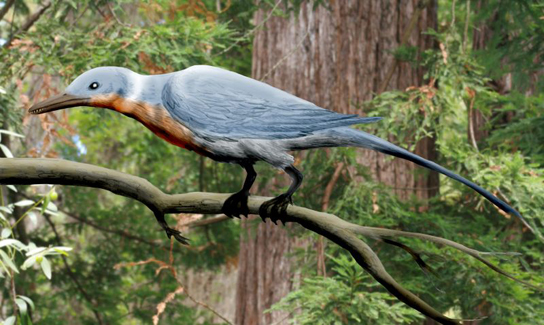
During the Cretaceous period (145 to 66 MYA), a group known as the Enantiornithes was the dominant bird type (Figure 29.36). Enantiornithes means “opposite birds,” which refers to the fact that certain bones of the shoulder are joined differently than the way the bones are joined in modern birds. Like Archaeopteryx, these birds retained teeth in their jaws, but did have a shortened tail, and at least some fossils have preserved “fans” of tail feathers. These birds formed an evolutionary lineage separate from that of modern birds, and they did not survive past the Cretaceous. Along with the Enantiornithes, however, another group of birds—the Ornithurae ("bird tails"), with a short, fused tail or pygostyle—emerged from the evolutionary line that includes modern birds. This clade was also present in the Cretaceous.
英語のヒント
白亜紀(1億4500万〜6600万年前)には、エナンティオルニス類という群が主要な鳥類だった(図29.36)。Enantiornithes は「反対の鳥」を意味し、肩の一部の骨の接合の仕方が現生鳥類と異なることに由来する。始祖鳥と同様、顎に歯を残していたが、尾は短くなっており、少なくとも一部の化石には扇状の尾羽が残されている。これらの鳥は、現生鳥類とは別の進化的系統を形成し、白亜紀より後には生き残らなかった。しかしエナンティオルニス類と並んで、別の鳥の群、短く融合した尾、すなわち尾端骨をもつ真鳥類(Ornithurae、「鳥の尾」)が、現生鳥類を含む進化系統から現れた。この系統群も白亜紀に存在していた。
After the extinction of Enantiornithes, the Ornithurae became the dominant birds, with a large and rapid radiation occurring after the extinction of the dinosaurs during the Cenozoic era (66 MYA to the present). Molecular analysis based on very large data sets has produced our current understanding of the relationships among living birds. There are three major clades: the Paleognathae, the Galloanserae, and the Neoaves. The Paleognathae (“old jaw”) or ratites (polyphyletic) are a group of flightless birds including ostriches, emus, rheas, and kiwis. The Galloanserae include pheasants, ducks, geese and swans. The Neoaves ("new birds") includes all other birds. The Neoaves themselves have been distributed among five clades: Prum, RO et al. 2015. A comprehensive phylogeny of birds (Aves) using targeted next-generation DNA sequencing. Nature 526: 569 - 573. http://dx.doi.org/10.1038/nature15697 Strisores (nightjars, swifts, and hummingbirds), Columbaves (turacos, bustards, cuckoos, pigeons, and doves), Gruiformes (cranes), Aequorlitornithes (diving birds, wading birds, and shorebirds), and Inopinaves (a very large clade of land birds including hawks, owls, woodpeckers, parrots, falcons, crows, and songbirds). Despite the current classification scheme, it is important to understand that phylogenetic revisions, even for the extant birds, are still taking place.
英語のヒント
エナンティオルニス類の絶滅後、真鳥類が主要な鳥類となり、恐竜が絶滅した後の新生代(6600万年前〜現在)に、大規模で急速な適応放散が起こった。非常に大きなデータセットに基づく分子解析によって、現生鳥類の類縁関係についての現在の理解が得られた。主要な系統群は、古顎類、キジカモ類、新鳥類(Neoaves)の三つである。古顎類(Paleognathae、「古い顎」)、または走鳥類(多系統群)は、ダチョウ、エミュー、レア、キーウィを含む飛べない鳥の群である。キジカモ類には、キジ、カモ、ガン、ハクチョウが含まれる。新鳥類(Neoaves、「新しい鳥」)には、残るすべての鳥が含まれる。新鳥類は、さらに五つの系統群に分けられている。Prum, RO et al. 2015.「標的を定めた次世代DNAシーケンシングによる鳥類の包括的系統樹」Nature 526: 569–573. http://dx.doi.org/10.1038/nature15697。五群は、Strisores(ヨタカ、アマツバメ、ハチドリ)、Columbaves(エボシドリ、ノガン、カッコウ、ハト類)、Gruiformes(ツル類)、Aequorlitornithes(潜水性の鳥、渉禽類、海岸の鳥)、Inopinaves(タカ、フクロウ、キツツキ、オウム、ハヤブサ、カラス、鳴禽類を含む非常に大きな陸鳥の系統群)である。現在の分類体系はあるものの、現生鳥類についてもなお、系統分類の見直しが続いていることを理解しておくことが重要である。
© Nobu Tamura; Shanweiniao cooperorum. The CC BY option is selected from the original dual license. OpenStax, Biology 2e adaptation. · CC BY 3.0 · Source出典

Figure 29.36図 29.36
Enantiornithean bird. Shanweiniao cooperorum was a species of Enantiornithes that did not survive past the Cretaceous period. (credit: Nobu Tamura)
エナンティオルニス類の鳥。シャンウェイニャオ・コオペロルム(Shanweiniao cooperorum)は、白亜紀より後には生き残らなかったエナンティオルニス類の一種である。(クレジット:Nobu Tamura)