第29章脊椎動物
29.1 Chordates29.1 脊索動物
Learning Objectives学習目標
By the end of this section, you will be able to do the following:
この節を学ぶと、次のことができるようになる。
- Describe the distinguishing characteristics of chordates脊索動物を特徴づける性質を説明する。
- Identify the derived characters of craniates that sets them apart from other chordates有頭動物をほかの脊索動物と区別する派生形質を挙げる。
- Describe the developmental fate of the notochord in vertebrates脊椎動物の発生において、脊索が何になるかを説明する。
The vertebrates exhibit two major innovations in their evolution from the invertebrate chordates. These innovations may be associated with the whole genome duplications that resulted in a quadruplication of the basic chordate genome, including the Hox gene loci that regulate the placement of structures along the three axes of the body. One of the first major steps was the emergence of the quadrupeds in the form of the amphibians. A second step was the evolution of the amniotic egg, which, similar to the evolution of pollen and seeds in plants, freed terrestrial animals from their dependence on water for fertilization and embryonic development. Within the amniotes, modifications of keratinous epidermal structures have given rise to scales, claws, hair, and feathers. The scales of reptiles sealed their skins against water loss, while hair and feathers provided insulation to support the evolution of endothermy, as well as served other functions such as camouflage and mate attraction in the vertebrate lineages that led to birds and mammals.
英語のヒント
脊椎動物が無脊椎の脊索動物から進化する過程では、二つの大きな革新が見られる。これらは、基本的な脊索動物のゲノムを4倍にした全ゲノム重複と関連する可能性がある。重複には、体の三つの軸に沿った構造の配置を調節するHox遺伝子座も含まれる。最初の大きな段階の一つは、両生類という形で四足動物が現れたことである。第二の段階は羊膜卵の進化である。植物での花粉と種子の進化に似て、羊膜卵は陸上動物を、受精と胚発生に水が必要という制約から解放した。羊膜類では、ケラチン性の表皮構造の改変から、鱗、爪、毛、羽毛が生じた。爬虫類の鱗は皮膚を密閉して水分喪失を防ぎ、毛と羽毛は断熱によって内温性の進化を支えた。さらに、鳥類や哺乳類へ至る脊椎動物の系統で、カモフラージュや配偶相手の誘引など、ほかの機能も果たした。
Currently, a number of vertebrate species face extinction primarily due to habitat loss and pollution. According to the International Union for the Conservation of Nature, more than 6,000 vertebrate species are classified as threatened. Amphibians and mammals are the classes with the greatest percentage of threatened species, with 29 percent of all amphibians and 21 percent of all mammals classified as threatened. Attempts are being made around the world to prevent the extinction of threatened species. For example, the Biodiversity Action Plan is an international program, ratified by 188 countries, which is designed to protect species and habitats.
英語のヒント
現在、多くの脊椎動物種が、主に生息地の喪失と汚染によって絶滅に直面している。国際自然保護連合によると、6,000種を超える脊椎動物が絶滅危惧に分類される。絶滅危惧種の割合が最も高い綱は両生類と哺乳類で、両生類全体の29%、哺乳類全体の21%が絶滅危惧とされる。世界各地で、絶滅危惧種の絶滅を防ぐ試みが進められている。例えば生物多様性行動計画は、188か国が批准した、種と生息地を保護するための国際的なプログラムである。
Vertebrates are members of the kingdom Animalia and the phylum Chordata (Figure 29.2). Recall that animals that possess bilateral symmetry can be divided into two groups—protostomes and deuterostomes—based on their patterns of embryonic development. The deuterostomes, whose name translates as “second mouth,” consist of two major phyla: Echinodermata and Chordata. Echinoderms are invertebrate marine animals that have pentaradial symmetry and a spiny body covering, a group that includes sea stars, sea urchins, and sea cucumbers. The most conspicuous and familiar members of Chordata are vertebrates, but this phylum also includes two groups of invertebrate chordates.
英語のヒント
脊椎動物は動物界・脊索動物門に属する(図29.2)。左右相称の動物は、胚発生の様式に基づき、前口動物と後口動物の二群に分けられることを思い出そう。「二番目の口」を意味する後口動物は、棘皮動物門と脊索動物門という二つの主要な門からなる。棘皮動物は、五放射相称と棘のある体表をもつ海産無脊椎動物で、ヒトデ、ウニ、ナマコなどを含む。脊索動物で最も目立ち、なじみ深いのは脊椎動物だが、この門には無脊椎の脊索動物も二群含まれる。
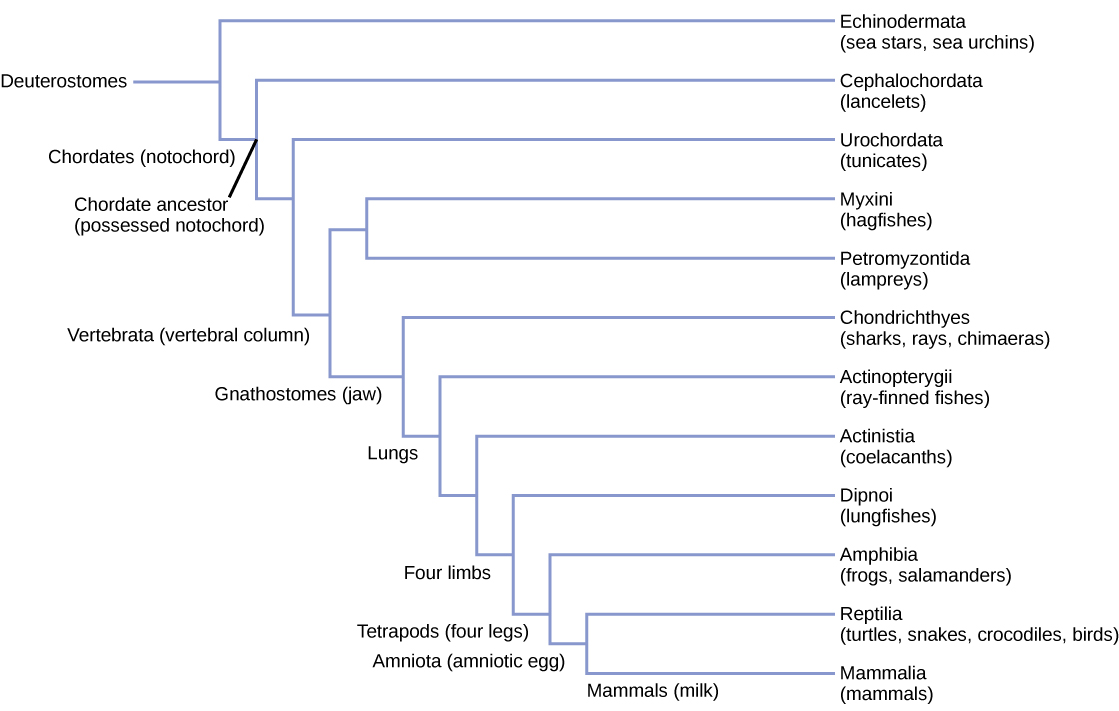

Figure 29.2図 29.2
Deuterostome phylogeny. All chordates are deuterostomes possessing a notochord at some stage of their life cycle.
後口動物の系統。すべての脊索動物は、生活環のどこかの段階に脊索をもつ後口動物である。
Characteristics of Chordata脊索動物の特徴
Animals in the phylum Chordata share five key characteristics that appear at some stage during their development: a notochord, a dorsal hollow (tubular) nerve cord, pharyngeal gill arches or slits, a post-anal tail, and an endostyle/thyroid gland (Figure 29.3). In some groups, some of these key characteristics are present only during embryonic development.
英語のヒント
脊索動物門の動物は、発生のどこかの段階に現れる五つの重要な特徴を共有する。脊索、背側の中空(管状)の神経索、咽頭の鰓弓または鰓裂、肛門後方の尾、内柱または甲状腺である(図29.3)。一部の群では、これらの特徴のいくつかは胚発生中にしか存在しない。
The chordates are named for the notochord, which is a flexible, rod-shaped mesodermal structure that is found in the embryonic stage of all chordates and in the adult stage of some chordate species. It is strengthened with glycoproteins similar to cartilage and covered with a collagenous sheath. The notochord is located between the digestive tube and the nerve cord, and provides rigid skeletal support as well as a flexible location for attachment of axial muscles. In some chordates, the notochord acts as the primary axial support of the body throughout the animal’s lifetime. However, in vertebrates (craniates), the notochord is present only during embryonic development, at which time it induces the development of the neural tube and serves as a support for the developing embryonic body. The notochord, however, is not found in the postembryonic stages of vertebrates; at this point, it has been replaced by the vertebral column (that is, the spine).
英語のヒント
脊索動物という名は脊索に由来する。脊索は、柔軟な棒状の中胚葉構造で、すべての脊索動物の胚期と、一部の種の成体期に存在する。軟骨に似た糖タンパク質で補強され、コラーゲン性の鞘で覆われる。消化管と神経索の間にあり、硬い骨格支持を与えるとともに、体軸筋が付着する柔軟な場所にもなる。一部の脊索動物では、生涯を通じて脊索が体軸の主要な支持構造として働く。しかし脊椎動物(有頭動物)では、胚発生中にしか存在せず、その間に神経管の発生を誘導し、発生中の胚の体を支える。胚期を過ぎた脊椎動物には脊索は見られず、この時点では脊柱、すなわち背骨に置き換わっている。
The dorsal hollow nerve cord is derived from ectoderm that rolls into a hollow tube during development. In chordates, it is located dorsally to the notochord. In contrast, the nervous system in protostome animal phyla is characterized by solid nerve cords that are located either ventrally and/or laterally to the gut. In vertebrates, the neural tube develops into the brain and spinal cord, which together comprise the central nervous system (CNS). The peripheral nervous system (PNS) refers to the peripheral nerves (including the cranial nerves) lying outside of the brain and spinal cord.
英語のヒント
背側中空神経索は、発生中に巻き込まれて中空の管になる外胚葉に由来する。脊索動物では脊索の背側に位置する。対照的に、前口動物の各門の神経系は、腸の腹側や側方に位置する中実の神経索を特徴とする。脊椎動物では神経管が脳と脊髄へ発達し、両者で中枢神経系(CNS)を構成する。末梢神経系(PNS)とは、脳と脊髄の外にある末梢神経(脳神経を含む)を指す。
Pharyngeal slits are openings in the pharynx (the region just posterior to the mouth) that extend to the outside environment. In organisms that live in aquatic environments, pharyngeal slits allow for the exit of water that enters the mouth during feeding. Some invertebrate chordates use the pharyngeal slits to filter food out of the water that enters the mouth. The endostyle is a strip of ciliated mucus-producing tissue in the floor of the pharynx. Food particles trapped in the mucus are moved along the endostyle toward the gut. The endostyle also produces substances similar to thyroid hormones and is homologous with the thyroid gland in vertebrates. In vertebrate fishes, the pharyngeal slits are modified into gill supports, and in jawed fishes, into jaw supports. In tetrapods (land vertebrates), the slits are highly modified into components of the ear, and tonsils and thymus glands. In other vertebrates, pharyngeal arches, derived from all three germ layers, give rise to the oral jaw from the first pharyngeal arch, with the second arch becoming the hyoid and jaw support.
英語のヒント
咽頭裂は、口のすぐ後ろの領域である咽頭から、外部環境へ通じる開口部である。水中に暮らす生物では、摂食中に口から入った水の出口となる。一部の無脊椎脊索動物は、咽頭裂を使い、口から入った水から食物をろ過する。内柱は、咽頭の底部にある、繊毛を備えて粘液をつくる帯状組織である。粘液に捕らえられた食物粒子は、内柱に沿って腸へ運ばれる。内柱は甲状腺ホルモンに似た物質もつくり、脊椎動物の甲状腺と相同である。脊椎動物である魚類では、咽頭裂は鰓の支持構造へ、有顎魚では顎の支持構造へと改変される。四足類(陸上脊椎動物)では、耳の構成要素、扁桃、胸腺へ大きく改変される。ほかの脊椎動物では、三つすべての胚葉に由来する咽頭弓のうち、第1咽頭弓から顎が、第2咽頭弓から舌骨と顎の支持構造が生じる。
The post-anal tail is a posterior elongation of the body, extending beyond the anus. The tail contains skeletal elements and muscles, which provide a source of locomotion in aquatic species, such as fishes. In some terrestrial vertebrates, the tail also helps with balance, courting, and signaling when danger is near. In humans and other great apes, the post-anal tail is reduced to a vestigial coccyx (“tail bone”) that aids in balance during sitting.
英語のヒント
肛門後方の尾は、肛門を越えて後方へ伸びた体の部分である。尾には骨格要素と筋肉があり、魚などの水生種では移動の力を生み出す。一部の陸上脊椎動物では、平衡の維持、求愛、危険が近いことを知らせる信号にも役立つ。人やほかの大型類人猿では、肛門後方の尾は痕跡的な尾骨へ縮小しており、座るときの平衡を助ける。