第29章脊椎動物
Chordates and the Evolution of Vertebrates脊索動物と脊椎動物の進化
Two clades of chordates are invertebrates: Cephalochordata and Urochordata. Members of these groups also possess the five distinctive features of chordates at some point during their development.
脊索動物の二つのクレード、頭索動物と尾索動物は無脊椎動物である。これらも発生のどこかの時点で、脊索動物に特有の五つの特徴をもつ。
Cephalochordata頭索動物
Members of Cephalochordata possess a notochord, dorsal hollow tubular nerve cord, pharyngeal slits, endostyle/thyroid gland, and a post-anal tail in the adult stage (Figure 29.4). The notochord extends into the head, which gives the subphylum its name. Although the neural tube also extends into the head region, there is no well-defined brain, and the nervous system is centered around a hollow nerve cord lying above the notochord. Extinct members of this subphylum include Pikaia, which is the oldest known cephalochordate. Excellently preserved Pikaia fossils were recovered from the Burgess shales of Canada and date to the middle of the Cambrian age, making them more than 500 million years old. The anatomy of Pikaia closely resembles that of the extant lancelet in the genus Branchiostoma.
英語のヒント
頭索動物は成体で、脊索、背側の中空管状神経索、咽頭裂、内柱または甲状腺、肛門後方の尾をもつ(図29.4)。脊索が頭部まで伸びることが、亜門名の由来である。神経管も頭部へ伸びるが、明瞭な脳はなく、神経系は脊索の上にある中空神経索を中心とする。この亜門の絶滅動物には、知られている最古の頭索動物であるピカイアが含まれる。保存状態の非常によいピカイアの化石がカナダのバージェス頁岩から見つかっており、カンブリア紀中期、すなわち5億年以上前にさかのぼる。その体の構造は、現生のナメクジウオ属 Branchiostoma によく似ている。
The lancelets are named for their bladelike shape. Lancelets are only a few centimeters long and are usually found buried in sand at the bottom of warm temperate and tropical seas. Cephalochordates are suspension feeders. A water current is created by cilia in the mouth, and is filtered through oral tentacles. Water from the mouth then enters the pharyngeal slits, which filter out food particles. The filtered water collects in a gill chamber called the atrium and exits through the atriopore. Trapped food particles are caught in a stream of mucus produced by the endostyle in a ventral ciliated fold (or groove) of the pharynx and carried to the gut. Most gas exchange occurs across the body surface. Sexes are separate and gametes are released into the water through the atriopore for external fertilization.
英語のヒント
ナメクジウオの英名 lancelet は、刃に似た形に由来する。長さは数cmにすぎず、通常、暖温帯や熱帯の海の海底の砂に埋まっている。頭索動物は懸濁物食者である。口の繊毛が水流をつくり、口の触手を通じてろ過する。口から入った水は次に咽頭裂へ進み、そこで食物粒子がろ過される。ろ過された水は囲鰓腔という鰓の部屋に集まり、囲鰓腔孔から出る。捕らえられた食物粒子は、咽頭腹側の繊毛のあるひだ(または溝)にある内柱がつくる粘液の流れに取り込まれ、腸へ運ばれる。ガス交換の大部分は体表で起こる。雌雄は別で、配偶子は囲鰓腔孔から水中へ放出され、体外受精する。
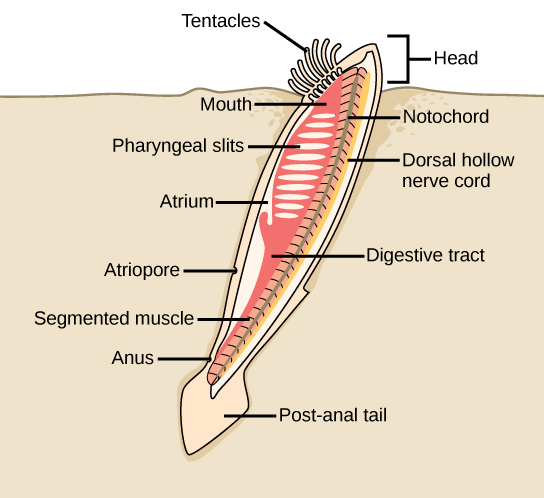

Figure 29.4図 29.4
Cephalochordate anatomy. In the lancelet and other cephalochordates, the notochord extends into the head region. Adult lancelets retain all five key characteristics of chordates: a notochord, a dorsal hollow nerve cord, pharyngeal slits, an endostyle, and a post-anal tail.
頭索動物の体の構造。ナメクジウオなどの頭索動物では、脊索が頭部まで伸びる。成体のナメクジウオは、脊索、背側中空神経索、咽頭裂、内柱、肛門後方の尾という、脊索動物の五つの重要な特徴をすべて保持する。
Urochordata尾索動物
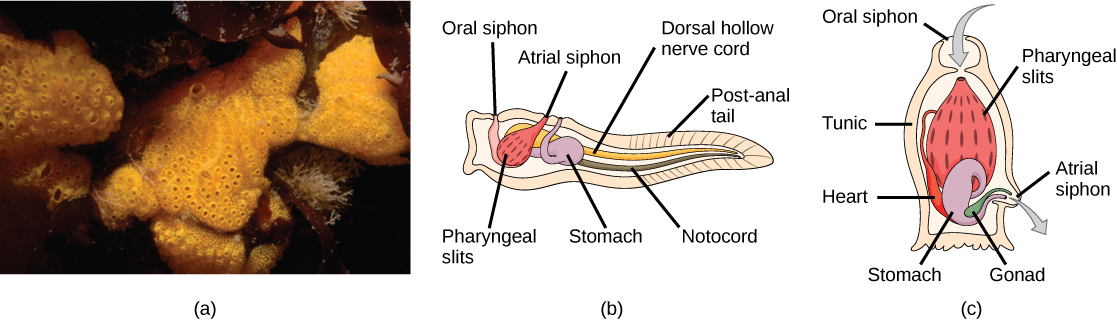
The 1,600 species of Urochordata are also known as tunicates (Figure 29.5). The name tunicate derives from the cellulose-like carbohydrate material, called the tunic, which covers the outer body of tunicates. Although tunicates are classified as chordates, the adults do not have a notochord, a dorsal hollow nerve cord, or a post-anal tail, although they do have pharyngeal slits and an endostyle. The “tadpole” larval form, however, possesses all five structures. Most tunicates are hermaphrodites; their larvae hatch from eggs inside the adult tunicate’s body. After hatching, a tunicate larva (possessing all five chordate features) swims for a few days until it finds a suitable surface on which it can attach, usually in a dark or shaded location. It then attaches via the head to the surface and undergoes metamorphosis into the adult form, at which point the notochord, nerve cord, and tail disappear, leaving the pharyngeal gill slits and the endostyle as the two remaining features of its chordate morphology.
英語のヒント
1,600種の尾索動物は、被嚢類とも呼ばれる(図29.5)。被嚢類の名は、外側の体を覆う被嚢というセルロース様の炭水化物に由来する。脊索動物に分類されるが、成体には脊索、背側中空神経索、肛門後方の尾がなく、咽頭裂と内柱はある。一方、オタマジャクシ型の幼生には、五つの構造がすべてそろう。多くの被嚢類は雌雄同体で、成体の体内の卵から幼生が孵化する。五つの特徴を備えた幼生は、孵化後数日間泳ぎ、通常は暗い場所や日陰に、付着に適した表面を見つける。次に頭部で表面へ付着し、成体へ変態する。その時点で脊索、神経索、尾が消え、咽頭鰓裂と内柱が、脊索動物の形態として残る二つの特徴となる。
OpenStax, Rice University; Biology 2e. (credit: modification of work by Dann Blackwood, USGS) · CC BY 4.0 · Source出典

Figure 29.5図 29.5
Urochordate anatomy. (a) This photograph shows a colony of the tunicate Botrylloides violaceus. (b) The larval stage of the tunicate possesses all of the features characteristic of chordates: a notochord, a dorsal hollow nerve cord, pharyngeal slits, an endostyle, and a post-anal tail. (c) In the adult stage, the notochord, nerve cord, and tail disappear, leaving just the pharyngeal slits and endostyle. (credit: modification of work by Dann Blackwood, USGS)
尾索動物の体の構造。(a)ホヤ類 Botrylloides violaceus の群体の写真。(b)被嚢類の幼生には、脊索、背側中空神経索、咽頭裂、内柱、肛門後方の尾という、脊索動物の特徴がすべてある。(c)成体では脊索、神経索、尾が消え、咽頭裂と内柱だけが残る。(提供:Dann Blackwood、USGSの作品を改変)
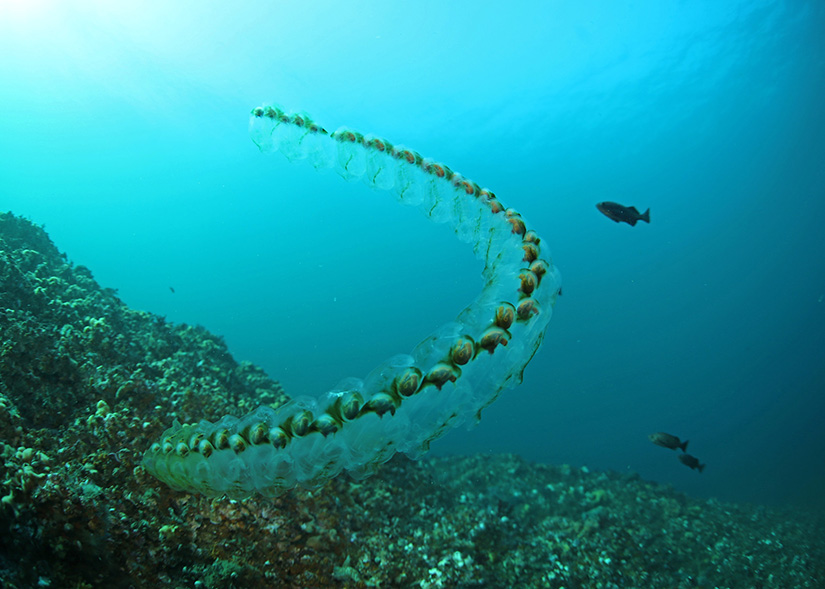
Adult tunicates may be either solitary or colonial forms, and some species may reproduce by budding. Most tunicates live a sessile existence on the ocean floor and are suspension feeders. However, chains of thaliacean tunicates called salps (Figure 29.6) can swim actively while feeding, propelling themselves as they move water through the pharyngeal slits. The primary foods of tunicates are plankton and detritus. Seawater enters the tunicate’s body through its incurrent siphon. Suspended material is filtered out of this water by a mucous net produced by the endostyle and is passed into the intestine via the action of cilia. The anus empties into the excurrent siphon, which expels wastes and water. Tunicates are found in shallow ocean waters around the world.
英語のヒント
被嚢類の成体には、単独性と群体性の形態があり、出芽で繁殖する種もある。大部分は海底に固着して暮らす懸濁物食者である。しかし、タリア類の被嚢類であるサルパが鎖状につながったもの(図29.6)は、咽頭裂を通して水を流して推進力を得ながら、能動的に泳いで摂食できる。主な食物はプランクトンとデトリタスである。海水は入水管から体内へ入り、内柱がつくる粘液の網が懸濁物をろ過し、繊毛の働きで腸へ送る。肛門は出水管へ開き、出水管が老廃物と水を排出する。被嚢類は世界中の浅い海に見られる。
OpenStax, Rice University; Biology 2e. (credit: Oregon Department of Fish & Wildlife via Wikimedia Commons) · CC BY 4.0 · Source出典

Figure 29.6図 29.6
Salps. These colonial tunicates feed on phytoplankton. Salps are sequential hermaphrodites, with younger female colonies fertilized by older male colonies. (credit: Oregon Department of Fish & Wildlife via Wikimedia Commons)
サルパ。この群体性の被嚢類は植物プランクトンを食べる。サルパは性転換する雌雄同体であり、若い雌の群体が、年長の雄の群体によって受精する。(提供:Oregon Department of Fish & Wildlife、Wikimedia Commons経由)