第29章脊椎動物
Modern Reptiles現生の爬虫類
Class Reptilia includes many diverse species that are classified into four living clades. There are the 25 species of Crocodilia, two species of Sphenodontia, approximately 9,200 Squamata species, and about 325 species of Testudines.
爬虫綱には多くの多様な種が含まれ、現生の四つの系統群に分類される。ワニ目25種、ムカシトカゲ目2種、有鱗目約9200種、カメ目約325種である。
Crocodiliaワニ目
Crocodilia (“small lizard”) arose as a distinct lineage by the middle Triassic; extant species include alligators, crocodiles, gharials, and caimans. Crocodilians (Figure 29.27) live throughout the tropics and subtropics of Africa, South America, Southern Florida, Asia, and Australia. They are found in freshwater, saltwater, and brackish habitats, such as rivers and lakes, and spend most of their time in water. Crocodiles are descended from terrestrial reptiles and can still walk and run well on land. They often move on their bellies in a swimming motion, propelled by alternate movements of their legs. However, some species can lift their bodies off the ground, pulling their legs in under the body with their feet rotated to face forward. This mode of locomotion takes a lot of energy, and seems to be used primarily to clear ground obstacles. Amazingly, some crocodiles can also gallop, pushing off with their hind legs and moving their hind and forelegs alternately in pairs. Galloping crocodiles have been clocked at speeds over 17 kph and, over short distances, in an ambush situation, they can easily chase down most humans if they are taken by surprise. However, they are short distance runners, not interested in a long chase, and most fit humans can probably outrun them in a sprint (assuming they respond quickly to the ambush!).
英語のヒント
ワニ目(Crocodilia、「小さなトカゲ」)は、三畳紀中期までに独立した系統として出現した。現生種には、アリゲーター、クロコダイル、ガビアル、カイマンが含まれる。ワニ類(図29.27)は、アフリカ、南アメリカ、フロリダ南部、アジア、オーストラリアの熱帯・亜熱帯域に広く生息する。河川や湖など、淡水、海水、汽水の生息地に見られ、時間の大部分を水中で過ごす。ワニ類は陸生爬虫類に由来し、現在でも陸上をうまく歩いたり走ったりできる。脚を交互に動かして推進力を生み、泳ぐような動きで腹ばいに進むことが多い。しかし、一部の種では、足先を前方へ向けて脚を体の下に引き寄せ、体を地面から持ち上げられる。この移動方法には多くのエネルギーが必要で、主に地上の障害物を越えるために使われるようだ。驚くことに、一部のワニは、後肢で蹴り出し、左右の後肢と左右の前肢を交互にそろえて動かすギャロップ走行もできる。ギャロップするワニでは、時速17 kmを超える速度が記録されており、待ち伏せからの短距離なら、不意を突かれた大部分の人を容易に追いつめられる。しかし、ワニは短距離走者であり、長く追跡しようとはしない。体力のある大部分の人は、おそらく短距離走でワニを振り切れるだろう(待ち伏せに素早く反応できればの話だが!)。
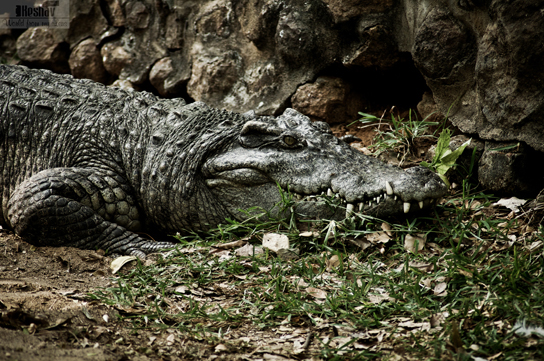
Figure 29.27図 29.27
A crocodilian. Crocodilians, such as this Siamese crocodile (Crocodylus siamensis), provide parental care for their offspring. (credit: Keshav Mukund Kandhadai)
ワニ類。このシャムワニ(Crocodylus siamensis)など、ワニ類は子の世話をする。(クレジット:Keshav Mukund Kandhadai)
Sphenodontiaムカシトカゲ目
Sphenodontia (“wedge tooth”) arose in the early Mesozoic era, when they had a moderate radiation, but now are represented by only two living species: Sphenodon punctatus and Sphenodon guntheri, both found on offshore islands in New Zealand (Figure 29.28). The common name "tuatara" comes from a Maori word describing the crest along its back. Tuataras have a primitive diapsid skull with biconcave vertebrae. They measure up to 80 centimeters and weigh about 1 kilogram. Although superficially similar to an iguanid lizard, several unique features of the skull and jaws clearly define them and distinguish this group from the Squamata. They have no external ears. Tuataras briefly have a third (parietal) eye—with a lens, retina, and cornea—in the middle of the forehead. The eye is visible only in very young animals; it is soon covered with skin. Parietal eyes can sense light, but have limited color discrimination. Similar light-sensing structures are also seen in some other lizards. In their jaws, tuataras have two rows of teeth in the upper jaw that bracket a single row of teeth in the lower jaw. These teeth are actually projections from the jawbones, and are not replaced as they wear down.
英語のヒント
ムカシトカゲ目(Sphenodontia、「くさび形の歯」)は中生代初期に出現し、そのころにはある程度の適応放散を遂げた。しかし現在は、Sphenodon punctatus と Sphenodon guntheri の2種だけが生き残り、どちらもニュージーランド沖の島々に分布する(図29.28)。英語の通称 tuatara は、背に沿ったとさかを表すマオリ語に由来する。ムカシトカゲは原始的な双弓型頭骨と、両端が凹んだ椎骨をもつ。体長は最大80 cm、体重は約1 kgである。外見はイグアナ類に似ているが、頭骨と顎のいくつかの独特の特徴によって明確に識別でき、有鱗目とは区別される。外耳はない。ムカシトカゲは短い期間だけ、額の中央に、水晶体、網膜、角膜を備えた第3の眼(頭頂眼)をもつ。この眼が見えるのは非常に若い個体だけで、すぐに皮膚で覆われる。頭頂眼は光を感知できるが、色を識別する能力は限られている。同様の光を感知する構造は、ほかの一部のトカゲにも見られる。ムカシトカゲの上顎には2列の歯があり、下顎の1列の歯を両側から挟む。これらの歯は、実際には顎骨の突起であり、すり減っても生え替わらない。
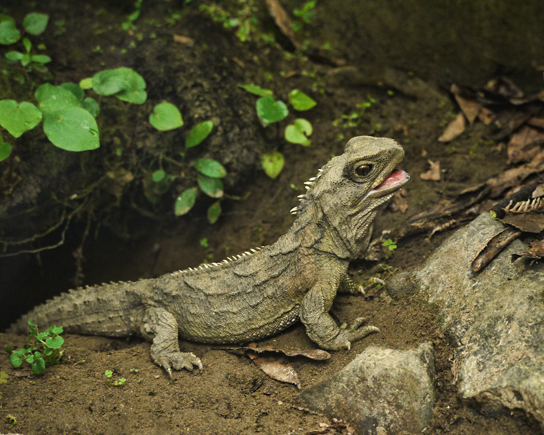
Figure 29.28図 29.28
A tuatara. This tuatara from New Zealand may resemble a lizard but belongs to a distinct lineage, the Sphenodontidae family. (credit: Sid Mosdell)
ムカシトカゲ。ニュージーランドのこのムカシトカゲは、トカゲに似て見えるかもしれないが、ムカシトカゲ科という別の系統に属する。(クレジット:Sid Mosdell)
Squamata有鱗目
The Squamata (“scaly or having scales”) arose in the mid-Triassic period approximately 220 million years ago, and extant species include lizards and snakes. Both are found on all continents except Antarctica. Lizards and snakes are most closely related to tuataras, both groups having evolved from a lepidosaurian ancestor. Squamata is the largest extant clade of reptiles (Figure 29.29).
英語のヒント
有鱗目(Squamata、「鱗のあるもの」)は、約2億2000万年前の三畳紀中期に出現した。現生種にはトカゲとヘビが含まれ、どちらも南極以外のすべての大陸に分布する。トカゲとヘビに最も近縁なのはムカシトカゲであり、両群とも鱗竜類の祖先から進化した。有鱗目は、現生爬虫類の中で最大の系統群である(図29.29)。
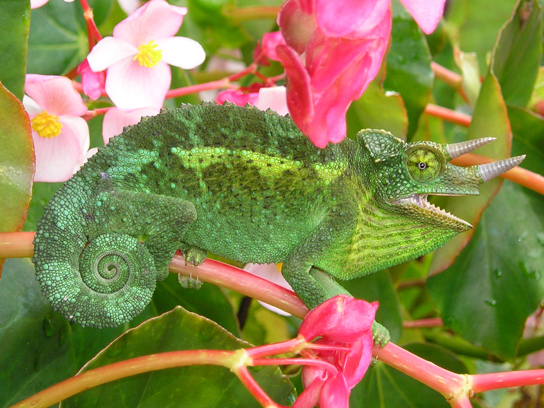
Figure 29.29図 29.29
A chameleon. This Jackson’s chameleon (Trioceros jacksonii) blends in with its surroundings.
カメレオン。このジャクソンカメレオン(Trioceros jacksonii)は周囲に溶け込んでいる。
Most lizards differ from snakes by having four limbs, although these have often been lost or significantly reduced in at least 60 lineages. Snakes lack eyelids and external ears, which are both present in lizards. There are about 6,000 species of lizards, ranging in size from tiny chameleons and geckos, some of which are only a few centimeters in length, to the Komodo dragon, which is about 3 meters in length.
英語のヒント
大部分のトカゲは、4本の肢をもつ点でヘビと異なる。ただし、少なくとも60の系統では、肢が失われたり大幅に縮小したりすることが繰り返し起こっている。ヘビにはまぶたと外耳がないが、トカゲにはどちらもある。トカゲは約6000種あり、体長がわずか数cmのものもいる小型のカメレオンやヤモリから、全長約3 mのコモドオオトカゲまで、大きさはさまざまである。
Some lizards are extravagantly decorated with spines, crests, and frills, and many are brightly colored. Some lizards, like chameleons (Figure 29.29), can change their skin color by redistributing pigment within chromatophores in their skins. Chameleons change color both for camouflage and for social signaling. Lizards have multiple-colored oil droplets in their retinal cells that give them a good range of color vision. Lizards, unlike snakes, can focus their eyes by changing the shape of the lens. The eyes of chameleons can move independently. Several species of lizards have a "hidden" parietal eye, similar to that in the tuatara. Both lizards and snakes use their tongues to sample the environment and a pit in the roof of the mouth, Jacobson's organ, is used to evaluate the collected sample.
英語のヒント
一部のトカゲは、棘、とさか、襟飾りによって派手に飾られ、多くは鮮やかな色をしている。カメレオンなど一部のトカゲ(図29.29)は、皮膚の色素胞内で色素を再配置することで、皮膚の色を変えられる。カメレオンは、カモフラージュのためにも、仲間への信号のためにも色を変える。トカゲの網膜細胞にはさまざまな色の油滴があり、幅広い色覚をもたらす。トカゲはヘビと異なり、水晶体の形を変えて焦点を合わせられる。カメレオンの眼は左右独立に動く。数種のトカゲには、ムカシトカゲのものに似た「隠れた」頭頂眼がある。トカゲもヘビも舌で環境から試料を集め、口の天井にあるくぼみ、ヤコブソン器官で、その試料を調べる。
Most lizards are carnivorous, but some large species, such as iguanas, are herbivores. Some predatory lizards are ambush predators, waiting quietly until their prey is close enough for a quick grab. Others are patient foragers, moving slowly through their environment to detect possible prey. Lizard tongues are long and sticky and can be extended at high speed for capturing insects or other small prey. Traditionally, the only venomous lizards are the Gila monster and the beaded lizard. However, venom glands have also been identified in several species of monitors and iguanids, but the venom is not injected directly and should probably be regarded as a toxin delivered with the bite.
英語のヒント
大部分のトカゲは肉食性だが、イグアナなど一部の大型種は草食性である。捕食性のトカゲの中には、獲物が素早く捕まえられる距離に来るまで静かに待つ、待ち伏せ型のものもいる。一方で、ゆっくり周囲を移動しながら獲物になりそうなものを探す、根気強い採食者もいる。トカゲの舌は長く粘着性があり、昆虫などの小さな獲物を捕らえるため、高速で伸ばすことができる。従来、毒をもつトカゲはアメリカドクトカゲとメキシコドクトカゲだけとされてきた。しかし、オオトカゲ類とイグアナ類の数種にも毒腺が確認されている。ただし、毒は直接注入されないため、おそらく咬傷によって届けられる毒素と考えるべきだろう。
Specialized features of the jaw are related to adaptations for feeding that have evolved to feed on relatively large prey (even though some current species have reversed this trend). Snakes are thought to have descended from either burrowing or aquatic lizards over 100 million years ago (Figure 29.30). They include about 3,600 species, ranging in size from 10 centimeter-long thread snakes to 10 meter-long pythons and anacondas. All snakes are legless, except for boids (e.g., boa constrictors), which have vestigial hindlimbs in the form of pelvic spurs. Like caecilian amphibians, the narrow bodies of most snakes have only a single functional lung. All snakes are carnivorous and eat small animals, birds, eggs, fish, and insects.
英語のヒント
顎の特殊化した特徴は、比較的大きな獲物を食べるために進化した摂食の適応と関係している(ただし、一部の現生種では、この傾向が逆転している)。ヘビは、1億年以上前に、穴を掘って暮らすトカゲか水生のトカゲから生じたと考えられている(図29.30)。ヘビには約3600種が含まれ、体長10 cmのホソメクラヘビ類から、全長10 mのニシキヘビやアナコンダまで、大きさはさまざまである。ボア類(ボアコンストリクターなど)を除き、すべてのヘビに脚がない。ボア類には、総排泄孔付近の蹴爪の形で、痕跡的な後肢が残っている。アシナシイモリと同様、大部分のヘビの細長い体には、機能する肺が一つしかない。すべてのヘビは肉食性で、小動物、鳥、卵、魚、昆虫を食べる。
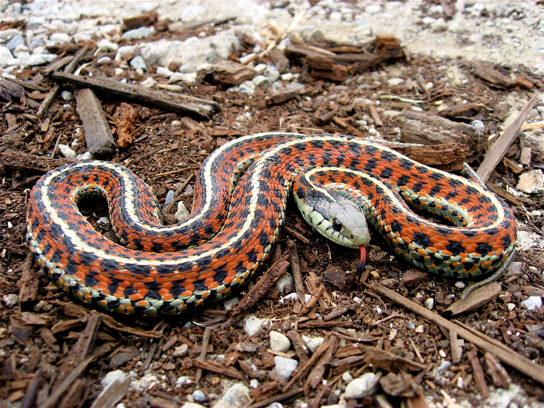


Figure 29.30図 29.30
A nonvenomous snake. The garter snake belongs to the genus Thamnophis, the most widely distributed reptile genus in North America. (credit: Steve Jurvetson)
毒をもたないヘビ。ガーターヘビは、北アメリカで最も広く分布する爬虫類の属であるガーターヘビ属(Thamnophis)に属する。(クレジット:Steve Jurvetson)
Most snakes have a skull that is very flexible, involving eight rotational joints. They also differ from other squamates by having mandibles (lower jaws) without either bony or ligamentous attachment anteriorly. Having this connection via skin and muscle allows for great dynamic expansion of the gape and independent motion of the two sides—both advantages in swallowing big prey. Most snakes are nonvenomous and simply swallow their prey alive, or subdue it by constriction before swallowing it. Venomous snakes use their venom both to kill or immobilize their prey, and to help digest it.
英語のヒント
大部分のヘビは、回転できる八つの関節を備えた、非常に柔軟な頭骨をもつ。また、下顎の左右の骨の前端が、骨でも靱帯でもつながっていない点で、ほかの有鱗類と異なる。ここが皮膚と筋肉でつながっているため、口を大きく広げ、左右を独立して動かせる。どちらも大きな獲物を飲み込むうえで有利である。大部分のヘビは毒をもたず、獲物を生きたまま飲み込むか、締めつけて動けなくしてから飲み込む。毒ヘビは、獲物を殺す、あるいは動けなくするためだけでなく、消化を助けるためにも毒を使う。
Although snakes have no eyelids, their eyes are protected with a transparent scale. Their retinas have both rods and cones, and like many animals, they do not have receptor pigments for red light. Some species, however, can see in the ultraviolet, which allows them to track ultraviolet signals in rodent trails. Snakes adjust focus by moving their heads. They have lost both external and middle ears, although their inner ears are sensitive to ground vibrations. Snakes have a number of sensory structures that assist in tracking prey. In pit vipers, like rattlesnakes, a sensory pit between the eye and nostrils is sensitive to infrared (“heat”) emissions from warm-blooded prey. A row of similar pits is located on the upper lip of boids. As noted above, snakes also use Jacobson's organ for detecting olfactory signals.
英語のヒント
ヘビにはまぶたがないが、眼は透明な鱗で保護されている。網膜には桿体と錐体の両方があり、多くの動物と同様、赤い光を受け取る色素はない。しかし、一部の種は紫外線を見ることができ、げっ歯類の通り道に残された紫外線の信号をたどれる。ヘビは頭を動かして焦点を調整する。外耳と中耳はともに失われているが、内耳は地面の振動に敏感である。ヘビには、獲物を追うのを助ける多くの感覚構造がある。ガラガラヘビなどのクサリヘビ科マムシ亜科では、眼と鼻孔の間の感覚性のくぼみが、温血の獲物から出る赤外線(「熱」)に反応する。ボア類の上唇にも、同様のくぼみが一列に並ぶ。前述のとおり、ヘビは嗅覚信号の検出にもヤコブソン器官を使う。