第29章脊椎動物
29.3 Amphibians29.3 両生類
Learning Objectives学習目標
By the end of this section, you will be able to do the following:
この節を学び終えると、次のことができるようになる。
- Describe the important difference between the life cycle of amphibians and the life cycles of other vertebrates両生類の生活環とほかの脊椎動物の生活環の重要な違いを説明する。
- Distinguish between the characteristics of Urodela, Anura, and Apoda有尾類、無尾類、無足類の特徴を区別する。
- Describe the evolutionary history of amphibians両生類の進化史を説明する。
Amphibians are vertebrate tetrapods (“four limbs”), and include frogs, salamanders, and caecilians. The term “amphibian” loosely translates from the Greek as “dual life,” which is a reference to the metamorphosis that many frogs and salamanders undergo and the unique mix of aquatic and terrestrial phases that are required in their life cycle. In fact, they cannot stray far from water because their reproduction is intimately tied to aqueous environments. Amphibians evolved during the Devonian period and were the earliest terrestrial tetrapods. They represent an evolutionary transition from water to land that occurred over many millions of years. Thus, the Amphibia are the only living true vertebrates that have made a transition from water to land in both their ontogeny (life development) and phylogeny (evolution). They have not changed much in morphology over the past 350 million years!
英語のヒント
両生類は四肢動物(「四つの肢」)に属する脊椎動物で、カエル、サンショウウオ、アシナシイモリを含む。「両生類」にあたる amphibian は、ギリシャ語を大まかに訳すと「二重の生活」を意味する。これは、多くのカエルやサンショウウオが経験する変態と、その生活環に必要な、水中生活と陸上生活の独特な組み合わせを指している。実際、その生殖は水のある環境と密接に結びついているため、水から遠く離れることはできない。両生類はデボン紀に進化した、最初の陸上四肢動物である。両生類は、何百万年もかけて起こった、水中から陸上への進化的移行を示している。したがって、現生の真の脊椎動物のうち、個体発生(個体の発達)と系統発生(進化)の両方で水中から陸上へ移行したのは両生類だけである。その形態は、過去3億5000万年にわたってあまり変わっていない!
Characteristics of Amphibians両生類の特徴
As tetrapods, most amphibians are characterized by four well-developed limbs. In some species of salamanders, hindlimbs are reduced or absent, but all caecilians are (secondarily) limbless. An important characteristic of extant amphibians is a moist, permeable skin that is achieved via mucus glands. Most water is taken in across the skin rather than by drinking. The skin is also one of three respiratory surfaces used by amphibians. The other two are the lungs and the buccal (mouth) cavity. Air is taken first into the mouth through the nostrils, and then pushed by positive pressure into the lungs by closing the nostrils and elevating the throat.
英語のヒント
四肢動物である大部分の両生類は、よく発達した4本の肢を特徴とする。サンショウウオの一部の種では後肢が縮小するか失われているが、アシナシイモリではすべての種で(二次的に)肢がなくなっている。現生両生類の重要な特徴は、粘液腺によって保たれる、湿っていて物質を通す皮膚である。水の大部分は、飲むことによってではなく、皮膚を通して取り込まれる。皮膚はまた、両生類が使う三つの呼吸面の一つでもある。残る二つは肺と口腔である。空気はまず鼻孔を通って口に取り込まれ、その後、鼻孔を閉じて喉を持ち上げることで生じる陽圧により肺へ押し込まれる。
All extant adult amphibians are carnivorous, and some terrestrial amphibians have a sticky tongue used to capture prey. Amphibians also have multiple small teeth at the edge of the jaws. In salamanders and caecilians, teeth are present in both jaws, sometimes in multiple rows. In frogs and toads, teeth are seen only in the upper jaw. Additional teeth, called vomerine teeth, may be found in the roof of the mouth. Amphibian teeth are pedicellate, which means that the root and crown are calcified, separated by a zone of noncalcified tissue.
英語のヒント
現生両生類の成体はすべて肉食性で、陸生の両生類の一部は、獲物を捕らえるための粘着性の舌をもつ。両生類には顎の縁に多数の小さな歯もある。サンショウウオとアシナシイモリでは上下両方の顎に歯があり、ときには複数列に並ぶ。カエルとヒキガエルでは、歯は上顎にしか見られない。口の天井には、鋤骨歯と呼ばれる別の歯があることもある。両生類の歯は有柄歯であり、歯根と歯冠が石灰化し、その間が石灰化していない組織の領域によって隔てられている。
Amphibians have image-forming eyes and color vision. Ears are best developed in frogs and toads, which vocalize to communicate. Frogs use separate regions of the inner ear for detecting higher and lower sounds: the papilla amphibiorum, which is sensitive to frequencies below 10,000 hertz and unique to amphibians, and the papilla basilaris, which is sensitive to higher frequencies, including mating calls, transmitted from the eardrum through the stapes bone. Amphibians also have an extra bone in the ear, the operculum, which transmits low-frequency vibrations from the forelimbs and shoulders to the inner ear, and may be used for the detection of seismic signals.
英語のヒント
両生類には像を結ぶ眼があり、色覚もある。耳が最もよく発達しているのは、声を出して意思を伝えるカエルとヒキガエルである。カエルは、高い音と低い音を検出するために、内耳の別々の領域を使う。一つは、1万ヘルツ未満の周波数に反応する、両生類に特有の両生類乳頭である。もう一つは基底乳頭で、求愛の鳴き声など、鼓膜からアブミ骨を通って伝わる高い周波数の音に反応する。両生類の耳にはさらに蓋骨という骨があり、前肢や肩からの低周波振動を内耳に伝える。この骨は、地面を伝わる振動信号の検出に使われている可能性がある。
Evolution of Amphibians両生類の進化
The fossil record provides evidence of the first tetrapods: now-extinct amphibian species dating to nearly 400 million years ago. Evolution of tetrapods from lobe-finned freshwater fishes (similar to coelacanths and lungfish) represented a significant change in body plan from one suited to organisms that respired and swam in water, to organisms that breathed air and moved onto land; these changes occurred over a span of 50 million years during the Devonian period.
英語のヒント
化石記録は、最初の四肢動物の証拠を示している。それは、約4億年前にさかのぼる、現在は絶滅した両生類の種である。シーラカンスやハイギョに似た、淡水性の肉鰭類から四肢動物が進化したことは、体の基本構造に大きな変化が起こったことを意味した。水中で呼吸し泳ぐ生物に適した体から、空気を呼吸して陸上を移動する生物の体へと変わったのである。これらの変化は、デボン紀の5000万年の間に起こった。
Aquatic tetrapods of the Devonian period include Ichthyostega and Acanthostega. Both were aquatic, and may have had both gills and lungs. They also had four limbs, with the skeletal structure of limbs found in present-day tetrapods, including amphibians. However, the limbs could not be pulled in under the body and would not have supported their bodies well out of water. They probably lived in shallow freshwater environments, and may have taken brief terrestrial excursions, much like “walking” catfish do today in Florida. In Ichthyostega, the forelimbs were more developed than the hind limbs, so it might have dragged itself along when it ventured onto land. What preceded Acanthostega and Ichthyostega?
英語のヒント
デボン紀の水生四肢動物には、イクチオステガとアカントステガが含まれる。どちらも水生で、鰓と肺の両方をもっていた可能性がある。また、両生類を含む現生四肢動物と同じ肢の骨格構造を備えた、4本の肢をもっていた。しかし、その肢を体の下へ引き寄せることはできず、水から出ると体を十分には支えられなかっただろう。おそらく浅い淡水環境に生息し、現在フロリダで「歩く」ナマズがするのと同じように、短時間だけ陸上へ出ていたのかもしれない。イクチオステガでは前肢が後肢より発達していたため、思い切って陸上へ出たときには、体を引きずって進んだ可能性がある。アカントステガとイクチオステガより前には、どのような動物がいたのだろうか。
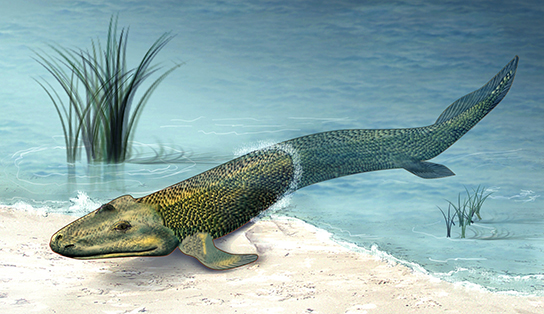
In 2006, researchers published news of their discovery of a fossil of a “tetrapod-like fish,” Tiktaalik roseae, which seems to be a morphologically “intermediate form” between sarcopterygian fishes having feet-like fins and early tetrapods having true limbs (Figure 29.17). Tiktaalik likely lived in a shallow water environment about 375 million years ago. Daeschler, E. B., Shubin, N. H., and Jenkins, F. J. “A Devonian tetrapod-like fish and the evolution of the tetrapod body plan,” Nature 440 (2006): 757–763, doi:10.1038/nature04639, http://www.nature.com/nature/journal/v440/n7085/abs/nature04639.html. Tiktaalik also had gills and lungs, but the loss of some gill elements gave it a neck, which would have allowed its head to move sideways for feeding. The eyes were on top of the head. It had fins, but the attachment of the fin bones to the shoulder suggested they might be weight-bearing. Tiktaalik preceded Acanthostega and Ichthyostega, with their four limbs, by about 10 million years and is considered to be a true intermediate clade between fish and amphibians.
英語のヒント
2006年、研究者たちは「四肢動物に似た魚」、ティクターリク・ロゼア(Tiktaalik roseae)の化石を発見したと発表した。この動物は、足のような鰭をもつ肉鰭類と、真の肢をもつ初期四肢動物との間の、形態的な「中間型」と考えられる(図29.17)。ティクターリクは、およそ3億7500万年前、浅い水域に生息していたとみられる。Daeschler, E. B., Shubin, N. H., and Jenkins, F. J.「デボン紀の四肢動物に似た魚と、四肢動物の体の基本構造の進化」Nature 440 (2006): 757–763, doi:10.1038/nature04639, http://www.nature.com/nature/journal/v440/n7085/abs/nature04639.html.ティクターリクも鰓と肺をもっていたが、鰓を構成する一部の要素を失ったことで首が生じ、摂食の際に頭を左右へ動かせるようになったと考えられる。眼は頭の上面にあった。鰭をもっていたが、鰭の骨と肩との接合の仕方から、鰭で体重を支えられた可能性がある。ティクターリクは、4本の肢をもつアカントステガやイクチオステガより約1000万年早く現れ、魚類と両生類の間の真の中間的な系統群と考えられている。
OpenStax, Rice University; Biology 2e. (credit: Zina Deretsky, National Science Foundation) · CC BY 4.0 · Source出典

Figure 29.17図 29.17
Tiktaalik. The recent fossil discovery of Tiktaalik roseae suggests evidence for an animal intermediate to finned fish and legged tetrapods, sometimes called a "fishapod." (credit: Zina Deretsky, National Science Foundation)
ティクターリク。近年発見されたティクターリク・ロゼア(Tiktaalik roseae)の化石は、鰭をもつ魚類と脚をもつ四肢動物の中間に位置する動物の証拠を示唆する。この動物は「フィシャポッド」と呼ばれることもある。(クレジット:Zina Deretsky, National Science Foundation)
The early tetrapods that moved onto land had access to new nutrient sources and relatively few predators. This led to the widespread distribution of tetrapods during the early Carboniferous period, a period sometimes called the “age of the amphibians.”
英語のヒント
陸上へ進出した初期の四肢動物は、新しい栄養源を利用でき、捕食者も比較的少なかった。その結果、四肢動物は石炭紀前期に広く分布するようになった。この時期は「両生類の時代」と呼ばれることもある。