第29章脊椎動物
Characteristics of Reptiles爬虫類の特徴
Reptiles are tetrapods. Limbless reptiles—snakes and legless lizards—are classified as tetrapods because they are descended from four-limbed ancestors. Reptiles lay calcareous or leathery eggs enclosed in shells on land. Even aquatic reptiles return to the land to lay eggs. They usually reproduce sexually with internal fertilization. Some species display ovoviviparity, with the eggs remaining in the mother’s body until they are ready to hatch. In ovoviviparous reptiles, most nutrients are supplied by the egg yolk, while the chorioallantois assists with respiration. Other species are viviparous, with the offspring born alive, with their development supported by a yolk sac-placenta, a chorioallantoic-placenta, or both.
英語のヒント
爬虫類は四肢動物である。肢のない爬虫類、つまりヘビや脚のないトカゲも、4本の肢をもつ祖先から生じたため、四肢動物に分類される。爬虫類は、石灰質または革のような殻に包まれた卵を陸上に産む。水生爬虫類でさえ、産卵のために陸上へ戻る。通常は、体内受精を伴う有性生殖を行う。一部の種は卵胎生で、卵は孵化の準備が整うまで母体内にとどまる。卵胎生の爬虫類では、栄養分の大部分は卵黄から供給され、漿尿膜が呼吸を助ける。ほかに、生きた子を産む胎生の種もあり、卵黄嚢胎盤、漿尿膜胎盤、あるいはその両方が子の発生を支えている。
One of the key adaptations that permitted reptiles to live on land was the development of their scaly skin, containing the protein keratin and waxy lipids, which reduced water loss from the skin. A number of keratinous epidermal structures have emerged in the descendants of various reptilian lineages and some have become defining characters for these lineages: scales, claws, nails, horns, feathers, and hair. Their occlusive skin means that reptiles cannot use their skin for respiration, like amphibians, and thus all amniotes breathe with lungs. All reptiles grow throughout their lives and regularly shed their skin, both to accommodate their growth and to rid themselves of ectoparasites. Snakes tend to shed the entire skin at one time, but other reptiles shed their skins in patches.
英語のヒント
爬虫類が陸上で暮らせるようにした重要な適応の一つは、鱗のある皮膚の発達だった。この皮膚には、タンパク質のケラチンと蝋状の脂質が含まれ、皮膚からの水分の損失を減らした。さまざまな爬虫類の系統の子孫には、多くの角質性の表皮構造が現れた。その一部、すなわち鱗、鉤爪、平爪、角、羽毛、毛は、それぞれの系統を特徴づける形質となった。爬虫類の皮膚は物質を通しにくいため、両生類のように皮膚を呼吸に使うことはできず、有羊膜類はすべて肺で呼吸する。爬虫類はすべて生涯にわたって成長し、成長に対応するとともに外部寄生虫を取り除くため、定期的に脱皮する。ヘビは一度に皮膚全体を脱ぐ傾向があるが、ほかの爬虫類では、皮膚が部分ごとに剥がれる。
Reptiles ventilate their lungs using various muscular mechanisms to produce negative pressure (low pressure) within the lungs that allows them to expand and draw in air. In snakes and lizards, the muscles of the spine and ribs are used to expand or contract the rib cage. Since walking or running interferes with this activity, the squamates cannot breathe effectively while running. Some squamates can supplement rib movement with buccal pumping through the nose, with the mouth closed. In crocodilians, the lung chamber is expanded and contracted by moving the liver, which is attached to the pelvis. Turtles have a special problem with breathing, because their rib cage cannot expand. However, they can change the pressure around the lungs by pulling their limbs in and out of the shell, and by moving their internal organs. Some turtles also have a posterior respiratory sac that opens off the hindgut that aids in the diffusion of gases.
英語のヒント
爬虫類は、さまざまな筋肉の仕組みによって肺内に陰圧(低い圧力)を生み、肺を広げて空気を吸い込むことで換気する。ヘビとトカゲでは、脊柱と肋骨の筋肉を使って胸郭を拡張・収縮させる。歩行や走行がこの動作を妨げるため、有鱗類は走りながら効率よく呼吸することができない。一部の有鱗類では、口を閉じたまま鼻を通して口腔をポンプのように動かすことで、肋骨の動きを補うことができる。ワニ類では、骨盤につながる肝臓を動かすことで、肺のある空間を拡張・収縮させる。カメ類には、胸郭を広げられないという、呼吸上の特別な問題がある。しかし、肢を甲羅の内外へ動かしたり、内臓を動かしたりして、肺の周囲の圧力を変えることができる。一部のカメには、後腸から開く後方の呼吸嚢もあり、ガスの拡散を助けている。
Most reptiles are ectotherms, animals whose main source of body heat comes from the environment; however, some crocodilians maintain elevated thoracic temperatures and thus appear to be at least regional endotherms. This is in contrast to true endotherms, which use heat produced by metabolism and muscle contraction to regulate body temperature over a very narrow temperature range, and thus are properly referred to as homeotherms. Reptiles have behavioral adaptations to help regulate body temperature, such as basking in sunny places to warm up through the absorption of solar radiation, or finding shady spots or going underground to minimize the absorption of solar radiation, which allows them to cool down and prevent overheating. The advantage of ectothermy is that metabolic energy from food is not required to heat the body; therefore, reptiles can survive on about 10 percent of the calories required by a similarly sized endotherm. In cold weather, some reptiles such as the garter snake brumate. Brumation is similar to hibernation in that the animal becomes less active and can go for long periods without eating, but differs from hibernation in that brumating reptiles are not asleep or living off fat reserves. Rather, their metabolism is slowed in response to cold temperatures, and the animal is very sluggish.
英語のヒント
大部分の爬虫類は、体熱の主な供給源を環境に求める外温動物である。ただし、一部のワニ類は胸部の温度を高く保っており、少なくとも局所的には内温動物であるように見える。これに対して真の内温動物は、代謝と筋収縮によって生じる熱を使い、非常に狭い温度範囲に体温を調節するため、恒温動物と呼ぶのが適切である。爬虫類には、体温調節を助ける行動上の適応がある。日当たりのよい場所で日光浴をして太陽放射を吸収し、体を温める。また、日陰を探したり地下に入ったりして太陽放射の吸収を最小限にし、体を冷やして過熱を防ぐ。外温性の利点は、食物から得られる代謝エネルギーを体の加熱に使う必要がないことである。そのため爬虫類は、同じくらいの大きさの内温動物に必要なカロリーの約10%で生存できる。寒い時期には、ガーターヘビなど一部の爬虫類がブルメーションと呼ばれる休眠をする。ブルメーションは、活動が低下し、長い間食べずに過ごせる点では冬眠に似ている。しかし、眠っているわけでも、蓄えた脂肪で生活しているわけでもない点で冬眠とは異なる。低温に応じて代謝が遅くなり、動きが非常に鈍くなるのである。
Evolution of Reptiles爬虫類の進化
Reptiles originated approximately 300 million years ago during the Carboniferous period. One of the oldest known amniotes is Casineria, which had both amphibian and reptilian characteristics. One of the earliest undisputed reptile fossils was Hylonomus, a lizardlike animal about 20 cm long. Soon after the first amniotes appeared, they diverged into three groups—synapsids, anapsids, and diapsids—during the Permian period. The Permian period also saw a second major divergence of diapsid reptiles into stem archosaurs (predecessors of thecodonts, crocodilians, dinosaurs, and birds) and lepidosaurs (predecessors of snakes and lizards). These groups remained inconspicuous until the Triassic period, when the archosaurs became the dominant terrestrial group possibly due to the extinction of large-bodied anapsids and synapsids during the Permian-Triassic extinction. About 250 million years ago, archosaurs radiated into the pterosaurs and both saurischian “lizard hip” and ornithischian “bird-hip” dinosaurs (see below).
英語のヒント
爬虫類は、約3億年前の石炭紀に起源をもつ。知られている最古級の有羊膜類の一つがカシネリアで、両生類と爬虫類の両方の特徴をもっていた。爬虫類であることに疑いのない最初期の化石の一つは、体長約20 cmのトカゲに似た動物、ヒロノムスである。最初の有羊膜類が出現してまもなく、ペルム紀に、単弓類、無弓類、双弓類の三群へと分岐した。ペルム紀には、双弓類の爬虫類が、幹系統の主竜類(槽歯類、ワニ類、恐竜、鳥類の祖先)と鱗竜類(ヘビとトカゲの祖先)へ分かれる、二度目の大きな分岐も起こった。これらの群は三畳紀までは目立たなかったが、そのころ主竜類が陸上で優勢な群となった。ペルム紀末の大量絶滅で、大型の無弓類や単弓類が絶滅したためかもしれない。約2億5000万年前、主竜類は、翼竜と、竜盤類(「トカゲの腰」)および鳥盤類(「鳥の腰」)の恐竜へと適応放散した(下記参照)。
Although they are sometimes mistakenly called dinosaurs, the pterosaurs were distinct from true dinosaurs (Figure 29.25). Pterosaurs had a number of adaptations that allowed for flight, including hollow bones (birds also exhibit hollow bones, a case of convergent evolution). Their wings were formed by membranes of skin that attached to the long, fourth finger of each arm and extended along the body to the legs.
英語のヒント
翼竜はときに誤って恐竜と呼ばれるが、真の恐竜とは別の群である(図29.25)。翼竜には、中空の骨など、飛行を可能にする多くの適応があった。鳥類にも中空の骨があり、これは収斂進化の一例である。翼は皮膚の膜でできており、左右それぞれの腕の長い第4指につながり、体に沿って脚まで伸びていた。
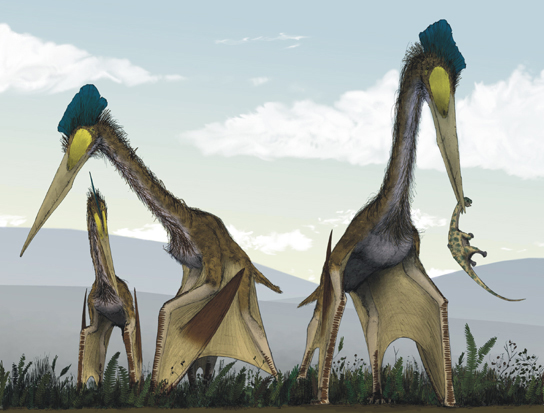

Figure 29.25図 29.25
Pterosaurs. Pterosaurs, such as this Quetzalcoatlus, which existed from the late Triassic to the Cretaceous period (230 to 65.5 million years ago), possessed wings but are not believed to have been capable of powered flight. Instead, they may have been able to soar after launching from cliffs. (credit: Mark Witton, Darren Naish)
翼竜。このケツァルコアトルスなどの翼竜は、三畳紀後期から白亜紀(2億3000万〜6550万年前)に生息した。翼をもっていたが、羽ばたきによる飛行はできなかったと考えられている。その代わり、崖から飛び立った後に滑翔できたのかもしれない。(クレジット:Mark Witton, Darren Naish)