第29章脊椎動物
Osteichthyes: Bony Fishes硬骨魚類:骨の魚
Members of the clade Osteichthyes, also called bony fishes, are characterized by a bony skeleton. The vast majority of present-day fishes belong to this group, which consists of approximately 30,000 species, making it the largest class of vertebrates in existence today.
硬骨魚類というクレードは、骨性の骨格を特徴とする。現生魚類の大多数はこの群に属し、約3万種からなるため、現在生存する脊椎動物の中で最大の綱となる。
Nearly all bony fishes have an ossified skeleton with specialized bone cells (osteocytes) that produce and maintain a calcium phosphate matrix. This characteristic has been reversed only in a few groups of Osteichthyes, such as sturgeons and paddlefish, which have primarily cartilaginous skeletons. The skin of bony fishes is often covered by overlapping scales, and glands in the skin secrete mucus that reduces drag when swimming and aids the fish in osmoregulation. Like sharks, bony fishes have a lateral line system that detects vibrations in water.
英語のヒント
ほぼすべての硬骨魚類は、リン酸カルシウムの基質をつくり維持する特殊な骨細胞を備えた、骨化した骨格をもつ。この特徴が逆転したのは、チョウザメやヘラチョウザメなど、ごく少数の群だけであり、これらは主に軟骨性の骨格をもつ。皮膚はしばしば重なり合う鱗で覆われ、皮膚の腺が分泌する粘液は、遊泳時の抵抗を減らし、浸透圧調節を助ける。サメと同じく、水中の振動を検出する側線系がある。
All bony fishes use gills to breathe. Water is drawn over gills that are located in chambers covered and ventilated by a protective, muscular flap called the operculum. Many bony fishes also have a swim bladder, a gas-filled organ derived as a pouch from the gut. The swim bladder helps to control the buoyancy of the fish. In most bony fish, the gases of the swim bladder are exchanged directly with the blood. The swim bladder is believed to be homologous to the lungs of lungfish and the lungs of land vertebrates.
英語のヒント
すべての硬骨魚類は鰓で呼吸する。鰓は、鰓蓋という筋肉質の保護用のふたで覆われ、換水される部屋の中にあり、その上へ水が引き込まれる。多くの硬骨魚類には、腸から袋状に派生した、ガスを含む器官である浮袋もある。浮袋は浮力の調節を助ける。多くの硬骨魚では、浮袋のガスは血液と直接交換される。浮袋は、肺魚の肺や陸上脊椎動物の肺と相同と考えられる。
Bony fishes are further divided into two extant clades: Class Actinopterygii (ray-finned fishes) and Class Sarcopterygii (lobe-finned fishes).
硬骨魚類はさらに、現生の二つのクレード、条鰭綱と肉鰭綱に分けられる。
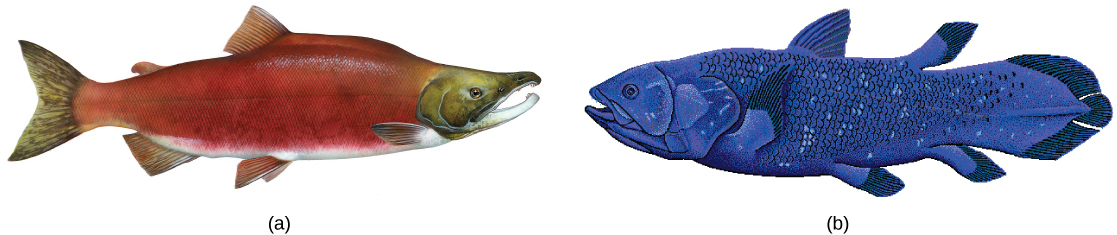
Actinopterygii (Figure 29.16a), the ray-finned fishes, include many familiar fishes—tuna, bass, trout, and salmon among others—and represent about half of all vertebrate species. Ray-finned fishes are named for the fan of slender bones that supports their fins.
英語のヒント
条鰭類(図29.16a)には、マグロ、バス、マス、サケなど、なじみ深い魚が数多く含まれ、脊椎動物の全種の約半数を占める。条鰭類の名は、鰭を支える扇状の細い骨に由来する。
In contrast, the fins of Sarcopterygii (Figure 29.16b) are fleshy and lobed, supported by bones that are similar in type and arrangement to the bones in the limbs of early tetrapods. The few extant members of this clade include several species of lungfishes and the less familiar coelacanths, which were thought to be extinct until living specimens were discovered between Africa and Madagascar. Currently, two extant species of coelacanths have been described.
英語のヒント
対照的に、肉鰭類(図29.16b)の鰭は肉質の葉状で、初期四足類の四肢の骨と、種類や配置が似た骨によって支えられる。このクレードの少数の現生動物には、数種の肺魚と、あまりなじみのないシーラカンス類が含まれる。シーラカンスは、アフリカとマダガスカルの間で生きた標本が発見されるまで、絶滅したと考えられていた。現在、現生のシーラカンスは2種が記載されている。
OpenStax, Rice University; Biology 2e. (credit a: modification of work by Timothy Knepp, USFWS; credit b: modification of work by Robbie Cada) · CC BY 4.0 · Source出典

Figure 29.16図 29.16
Osteichthyes. The (a) sockeye salmon and (b) coelacanth are both bony fishes of the Osteichthyes clade. The coelacanth, sometimes called a lobe-finned fish, was thought to have gone extinct in the Late Cretaceous period, 100 million years ago, until one was discovered in 1938 near the Comoros Islands between Africa and Madagascar. (credit a: modification of work by Timothy Knepp, USFWS; credit b: modification of work by Robbie Cada)
硬骨魚類。(a)ベニザケと(b)シーラカンスは、ともに硬骨魚類クレードの魚である。肉鰭類とも呼ばれるシーラカンスは、1億年前の白亜紀後期に絶滅したと考えられていたが、1938年、アフリカとマダガスカルの間のコモロ諸島付近で1個体が発見された。(a:Timothy Knepp、USFWSの作品を改変。b:Robbie Cadaの作品を改変)
Section Summary節のまとめ
The earliest vertebrates that diverged from the invertebrate chordates were the agnathan jawless fishes, whose extant members include the hagfishes and lampreys. Hagfishes are eel-like scavengers that feed on dead invertebrates and other fishes. Lampreys are characterized by a toothed, funnel-like sucking mouth, and most species are parasitic or predaceous on other fishes. Fishes with jaws (gnathostomes) evolved later. Jaws allowed early gnathostomes to exploit new food sources.
英語のヒント
無脊椎の脊索動物から最初に分岐した脊椎動物は、顎のない無顎魚であり、現生ではヌタウナギとヤツメウナギが含まれる。ヌタウナギはウナギに似た腐肉食者で、死んだ無脊椎動物やほかの魚を食べる。ヤツメウナギは、歯のある漏斗状の吸い付く口を特徴とし、多くの種はほかの魚に寄生するか、捕食する。顎のある魚(顎口類)は、その後に進化した。顎によって、初期顎口類は新しい食物源を利用できた。
Gnathostomes include the cartilaginous fishes and the bony fishes, as well as all other tetrapods (amphibians, reptiles, mammals). Cartilaginous fishes include sharks, rays, skates, and ghost sharks. Most cartilaginous fishes live in marine habitats, with a few species living in fresh water for part or all of their lives. The vast majority of present-day fishes belong to the clade Osteichthyes, which consists of approximately 30,000 species. Bony fishes (Osteichthyes) can be divided into two clades: Actinopterygii (ray-finned fishes, virtually all extant species) and Sarcopterygii (lobe-finned fishes, comprising fewer than 10 extant species, but form the sister group of the tetrapods).
顎口類には、軟骨魚類、硬骨魚類、さらにほかのすべての四足類(両生類、爬虫類、哺乳類)が含まれる。軟骨魚類には、サメ、エイ、ガンギエイ、ギンザメがある。多くは海に暮らすが、一生の一部または全部を淡水で過ごす種も少数いる。現生魚類の大多数は、約3万種からなる硬骨魚類クレードに属する。硬骨魚類は、条鰭類(現生種のほぼすべて)と肉鰭類(現生種は10種未満だが、四足類の姉妹群を形成する)の二クレードに分けられる。
Review Questions確認問題
Exercises 7–9練習問題 7–9
Exercise 7問題 7
Members of Chondrichthyes differ from members of Osteichthyes by having (a) ________.
軟骨魚類は________をもつ点で、硬骨魚類と異なる。
- jaw顎
- bony skeleton骨性の骨格
- cartilaginous skeleton軟骨性の骨格
- two sets of paired fins二組の対鰭
Solution解き方
C
C
Exercise 8問題 8
Members of Chondrichthyes are thought to be descended from fishes that had ________.
軟骨魚類は、________をもつ魚から進化したと考えられる。
- a cartilaginous skeleton軟骨性の骨格
- a bony skeleton骨性の骨格
- mucus glands粘液腺
- slime glandsぬめりを出す腺
Solution解き方
B
B
Exercise 9問題 9
A marine biologist catches a species of fish she has never seen before. Upon examination, she determines that the species has a predominantly cartilaginous skeleton and a swim bladder. If its pectoral fins are not fused with its head, to which category of fish does the specimen belong?
海洋生物学者が、これまで見たことのない魚種を捕まえた。調べると、骨格は主に軟骨性で、浮袋があると分かった。胸鰭が頭部と融合していない場合、この標本はどの魚の区分に属するか。
- Raysエイ類
- Osteichthyes硬骨魚類
- Sharksサメ類
- Hagfishヌタウナギ類
Solution解き方
B
B