第29章脊椎動物
29.6 Mammals29.6 哺乳類
Learning Objectives学習目標
By the end of this section, you will be able to do the following:
この節を学び終えると、次のことができるようになる。
- Name and describe the distinguishing features of the three main groups of mammals哺乳類の主要な三群を特徴づける形質を挙げ、説明する。
- Describe the likely line of evolutionary descent that produced mammals哺乳類を生じたと考えられる進化的な系統を説明する。
- List some derived features that may have arisen in response to mammals’ need for constant, high-level metabolism一定の高い代謝を必要とすることに応じて生じた可能性のある、哺乳類の派生形質をいくつか挙げる。
- Identify the major clades of eutherian mammals真獣類の主要な系統群を挙げる。
Mammals, comprising about 5,200 species, are vertebrates that possess hair and mammary glands. Several other characteristics are distinctive to mammals, including certain features of the jaw, skeleton, integument, and internal anatomy. Modern mammals belong to three clades: monotremes, marsupials, and eutherians (or placental mammals).
英語のヒント
約5200種からなる哺乳類は、毛と乳腺をもつ脊椎動物である。顎、骨格、外皮、内部構造の特定の特徴など、ほかにも哺乳類に特有の形質がいくつかある。現生哺乳類は、単孔類、有袋類、真獣類(有胎盤哺乳類)という三つの系統群に属する。
Characteristics of Mammals哺乳類の特徴
The presence of hair, composed of the protein keratin, is one of the most obvious characteristics of mammals. Although it is not very extensive or obvious on some species (such as whales), hair has many important functions for most mammals. Mammals are endothermic, and hair traps a boundary layer of air close to the body, retaining heat generated by metabolic activity. Along with insulation, hair can serve as a sensory mechanism via specialized hairs called vibrissae, better known as whiskers. Vibrissae attach to nerves that transmit information about tactile vibration produced by sound sensation, which is particularly useful to nocturnal or burrowing mammals. Hair can also provide protective coloration or be part of social signaling, such as when an animal’s hair stands “on end” to warn enemies, or possibly to make the mammal “look bigger” to predators.
英語のヒント
タンパク質のケラチンでできた毛の存在は、哺乳類の最もわかりやすい特徴の一つである。クジラのように、毛があまり広範囲に生えず目立たない種もいるが、大部分の哺乳類では、毛は多くの重要な機能をもつ。哺乳類は内温動物であり、毛は体の近くに空気の境界層を閉じ込め、代謝活動で生じた熱を保つ。断熱に加え、毛は感覚の仕組みとしても働く。触毛と呼ばれる特殊化した毛、いわゆるひげがそれを担う。触毛は、音の感覚が生む触覚的な振動の情報を伝える神経につながり、特に夜行性や穴を掘って暮らす哺乳類に役立つ。毛は保護色にもなり、社会的な信号の一部にもなる。たとえば、敵を威嚇したり、捕食者に対して「大きく見せ」たりするために、動物の毛が逆立つ場合である。
Unlike the skin of birds, the integument (skin) of mammals, includes a number of different types of secretory glands. Sebaceous glands produce a lipid mixture called sebum that is secreted onto the hair and skin, providing water resistance and lubrication for hair. Sebaceous glands are located over most of the body. Eccrine glands produce sweat, or perspiration, which is mainly composed of water, but also contains metabolic waste products, and sometimes compounds with antibiotic activity. In most mammals, eccrine glands are limited to certain areas of the body, and some mammals do not possess them at all. However, in primates, especially humans, sweat glands are located over most of the body surface and figure prominently in regulating the body temperature through evaporative cooling. Apocrine glands, or scent glands, secrete substances that are used for chemical communication, such as in skunks. Mammary glands produce milk that is used to feed newborns. In both monotremes and eutherians, both males and females possess mammary glands, while in some marsupials, mammary glands are found only in females, with exception of some opossums. Mammary glands likely are modified sebaceous or eccrine glands, but their evolutionary origin is not entirely clear.
英語のヒント
鳥類の皮膚とは異なり、哺乳類の外皮(皮膚)には、さまざまな種類の分泌腺がある。皮脂腺は皮脂と呼ばれる脂質の混合物をつくり、毛と皮膚の表面へ分泌する。これにより、水をはじき、毛を滑らかにする。皮脂腺は体のほぼ全体に分布する。エクリン腺は汗をつくる。汗の主成分は水だが、代謝老廃物も含まれ、ときには抗菌作用のある化合物も含まれる。大部分の哺乳類では、エクリン腺は体の特定の部位に限られ、まったくもたない哺乳類もいる。しかし、霊長類、とりわけヒトでは、汗腺は体表のほぼ全体にあり、蒸発による冷却を通じた体温調節に大きな役割を果たす。アポクリン腺、すなわち臭腺は、スカンクのように、化学的な情報伝達に使われる物質を分泌する。乳腺は、新生児に与える乳をつくる。単孔類と真獣類では、雄も雌も乳腺をもつ。一方、一部の有袋類では、一部のオポッサムを除いて、乳腺は雌にしか見られない。乳腺はおそらく皮脂腺かエクリン腺が変化したものだが、その進化的起源は完全には明らかになっていない。
The skeletal system of mammals possesses many unique features. The lower jaw of mammals consists of only one bone, the dentary, and the jaw hinge connects the dentary to the squamosal (flat) part of the temporal bone in the skull. The jaws of other vertebrates are composed of several bones, including the quadrate bone at the back of the skull and the articular bone at the back of the jaw, with the jaw connected between the quadrate and articular bones. In the ear of other vertebrates, vibrations are transmitted to the inner ear by a single bone, the stapes. In mammals, the quadrate and articular bones have moved into the middle ear (Figure 29.37). The malleus is derived from the articular bone, whereas the incus originated from the quadrate bone. This arrangement of jaw and ear bones aids in distinguishing fossil mammals from fossils of other synapsids.
英語のヒント
哺乳類の骨格系には、多くの独特な特徴がある。下顎は歯骨という一つの骨だけからなり、顎の関節は、歯骨と、頭骨の側頭骨にある鱗状部(平たい部分)をつないでいる。ほかの脊椎動物の顎は、頭骨後方の方形骨や顎後方の関節骨など、複数の骨からなり、顎は方形骨と関節骨の間でつながっている。ほかの脊椎動物の耳では、振動はアブミ骨という一つの骨によって内耳へ伝わる。哺乳類では、方形骨と関節骨が中耳へ移動した(図29.37)。ツチ骨は関節骨に由来し、キヌタ骨は方形骨に由来する。この顎と耳の骨の配置は、哺乳類の化石をほかの単弓類の化石から区別するのに役立つ。
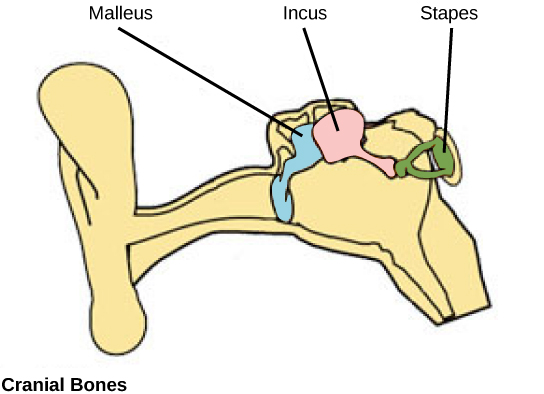

Figure 29.37図 29.37
Mammalian ear bones. Bones of the mammalian middle ear are modified from bones of the jaw and skull in reptiles. The stapes is found in other vertebrates (e.g., the columella of birds) whereas in mammals, the malleus and incus are derived from the articular and quadrate bones, respectively. (credit: NCI)
哺乳類の耳の骨。哺乳類の中耳の骨は、爬虫類の顎と頭骨の骨が変化したものである。アブミ骨はほかの脊椎動物にも見られる(鳥類の耳小柱など)。一方、哺乳類のツチ骨とキヌタ骨は、それぞれ関節骨と方形骨に由来する。(クレジット:NCI)
The adductor muscles that close the jaw comprise two major muscles in mammals: the temporalis and the masseter. Working together, these muscles permit up-and-down and side-to-side movements of the jaw, making chewing possible—which is unique to mammals. Most mammals have heterodont teeth, meaning that they have different types and shapes of teeth (incisors, canines, premolars, and molars) rather than just one type and shape of tooth. Most mammals are also diphyodonts, meaning that they have two sets of teeth in their lifetime: deciduous or “baby” teeth, and permanent teeth. Most other vertebrates with teeth are polyphyodonts, that is, their teeth are replaced throughout their entire life.
英語のヒント
顎を閉じる内転筋は、哺乳類では側頭筋と咬筋という二つの主要な筋からなる。これらが協調して働くことで、顎を上下左右に動かし、哺乳類に特有の咀嚼を可能にする。大部分の哺乳類は異形歯性である。つまり、一種類・一形状の歯だけではなく、切歯、犬歯、小臼歯、大臼歯という、種類と形の異なる歯をもつ。また、大部分の哺乳類は二生歯性で、一生の間に乳歯と永久歯という二組の歯をもつ。歯をもつほかの脊椎動物の大部分は多生歯性であり、一生を通じて歯が生え替わる。
Mammals, like birds, possess a four-chambered heart; however, the hearts of birds and mammals are an example of convergent evolution, since mammals clearly arose independently from different groups of tetrapod ancestors. Mammals also have a specialized group of cardiac cells (fibers) located in the walls of their right atrium called the sinoatrial node, or pacemaker, which determines the rate at which the heart beats. Mammalian erythrocytes (red blood cells) do not have nuclei, whereas the erythrocytes of other vertebrates are nucleated.
英語のヒント
哺乳類は鳥類と同様、四つの部屋からなる心臓をもつ。しかし、哺乳類は明らかに別の四肢動物の祖先群から独立して生じたため、鳥類と哺乳類の心臓は収斂進化の例である。哺乳類の右心房の壁には、洞房結節、またはペースメーカーと呼ばれる、特殊な心臓の細胞(線維)の集まりがあり、心拍数を決めている。哺乳類の赤血球には核がないが、ほかの脊椎動物の赤血球には核がある。
The kidneys of mammals have a portion of the nephron called the loop of Henle or nephritic loop, which allows mammals to produce urine with a high concentration of solutes—higher than that of the blood. Mammals lack a renal portal system, which is a system of veins that moves blood from the hind or lower limbs and region of the tail to the kidneys. Renal portal systems are present in all other vertebrates except jawless fishes. A urinary bladder is present in all mammals.
英語のヒント
哺乳類の腎臓のネフロンには、ヘンレ係蹄、または腎係蹄という部分がある。これによって、血液より溶質濃度の高い尿をつくることができる。哺乳類には、後肢または下肢と尾の領域から腎臓へ血液を運ぶ静脈系である、腎門脈系がない。腎門脈系は、無顎の魚類を除く、ほかのすべての脊椎動物に存在する。膀胱はすべての哺乳類にある。
Unlike birds, the skulls of mammals have two occipital condyles, bones at the base of the skull that articulate with the first vertebra, as well as a secondary palate at the rear of the pharynx that helps to separate the pathway of swallowing from that of breathing. Turbinate bones (conchae in humans) are located along the sides of the nasal cavity, and help warm and moisten air as it is inhaled. The pelvic bones are fused in mammals, and there are typically seven cervical vertebrae (except for some edentates and manatees). Mammals have movable eyelids and fleshy external ears (pinnae), quite unlike the naked external auditory openings of birds. Mammals also have a muscular diaphragm that is lacking in birds.
英語のヒント
鳥類とは異なり、哺乳類の頭骨には、第1椎骨と関節する、頭骨の底の骨である後頭顆が二つある。また、咽頭後部には二次口蓋があり、嚥下の経路と呼吸の経路を分けるのを助ける。鼻腔の側面に沿って鼻甲介骨があり、吸い込まれる空気を温め、湿らせる。哺乳類の骨盤の骨は融合し、頸椎は通常7個ある(一部の貧歯類とマナティー類を除く)。哺乳類には、動くまぶたと、肉質の外耳(耳介)があり、鳥類の覆いのない外耳の開口部とは大きく異なる。また、鳥類にはない、筋肉性の横隔膜もある。
Mammalian brains also have certain characteristics that differ from the brains of other vertebrates. In some, but not all mammals, the cerebral cortex, the outermost part of the cerebrum, is highly convoluted and folded, allowing for a greater surface area than is possible with a smooth cortex. The optic lobes, located in the midbrain, are divided into two parts in mammals, while other vertebrates possess a single, undivided lobe. Eutherian mammals also possess a specialized structure, the corpus callosum, which links the two cerebral hemispheres together. The corpus callosum functions to integrate motor, sensory, and cognitive functions between the left and right cerebral cortexes.
英語のヒント
哺乳類の脳にも、ほかの脊椎動物の脳とは異なる特徴がある。すべてではないが一部の哺乳類では、大脳の最外部にあたる大脳皮質が強く入り組み、折りたたまれている。そのため、滑らかな皮質の場合より大きな表面積が得られる。中脳にある視葉は、哺乳類では二つに分かれるが、ほかの脊椎動物では一つで、分割されていない。真獣類の哺乳類は、左右の大脳半球を結ぶ特殊な構造である脳梁ももつ。脳梁は、左右の大脳皮質の間で、運動、感覚、認知の機能を統合する。