第29章脊椎動物
Human Evolutionヒトの進化
The family Hominidae of order Primates includes the hominoids: the great apes and humans (Figure 29.46). Evidence from the fossil record and from a comparison of human and chimpanzee DNA suggests that humans and chimpanzees diverged from a common hominoid ancestor approximately six million years ago. Several species evolved from the evolutionary branch that includes humans, although our species is the only surviving member. The term hominin is used to refer to those species that evolved after this split of the primate line, thereby designating species that are more closely related to humans than to chimpanzees. A number of marker features differentiate humans from the other hominoids, including bipedalism or upright posture, increase in the size of the brain, and a fully opposable thumb that can touch the little finger. Bipedal hominins include several groups that were probably part of the modern human lineage—Australopithecus, Homo habilis, and Homo erectus—and several non-ancestral groups that can be considered “cousins” of modern humans, such as Neanderthals and Denisovans.
英語のヒント
霊長目のヒト科には、ヒト上科の動物、すなわち大型類人猿とヒトが含まれる(図29.46)。化石記録と、ヒトとチンパンジーのDNAの比較から得られた証拠は、両者が約600万年前に共通のヒト上科の祖先から分岐したことを示唆する。ヒトを含む進化の枝からは複数の種が進化したが、私たちの種だけが生き残っている。ホミニンという語は、霊長類の系統がこのように分かれた後で進化した種を指す。つまり、チンパンジーよりヒトに近縁な種を表す。ヒトをほかのヒト上科の動物から区別する特徴には、二足歩行または直立姿勢、脳の大型化、小指に触れられるほど完全に対向する親指などがある。二足歩行のホミニンには、アウストラロピテクス、ホモ・ハビリス、ホモ・エレクトスなど、おそらく現生人類の系統の一部をなした群と、ネアンデルタール人やデニソワ人のように、現生人類の「いとこ」と考えられる、直接の祖先ではない群が含まれる。
Determining the true lines of descent in hominins is difficult. In years past, when relatively few hominin fossils had been recovered, some scientists believed that considering them in order, from oldest to youngest, would demonstrate the course of evolution from early hominins to modern humans. In the past several years, however, many new fossils have been found, and it is clear that there was often more than one species alive at any one time and that many of the fossils found (and species named) represent hominin species that died out and are not ancestral to modern humans.
英語のヒント
ホミニンの本当の系統関係を決めることは難しい。以前、回収されたホミニン化石が比較的少なかったころには、最も古いものから新しいものへ順に並べれば、初期のホミニンから現生人類への進化の道筋がわかると考える科学者もいた。しかし近年、多くの新しい化石が見つかった。その結果、一つの時点で複数の種が生きていたことが多く、見つかった化石と命名された種の多くは、絶滅して現生人類の祖先とはならなかったホミニンの種を表していることが、明らかになっている。
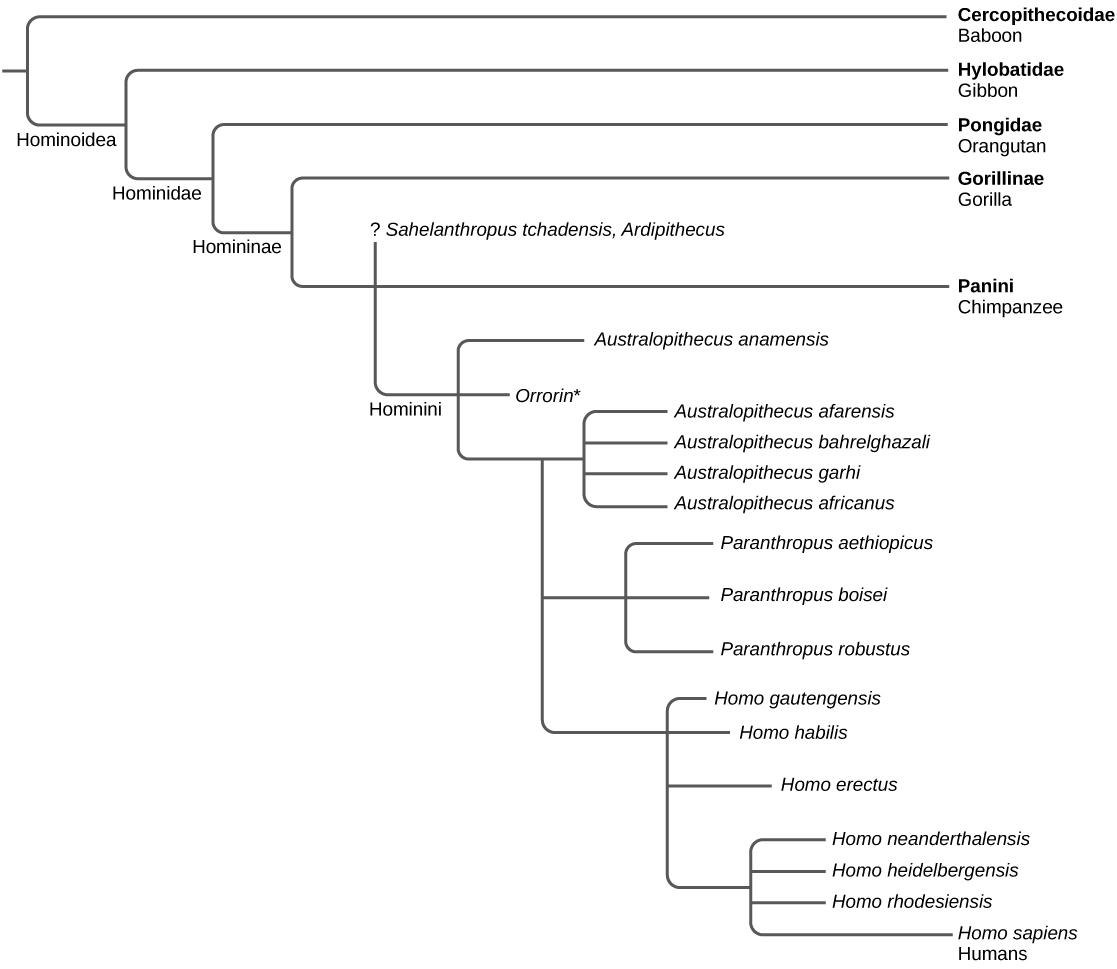
Figure 29.46図 29.46
Hominin phylogeny. This chart shows evolutionary relationship among Hominins and hypothesized relation to modern humans. (*still debated phylogeny position).
ホミニンの系統。この図は、ホミニンの間の進化的関係と、現生人類との推定上の関係を示す。(*系統上の位置には現在も議論がある。)
Very Early Hominins最初期のホミニン
Three species of very early hominins have made news in the late 20th and early 21st centuries: Ardipithecus, Sahelanthropus, and Orrorin. The youngest of the three species, Ardipithecus, was discovered in the 1990s, and dates to about 4.4 MYA. Although the bipedality of the early specimens was uncertain, several more specimens of Ardipithecus were discovered in the intervening years and demonstrated that the organism was bipedal. Two different species of Ardipithecus have been identified, A. ramidus and A. kadabba, whose specimens are older, dating to 5.6 MYA. However, the status of this genus as a human ancestor is uncertain.
英語のヒント
20世紀末から21世紀初めにかけて、アルディピテクス、サヘラントロプス、オロリンという、非常に初期のホミニン3種が話題になった。この3種のうち最も新しいアルディピテクスは、1990年代に発見され、約440万年前にさかのぼる。初期の標本では二足歩行をしていたかどうか不確かだったが、その後の数年間にさらに標本が発見され、二足歩行だったことが示された。アルディピテクスには、A. ramidus と、より古い560万年前の標本に基づく A. kadabba という2種が確認されている。しかし、この属をヒトの祖先と位置づけられるかどうかは不確かである。
The oldest of the three, Sahelanthropus tchadensis, was discovered in 2001-2002 and has been dated to nearly seven million years ago. There is a single specimen of this genus, a skull that was a surface find in Chad. The fossil, informally called “Toumai,” is a mosaic of primitive and evolved characteristics, and it is unclear how this fossil fits with the picture given by molecular data, namely that the line leading to modern humans and modern chimpanzees apparently bifurcated about six million years ago. It is not thought at this time that this species was an ancestor of modern humans.
英語のヒント
この三つのうち最も古いサヘラントロプス・チャデンシス(Sahelanthropus tchadensis)は、2001〜2002年に発見され、約700万年前のものと年代測定されている。この属の標本は一つだけで、チャドの地表で見つかった頭骨である。非公式に「トゥーマイ」と呼ばれるこの化石は、原始的な特徴と進化した特徴が入り混じっている。現生人類と現生チンパンジーに至る系統は約600万年前に分岐したらしい、という分子データの示す像と、この化石がどう整合するかは明らかでない。現在、この種は現生人類の祖先とは考えられていない。
A younger (c. 6 MYA) species, Orrorin tugenensis, is also a relatively recent discovery, found in 2000. There are several specimens of Orrorin. Some features of Orrorin are more similar to those of modern humans than are the australopithicenes, although Orrorin is much older. If Orrorin is a human ancestor, then the australopithicenes may not be in the direct human lineage. Additional specimens of these species may help to clarify their role.
英語のヒント
より新しい約600万年前の種、オロリン・トゥゲネンシス(Orrorin tugenensis)も、2000年に見つかった比較的新しい発見である。オロリンの標本は複数ある。オロリンのほうがはるかに古いにもかかわらず、その一部の特徴は、アウストラロピテクス類のものより現生人類に似ている。オロリンがヒトの祖先なら、アウストラロピテクス類はヒトの直接の系統上にはないかもしれない。これらの種の標本がさらに見つかれば、その役割の解明に役立つ可能性がある。
Early Hominins: Genus Australopithecus初期のホミニン:アウストラロピテクス属
Australopithecus (“southern ape”) is a genus of hominin that evolved in eastern Africa approximately four million years ago and went extinct about two million years ago. This genus is of particular interest to us as it is thought that our genus, genus Homo, evolved from a common ancestor shared with Australopithecus about two million years ago (after likely passing through some transitional states). Australopithecus had a number of characteristics that were more similar to the great apes than to modern humans. For example, sexual dimorphism was more exaggerated than in modern humans. Males were up to 50 percent larger than females, a ratio that is similar to that seen in modern gorillas and orangutans. In contrast, modern human males are approximately 15 to 20 percent larger than females. The brain size of Australopithecus relative to its body mass was also smaller than in modern humans and more similar to that seen in the great apes. A key feature that Australopithecus had in common with modern humans was bipedalism, although it is likely that Australopithecus also spent time in trees. Hominin footprints, similar to those of modern humans, were found in Laetoli, Tanzania and dated to 3.6 million years ago. They showed that hominins at the time of Australopithecus were walking upright.
英語のヒント
アウストラロピテクス(「南の類人猿」)は、約400万年前に東アフリカで進化し、約200万年前に絶滅したホミニンの属である。私たちの属であるヒト属(Homo)は、おそらくいくつかの移行段階を経て、約200万年前にアウストラロピテクスと共通の祖先から進化したと考えられるため、この属は特に関心を引く。アウストラロピテクスには、現生人類より大型類人猿に似た特徴がいくつもあった。たとえば、性的二型は現生人類より強かった。雄は雌より最大50%大きく、その比率は現生のゴリラやオランウータンに似ていた。これに対して、現生人類の男性は女性より約15〜20%大きい。体重に対する脳の大きさも、現生人類より小さく、大型類人猿のものに近かった。アウストラロピテクスが現生人類と共有した重要な特徴は二足歩行である。ただし、樹上でも時間を過ごしていた可能性が高い。タンザニアのラエトリでは、現生人類に似たホミニンの足跡が見つかり、360万年前のものと年代測定された。これは、アウストラロピテクスの時代のホミニンが、直立して歩いていたことを示している。
There were a number of Australopithecus species, which are often referred to as australopiths. Australopithecus anamensis lived about 4.2 million years ago. More is known about another early species, Australopithecus afarensis, which lived between 3.9 and 2.9 million years ago. This species demonstrates a trend in human evolution: the reduction of the dentition and jaw in size. A. afarensis (Figure 29.47a) had smaller canines and molars compared to apes, but these were larger than those of modern humans. Its brain size was 380 to 450 cubic centimeters, approximately the size of a modern chimpanzee brain. It also had prognathic jaws, which is a relatively longer jaw than that of modern humans. In the mid-1970s, the fossil of an adult female A. afarensis was found in the Afar region of Ethiopia and dated to 3.24 million years ago (Figure 29.48). The fossil, which is informally called “Lucy,” is significant because it was the most complete australopith fossil found, with 40 percent of the skeleton recovered.
英語のヒント
アウストラロピテクス属には複数の種があり、まとめてアウストラロピスと呼ばれることが多い。アウストラロピテクス・アナメンシスは、約420万年前に生息した。もう一つの初期種、390万〜290万年前に生息したアウストラロピテクス・アファレンシスについては、さらに多くのことが知られている。この種は、歯列と顎の縮小という、ヒトの進化の傾向を示す。A. afarensis(図29.47a)の犬歯と臼歯は、類人猿より小さいが、現生人類よりは大きかった。脳容積は380〜450 cm³で、現生チンパンジーの脳とほぼ同じだった。また、現生人類より比較的長く前方に突き出した顎、すなわち突顎をもっていた。1970年代半ば、エチオピアのアファール地方で、A. afarensis の成体の雌の化石が見つかり、324万年前のものと年代測定された(図29.48)。非公式に「ルーシー」と呼ばれるこの化石は、骨格の40%が回収され、発見されたアウストラロピス化石の中で最も完全だったため、重要である。
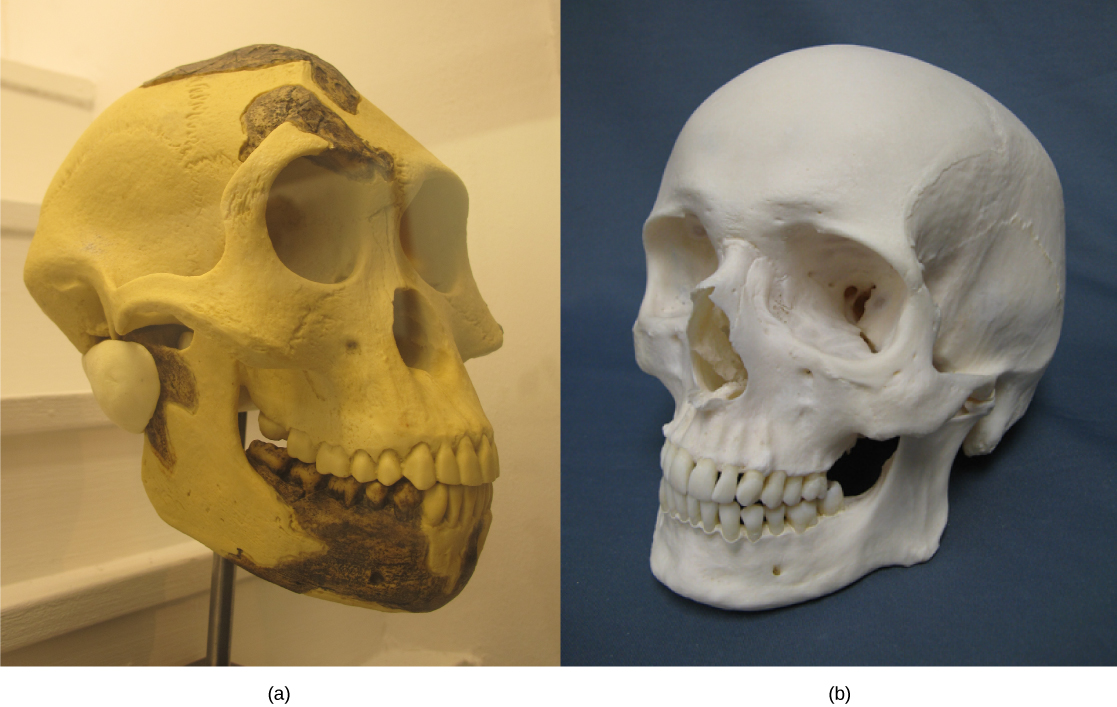
Figure 29.47図 29.47
Australopithicene and modern human skulls. The skull of (a) Australopithecus afarensis, an early hominid that lived between two and three million years ago, resembled that of (b) modern humans but was smaller with a sloped forehead, larger teeth, and a prominent jaw.
アウストラロピテクス類と現生人類の頭骨。200万〜300万年前に生息した初期のヒト科動物、(a)アウストラロピテクス・アファレンシスの頭骨は、(b)現生人類のものに似るが、より小さく、額が傾斜し、歯が大きく、顎が突出していた。
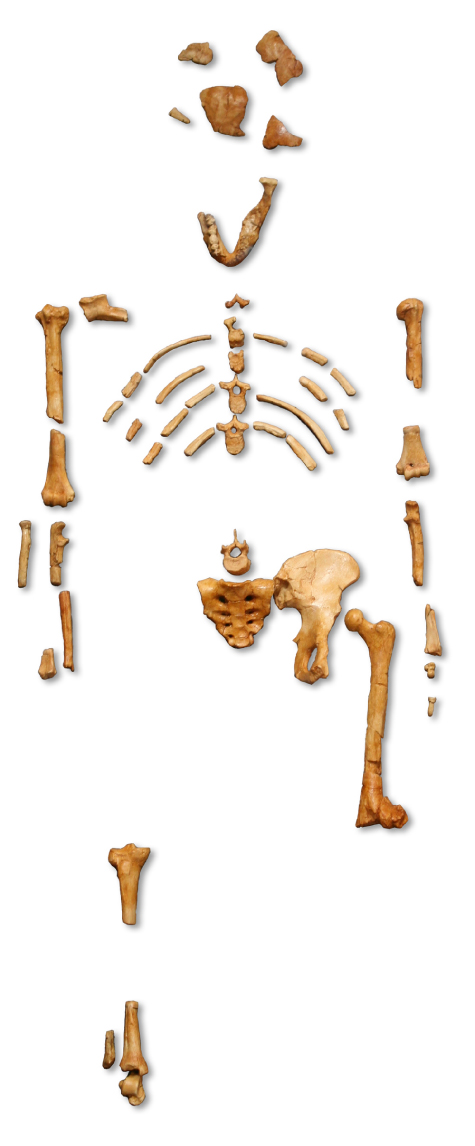


Figure 29.48図 29.48
Lucy. This adult female Australopithecus afarensis skeleton, nicknamed Lucy, was discovered in the mid-1970s. (credit: “120”/Wikimedia Commons)
ルーシー。ルーシーという愛称をもつ、このアウストラロピテクス・アファレンシスの成体の雌の骨格は、1970年代半ばに発見された。(クレジット:「120」/Wikimedia Commons)
Australopithecus africanus lived between two and three million years ago. It had a slender build and was bipedal, but had robust arm bones and, like other early hominids, may have spent significant time in trees. Its brain was larger than that of A. afarensis at 500 cubic centimeters, which is slightly less than one-third the size of modern human brains. Two other species, Australopithecus bahrelghazali and Australopithecus garhi, have been added to the roster of australopiths in recent years. A. bahrelghazali is unusual in being the only australopith found in Central Africa.
英語のヒント
アウストラロピテクス・アフリカヌスは、200万〜300万年前に生息した。体つきは細く、二足歩行をしたが、腕の骨は頑丈で、ほかの初期のヒト科動物と同様、樹上でかなりの時間を過ごしていた可能性がある。脳容積は500 cm³で A. afarensis より大きいが、現生人類の脳の3分の1弱だった。近年、アウストラロピテクス・バーレルガザリとアウストラロピテクス・ガルヒの2種が、アウストラロピスの一覧に加わった。A. bahrelghazali は、中央アフリカで発見された唯一のアウストラロピスである点で異例である。