第29章脊椎動物
Archosaurs: Dinosaurs主竜類:恐竜
Dinosaurs (“fearfully-great lizard”) include the Saurischia (“lizard-hipped”) with a simple, three-pronged pelvis, and Ornithischia (“bird-hipped”) dinosaurs with a more complex pelvis, superficially similar to that of birds. However, it is a fact that birds evolved from the saurischian “lizard hipped” lineage, not the ornithischian “bird hip” lineage. Dinosaurs and their theropod descendants, the birds, are remnants of what was formerly a hugely diverse group of reptiles, some of which like Argentinosaurus were nearly 40 meters (130 feet) in length and weighed at least 80,000 kg (88 tons). They were the largest land animals to have lived, challenging and perhaps exceeding the great blue whale in size, but probably not weight—which could be greater than 200 tons.
英語のヒント
恐竜(「恐ろしく巨大なトカゲ」)には、単純な三方向に伸びる骨盤をもつ竜盤類(「トカゲの腰」)と、鳥類のものに外見上似た、より複雑な骨盤をもつ鳥盤類(「鳥の腰」)が含まれる。しかし、鳥類が進化したのは「鳥の腰」をもつ鳥盤類ではなく、「トカゲの腰」をもつ竜盤類の系統である。恐竜と、その獣脚類の子孫である鳥類は、かつて非常に多様だった爬虫類の群の名残である。アルゼンチノサウルスなど、その一部は全長約40 m(130フィート)に達し、体重は少なくとも8万 kg(88トン)あった。それらは史上最大の陸生動物であり、大きさでは巨大なシロナガスクジラに匹敵し、あるいは上回ったかもしれない。ただし、シロナガスクジラの体重は200トンを超えることもあるため、重さではおそらく及ばなかった。
Herrerasaurus, a bipedal dinosaur from Argentina, was one of the earliest dinosaurs that walked upright with the legs positioned directly below the pelvis, rather than splayed outward to the sides as in the crocodilians. The Ornithischia were all herbivores, and sometimes evolved into crazy shapes, such as ankylosaur “armored tanks” and horned dinosaurs such as Triceratops. Some, such as Parasaurolophus, lived in great herds and may have amplified their species-specific calls through elaborate crests on their heads.
英語のヒント
アルゼンチンの二足歩行恐竜、ヘレラサウルスは、直立歩行をする最初期の恐竜の一つだった。ワニ類のように脚を左右へ張り出すのではなく、骨盤の真下に脚を置いていた。鳥盤類はすべて草食性で、ときには「装甲戦車」のようなアンキロサウルス類や、トリケラトプスなどの角竜のように、風変わりな姿へ進化した。パラサウロロフスなどは大きな群れで暮らし、頭の複雑なとさかによって、種に特有の鳴き声を増幅していたのかもしれない。
Both the ornithischian and saurischian dinosaurs provided parental care for their broods, just as crocodilians and birds do today. The end of the age of dinosaurs came about 65 million years ago, during the Mesozoic, coinciding with the impact of a large asteroid (that produced the Chicxulub crater) in what is now the Yucatan Peninsula of Mexico. Besides the immediate environmental disasters associated with this asteroid impacting the Earth at about 45,000 miles per hour, the impact may also have helped generate an enormous series of volcanic eruptions that changed the distribution and abundance of plant life worldwide, as well as its climate.
英語のヒント
鳥盤類と竜盤類の恐竜はいずれも、現在のワニ類や鳥類と同じように、子の世話をした。恐竜の時代が終わったのは、中生代の約6500万年前で、現在のメキシコのユカタン半島に巨大な小惑星が衝突した時期と一致する。この衝突でチクシュルーブ・クレーターができた。時速約4万5000マイルで地球に衝突したこの小惑星は、直接的な環境災害をもたらしただけでなく、巨大な一連の火山噴火の発生にも寄与した可能性がある。それにより、世界中の植物の分布と量、さらに気候が変わった。
Archosaurs: Pterosaurs主竜類:翼竜
More than 200 species of pterosaurs have been described, and in their day, beginning about 230 million years ago, they were the undisputed rulers of the Mesozoic skies for over 170 million years. Recent fossils suggest that hundreds of pterosaur species may have lived during any given period, dividing up the environment much like birds do today. Pterosaurs came in amazing sizes and shapes, ranging in size from that of a small song bird to that of the enormous Quetzalcoatlus northropi, which stood nearly 6 meters (19 feet) high and had a wingspan of nearly 14 meters (40 feet). This monstrous pterosaur, named after the Aztec god Quetzalcoatl, the feathered flying serpent that contributed largely to the creation of humankind, may have been the largest flying animal that ever evolved!
英語のヒント
翼竜は200種以上が記載されている。約2億3000万年前に始まるその時代、1億7000万年以上にわたって、中生代の空の疑いようのない支配者だった。近年の化石は、どの時期にも数百種の翼竜が暮らし、現代の鳥類と同じように環境を分け合っていた可能性を示している。翼竜の大きさと形は驚くほど多様だった。小さな鳴禽ほどのものから、立った高さが約6 m(19フィート)、翼開長が約14 m(40フィート)に達する巨大なケツァルコアトルス・ノルトロピ(Quetzalcoatlus northropi)までいた。この途方もなく大きな翼竜の名前は、人類の創造に大きく関わった、羽毛のある空飛ぶ蛇の姿のアステカの神、ケツァルコアトルに由来する。進化した飛翔動物の中で最大だったのかもしれない!
Some male pterosaurs apparently had brightly colored crests that may have served in sexual displays; some of these crests were much higher than the actual head! Pterosaurs had ultralight skeletons, with a pteroid bone, unique to pterosaurs, that strengthened the forewing membrane. Much of their wing span was exaggerated by a greatly elongated fourth finger that supported perhaps half of the wing. It is tempting to relate to them in terms of bird characteristics, but in reality, their proportions were decidedly not like birds at all. For example, it is common to find specimens, such as Quetzalcoatlus, with a head and neck region that together was three to four times as large as the torso. In addition, unlike the feathered bird wing, the reptilian wing had a layer of muscles, connective tissue, and blood vessels, all reinforced with a webbing of fibrous cords.
英語のヒント
雄の翼竜の一部には、どうやら鮮やかな色のとさかがあり、求愛ディスプレイに使われていた可能性がある。そのとさかの中には、頭そのものよりはるかに高いものもあった!翼竜の骨格は超軽量で、翼竜に特有の翼状骨が、翼前方の膜を補強していた。著しく長くなった第4指が、おそらく翼の半分を支え、翼開長を大きくしていた。鳥の特徴に当てはめて理解したくなるが、実際には、体の各部の比率はまったく鳥らしくなかった。たとえばケツァルコアトルスなどでは、頭と首を合わせた大きさが胴体の3〜4倍にもなる標本が普通に見つかる。さらに、羽毛のある鳥の翼とは異なり、この爬虫類の翼には、筋肉、結合組織、血管の層があり、それら全体が網状の線維性の紐で補強されていた。
In contrast to the aerial pterosaurs, the dinosaurs were a diverse group of terrestrial reptiles with more than 1,000 species classified to date. Paleontologists continue to discover new species of dinosaurs. Some dinosaurs were quadrupeds (Figure 29.26); others were bipeds. Some were carnivorous, whereas others were herbivorous. Dinosaurs laid eggs, and a number of nests containing fossilized eggs, with intact embryos, have been found. It is not known with certainty whether dinosaurs were homeotherms or facultative endotherms. However, given that modern birds are endothermic, the dinosaurs that were the immediate ancestors to birds likely were endothermic as well. Some fossil evidence exists for dinosaurian parental care, and comparative biology supports this hypothesis since the archosaur birds and crocodilians both display extensive parental care.
英語のヒント
空を飛ぶ翼竜とは対照的に、恐竜は多様な陸生爬虫類の群で、これまでに1000種以上が分類されている。古生物学者は今も新種の恐竜を発見し続けている。四足歩行の恐竜もいれば(図29.26)、二足歩行のものもいた。肉食性のものも、草食性のものもいた。恐竜は卵を産み、完全な胚を残した化石卵を含む巣が、いくつも見つかっている。恐竜が恒温動物だったのか、それとも状況に応じて内温性を示す動物だったのかは、確実にはわかっていない。しかし、現生鳥類が内温性であることを考えると、鳥類の直接の祖先だった恐竜も、内温性だった可能性が高い。恐竜が子の世話をしたことを示す化石証拠もある。主竜類に属する鳥類とワニ類はどちらも手厚い子の世話をするため、比較生物学もこの仮説を支持している。
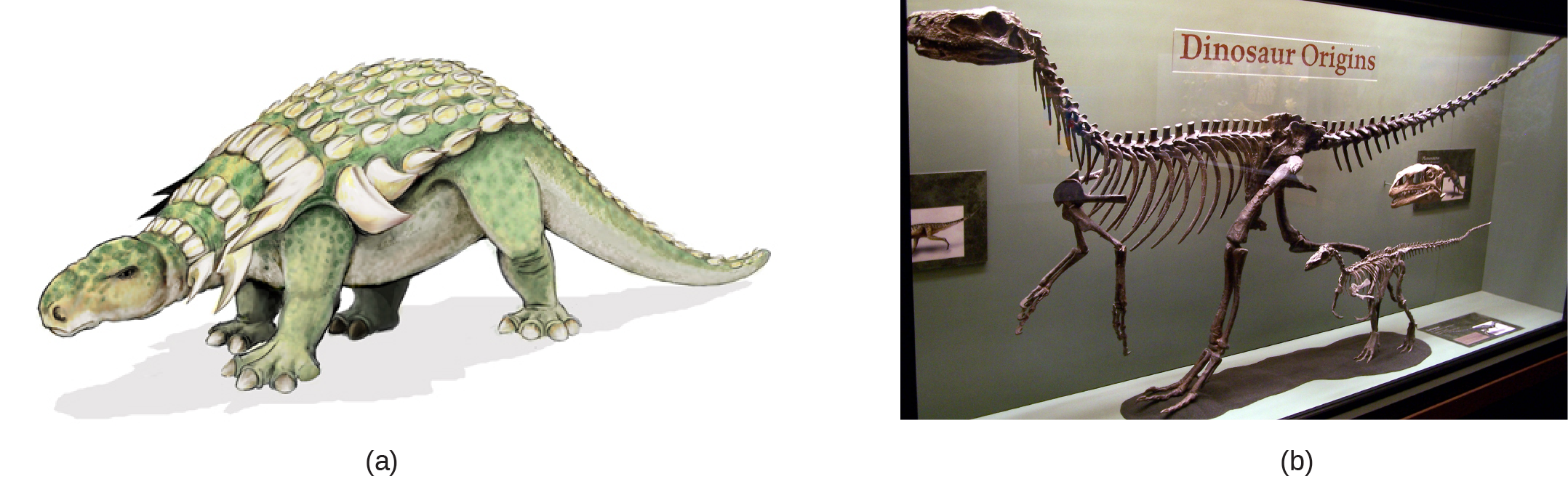
OpenStax, Rice University; Biology 2e. (credit: a Mariana Ruiz Villareal b Zach Tirrell from Plymouth, USA, Dino Origins) · CC BY 4.0 · Source出典

Figure 29.26図 29.26
Ornithischian and saurischian Dinosaurs. Edmontonia was an armored dinosaur that lived in the Late Cretaceous period, 145.5 to 65.6 million years ago. Herrerasaurus and Eoraptor (b) were late Triassic saurischian dinosaurs dating to about 230 million years ago. (credit: a Mariana Ruiz Villareal b Zach Tirrell from Plymouth, USA, Dino Origins)
鳥盤類と竜盤類の恐竜。エドモントニアは、1億4550万〜6560万年前の白亜紀後期に生息した、装甲をもつ恐竜だった。ヘレラサウルスとエオラプトル(b)は、約2億3000万年前、三畳紀後期の竜盤類の恐竜だった。(クレジット:a Mariana Ruiz Villareal、b Zach Tirrell from Plymouth, USA, Dino Origins)
Dinosaurs dominated the Mesozoic era, which was known as the “Age of Reptiles.” The dominance of dinosaurs lasted until the end of the Cretaceous, the last period of the Mesozoic era. The Cretaceous-Tertiary extinction resulted in the loss of most of the large-bodied animals of the Mesozoic era. Birds are the only living descendants of one of the major clades of theropod dinosaurs.
恐竜は、「爬虫類の時代」と呼ばれる中生代に繁栄した。恐竜の優勢は、中生代最後の紀である白亜紀の終わりまで続いた。白亜紀末の大量絶滅によって、中生代の大型動物の大部分が失われた。鳥類は、獣脚類恐竜の主要な系統群の一つから生じた、唯一の現生の子孫である。