第29章脊椎動物
29.5 Birds29.5 鳥類
Learning Objectives学習目標
By the end of this section, you will be able to do the following:
この節を学び終えると、次のことができるようになる。
- Describe the evolutionary history of birds鳥類の進化史を説明する。
- Describe the derived characteristics in birds that facilitate flight飛行を容易にする鳥類の派生形質を説明する。
With over 10,000 identified species, the birds are the most speciose of the land vertebrate classes. Abundant research has shown that birds are really an extant clade that evolved from maniraptoran theropod dinosaurs about 150 million years ago. Thus, even though the most obvious characteristic that seems to set birds apart from other extant vertebrates is the presence of feathers, we now know that feathers probably appeared in the common ancestor of both ornithischian and saurischian lineages of dinosaurs. Feathers in these clades are also homologous to reptilian scales and mammalian hair, according to the most recent research. While the wings of vertebrates like bats function without feathers, birds rely on feathers, and wings, along with other modifications of body structure and physiology, for flight, as we shall see.
英語のヒント
1万種以上が確認されている鳥類は、陸上脊椎動物の綱の中で最も種数が多い。豊富な研究から、鳥類は実際には、約1億5000万年前にマニラプトル類の獣脚類恐竜から進化した、現在も生き残る系統群であることがわかっている。したがって、鳥類をほかの現生脊椎動物から区別する最も明白な特徴は羽毛の存在に見えるものの、羽毛はおそらく、恐竜の鳥盤類と竜盤類の両系統に共通する祖先で現れたことが、現在ではわかっている。最新の研究によると、これらの系統群の羽毛は、爬虫類の鱗や哺乳類の毛とも相同である。コウモリのような脊椎動物の翼は羽毛なしで機能するが、これから見るように、鳥類は飛行のために、体の構造や生理のほかの変化とともに、羽毛と翼に依存している。
Characteristics of Birds鳥類の特徴
Birds are endothermic, and more specifically, homeothermic—meaning that they usually maintain an elevated and constant body temperature, which is significantly above the average body temperature of most mammals. This is, in part, due to the fact that active flight—especially the hovering skills of birds such as hummingbirds—requires enormous amounts of energy, which in turn necessitates a high metabolic rate. Like mammals (which are also endothermic and homeothermic and covered with an insulating pelage), birds have several different types of feathers that together keep “heat” (infrared energy) within the core of the body, away from the surface where it can be lost by radiation and convection to the environment.
英語のヒント
鳥類は内温性であり、より具体的には恒温性である。つまり、通常は高く一定した体温を保ち、その体温は大部分の哺乳類の平均体温をかなり上回る。その一因は、能動的な飛行、とりわけハチドリなどのホバリングに膨大なエネルギーが必要であり、そのため高い代謝率が必要になることである。同じく内温性・恒温性で、断熱性の被毛に覆われる哺乳類と同様、鳥類にも数種類の羽毛がある。それらが一緒に働いて、「熱」(赤外線エネルギー)を体の中心部に保ち、放射と対流によって周囲へ熱が失われる体表から遠ざけている。
Modern birds produce two main types of feathers: contour feathers and down feathers. Contour feathers have a number of parallel barbs that branch from a central shaft. The barbs in turn have microscopic branches called barbules that are linked together by minute hooks, making the vane of a feather a strong, flexible, and uninterrupted surface. In contrast, the barbules of down feathers do not interlock, making these feathers especially good for insulation, trapping air in spaces between the loose, interlocking barbules of adjacent feathers to decrease the rate of heat loss by convection and radiation. Certain parts of a bird’s body are covered in down feathers, and the base of other feathers has a downy portion, whereas newly hatched birds are covered almost entirely in down, which serves as an excellent coat of insulation, increasing the thermal boundary layer between the skin and the outside environment.
英語のヒント
現生鳥類は、正羽と綿羽という二つの主要なタイプの羽毛をつくる。正羽には、中央の羽軸から枝分かれして平行に並ぶ、多数の羽枝がある。羽枝にはさらに小羽枝という微細な枝があり、それらがごく小さな鉤で互いにつながる。このため、羽弁は丈夫で柔軟な、切れ目のない面となる。これに対して、綿羽の小羽枝は互いにかみ合わないため、特に断熱に適している。隣り合う羽毛の緩く絡み合う小羽枝の間に空気を閉じ込め、対流と放射による熱損失を遅くするのである。鳥の体の一部は綿羽で覆われ、ほかの羽毛にも根元に綿羽状の部分がある。一方、孵化したばかりの鳥は、ほぼ全身が綿羽に覆われている。これは優れた断熱の被覆として働き、皮膚と外部環境の間の温度境界層を厚くする。
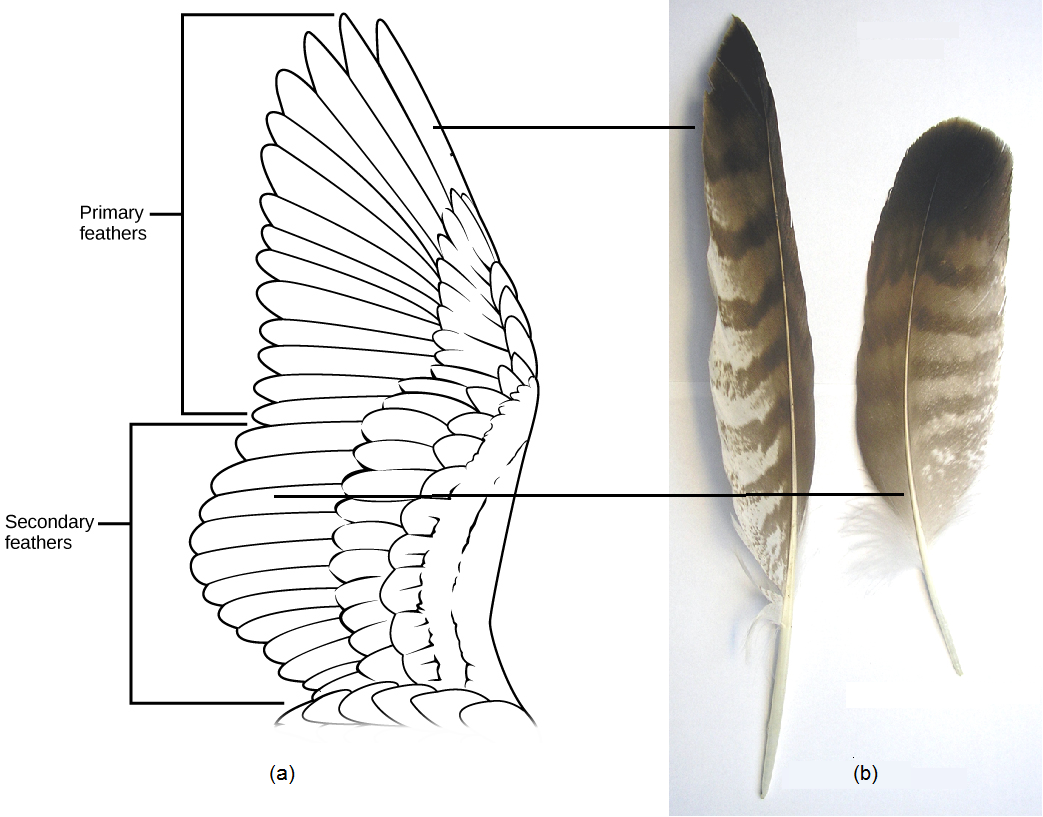
Feathers not only provide insulation, but also allow for flight, producing the lift and thrust necessary for flying birds to become and stay airborne. The feathers on a wing are flexible, so the feathers at the end of the wing separate as air moves over them, reducing the drag on the wing. Flight feathers are also asymmetrical and curved, so that air flowing over them generates lift. Two types of flight feathers are found on the wings, primary feathers and secondary feathers (Figure 29.32). Primary feathers are located at the tip of the wing and provide thrust as the bird moves its wings downward, using the pectoralis major muscles. Secondary feathers are located closer to the body, in the forearm portion of the wing, and provide lift. In contrast to primary and secondary feathers, contour feathers are found on the body, where they help reduce form drag produced by wind resistance against the body during flight. They create a smooth, aerodynamic surface so that air moves swiftly over the bird’s body, preventing turbulence and creating ideal aerodynamic conditions for efficient flight.
英語のヒント
羽毛は断熱するだけでなく、飛行も可能にする。飛ぶ鳥が空中へ上がり、そこにとどまるために必要な揚力と推力を生み出すのである。翼の羽毛は柔軟なので、空気が上を流れると翼端の羽毛が開き、翼に働く抗力を減らす。風切羽は非対称で湾曲しており、その上を流れる空気が揚力を生む。翼には初列風切と次列風切という、二種類の風切羽がある(図29.32)。初列風切は翼の先端にあり、鳥が大胸筋を使って翼を下へ動かすときに推力を生む。次列風切は体に近い、翼の前腕部分にあり、揚力を生む。初列風切や次列風切に対し、体を覆う正羽は、飛行中に体が風の抵抗を受けて生じる形状抗力を減らすのを助ける。正羽は滑らかな空気力学的表面をつくり、空気が鳥の体の上を速やかに流れるようにする。これにより乱流が防がれ、効率的な飛行に理想的な空気力学的条件が生まれる。
OpenStax, Rice University; Biology 2e. (Credit b: Mod. from S. Seyfert https://commons.wikimedia.org/w/index.php?curid=613813) Original S. Seyfert; Buteo buteo primary secondary (panel b) is available under CC BY 2.5: https://creativecommons.org/licenses/by/2.5/ (CC BY option selected). · CC BY 4.0 · Source出典
Figure 29.32図 29.32
Flight feathers. (a) Primary feathers are located at the wing tip and provide thrust; secondary feathers are located close to the body and provide lift. (b) Primary and secondary feathers from a common buzzard (Buteo buteo). (Credit b: Mod. from S. Seyfert https://commons.wikimedia.org/w/index.php?curid=613813)
風切羽。(a)初列風切は翼端にあって推力を生み、次列風切は体の近くにあって揚力を生む。(b)ノスリ(Buteo buteo)の初列風切と次列風切。(クレジットb:S. Seyfert の作品を改変。https://commons.wikimedia.org/w/index.php?curid=613813)
Flapping of the entire wing occurs primarily through the actions of the chest muscles: Specifically, the contraction of the pectoralis major muscles moves the wings downward (downstroke), whereas contraction of the supracoracoideus muscles moves the wings upward (upstroke) via a tough tendon that passes over the coracoid bone and the top of the humerus. Both muscles are attached to the keel of the sternum, and these are the muscles that humans eat on holidays (this is why the back of the bird offers little meat!). These muscles are highly developed in birds and account for a higher percentage of body mass than in most mammals. The flight muscles attach to a blade-shaped keel projecting ventrally from the sternum, like the keel of a boat. The sternum of birds is deeper than that of other vertebrates, which accommodates the large flight muscles. The flight muscles of birds who are active flyers are rich with oxygen-storing myoglobin. Another skeletal modification found in most birds is the fusion of the two clavicles (collarbones), forming the furcula or wishbone. The furcula is flexible enough to bend and provide support to the shoulder girdle during flapping.
英語のヒント
翼全体の羽ばたきは、主に胸の筋肉の働きで起こる。具体的には、大胸筋が収縮すると翼が下がり(打ち下ろし)、烏口上筋が収縮すると翼が上がる(打ち上げ)。後者では、烏口骨と上腕骨の上部を通る丈夫な腱が力を伝える。両筋は胸骨の竜骨突起に付着しており、祝日に人間が食べるのはこれらの筋肉である(だから鳥の背中には肉が少ないのだ!)。鳥類ではこれらの筋肉がよく発達し、体重に占める割合は大部分の哺乳類より高い。飛翔筋は、船の竜骨のように胸骨から腹側へ張り出した、刃状の竜骨突起に付着する。鳥類の胸骨はほかの脊椎動物より深く、大きな飛翔筋を収める。盛んに飛ぶ鳥の飛翔筋には、酸素を蓄えるミオグロビンが豊富である。大部分の鳥に見られるもう一つの骨格の変化は、左右の鎖骨が融合し、叉骨を形成していることである。叉骨は十分にしなやかに曲がり、羽ばたく際に肩帯を支える。
An important requirement for flight is a low body weight. As body weight increases, the muscle output required for flying increases. The largest living bird is the ostrich, and while it is much smaller than the largest mammals, it is secondarily flightless. For birds that do fly, reduction in body weight makes flight easier. Several modifications are found in birds to reduce body weight, including pneumatization of bones. Pneumatic bones (Figure 29.33) are bones that are hollow, rather than filled with tissue; cross struts of bone called trabeculae provide structural reinforcement. Pneumatic bones are not found in all birds, and they are more extensive in large birds than in small birds. Not all bones of the skeleton are pneumatic, although the skulls of almost all birds are. The jaw is also lightened by the replacement of heavy jawbones and teeth with a beak made of keratin (just as hair, scales, and feathers are).
英語のヒント
飛行に重要な条件は、体重が軽いことである。体重が増すにつれ、飛行に必要な筋肉の出力も増える。現生最大の鳥はダチョウで、最大の哺乳類よりはるかに小さいが、二次的に飛行能力を失っている。飛ぶ鳥では、体重が減るほど飛行は容易になる。鳥類には、骨の含気化など、体重を減らすいくつかの変化がある。含気骨(図29.33)は、組織で満たされる代わりに内部が空洞になった骨である。骨梁と呼ばれる骨の横支柱が、構造を補強している。含気骨はすべての鳥にあるわけではなく、小型の鳥より大型の鳥で広く発達する。骨格の骨がすべて含気骨というわけでもないが、ほぼすべての鳥の頭骨は含気骨である。顎も、重い顎骨と歯が、ケラチンでできたくちばしに置き換わることで軽くなっている。毛、鱗、羽毛も同じくケラチンでできている。
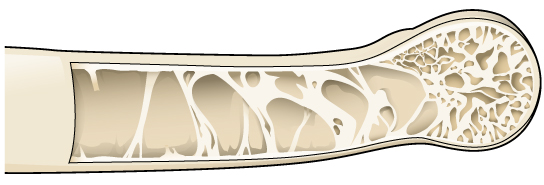


Figure 29.33図 29.33
Pneumatic bone. Many birds have hollow, pneumatic bones, which make flight easier.
含気骨。多くの鳥は中空の含気骨をもち、それが飛行を容易にしている。
Other modifications that reduce weight include the lack of a urinary bladder. Birds possess a cloaca, an external body cavity into which the intestinal, urinary, and genital orifices empty in reptiles, birds, and the monotreme mammals. The cloaca allows water to be reabsorbed from waste back into the bloodstream. Thus, uric acid is not eliminated as a liquid but is concentrated into urate salts, which are expelled along with fecal matter. In this way, water is not held in a urinary bladder, which would increase body weight. In addition, the females of most bird species only possess one functional (left) ovary rather than two, further reducing body mass.
英語のヒント
体重を減らすほかの変化には、膀胱をもたないことがある。鳥類は総排泄腔をもつ。これは、爬虫類、鳥類、単孔類の哺乳類で、腸、泌尿器、生殖器の開口部が合流する、外部に通じる腔である。総排泄腔では、老廃物から水を血流へ再吸収できる。そのため、尿酸は液体として排出されるのではなく、尿酸塩として濃縮され、糞とともに排出される。このように、水を膀胱内にためないことで、体重の増加を避けている。さらに、大部分の鳥類の雌は、二つではなく左側一つだけの機能する卵巣をもち、体重をさらに減らしている。
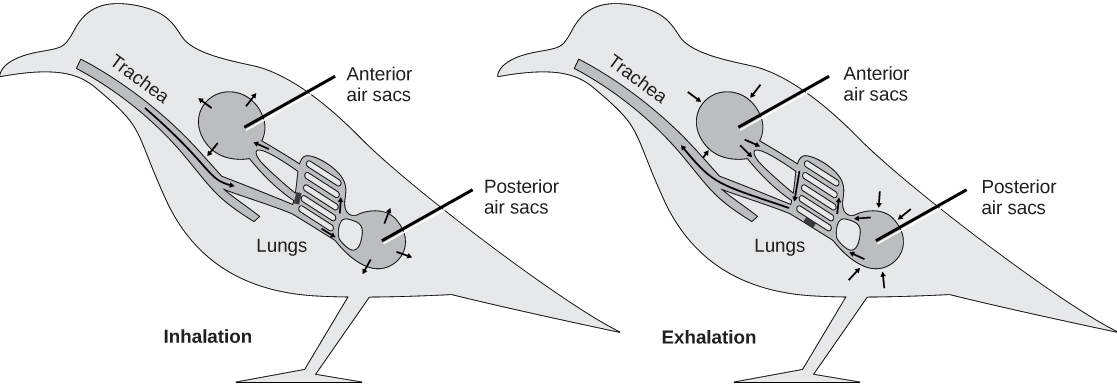
The respiratory system of birds is dramatically different from that of reptiles and mammals, and is well adapted for the high metabolic rate required for flight. To begin, the air spaces of pneumatic bone are sometimes connected to air sacs in the body cavity, which replace coelomic fluid and also lighten the body. These air sacs are also connected to the path of airflow through the bird's body, and function in respiration. Unlike mammalian lungs in which air flows in two directions, as it is breathed in and out, diluting the concentration of oxygen, airflow through bird lungs is unidirectional (Figure 29.34). Gas exchange occurs in "air capillaries" or microscopic air passages within the lungs. The arrangement of air capillaries in the lungs creates a cross-current exchange system with the pulmonary blood. In a cross-current exchange system, the flow of air is perpendicular to the flow of blood, producing a favorable diffusion gradient and creating an efficient means of gas exchange. This very effective oxygen-delivery system of birds supports their higher metabolic activity. In effect, ventilation is provided by the parabronchi (minimally expandible lungs) with thin air sacs located among the visceral organs and the skeleton. A syrinx (voice box) resides near the junction of the trachea and bronchi. The syrinx, however, is not homologous to the mammalian larynx, which resides within the upper part of the trachea.
英語のヒント
鳥類の呼吸器系は、爬虫類や哺乳類のものと大きく異なり、飛行に必要な高い代謝率によく適応している。まず、含気骨の空洞は、体腔内の気嚢とつながっていることがある。気嚢は体腔液に置き換わり、体を軽くする。これらの気嚢は、鳥の体内を通る空気の流路ともつながり、呼吸に働く。哺乳類の肺では、吸気と呼気で空気が二方向に流れるため、酸素濃度が薄まる。これとは異なり、鳥類の肺を通る空気の流れは一方向である(図29.34)。ガス交換は、肺内の「空気毛細管」、すなわち微細な空気通路で起こる。空気毛細管の配置により、肺の血液との間に交差流交換系ができる。交差流交換系では、空気の流れが血流に対して直角になり、有利な拡散勾配が生まれて、効率よくガス交換が行われる。この非常に効果的な酸素供給系が、鳥類の高い代謝活動を支えている。実際の換気は、内臓と骨格の間にある薄い気嚢を伴う傍気管支(ほとんど膨張しない肺)によって行われる。気管と気管支の分岐点付近には、鳴管(発声器官)がある。ただし、鳴管は、気管上部にある哺乳類の喉頭とは相同ではない。
OpenStax, Rice University; Biology 2e. (credit: modification of work by L. Shyamal) · CC BY 4.0 · Source出典

Figure 29.34図 29.34
Air flow in bird lungs. Avian respiration is an efficient system of gas exchange with air flowing unidirectionally. A full ventilation cycle takes two breathing cycles. During the first inhalation, air passes from the trachea into posterior air sacs. The first exhalation moves the air from the posterior air sacs to the lungs. The second inhalation moves the air in the lungs to the anterior air sacs, and the second exhalation moves the air in the anterior air sacs out of the body. Overall, each inhalation moves air into the air sacs, while each exhalation moves fresh air through the lungs and "used" air out of the body. The air sacs are connected to the hollow interior of bones. (credit: modification of work by L. Shyamal)
鳥の肺の空気の流れ。鳥類の呼吸は、一方向の空気の流れを伴う、効率的なガス交換系である。換気の一巡には、2回の呼吸周期が必要になる。最初の吸気で、空気は気管から後気嚢へ入る。最初の呼気で、後気嚢から肺へ移動する。2回目の吸気で、肺の空気が前気嚢へ移り、2回目の呼気で、前気嚢の空気が体外へ出る。全体として、各吸気は気嚢へ空気を送り、各呼気は新鮮な空気を肺に通し、「使用済み」の空気を体外へ送る。気嚢は、骨の中空の内部とつながっている。(クレジット:L. Shyamal の作品を改変)
Beyond the unique characteristics discussed above, birds are also unusual vertebrates because of a number of other features. First, they typically have an elongated (very “dinosaurian”) S-shaped neck, but a short tail or pygostyle, produced from the fusion of the caudal vertebrae. Unlike mammals, birds have only one occipital condyle, allowing them extensive movement of the head and neck. They also have a very thin epidermis without sweat glands, and a specialized uropygial gland or sebaceous “preening gland” found at the dorsal base of the tail. This gland is an essential to preening (a virtually continuous activity) in most birds because it produces an oily substance that birds use to help waterproof their feathers as well as keep them flexible for flight. A number of birds, such as pigeons, parrots, hawks, and owls, lack a uropygial gland but have specialized feathers that “disintegrate” into a powdery down, which serves the same purpose as the oils of the uropygial gland.
英語のヒント
上で述べた独特な特徴に加え、鳥類はほかにも多くの点で、脊椎動物として特異である。まず、通常は細長い(とても「恐竜らしい」)S字形の首をもつ一方、尾は短く、尾椎の融合によってできた尾端骨をもつ。哺乳類とは異なり、後頭顆が一つだけなので、頭と首を大きく動かすことができる。また、表皮は非常に薄く、汗腺はない。尾の付け根の背側には、特殊な尾脂腺、すなわち脂質を分泌する「羽繕い腺」がある。この腺は、多くの鳥がほとんど絶えず行う羽繕いに欠かせない。分泌する油性物質を、鳥は羽毛の防水を助けるため、また飛行に必要なしなやかさを保つために使う。ハト、オウム、タカ、フクロウなど多くの鳥には尾脂腺がないが、粉末状の綿羽へと「崩れる」特殊な羽毛があり、尾脂腺の油と同じ役割を果たす。
Like mammals, birds have 12 pairs of cranial nerves, and a very large cerebellum and optic lobes, but only a single bone in the middle ear called the columella (the stapes in mammals). They have a closed circulatory system with two atria and two ventricles, but rather than a “left-bending” aortic arch like that of mammals, they have a “right-bending” aortic arch, and nucleated red blood cells (unlike the enucleated red blood cells of mammals).
英語のヒント
鳥類は哺乳類と同様、12対の脳神経と、非常に大きな小脳および視葉をもつ。しかし、中耳には耳小柱という骨が一つしかない(哺乳類のアブミ骨にあたる)。循環系は閉鎖血管系で、二つの心房と二つの心室をもつが、大動脈弓は哺乳類のような「左曲がり」ではなく、「右曲がり」である。また、哺乳類の無核の赤血球とは異なり、核のある赤血球をもつ。
All these unique and highly derived characteristics make birds one of the most conspicuous and successful groups of vertebrate animals, filling a range of ecological niches, and ranging in size from the tiny bee hummingbird of Cuba (about 2 grams) to the ostrich (about 140,000 grams). Their large brains, keen senses, and the abilities of many species to imitate vocalization and use tools make them some of the most intelligent vertebrates on Earth.
英語のヒント
これらすべての独特で高度に派生した特徴によって、鳥類は、脊椎動物の中でも特に目立ち、成功した群の一つとなっている。さまざまな生態的地位を占め、大きさは、キューバの小さなマメハチドリ(約2 g)からダチョウ(約14万 g)まで及ぶ。大きな脳、鋭敏な感覚、そして多くの種がもつ、声をまねたり道具を使ったりする能力によって、鳥類は地球上でも特に知能の高い脊椎動物となっている。