第29章脊椎動物
A Dead End: Genus Paranthropus子孫を残さなかった系統:パラントロプス属
The australopiths had a relatively slender build and teeth that were suited for soft food. In the past several years, fossils of hominids of a different body type have been found and dated to approximately 2.5 million years ago. These hominids, of the genus Paranthropus, were muscular, stood 1.3 to 1.4 meters tall, and had large grinding teeth. Their molars showed heavy wear, suggesting that they had a coarse and fibrous vegetarian diet as opposed to the partially carnivorous diet of the australopiths. Paranthropus includes Paranthropus robustus of South Africa, and Paranthropus aethiopicus and Paranthropus boisei of East Africa. The hominids in this genus went extinct more than one million years ago and are not thought to be ancestral to modern humans, but rather members of an evolutionary branch on the hominin tree that left no descendants.
英語のヒント
アウストラロピスは比較的細い体つきで、歯は柔らかい食物に適していた。近年、それとは異なる体型のヒト科動物の化石が見つかり、約250万年前と年代測定された。パラントロプス属に属するこれらのヒト科動物は、筋肉質で、身長1.3〜1.4 m、大きなすりつぶし用の歯をもっていた。臼歯には強い摩耗があり、部分的に肉食をしていたアウストラロピスとは異なり、粗く繊維質の多い植物食だったことが示唆される。パラントロプスには、南アフリカの P. robustus と、東アフリカの P. aethiopicus および P. boisei が含まれる。この属のヒト科動物は100万年以上前に絶滅した。現生人類の祖先ではなく、ホミニンの系統樹において、子孫を残さなかった進化の枝の一員だったと考えられている。
Early Hominins: Genus Homo初期のホミニン:ヒト属
The human genus, Homo, first appeared between 2.5 and three million years ago. For many years, fossils of a species called H. habilis were the oldest examples in the genus Homo, but in 2010, a new species called Homo gautengensis was discovered and may be older. Compared to A. africanus, H. habilis had a number of features more similar to modern humans. H. habilis had a jaw that was less prognathic than the australopiths and a larger brain, at 600 to 750 cubic centimeters. However, H. habilis retained some features of older hominin species, such as long arms. The name H. habilis means “handy man,” which is a reference to the stone tools that have been found with its remains.
英語のヒント
ヒト属(Homo)は、250万〜300万年前に初めて現れた。長年、H. habilis という種の化石が、ヒト属の最古の例だった。しかし2010年、Homo gautengensis という新種が発見され、こちらのほうが古い可能性がある。A. africanus と比べ、H. habilis には現生人類により近い特徴がいくつもあった。顎の前方への突出はアウストラロピスより小さく、脳は600〜750 cm³と大きかった。しかし、長い腕など、古いホミニンの特徴も残していた。H. habilis という名は「器用な人」を意味し、遺骸とともに石器が見つかったことに由来する。
H. erectus appeared approximately 1.8 million years ago (Figure 29.49). It is believed to have originated in East Africa and was the first hominin species to migrate out of Africa. Fossils of H. erectus have been found in India, China, Java, and Europe, and were known in the past as “Java Man” or “Peking Man.” H. erectus had a number of features that were more similar to modern humans than those of H. habilis. H. erectus was larger in size than earlier hominins, reaching heights up to 1.85 meters and weighing up to 65 kilograms, which are sizes similar to those of modern humans. Its degree of sexual dimorphism was less than in earlier species, with males being 20 to 30 percent larger than females, which is close to the size difference seen in our own species. H. erectus had a larger brain than earlier species at 775 to 1,100 cubic centimeters, which compares to the 1,130 to 1,260 cubic centimeters seen in modern human brains. H. erectus also had a nose with downward-facing nostrils similar to modern humans, rather than the forward-facing nostrils found in other primates. Longer, downward-facing nostrils allow for the warming of cold air before it enters the lungs and may have been an adaptation to colder climates. Artifacts found with fossils of H. erectus suggest that it was the first hominin to use fire, hunt, and have a home base. H. erectus is generally thought to have lived until about 50,000 years ago.
英語のヒント
H. erectus は約180万年前に現れた(図29.49)。東アフリカで生じ、アフリカの外へ移動した最初のホミニンの種だったと考えられている。化石はインド、中国、ジャワ、ヨーロッパで見つかり、かつては「ジャワ原人」や「北京原人」と呼ばれていた。H. erectus には、H. habilis より現生人類に近い特徴がいくつもあった。それ以前のホミニンより大型で、身長は最大1.85 m、体重は最大65 kgに達し、現生人類と似た体格だった。性的二型の程度は以前の種より小さく、雄は雌より20〜30%大きかった。これは、私たちの種に見られる体格差に近い。脳容積は775〜1100 cm³で、それ以前の種より大きかった。現生人類の脳の1130〜1260 cm³と比較できる。また、ほかの霊長類に見られる前向きの鼻孔ではなく、現生人類に似た下向きの鼻孔をもつ鼻があった。長く下向きの鼻孔は、冷たい空気が肺へ入る前に温めることを可能にし、寒冷な気候への適応だったのかもしれない。H. erectus の化石とともに見つかった人工遺物は、この種が、火を使い、狩りをし、生活の拠点をもった最初のホミニンだったことを示唆する。H. erectus は一般に、約5万年前まで生存したと考えられている。
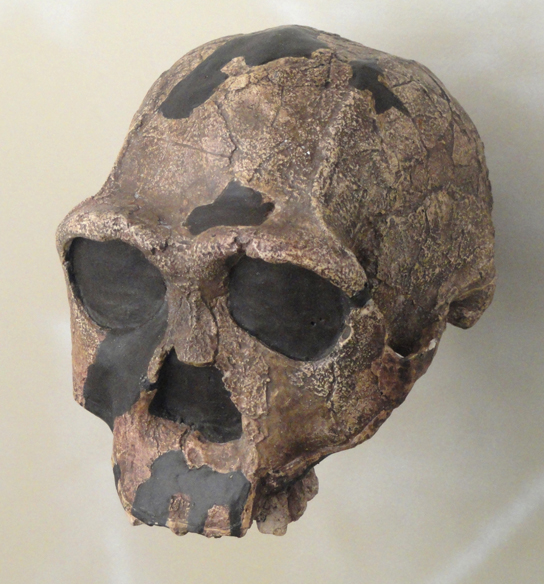
Figure 29.49図 29.49
Homo erectus. Homo erectus had a prominent brow and a nose that pointed downward rather than forward.
ホモ・エレクトス。ホモ・エレクトスには、目立つ眉の隆起と、前方ではなく下方を向く鼻があった。
Humans: Homo sapiensヒト:ホモ・サピエンス
A number of species, sometimes called archaic Homo sapiens, apparently evolved from H. erectus starting about 500,000 years ago. These species include Homo heidelbergensis, Homo rhodesiensis, and Homo neanderthalensis. These archaic H. sapiens had a brain size similar to that of modern humans, averaging 1,200 to 1,400 cubic centimeters. They differed from modern humans by having a thick skull, a prominent brow ridge, and a receding chin. Some of these species survived until 30,000 to 10,000 years ago, overlapping with modern humans (Figure 29.50).
英語のヒント
約50万年前から、古代型ホモ・サピエンスと呼ばれることもある複数の種が、H. erectus から進化したらしい。これらには、ホモ・ハイデルベルゲンシス、ホモ・ローデシエンシス、ホモ・ネアンデルターレンシスが含まれる。古代型 H. sapiens の脳容積は、平均1200〜1400 cm³で、現生人類と似ていた。しかし、厚い頭骨、目立つ眉弓、後退した顎先をもつ点で現生人類と異なった。一部の種は3万〜1万年前まで生き残り、現生人類と同時期に存在した(図29.50)。
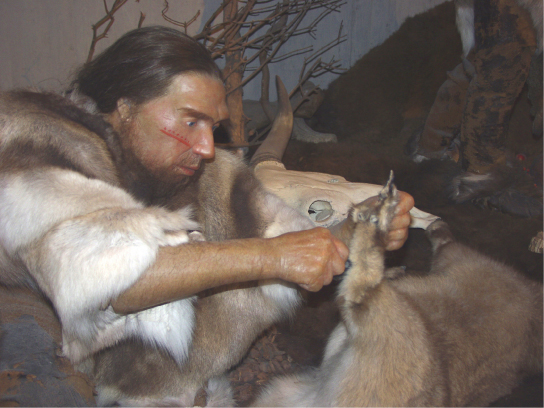


Figure 29.50図 29.50
Neanderthal. The Homo neanderthalensis used tools and may have worn clothing.
ネアンデルタール人。ホモ・ネアンデルターレンシスは道具を使い、衣服を身につけていた可能性がある。
There is considerable debate about the origins of anatomically modern humans or Homo sapiens sapiens. As discussed earlier, H. erectus migrated out of Africa and into Asia and Europe in the first major wave of migration about 1.5 million years ago. It is thought that modern humans arose in Africa from H. erectus and migrated out of Africa about 100,000 years ago in a second major migration wave. Then, modern humans replaced H. erectus species that had migrated into Asia and Europe in the first wave.
英語のヒント
解剖学的な現生人類、すなわちホモ・サピエンス・サピエンスの起源については、大きな議論がある。前に述べたように、H. erectus は約150万年前の最初の大きな移住の波で、アフリカからアジアとヨーロッパへ移動した。現生人類は、アフリカで H. erectus から生じ、約10万年前に2回目の大きな移住の波としてアフリカを出たと考えられている。その後、最初の波でアジアとヨーロッパへ移った H. erectus の種に、現生人類が取って代わった。
This evolutionary timeline is supported by molecular evidence. One approach to studying the origins of modern humans is to examine mitochondrial DNA (mtDNA) from populations around the world. Because a fetus develops from an egg containing its mother’s mitochondria (which have their own, non-nuclear DNA), mtDNA is passed entirely through the maternal line. Mutations in mtDNA can now be used to estimate the timeline of genetic divergence. The resulting evidence suggests that all modern humans have mtDNA inherited from a common ancestor that lived in Africa about 160,000 years ago. Another approach to the molecular understanding of human evolution is to examine the Y chromosome, which is passed from male parent to male offspring. This evidence suggests that all males today inherited a Y chromosome from a male that lived in Africa about 140,000 years ago.
英語のヒント
この進化の時間的な流れは、分子学的な証拠によって支持されている。現生人類の起源を調べる方法の一つは、世界各地の集団のミトコンドリアDNA(mtDNA)を調べることである。胎児は、母親のミトコンドリアを含む卵から発生するため、mtDNAは完全に母系を通じて伝わる。ミトコンドリアには、核のものとは別の独自のDNAがある。現在では、mtDNAの突然変異を使って、遺伝的な分岐の年代を推定できる。得られた証拠は、現生人類のすべてが、約16万年前にアフリカに生きた共通祖先から受け継いだmtDNAをもつことを示唆する。ヒトの進化を分子的に理解するもう一つの方法は、父親から息子へ伝わるY染色体を調べることである。この証拠は、現在のすべての男性が、約14万年前にアフリカに生きた一人の男性から、Y染色体を受け継いだことを示唆する。
The study of mitochondrial DNA led to the identification of another human species or subspecies, the Denisovans. DNA from teeth and finger bones suggested two things. First, the mitochondrial DNA was different from that of both modern humans and Neanderthals. Second, the genomic DNA suggested that the Denisovans shared a common ancestor with the Neanderthals. Genes from both Neanderthals and Denisovans have been identified in modern human populations, indicating that interbreeding among the three groups occurred over part of their range.
英語のヒント
ミトコンドリアDNAの研究によって、別のヒトの種または亜種、デニソワ人が確認された。歯と指の骨から得られたDNAは、二つのことを示唆した。第一に、ミトコンドリアDNAは、現生人類とネアンデルタール人のどちらのものとも異なっていた。第二に、ゲノムDNAは、デニソワ人がネアンデルタール人と共通祖先をもつことを示唆した。現生人類の集団には、ネアンデルタール人とデニソワ人の両方に由来する遺伝子が確認されている。これは、分布域の一部で、三つの群の間の交雑が起こったことを示している。