第29章脊椎動物
29.2 Fishes29.2 魚類
Learning Objectives学習目標
By the end of this section, you will be able to do the following:
この節を学び終えると、次のことができるようになる。
- Describe the difference between jawless and jawed fishes無顎の魚類と有顎の魚類の違いを説明する。
- Discuss the distinguishing features of sharks and rays compared to other modern fishesほかの現生魚類と比較して、サメとエイを特徴づける形質を論じる。
Modern fishes include an estimated 31,000 species, by far the most of all clades within the Vertebrata. Fishes were the earliest vertebrates, with jawless species being the earliest forms and jawed species evolving later. They are active feeders, rather than sessile, suspension feeders. The Agnatha (jawless fishes)—the hagfishes and lampreys—have a distinct cranium and complex sense organs including eyes, that distinguish them from the invertebrate chordates, the urochordates and cephalochordates.
英語のヒント
現生魚類には推定3万1,000種が含まれ、脊椎動物内のすべてのクレードの中で、群を抜いて多い。魚類は最初の脊椎動物であり、最初は顎のない種が現れ、その後に顎のある種が進化した。固着性の懸濁物食者ではなく、能動的に食物をとる。ヌタウナギとヤツメウナギからなる無顎類は、明瞭な頭蓋と、眼を含む複雑な感覚器官をもつ。この点で、無脊椎脊索動物である尾索動物や頭索動物と区別される。
Jawless Fishes: Superclass Agnatha顎のない魚:無顎上綱
Jawless fishes (Agnatha) are craniates representing an ancient vertebrate lineage that arose over 550 million years ago. In the past, hagfishes and lampreys were sometimes recognized as separate clades within the Agnatha, primarily because lampreys were regarded as true vertebrates, whereas hagfishes were not. However, recent molecular data, both from rRNA and mtDNA, as well as embryological data, provide strong support for the hypothesis that living agnathans—previously called cyclostomes—are monophyletic, and thus share recent common ancestry. The discussion below, for convenience, separates the modern “cyclostomes” into the class Myxini and class Petromyzontida. The defining features of the living jawless fishes are the lack of jaws and lack of paired lateral appendages (fins). They also lack internal ossification and scales, although these are not defining features of the clade.
英語のヒント
無顎魚(無顎類)は、5億5,000万年以上前に現れた古い脊椎動物の系統を代表する有頭動物である。過去には、ヌタウナギとヤツメウナギを、無顎類内の別々のクレードとすることもあった。主な理由は、ヤツメウナギは真の脊椎動物とみなされる一方、ヌタウナギはそうではなかったためである。しかし近年のrRNAとmtDNAの分子データ、そして発生学的データは、以前は円口類と呼ばれた現生無顎類が単系統であり、したがって近い共通祖先をもつという仮説を強く支持する。以下では便宜上、現生の「円口類」をヌタウナギ綱とヤツメウナギ綱に分ける。現生無顎魚を特徴づけるのは、顎がないことと、側方に対の付属肢(鰭)がないことである。内部の骨化と鱗も欠くが、これらはクレードを定義する特徴ではない。
Some of the earliest jawless fishes were the armored ostracoderms (which translates to “shell-skin”): vertebrate fishes encased in bony armor—unlike present-day jawless fishes, which lack bone in their scales. Some ostracoderms, also unlike living jawless fishes, may have had paired fins. We should note, however, that the “ostracoderms” represent an assemblage of heavily armored extinct jawless fishes that may not form a natural evolutionary group. Fossils of the genus Haikouichthys from China, with an age of about 530 million years, show many typical vertebrate characteristics including paired eyes, auditory capsules, and rudimentary vertebrae.
英語のヒント
最初期の無顎魚には、甲冑をまとった甲皮類(「殻の皮膚」の意)がいた。これは骨性の装甲に包まれた脊椎動物の魚であり、鱗に骨をもたない現生の無顎魚とは異なる。一部の甲皮類は、現生無顎魚と異なり、対鰭をもっていた可能性もある。ただし「甲皮類」は、重い装甲をもつ絶滅無顎魚の寄せ集めであり、自然な進化上の群を形成しない可能性がある。中国産の Haikouichthys 属の約5億3,000万年前の化石には、対の眼、耳嚢、初歩的な椎骨など、典型的な脊椎動物の特徴が数多く見られる。
Class Myxini: Hagfishesヌタウナギ綱:ヌタウナギ
The class Myxini includes at least 70 species of hagfishes—eel-like scavengers that live on the ocean floor and feed on living or dead invertebrates, fishes, and marine mammals (Figure 29.9). Although they are almost completely blind, sensory barbels around the mouth help them locate food by smell and touch. They feed using keratinized teeth on a movable cartilaginous plate in the mouth, which rasp pieces of flesh from their prey. These feeding structures allow the gills to be used exclusively for respiration, not for filter feeding as in the urochordates and cephalochordates. Hagfishes are entirely marine and are found in oceans around the world, except for the polar regions. Unique slime glands beneath the skin release a milky mucus (through surface pores) that upon contact with water becomes incredibly slippery, making the animal almost impossible to hold. This slippery mucus thus allows the hagfish to escape from the grip of predators. Hagfish can also twist their bodies into a knot, which provides additional leverage to feed. Sometimes hagfish enter the bodies of dead animals and eat carcasses from the inside out! Interestingly, they do not have a stomach!
英語のヒント
ヌタウナギ綱には少なくとも70種が含まれる。ウナギに似た腐肉食者で、海底に暮らし、生きた、または死んだ無脊椎動物、魚、海産哺乳類を食べる(図29.9)。ほとんど目が見えないが、口の周囲の感覚ひげが、匂いと触覚による食物の発見を助ける。口の中の可動性の軟骨板にある角質化した歯を使い、獲物の肉片を削り取る。この摂食構造により、尾索動物や頭索動物のようなろ過摂食に鰓を使う必要がなく、呼吸専用にできる。ヌタウナギはすべて海産で、極域を除く世界中の海に見られる。皮膚の下の独特な粘液腺は、表面の孔から乳白色の粘液を放出する。水に触れると信じられないほど滑りやすくなり、体をつかむのはほぼ不可能になる。この滑る粘液によって、捕食者のつかみから逃れられる。また、自分の体を結び目にすることもでき、摂食する際にさらに力をかけやすくなる。死んだ動物の体内に入り、内側から死骸を食べることさえある。興味深いことに、胃はもたない。
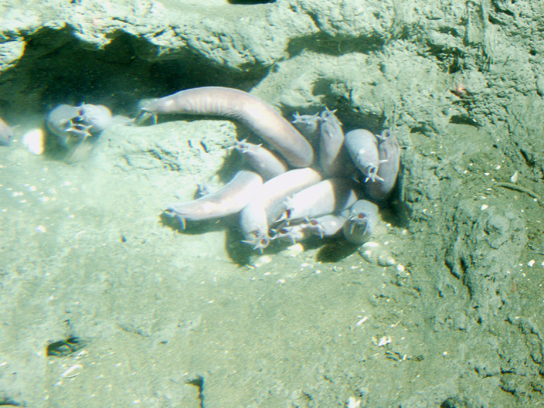
OpenStax, Rice University; Biology 2e. (credit: Linda Snook, NOAA/CBNMS) Embedded rights notice: This image is in the public domain and cannot be copyrighted. · CC BY 4.0 · Source出典
Figure 29.9図 29.9
Hagfish. Pacific hagfish are scavengers that live on the ocean floor. (credit: Linda Snook, NOAA/CBNMS)
ヌタウナギ。太平洋のヌタウナギは、海底に暮らす腐肉食者である。(提供:Linda Snook、NOAA/CBNMS)
Hagfishes have a cartilaginous skull, as well as a fibrous and cartilaginous skeleton, but the major supportive structure is the notochord that runs the length of the body. In hagfishes, the notochord is not replaced by the vertebral column, as it is in true vertebrates, and thus they may (morphologically) represent a sister group to the true vertebrates, making them the most basal clade among the skull-bearing chordates.
英語のヒント
ヌタウナギには軟骨性の頭骨と、線維性・軟骨性の骨格があるが、主要な支持構造は体の全長を走る脊索である。真の脊椎動物とは異なり、脊索は脊柱に置き換わらない。したがって形態上は、真の脊椎動物の姉妹群を表す可能性があり、頭骨をもつ脊索動物の中で最も基部のクレードとなる。
Class Petromyzontida: Lampreysヤツメウナギ綱:ヤツメウナギ
The class Petromyzontida includes approximately 40 species of lampreys, which are superficially similar to hagfishes in size and shape. However, lampreys possess extrinsic eye muscles, at least two semicircular canals, and a true cerebellum, as well as simple vertebral elements, called arcualia—cartilaginous structures arranged above the notochord. These features are also shared with the gnathostomes—vertebrates with jawed mouths and paired appendages (see below). Lampreys also have a dorsal tubular nerve cord with a well-differentiated brain, a small cerebellum, and 10 pairs of nerves. The classification of lampreys is still debated, but they clearly represent one of the oldest divergences of the vertebrate lineage. Lampreys lack paired appendages, as do the hagfishes, although they have one or two fleshy dorsal fins. As adults, lampreys are characterized by a rasping tongue within a toothed, funnel-like sucking mouth. Many species have a parasitic stage of their life cycle during which they are fish ectoparasites (some call them predators because they attack and eventually fall off) (Figure 29.10).
英語のヒント
ヤツメウナギ綱には約40種が含まれ、大きさと形は外見上ヌタウナギに似ている。しかし、外眼筋、少なくとも二つの半規管、真の小脳に加え、脊索の上に並ぶアルクアリアという軟骨性の単純な椎骨要素をもつ。これらは、顎と対の付属肢をもつ脊椎動物、すなわち顎口類(後述)にも共通する特徴である。ヤツメウナギには、よく分化した脳、小さな小脳、10対の神経を備えた背側管状神経索もある。分類にはまだ議論があるが、脊椎動物系統の最も古い分岐の一つを代表することは明らかである。ヌタウナギと同様、対の付属肢はないが、肉質の背鰭が一つまたは二つある。成体の特徴は、歯のある漏斗状の吸い付く口の中にある、削り取る舌である。多くの種の生活環には、魚の外部寄生虫となる寄生期がある。攻撃した後に離れるため、捕食者と呼ぶ人もいる(図29.10)。
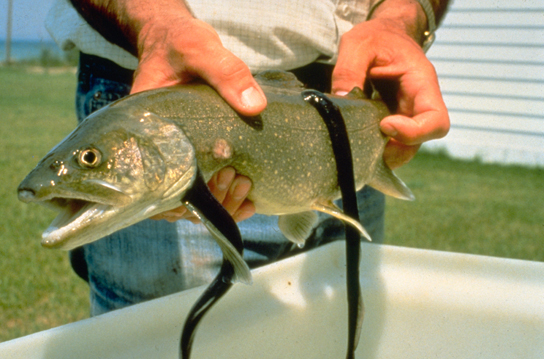


Figure 29.10図 29.10
Lamprey. These parasitic sea lampreys, Petromyzon marinus, attach by suction to their lake trout host, and use their rough tongues to rasp away flesh in order to feed on the trout’s blood. (credit: USGS)
ヤツメウナギ。この寄生性のウミヤツメ Petromyzon marinus は、宿主のレイクトラウトに吸い付き、粗い舌で肉を削り、血液を食べる。(提供:USGS)
Lampreys live primarily in coastal and freshwater environments, and have a worldwide distribution, except for the tropics and polar regions. Some species are marine, but all species spawn in fresh water. Interestingly, northern lampreys in the family Petromyzontidae, have the highest number of chromosomes (164 to 174) among the vertebrates. Eggs are fertilized externally, and the larvae (called ammocoetes) differ greatly from the adult form, closely resembling the adult cephalocordate amphioxus. After spending three to 15 years as suspension feeders in rivers and streams, they attain sexual maturity. After one to three years of feeding on fish as ectoparasites during life in open water, the adults swim upstream, reproduce, and die within days.
英語のヒント
ヤツメウナギは主に沿岸や淡水に暮らし、熱帯と極域を除いて世界中に分布する。海産の種もいるが、すべての種が淡水で産卵する。興味深いことに、ヤツメウナギ科の北方のヤツメウナギは、脊椎動物で最多の染色体数(164〜174本)をもつ。卵は体外受精し、アンモシーテスと呼ばれる幼生は成体と大きく異なり、頭索動物であるナメクジウオの成体によく似る。川や小川で懸濁物食者として3〜15年過ごした後、性成熟に達する。開けた水域で外部寄生虫として魚を食べる生活を1〜3年送ると、成体は川をさかのぼって繁殖し、数日以内に死ぬ。