第29章脊椎動物
Subphylum Vertebrata (Craniata)脊椎動物亜門(有頭動物)
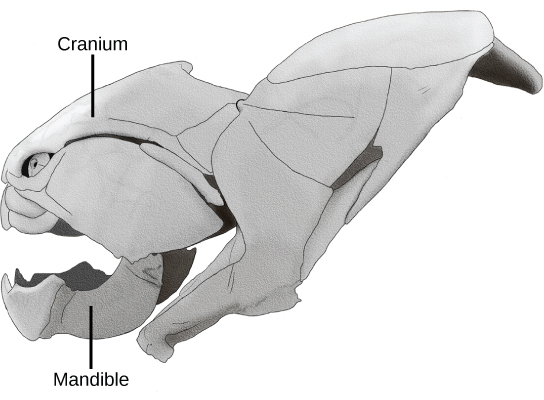
A cranium is a bony, cartilaginous, or fibrous structure surrounding the brain, jaw, and facial bones (Figure 29.7). Most bilaterally symmetrical animals have a head; of these, those that have a cranium comprise the clade Craniata/Vertebrata, which includes the primitively jawless Myxini (hagfishes), Petromyzontida (lampreys), and all of the organisms called “vertebrates.” (We should note that the Myxini have a cranium but lack a backbone.)
英語のヒント
頭蓋は、脳、顎、顔面骨を囲む、骨性、軟骨性、または線維性の構造である(図29.7)。左右相称の動物の多くは頭部をもつ。そのうち頭蓋をもつものが、有頭動物/脊椎動物というクレードを構成する。ここには、原始的に顎をもたないヌタウナギ類、ヤツメウナギ類、そして「脊椎動物」と呼ばれるすべての生物が含まれる。なお、ヌタウナギ類には頭蓋はあるが、背骨はない。
OpenStax, Rice University; Biology 2e. (credit: “Steveoc 86”/Wikimedia Commons) · CC BY 4.0 · Source出典

Figure 29.7図 29.7
A craniate skull. The subphylum Craniata (or Vertebrata), including this placoderm fish (Dunkleosteus sp.), are characterized by the presence of a cranium, mandible, and other facial bones. (credit: “Steveoc 86”/Wikimedia Commons)
有頭動物の頭骨。この板皮類の魚(Dunkleosteus 属)を含む有頭動物亜門(または脊椎動物亜門)は、頭蓋、下顎骨、その他の顔面骨の存在を特徴とする。(提供:「Steveoc 86」/Wikimedia Commons)
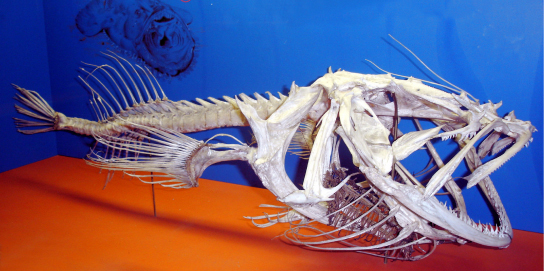
Members of the phylum Craniata/Vertebrata display the five characteristic features of the chordates; however, members of this group also share derived characteristics that distinguish them from invertebrate chordates. Vertebrates are named for the vertebral column, composed of vertebrae—a series of separate, irregularly shaped bones joined together to form a backbone (Figure 29.8). Initially, the vertebrae form in segments around the embryonic notochord, but eventually replace it in adults. In most derived vertebrates, the notochord becomes the nucleus pulposus of the intervertebral discs that cushion and support adjacent vertebrae.
英語のヒント
有頭動物/脊椎動物は、脊索動物の五つの特徴を示す。それに加え、無脊椎の脊索動物と区別する派生的な特徴も共有する。脊椎動物の名は脊柱に由来する。脊柱は、一つひとつ分かれた不規則な形の骨である椎骨が連結し、背骨を形成したものである(図29.8)。椎骨は最初、胚の脊索の周りに分節して形成され、最終的に成体では脊索に取って代わる。最も派生的な脊椎動物では、脊索は椎間板の髄核となり、椎間板が隣接する椎骨の衝撃を和らげ、支える。
OpenStax, Rice University; Biology 2e. (credit: Ernest V. More; taken at Smithsonian Museum of Natural History, Washington, D.C.) · CC BY 4.0 · Source出典

Figure 29.8図 29.8
A vertebrate skeleton. Vertebrata are characterized by the presence of a backbone, such as the one that runs through the middle of this fish. All vertebrates are in the Craniata clade and have a cranium. (credit: Ernest V. More; taken at Smithsonian Museum of Natural History, Washington, D.C.)
脊椎動物の骨格。脊椎動物は、この魚の中央を走るもののような背骨をもつことが特徴である。すべての脊椎動物は有頭動物クレードに属し、頭蓋をもつ。(提供:Ernest V. More。ワシントンD.C.のスミソニアン国立自然史博物館で撮影)
The relationship of the vertebrates to the invertebrate chordates has been a matter of contention, but although these cladistic relationships are still being examined, it appears that the Craniata/Vertebrata are a monophyletic group that shares the five basic chordate characteristics with the other two subphyla, Urochordata and Cephalochordata. Traditional phylogenies place the cephalochordates as a sister clade to the vertebrates, a view that has been supported by most current molecular analyses. This hypothesis is further supported by the discovery of a fossil in China from the genus Haikouella. This organism seems to be an intermediate form between cephalochordates and vertebrates. The Haikouella fossils are about 530 million years old and appear similar to modern lancelets. These organisms had a brain and eyes, as do vertebrates, but lack the skull found in craniates. Chen, J. Y., Huang, D. Y., and Li, C. W., “An early Cambrian craniate-like chordate,” Nature 402 (1999): 518–522, doi:10.1038/990080. This evidence suggests that vertebrates arose during the Cambrian explosion.
英語のヒント
脊椎動物と無脊椎の脊索動物との関係は、議論の対象となってきた。分岐関係の検討は続いているが、有頭動物/脊椎動物は単系統群であり、尾索動物・頭索動物というほかの二亜門と、脊索動物の五つの基本特徴を共有すると考えられる。伝統的な系統樹は、頭索動物を脊椎動物の姉妹クレードに置き、この見方は現在の分子解析の多くに支持されている。この仮説は、中国で発見された Haikouella 属の化石によっても裏付けられる。この生物は、頭索動物と脊椎動物の中間型に見える。化石は約5億3,000万年前のもので、現生のナメクジウオに似ている。脊椎動物と同じく脳と眼をもつが、有頭動物に見られる頭骨を欠く。Chen, J. Y.、Huang, D. Y.、Li, C. W., “An early Cambrian craniate-like chordate,” Nature 402(1999):518–522、doi:10.1038/990080。この証拠は、脊椎動物がカンブリア爆発の時期に現れたことを示唆する。
Vertebrates are the largest group of chordates, with more than 62,000 living species, which are grouped based on anatomical and physiological traits. More than one classification and naming scheme is used for these animals. Here we will consider the traditional groups Agnatha, Chondrichthyes, Osteichthyes, Amphibia, Reptilia, Aves, and Mammalia, which constitute classes in the subphylum Vertebrata/Craniata. Virtually all modern cladists classify birds within Reptilia, which correctly reflects their evolutionary heritage. Thus, we now have the nonavian reptiles and the avian reptiles in our reptilian classification. We consider them separately only for convenience. Further, we will consider hagfishes and lampreys together as jawless fishes, the Agnatha, although emerging classification schemes separate them into chordate jawless fishes (the hagfishes) and vertebrate jawless fishes (the lampreys).
英語のヒント
脊椎動物は脊索動物の最大の群で、現生種は6万2,000種を超え、解剖学的・生理学的特徴に基づいて分類される。分類や命名の方式は一つではない。ここでは、脊椎動物/有頭動物亜門の綱を構成する伝統的な群、無顎類、軟骨魚類、硬骨魚類、両生類、爬虫類、鳥類、哺乳類を扱う。現代の分岐分類学者は、ほぼ全員が鳥類を爬虫類内に分類する。これは進化的な由来を正しく反映している。したがって現在、爬虫類の分類には非鳥類型の爬虫類と鳥類型の爬虫類があり、ここでは便宜上だけ別々に扱う。さらに、ヌタウナギとヤツメウナギを、顎のない魚である無顎類としてまとめて扱う。ただし、新たな分類方式では、両者は脊索動物の無顎魚(ヌタウナギ)と、脊椎動物の無顎魚(ヤツメウナギ)に分けられる。
Animals that possess jaws are known as gnathostomes, which means “jawed mouth.” Gnathostomes include fishes and tetrapods. Tetrapod literally means “four-footed,” which refers to the phylogenetic history of various land vertebrates, even though in some of the tetrapods, the limbs may have been modified for purposes other than walking. Tetrapods include amphibians, reptiles, birds, and mammals, and technically could also refer to the extinct fishlike groups that gave rise to the tetrapods. Tetrapods can be further divided into two groups: amphibians and amniotes. Amniotes are animals whose eggs contain four extraembryonic membranes (yolk sac, amnion, chorion, and allantois) that provide nutrition and a water-retaining environment for their embryos. Amniotes are adapted for terrestrial living, and include mammals, reptiles, and birds.
英語のヒント
顎をもつ動物は、「顎のある口」を意味する顎口類と呼ばれ、魚類と四足類を含む。四足類という語は文字どおり「四本の足」を意味し、さまざまな陸上脊椎動物の系統史を指す。一部の四足類では、四肢が歩行以外の目的に改変されていても、この名で呼ばれる。四足類には両生類、爬虫類、鳥類、哺乳類が含まれ、厳密には四足類を生み出した絶滅した魚状の群を指すこともできる。さらに両生類と羊膜類の二群に分けられる。羊膜類の卵には、卵黄嚢、羊膜、漿膜、尿膜という四つの胚外膜がある。これらは胚に栄養を与え、水を保持する環境を提供する。羊膜類は陸上生活に適応しており、哺乳類、爬虫類、鳥類を含む。
Section Summary節のまとめ
The five characteristic features of chordates present during some time of their life cycles are a notochord, a dorsal hollow tubular nerve cord, pharyngeal slits, endostyle/thyroid gland, and a post-anal tail. Chordata contains two clades of invertebrates: Urochordata (tunicates) and Cephalochordata (lancelets), together with the vertebrates in the Vertebrata/Craniata. Lancelets are suspension feeders that feed on phytoplankton and other microorganisms. Most tunicates live on the ocean floor and are suspension feeders. Which of the two invertebrate chordate clades is more closely related to the vertebrates continues to be debated. Vertebrata is named for the vertebral column, which is a feature of almost all members of this clade. The name Craniata (organisms with a cranium) is considered to be synonymous with Vertebrata.
脊索動物が生活環のどこかの時期にもつ五つの特徴は、脊索、背側の中空管状神経索、咽頭裂、内柱または甲状腺、肛門後方の尾である。脊索動物には、脊椎動物/有頭動物に加え、無脊椎の二つのクレード、尾索動物(ホヤ類)と頭索動物(ナメクジウオ)が含まれる。ナメクジウオは植物プランクトンなどの微生物を食べる懸濁物食者である。多くのホヤ類も海底に暮らす懸濁物食者である。二つの無脊椎脊索動物クレードのどちらが脊椎動物により近縁かは、議論が続いている。脊椎動物という名は、ほぼすべての構成員がもつ脊柱に由来する。有頭動物、すなわち頭蓋をもつ生物という名は、脊椎動物と同義とみなされる。