第29章脊椎動物
Gnathostomes: Jawed Fishes顎口類:顎のある魚
Gnathostomes, or “jaw-mouths,” are vertebrates that possess true jaws—a milestone in the evolution of the vertebrates. In fact, one of the most significant developments in early vertebrate evolution was the development of the jaw: a hinged structure attached to the cranium that allows an animal to grasp and tear its food. Jaws were probably derived from the first pair of gill arches supporting the gills of jawless fishes.
英語のヒント
顎口類、すなわち「顎のある口」をもつ動物は、真の顎を備えた脊椎動物であり、顎の獲得は脊椎動物進化の重要な節目である。実際、初期脊椎動物の進化で最も重要な発達の一つは、頭蓋に関節でつながり、食物をつかんで引き裂ける構造である顎の発達だった。顎はおそらく、無顎魚の鰓を支える第一の一対の鰓弓に由来する。
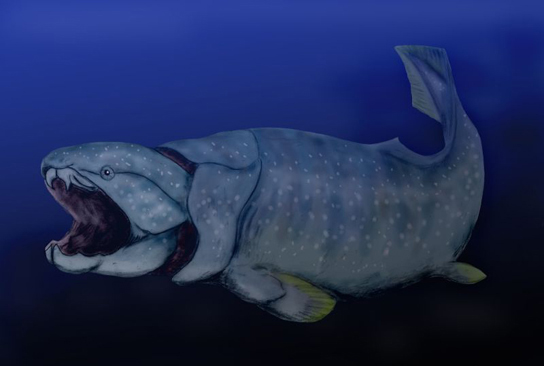
Early gnathostomes also possessed two sets of paired fins, allowing the fishes to maneuver accurately. Pectoral fins are typically located on the anterior body, and pelvic fins on the posterior. Evolution of the jaw and paired fins permitted gnathostomes to expand their food options from the scavenging and suspension feeding of jawless fishes to active predation. The ability of gnathostomes to exploit new nutrient sources probably contributed to their replacing most jawless fishes during the Devonian period. Two early groups of gnathostomes were the acanthodians and placoderms (Figure 29.11), which arose in the late Silurian period and are now extinct. Most modern fishes are gnathostomes that belong to the clades Chondrichthyes and Osteichthyes (which include the class Actinoptertygii and class Sarcopterygii).
英語のヒント
初期の顎口類は二組の対鰭ももち、正確に進行方向を変えられた。胸鰭は通常、体の前方に、腹鰭は後方にある。顎と対鰭の進化によって、無顎魚の腐肉食や懸濁物摂食から、能動的な捕食へと食物の選択肢が広がった。新しい栄養源を利用する能力は、デボン紀に顎口類が大部分の無顎魚に取って代わることに、おそらく寄与した。初期顎口類の二つの群は、シルル紀後期に現れ、現在は絶滅した棘魚類と板皮類である(図29.11)。現生魚類の多くは、軟骨魚類または硬骨魚類のクレードに属する顎口類である。硬骨魚類には条鰭綱と肉鰭綱が含まれる。
© Nobu Tamura; Dunkleosteus NT. OpenStax, Biology 2e adaptation. · CC BY-SA 3.0 · Source出典
Figure 29.11図 29.11
A placoderm. Dunkleosteus was an enormous placoderm from the Devonian period, 380 to 360 million years ago. It measured up to 10 meters in length and weighed up to 3.6 tons. Its head and neck were armored with heavy bony plates. Although Dunkleosteus had no true teeth, the edge of the jaw was armed with sharp bony blades. (credit: Nobu Tamura)
板皮類。Dunkleosteus は、3億8,000万〜3億6,000万年前のデボン紀に生息した巨大な板皮類である。全長は最大10 m、体重は最大3.6トンに達した。頭と首は重い骨板で覆われていた。真の歯はなかったが、顎の縁に鋭い骨の刃を備えていた。(提供:Nobu Tamura)
Class Chondrichthyes: Cartilaginous Fishes軟骨魚綱:軟骨の魚
The class Chondrichthyes (about 1,000 species) is a morphologically diverse clade, consisting of subclass Elasmobranchii (sharks [Figure 29.12], rays, and skates, together with the obscure and critically endangered sawfishes), and a few dozen species of fishes called chimaeras, or “ghost sharks” in the subclass Holocephali. Chondrichthyes are jawed fishes that possess paired fins and a skeleton made of cartilage. This clade arose approximately 370 million years ago in the early or middle Devonian. They are thought to be descended from the placoderms, which had endoskeletons made of bone; thus, the lighter cartilaginous skeleton of Chondrichthyes is a secondarily derived evolutionary development. Parts of shark skeleton are strengthened by granules of calcium carbonate, but this is not the same as bone.
英語のヒント
軟骨魚綱(約1,000種)は形態的に多様なクレードである。板鰓亜綱には、サメ(図29.12)、エイ、ガンギエイに加え、あまり知られておらず深刻な絶滅の危機にあるノコギリエイが含まれる。また、全頭亜綱には、ギンザメ、または「ゴーストシャーク」と呼ばれる魚が数十種含まれる。軟骨魚類は、対鰭と軟骨製の骨格をもつ有顎魚である。このクレードは約3億7,000万年前、デボン紀前期または中期に現れた。骨性の内骨格をもっていた板皮類から進化したと考えられるため、より軽い軟骨性骨格は、二次的に派生した進化的特徴である。サメの骨格の一部は炭酸カルシウムの粒で補強されるが、これは骨と同じではない。
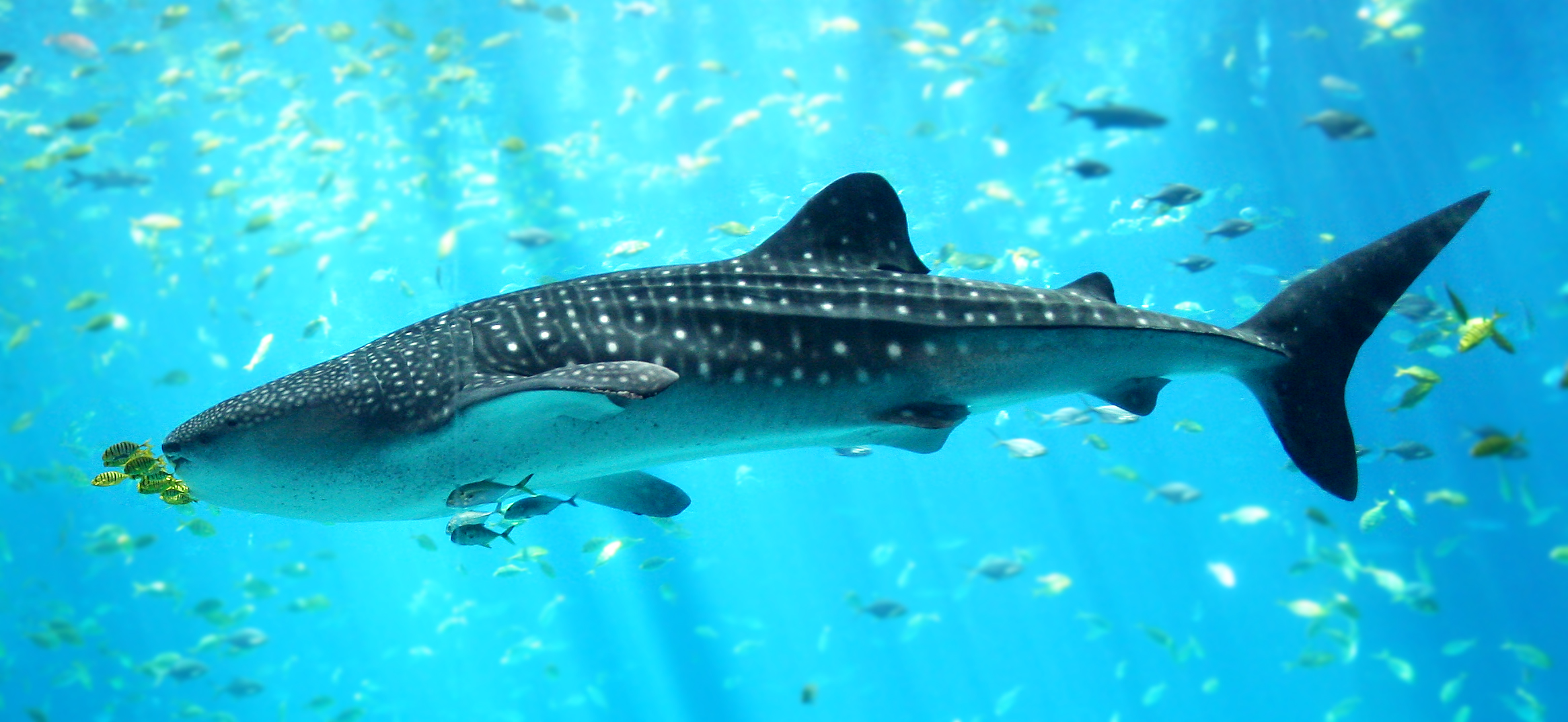
Most cartilaginous fishes live in marine habitats, with a few species living in fresh water for a part or all of their lives. Most sharks are carnivores that feed on live prey, either swallowing it whole or using their jaws and teeth to tear it into smaller pieces. Sharks have abrasive skin covered with tooth-like scales called placoid scales. Shark teeth probably evolved from rows of these scales lining the mouth. A few species of sharks and rays, like the enormous whale shark (Figure 29.13), are suspension feeders that feed on plankton. The sawfishes have an extended rostrum that looks like a double-edged saw. The rostrum is covered with electrosensitive pores that allow the sawfish to detect slight movements of prey hiding in the muddy sea floor. The teeth in the rostrum are actually modified tooth-like structures called denticles, similar to scales.
英語のヒント
軟骨魚類の大部分は海に暮らすが、一生の一部または全部を淡水で過ごす種も少数いる。サメの多くは生きた獲物を食べる肉食者で、丸飲みするか、顎と歯で小さく引き裂く。皮膚は楯鱗という歯状の鱗に覆われ、ざらざらしている。サメの歯は、おそらく口の内側に並ぶこうした鱗の列から進化した。巨大なジンベエザメ(図29.13)など、少数のサメやエイは、プランクトンを食べる懸濁物食者である。ノコギリエイは、両刃ののこぎりに似た長い吻をもつ。吻は電気に敏感な孔で覆われ、泥の海底に隠れた獲物のわずかな動きを検出できる。吻の歯は実際には、鱗に似た小歯という歯状構造が変化したものである。
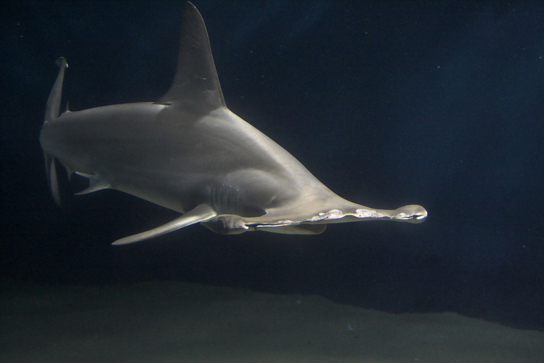
Figure 29.12図 29.12
Shark. Hammerhead sharks tend to school during the day and hunt prey at night. (credit: Masashi Sugawara)
サメ。シュモクザメは日中に群れをつくり、夜に獲物を狩る傾向がある。(提供:Masashi Sugawara)
Sharks have well-developed sense organs that aid them in locating prey, including a keen sense of smell and the ability to detect electromagnetic fields. Electroreceptors called ampullae of Lorenzini allow sharks to detect the electromagnetic fields that are produced by all living things, including their prey. (Electroreception has only been observed in aquatic or amphibious animals and sharks have perhaps the most sensitive electroreceptors of any animal.) Sharks, together with most fishes and aquatic and larval amphibians, also have a row of sensory structures called the lateral line, which is used to detect movement and vibration in the surrounding water, and is often considered to be functionally similar to the sense of “hearing” in terrestrial vertebrates. The lateral line is visible as a darker stripe that runs along the length of a fish’s body. Sharks have no mechanism for maintaining neutral buoyancy and must swim continuously to stay suspended in the water. Some must also swim in order to ventilate their gills but others have muscular pumps in their mouths to keep water flowing over the gills.
英語のヒント
サメは、鋭い嗅覚や電磁場を検出する能力など、獲物の発見を助ける発達した感覚器官をもつ。ロレンチーニ器官という電気受容器によって、獲物を含むすべての生物が生み出す電磁場を検出できる。電気受容は水生または水陸両生の動物でしか観察されておらず、サメの電気受容器は、おそらく全動物の中で最も敏感である。サメは、多くの魚や、水生の両生類・両生類の幼生とともに、側線という感覚構造の列ももつ。周囲の水の動きや振動を検出するために使われ、機能的には陸上脊椎動物の「聴覚」に似ているとされることが多い。側線は、体の長さに沿って走る暗い縞として見える。サメには中性浮力を維持する仕組みがなく、水中に浮いたままでいるには泳ぎ続ける必要がある。一部は鰓を換水するためにも泳ぐ必要があるが、口の筋肉のポンプで鰓に水を流し続けるものもいる。
Zac Wolf; Whale shark Georgia aquarium, cropped by Stefan; adapted by OpenStax. OpenStax, Biology 2e adaptation. · CC BY-SA 2.5 · Source出典
Figure 29.13図 29.13
Whale shark in the Georgia Aquarium. Whale sharks are filter-feeders and can grow to be over 10 meters long. Whale sharks, like most other sharks, are ovoviviparous. (credit: modified from Zac Wolf [Own work] [CC BY-SA 2.5 (http://creativecommons.org/licenses/by-sa/2.5)], via Wikimedia Commons)
ジョージア水族館のジンベエザメ。ジンベエザメはろ過摂食者で、全長10 mを超えることがある。ほかの大部分のサメと同様に卵胎生である。(提供:Zac Wolf自身の作品[CC BY-SA 2.5]を改変、Wikimedia Commons経由)
Sharks reproduce sexually, and eggs are fertilized internally. Most species are ovoviviparous: The fertilized egg is retained in the oviduct of the mother’s body and the embryo is nourished by the egg yolk. The eggs hatch in the uterus, and young are born alive and fully functional. Some species of sharks are oviparous: They lay eggs that hatch outside of the mother’s body. Embryos are protected by a shark egg case or “mermaid’s purse” (Figure 29.14) that has the consistency of leather. The shark egg case has tentacles that snag in seaweed and give the newborn shark cover. A few species of sharks, e.g., tiger sharks and hammerheads, are viviparous: the yolk sac that initially contains the egg yolk and transfers its nutrients to the growing embryo becomes attached to the oviduct of the female, and nutrients are transferred directly from the mother to the growing embryo. In both viviparous and ovoviviparous sharks, gas exchange uses this yolk sac transport.
英語のヒント
サメは有性生殖を行い、卵は体内で受精する。多くの種は卵胎生である。受精卵は母体の輸卵管に保持され、胚は卵黄から栄養を得る。卵は子宮内で孵化し、子は生きた、十分に機能する状態で生まれる。一部のサメは卵生であり、母体の外で孵化する卵を産む。胚は、革のような質感の卵殻、別名「人魚の財布」で保護される(図29.14)。卵殻には海藻に引っ掛かる触手状の部分があり、生まれたばかりのサメに隠れ場所を与える。イタチザメやシュモクザメなど、少数の種は胎生である。最初は卵黄を含み、その栄養を成長中の胚へ送っていた卵黄嚢が、雌の輸卵管に付着し、母体から胚へ直接栄養が渡される。胎生と卵胎生のどちらのサメでも、ガス交換には、この卵黄嚢を介した輸送が使われる。
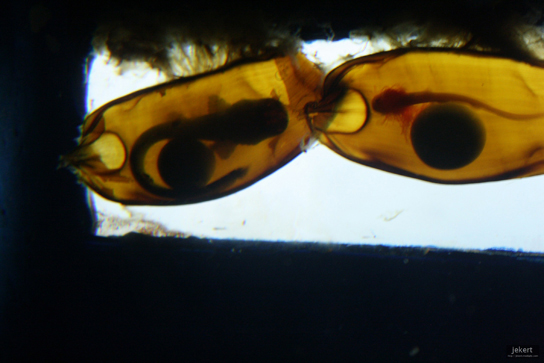


Figure 29.14図 29.14
Shark egg cases. Shark embryos are clearly visible through these transparent egg cases. The round structure is the yolk that nourishes the growing embryo. (credit: Jek Bacarisas)
サメの卵殻。透明な卵殻を通して、サメの胚がはっきり見える。丸い構造は、成長中の胚に栄養を与える卵黄である。(提供:Jek Bacarisas)
In general, the Chondrichthyes have a fusiform or dorsoventrally flattened body, a heterocercal caudal fin or tail (unequally sized fin lobes, with the tail vertebrae extending into the larger upper lobe) paired pectoral and pelvic fins (in males these may be modified as claspers), exposed gill slits (elasmobranch), and an intestine with a spiral valve that condenses the length of the intestine. They also have three pairs of semicircular canals, and excellent senses of smell, vibration, vision, and electroreception. A very large lobed liver produces squalene oil (a lightweight biochemical precursor to steroids) that serves to aid in buoyancy (because with a specific gravity of 0.855, it is lighter than that of water).
英語のヒント
一般に軟骨魚類は、紡錘形または背腹方向に平たい体、異尾型の尾鰭、対の胸鰭と腹鰭、露出した鰓裂(板鰓類)、腸を短くまとめるらせん弁を備える。異尾型では尾鰭の上下の葉の大きさが異なり、尾部の椎骨は大きい上葉へ伸びる。雄の腹鰭は交接器へ変化することがある。また、三対の半規管と、優れた嗅覚、振動感覚、視覚、電気受容をもつ。非常に大きく分葉した肝臓は、スクアレン油をつくる。これは軽いステロイドの生化学的前駆体で、比重0.855と水より軽いため、浮力を助ける。
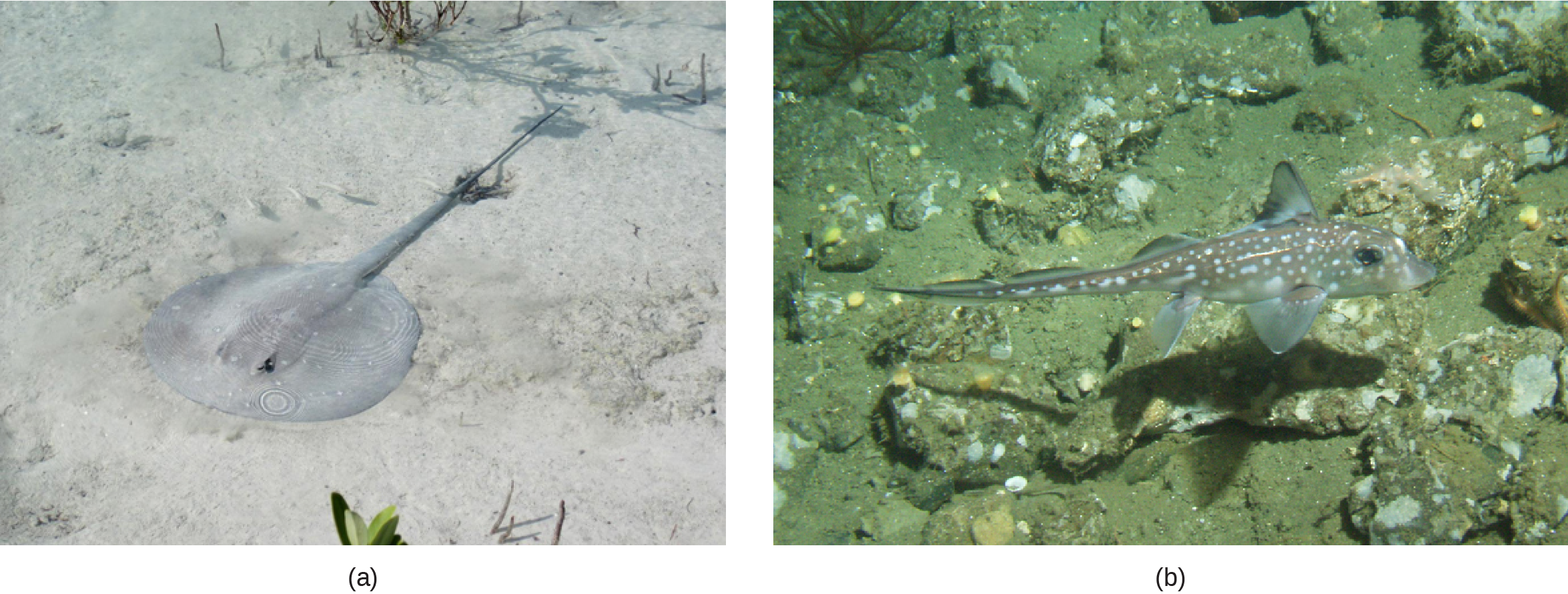
Rays and skates comprise more than 500 species. They are closely related to sharks but can be distinguished from sharks by their flattened bodies, pectoral fins that are enlarged and fused to the head, and gill slits on their ventral surface (Figure 29.15). Like sharks, rays and skates have a cartilaginous skeleton. Most species are marine and live on the sea floor, with nearly a worldwide distribution.
英語のヒント
エイとガンギエイは500種以上からなる。サメに近縁だが、平たい体、拡大して頭部と融合した胸鰭、腹面の鰓裂によって区別できる(図29.15)。サメと同じく軟骨性の骨格をもつ。多くの種は海産で海底に暮らし、ほぼ世界中に分布する。
Unlike the stereotypical sharks and rays, the Holocephali (chimaeras or ratfish) have a diphycercal tail (equally sized fin lobes, with the tail vertebrae located between them), lack scales (lost secondarily in evolution), and have teeth modified as grinding plates that are used to feed on mollusks and other invertebrates (Figure 29.15b). Unlike sharks with elasmobranch or naked gills, chimaeras have four pairs of gills covered by an operculum. Many species have a pearly iridescence and are extremely pretty.
英語のヒント
典型的なサメやエイとは異なり、全頭類(ギンザメ類)は両尾型の尾をもつ。これは、上下の鰭葉が同じ大きさで、尾部の椎骨がその間にある尾である。鱗は進化の過程で二次的に失われ、歯は、軟体動物などの無脊椎動物を食べるための、すりつぶす板へと変化している(図29.15b)。鰓が露出する板鰓型のサメとは異なり、ギンザメ類は鰓蓋で覆われた四対の鰓をもつ。多くの種は真珠のような虹色の光沢をもち、非常に美しい。
OpenStax, Rice University; Biology 2e. (credit: a "Sailn1"/Flickr b: Linda Snook / MBNMS [Public domain], via Wikimedia Commons.) · CC BY 4.0 · Source出典

Figure 29.15図 29.15
Cartilaginous fish. (a) Stingray. This stingray blends into the sandy bottom of the ocean floor. A spotted ratfish (b) Hydrolagus colliei. (credit: a "Sailn1"/Flickr b: Linda Snook / MBNMS [Public domain], via Wikimedia Commons.)
軟骨魚類。(a)アカエイ。海底の砂に溶け込んでいる。(b)斑点のあるギンザメ Hydrolagus colliei。(a:「Sailn1」/Flickr。b:Linda Snook/MBNMS、パブリックドメイン、Wikimedia Commons経由)