第29章脊椎動物
Modern Amphibians現生の両生類
Amphibia comprises an estimated 6,770 extant species that inhabit tropical and temperate regions around the world. All living species are classified in the subclass Lissamphibia ("smooth-amphibian"), which is divided into three clades: Urodela (“tailed”), the salamanders; Anura (“tail-less”), the frogs; and Apoda (“legless ones”), the caecilians.
英語のヒント
両生類は推定6770種の現生種からなり、世界各地の熱帯域と温帯域に生息する。現生種はすべて、平滑両生亜綱(Lissamphibia、「滑らかな両生類」)に分類される。この亜綱は、有尾類(Urodela、「尾のあるもの」)であるサンショウウオ類、無尾類(Anura、「尾のないもの」)であるカエル類、無足類(Apoda、「脚のないもの」)であるアシナシイモリ類という三つの系統群に分かれる。
Urodela: Salamanders有尾類:サンショウウオ類
Salamanders are amphibians that belong to the order Urodela (or Caudata). These animals are probably the most similar to ancestral amphibians. Living salamanders (Figure 29.18) include approximately 620 species, some of which are aquatic, others terrestrial, and some that live on land only as adults. Most adult salamanders have a generalized tetrapod body plan with four limbs and a tail. The placement of their legs makes it difficult to lift their bodies off the ground and they move by bending their bodies from side to side, called lateral undulation, in a fish-like manner while “walking” their arms and legs fore-and-aft. It is thought that their gait is similar to that used by early tetrapods. The majority of salamanders are lungless, and respiration occurs through the skin or through external gills in aquatic species. Some terrestrial salamanders have primitive lungs; a few species have both gills and lungs. The giant Japanese salamander, the largest living amphibian, has additional folds in its skin that enlarge its respiratory surface.
英語のヒント
サンショウウオ類は、有尾目(Urodela、またはCaudata)に属する両生類である。これらは、おそらく祖先的な両生類に最もよく似た動物である。現生のサンショウウオ類(図29.18)には約620種が含まれ、水生の種、陸生の種、成体のときだけ陸上で暮らす種がある。大部分のサンショウウオの成体は、4本の肢と尾を備えた、一般的な四肢動物の体の基本構造をもつ。脚の位置のために体を地面から持ち上げにくく、腕と脚を前後に「歩かせ」ながら、魚のように体を左右に曲げて移動する。この動きを側方波動運動という。この歩き方は、初期の四肢動物のものと似ていると考えられている。サンショウウオ類の大部分は肺をもたず、皮膚を通して呼吸する。水生種では外鰓を通して呼吸するものもいる。一部の陸生サンショウウオは原始的な肺をもち、少数の種は鰓と肺の両方をもつ。現生最大の両生類である日本のオオサンショウウオでは、皮膚にさらにひだがあり、呼吸面の面積を広げている。
Most salamanders reproduce using an unusual process of internal fertilization of the eggs. Mating between salamanders typically involves an elaborate and often prolonged courtship. Such a courtship ends in the deposition of sperm by the males in a packet called a spermatophore, which is subsequently picked up by the female, thus ultimately fertilization is internal. All salamanders except one, the fire salamander, are oviparous. Aquatic salamanders lay their eggs in water, where they develop into legless larvae called efts. Terrestrial salamanders lay their eggs in damp nests, where the eggs are guarded by their mothers. These embryos go through the larval stage and complete metamorphosis before hatching into tiny adult forms. One aquatic salamander, the Mexican axolotl, never leaves the larval stage, becoming sexually mature without metamorphosis.
英語のヒント
大部分のサンショウウオ類は、卵を体内受精させる独特の過程によって繁殖する。サンショウウオの交尾には通常、複雑で、しばしば長時間に及ぶ求愛が伴う。求愛の最後に、雄は精包という包みに精子を入れて置く。その後、雌がこれを取り込むため、最終的に受精は体内で起こる。ファイアサラマンダーを除くすべてのサンショウウオ類は卵生である。水生のサンショウウオは水中に産卵し、卵はそこでエフトと呼ばれる脚のない幼生へと発生する。陸生のサンショウウオは湿った巣に産卵し、母親が卵を守る。その胚は、幼生期を経て変態を終えてから、小さな成体の姿で孵化する。水生のサンショウウオの一種であるメキシコサンショウウオ(アホロートル)は、幼生期を離れることなく、変態せずに性成熟する。
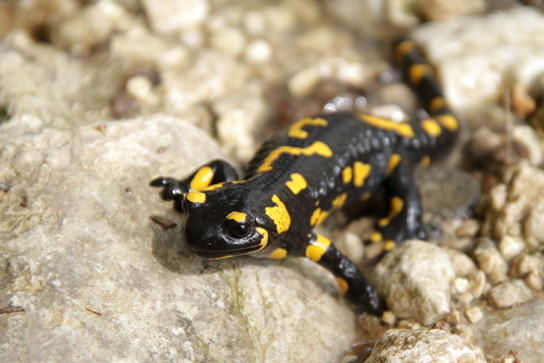
Figure 29.18図 29.18
Salamander. Most salamanders have legs and a tail, but respiration varies among species. (credit: Valentina Storti)
サンショウウオ。大部分のサンショウウオは脚と尾をもつが、呼吸の仕方は種によって異なる。(クレジット:Valentina Storti)
Anura: Frogs無尾類:カエル類
Frogs (Figure 29.19) are amphibians that belong to the order Anura or Salientia ("jumpers"). Anurans are among the most diverse groups of vertebrates, with approximately 5,965 species that occur on all of the continents except Antarctica. Anurans, ranging from the minute New Guinea frog at 7 mm to the huge goliath frog at 32 cm from tropical Africa, have a body plan that is more specialized for movement. Adult frogs use their hind limbs and their arrow-like endoskeleton to jump accurately to capture prey on land. Tree frogs have hands adapted for grasping branches as they climb. In tropical areas, “flying frogs” can glide from perch to perch on the extended webs of their feet. Frogs have a number of modifications that allow them to avoid predators, including skin that acts as camouflage. Many species of frogs and salamanders also release defensive chemicals that are poisonous to predators from glands in the skin. Frogs with more toxic skins have bright warning (aposematic) coloration.
英語のヒント
カエル類(図29.19)は、無尾目(Anura、またはSalientia「跳ぶもの」)に属する両生類である。無尾類は脊椎動物の中でも特に多様な群の一つで、約5965種が南極以外のすべての大陸に分布する。体長7 mmのニューギニアの小さなカエルから、熱帯アフリカの体長32 cmの巨大なゴライアスガエルまで、無尾類の体の基本構造は運動により特化している。成体のカエルは、後肢と矢のような内骨格を使って正確に跳び、陸上で獲物を捕らえる。樹上性のカエルは、木に登る際に枝をつかむのに適した手をもつ。熱帯域では、「トビガエル」が足の水かきを広げて、止まり場から別の止まり場へ滑空できる。カエルには、カモフラージュとして働く皮膚など、捕食者を避けるためのさまざまな適応がある。多くのカエルやサンショウウオの種は、皮膚の腺から、捕食者にとって有毒な防御用の化学物質も放出する。皮膚の毒性がより強いカエルは、鮮やかな警告色をもつ。
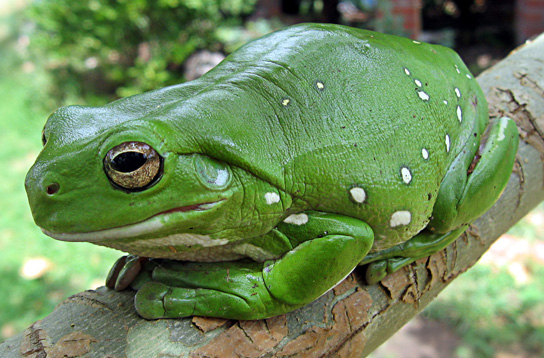
Figure 29.19図 29.19
Tree frog. The Australian green tree frog is a nocturnal predator that lives in the canopies of trees near a water source.
樹上性のカエル。オーストラリアのイエアメガエルは、水源の近くにある樹木の樹冠で暮らす夜行性の捕食者である。
Frog eggs are fertilized externally, and like other amphibians, frogs generally lay their eggs in moist environments. Although amphibian eggs are protected by a thick jelly layer, they would still dehydrate quickly in a dry environment. Frogs demonstrate a great diversity of parental behaviors, with some species laying many eggs and exhibiting little parental care, to species that carry eggs and tadpoles on their hind legs or embedded in their backs. The males of Darwin's frog carry tadpoles in their vocal sac. Many tree frogs lay their eggs off the ground in a folded leaf located over water so that the tadpoles can drop into the water as they hatch.
英語のヒント
カエルの卵は体外受精し、ほかの両生類と同様、カエルは一般に湿った環境に産卵する。両生類の卵は厚いゼリー状の層で保護されているが、それでも乾燥した環境ではすぐに水分を失ってしまう。カエルの子の世話の仕方はきわめて多様で、多数の卵を産んでほとんど世話をしない種から、卵やオタマジャクシを後肢につけたり、背中に埋め込んだりして運ぶ種まである。ダーウィンハナガエルの雄は、鳴嚢の中でオタマジャクシを育てる。多くの樹上性のカエルは、水上にある折りたたまれた葉の中に、地面から離して卵を産む。そのため、オタマジャクシは孵化すると水中へ落ちることができる。
The life cycle of most frogs, as other amphibians, consists of two distinct stages: the larval stage followed by metamorphosis to an adult stage. However, the eggs of frogs in the genus Eleutherodactylus develop directly into little froglets, guarded by a parent. The larval stage of a frog, the tadpole, is often a filter-feeding herbivore. Tadpoles usually have gills, a lateral line system, longfinned tails, and lack limbs. At the end of the tadpole stage, frogs undergo metamorphosis into the adult form (Figure 29.20). During this stage, the gills, tail, and lateral line system disappear, and four limbs develop. The jaws become larger and are suited for carnivorous feeding, and the digestive system transforms into the typical short gut of a predator. An eardrum and air-breathing lungs also develop. These changes during metamorphosis allow the larvae to move onto land in the adult stage.
英語のヒント
大部分のカエルの生活環は、ほかの両生類と同様、はっきり異なる二つの段階からなる。幼生期を経て、変態によって成体期へ移る。しかし、コヤスガエル属(Eleutherodactylus)の卵は、親に守られながら、直接小さなカエルへと発生する。カエルの幼生であるオタマジャクシは、多くの場合、濾過摂食をする草食動物である。オタマジャクシには通常、鰓、側線系、長い鰭のある尾があり、肢はない。オタマジャクシ期の終わりに、カエルは成体の姿へと変態する(図29.20)。この段階で、鰓、尾、側線系が消失し、4本の肢が発達する。顎は大きくなって肉食に適したものとなり、消化器系は捕食者に典型的な短い腸へと変化する。鼓膜と、空気呼吸をする肺も発達する。変態中に起こるこれらの変化によって、幼生は成体期に陸上へ移れるようになる。
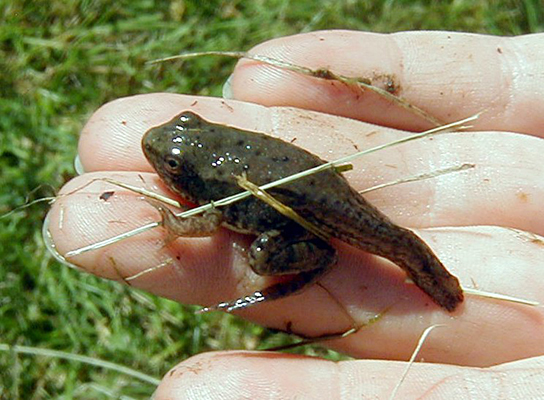


Figure 29.20図 29.20
Amphibian metamorphosis. A juvenile frog metamorphoses into a frog. Here, the frog has started to develop limbs, but its tadpole tail is still evident.
両生類の変態。若いカエルが変態してカエルになる。ここでは肢が発達し始めているが、オタマジャクシの尾がまだはっきり残っている。