第29章脊椎動物
Testudinesカメ目
The turtles, terrapins, and tortoises are members of the clade Testudines (“having a shell”) (Figure 29.31), and are characterized by a bony or cartilaginous shell. The shell in turtles is not just an epidermal covering, but is incorporated into the skeletal system. The dorsal shell is called the carapace and includes the backbone and ribs; the ventral shell is called the plastron. Both shells are covered with keratinous plates or scutes, and the two shells are held together by a bridge. In some turtles, the plastron is hinged to allow the head and legs to be withdrawn under the shell.
英語のヒント
ウミガメ、淡水性のカメ、リクガメは、カメ目(Testudines、「殻をもつもの」)という系統群に属し(図29.31)、骨性または軟骨性の甲羅を特徴とする。カメの甲羅は単なる表皮の覆いではなく、骨格系に組み込まれている。背側の甲羅は背甲と呼ばれ、脊柱と肋骨を含む。腹側の甲羅は腹甲と呼ばれる。両方の甲羅は角質の板、すなわち甲板で覆われ、甲橋によってつながっている。一部のカメでは腹甲に蝶番があり、頭と脚を甲羅の下へ引っ込められる。
The two living groups of turtles, Pleurodira and Cryptodira, have significant anatomical differences and are most easily recognized by how they retract their necks. The more common Cryptodira retract their neck in a vertical S-curve; they appear to simply pull their head backward when retracting. Less common Pleurodira ("side-neck") retract their neck with a horizontal curve, basically folding their neck to the side.
英語のヒント
現生のカメの二群、曲頸類と潜頸類には、解剖学上の重要な違いがある。最も見分けやすいのは、首の引っ込め方である。より一般的な潜頸類は、首を縦方向のS字形に曲げて引っ込めるため、頭をそのまま後方へ引いているように見える。より少ない曲頸類(「横向きの首」)は、首を水平方向に曲げ、基本的には横へ折りたたむ。
The earliest Testudines arose approximately 240 million years ago, partially overlapping with the evolution of crocodiles, lizards, and snakes. There are about 325 living species of turtles and tortoises. Like other reptiles, turtles are ectotherms. All turtles are oviparous, laying their eggs on land, although many species live in or near water. None exhibit parental care. Turtles range in size from the speckled padloper tortoise at 8 centimeters (3.1 inches) to the leatherback sea turtle at 200 centimeters (over 6 feet). The term “turtle” is sometimes used to describe only those species of Testudines that live in the sea, with the terms “tortoise” and “terrapin” used to refer to species that live on land and in fresh water, respectively.
英語のヒント
最初のカメ目は約2億4000万年前に現れ、その進化の時期は、ワニ、トカゲ、ヘビの進化と一部重なる。現生のカメとリクガメは約325種いる。ほかの爬虫類と同様、カメは外温動物である。すべてのカメは卵生で、多くの種は水中や水辺で暮らすが、卵は陸上に産む。子の世話をするものはいない。カメの大きさは、体長8 cm(3.1インチ)のシモフリヒラセリクガメから、200 cm(6フィート以上)のオサガメまでさまざまである。英語の turtle は、海にすむカメ目だけを指すために使われることもあり、その場合、陸上の種には tortoise、淡水の種には terrapin という語を使う。
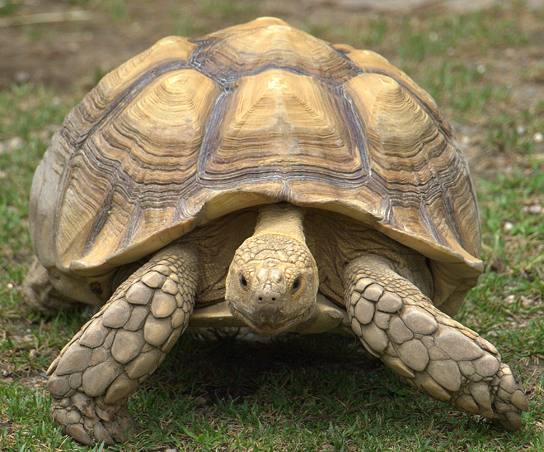

Figure 29.31図 29.31
A tortoise. The African spurred tortoise (Geochelone sulcata) lives at the southern edge of the Sahara Desert. It is the third largest tortoise in the world. (credit: Jim Bowen)
リクガメ。ケヅメリクガメ(Geochelone sulcata)は、サハラ砂漠の南縁に生息する。世界で3番目に大きなリクガメである。(クレジット:Jim Bowen)
Section Summaryこの節のまとめ
The amniotes are distinguished from amphibians by the presence of a terrestrially adapted egg protected by four extra-embryonic membranes. The amniotes include reptiles, birds, and mammals. The early amniotes diverged into two main lines soon after the first amniotes arose. The initial split was into synapsids (mammals) and sauropsids. Sauropsids can be further divided into anapsids and diapsids (crocodiles, dinosaurs, birds, and modern reptiles).
有羊膜類は、四つの胚膜に保護された、陸上に適応した卵をもつ点で両生類と区別される。有羊膜類には、爬虫類、鳥類、哺乳類が含まれる。初期の有羊膜類は、出現後まもなく二つの主要な系統に分岐した。最初の分岐は、単弓類(哺乳類)と竜弓類への分岐だった。竜弓類は、さらに無弓類と双弓類(ワニ類、恐竜、鳥類、現生爬虫類)に分けられる。
Reptiles are tetrapods that ancestrally had four limbs; however, a number of extant species have secondarily lost them or greatly reduced them over evolutionary time. For example, limbless reptiles (e.g., snakes) are classified as tetrapods, because they descended from ancestors with four limbs. One of the key adaptations that permitted reptiles to live on land was the development of scaly skin containing the protein keratin, which prevented water loss from the skin. Reptilia includes four living clades of nonavian organisms: Crocodilia (crocodiles and alligators), Sphenodontia (tuataras), Squamata (lizards and snakes), and Testudines (turtles). Currently, this classification is paraphyletic, leaving out the birds, which are now classified as avian reptiles in the class Reptilia.
爬虫類は、祖先が4本の肢をもっていた四肢動物である。しかし、多くの現生種では、進化の過程で肢を二次的に失ったり、大幅に縮小させたりしている。たとえば、ヘビなどの肢のない爬虫類も、4本の肢をもつ祖先から生じたため、四肢動物に分類される。爬虫類が陸上で生活できるようにした重要な適応の一つは、タンパク質のケラチンを含む鱗のある皮膚の発達であり、これが皮膚からの水分の損失を防いだ。爬虫類には、鳥類以外の現生動物の四つの系統群、すなわちワニ目(クロコダイルとアリゲーター)、ムカシトカゲ目(ムカシトカゲ)、有鱗目(トカゲとヘビ)、カメ目(カメ)が含まれる。この分類は、鳥類を除外しているため側系統的である。現在、鳥類は爬虫綱内の鳥型爬虫類として分類されている。
Visual Connection Questions図を使った問題
Exercises 17–18練習問題 17–18
Exercise 17問題 17
Figure 29.22 Which of the following statements about the parts of an amniotic egg are false?
図29.22 羊膜卵の各部分についての説明のうち、誤っているものはどれか。
- The allantois stores nitrogenous waste and facilitates respiration.尿膜は窒素性老廃物を蓄え、呼吸を促す。
- The chorion facilitates gas exchange.漿膜はガス交換を促す。
- The yolk provides food for the growing embryo.卵黄は成長中の胚に食物を供給する。
- The amniotic cavity is filled with albumen.羊膜腔は卵白で満たされている。
Solution解き方
Exercise 18問題 18
Figure 29.24 Members of the order Testudines have an anapsid-like skull without obvious temporal fenestrae. However, molecular studies indicate that turtles descended from a diapsid ancestor. Why might this be the case?
図29.24 カメ目の動物には、はっきりした側頭窓のない、無弓類に似た頭骨がある。しかし、分子学的研究は、カメ類が双弓類の祖先から生じたことを示している。これはなぜだと考えられるか。
Solution解き方
Figure 29.24 The ancestor of modern Testudines may at one time have had a second opening in the skull, but over time this might have been lost.
図29.24 現生カメ目の祖先は、かつて頭骨に第2の開口部をもっていたが、時とともにそれを失った可能性がある。
Review Questions確認問題
Exercises 19–21練習問題 19–21
Exercise 19問題 19
During the Mesozoic period, diapsids diverged into_______.
中生代に、双弓類は___へと分岐した。
- pterosaurs and dinosaurs翼竜と恐竜
- mammals and reptiles哺乳類と爬虫類
- lepidosaurs and archosaurs鱗竜類と主竜類
- Testudines and Sphenodontiaカメ目とムカシトカゲ目
Solution解き方
C
C
Exercise 20問題 20
Squamata includes_______.
有鱗目には___が含まれる。
- crocodiles and alligatorsクロコダイルとアリゲーター
- turtlesカメ類
- tuatarasムカシトカゲ類
- lizards and snakesトカゲとヘビ
Solution解き方
D
D
Exercise 21問題 21
Which of the following reptile groups gave rise to modern birds?
次の爬虫類の群のうち、現生鳥類を生じたのはどれか。
- Lepidosaurs鱗竜類
- Pterosaurs翼竜
- Anapsids無弓類
- Archosaurs主竜類
Solution解き方
D
D
Critical Thinking Questions考察問題
Exercises 22–24練習問題 22–24
Exercise 22問題 22
Describe the functions of the three extra-embryonic membranes present in amniotic eggs.
羊膜卵にある三つの胚膜の機能を説明しなさい。
Solution解き方
The chorion facilitates the exchange of oxygen and carbon dioxide gases between the embryo and the surrounding air. The amnion protects the embryo from mechanical shock and prevents dehydration. The allantois stores nitrogenous wastes produced by the embryo and facilitates respiration.
漿膜は、胚と周囲の空気との間の酸素と二酸化炭素の交換を促す。羊膜は、胚を機械的な衝撃から保護し、脱水を防ぐ。尿膜は、胚が生み出す窒素性老廃物を蓄え、呼吸を促す。
Exercise 23問題 23
What characteristics differentiate lizards and snakes?
トカゲとヘビは、どのような特徴によって区別されるか。
Solution解き方
Lizards differ from snakes by having eyelids, external ears, and less kinematic skulls.
トカゲは、まぶたと外耳をもち、頭骨の可動性がより低い点でヘビと異なる。
Exercise 24問題 24
Based on how reptiles thermoregulate, which climates would you predict to have the highest reptile population density, and why?
爬虫類の体温調節の仕方を踏まえると、どのような気候で爬虫類の個体群密度が最も高くなると予想されるか。理由も説明しなさい。
Solution解き方
Reptiles are ectotherms, dependent on external sources to regulate their body temperature (i.e. their environment). The highest density of reptiles will therefore be in regions of the world with moderate temperatures, rather than areas that experience temperature extremes.
爬虫類は外温動物であり、体温を調節するために外部の熱源、つまり環境に依存する。したがって、爬虫類の密度が最も高くなるのは、極端な気温になる地域ではなく、世界の中でも穏やかな気温の地域である。
amniote
有羊膜類
animal that produces a terrestrially adapted egg protected by amniotic membranes
胚膜で保護された、陸上に適応した卵をつくる動物。
allantois
尿膜
membrane of the egg that stores nitrogenous wastes produced by the embryo; also facilitates respiration
胚が生み出す窒素性老廃物を蓄える卵の膜。呼吸も促す。
amnion
羊膜
membrane of the egg that protects the embryo from mechanical shock and prevents dehydration
胚を機械的な衝撃から守り、脱水を防ぐ卵の膜。
anapsid
無弓類
animal having no temporal fenestrae in the cranium
頭蓋に側頭窓をもたない動物。
archosaur
主竜類
modern crocodilian or bird, or an extinct pterosaur or dinosaur
現生のワニ類や鳥類、または絶滅した翼竜や恐竜。
brumation
ブルメーション
period of much reduced metabolism and torpor that occurs in any ectotherm in cold weather
寒い時期に外温動物で起こる、代謝が大幅に低下して不活発になる期間。
Casineria
カシネリア
one of the oldest known amniotes; had both amphibian and reptilian characteristics
知られている最古級の有羊膜類の一つ。両生類と爬虫類の両方の特徴をもっていた。
chorion
漿膜
membrane of the egg that surrounds the embryo and yolk sac
胚と卵黄嚢を囲む卵の膜。
Crocodilia
ワニ目(Crocodilia)
crocodiles and alligators
クロコダイルとアリゲーター。
diapsid
双弓類
animal having two temporal fenestrae in the cranium
頭蓋に二つの側頭窓をもつ動物。
Hylonomus
ヒロノムス
one of the earliest reptiles
最初期の爬虫類の一つ。
lepidosaur
鱗竜類
modern lizards, snakes, and tuataras
現生のトカゲ、ヘビ、ムカシトカゲ。
sauropsid
竜弓類
reptile or bird
爬虫類または鳥類。
Sphenodontia
ムカシトカゲ目(Sphenodontia)
clade of tuataras
ムカシトカゲの系統群。
Squamata
有鱗目(Squamata)
clade of lizards and snakes
トカゲとヘビの系統群。
synapsid
単弓類
mammal having one temporal fenestra
一つの側頭窓をもつ哺乳類。
temporal fenestra
側頭窓
non-orbital opening in the skull that may allow muscles to expand and lengthen
頭骨にある眼窩以外の開口部。筋肉が広がり、長くなることを可能にすると考えられる。
Testudines
カメ目(Testudines)
order of turtles
カメ類の目。