第29章脊椎動物
Evolution of Mammals哺乳類の進化
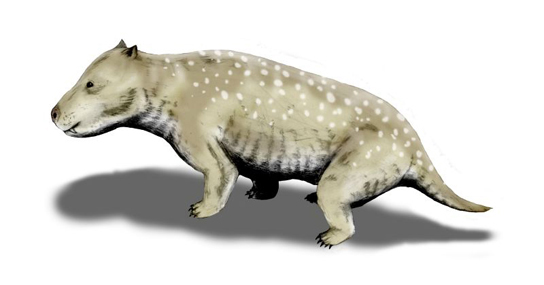
Mammals are synapsids, meaning they have a single, ancestrally fused, postorbital opening in the skull. They are the only living synapsids, as earlier forms became extinct by the Jurassic period. The early non-mammalian synapsids can be divided into two groups, the pelycosaurs and the therapsids. Within the therapsids, a group called the cynodonts are thought to have been the ancestors of mammals (Figure 29.38).
英語のヒント
哺乳類は単弓類であり、祖先の段階で融合した、眼窩後方の単一の開口部を頭骨にもつ。初期の型はジュラ紀までに絶滅したため、哺乳類は唯一の現生単弓類である。初期の、哺乳類以外の単弓類は、盤竜類と獣弓類の二群に分けられる。獣弓類の中では、キノドン類という群が哺乳類の祖先だったと考えられている(図29.38)。
© Nobu Tamura; Cynognathus BW. The CC BY option is selected from the original multiple licenses. OpenStax, Biology 2e adaptation. · CC BY 2.5 · Source出典
Figure 29.38図 29.38
Cynodont. Cynodonts ("dog teeth"), which first appeared in the Late Permian period 260 million years ago, are thought to be the ancestors of modern mammals. Holes in the upper jaws of cynodonts suggest that they had whiskers, which might also indicate the presence of hair. (credit: Nobu Tamura)
キノドン類。2億6000万年前のペルム紀後期に初めて現れたキノドン類(「犬の歯」)は、現生哺乳類の祖先と考えられている。上顎にある穴は、ひげがあったことを示唆し、毛の存在を示している可能性もある。(クレジット:Nobu Tamura)
As with birds, a key characteristic of synapsids is endothermy, rather than the ectothermy seen in many other vertebrates (such as fish, amphibians, and most reptiles). The increased metabolic rate required to internally modify body temperature likely went hand-in-hand with changes to certain skeletal structures that improved food processing and ambulation. The later synapsids, which had more evolved characteristics unique to mammals, possess cheeks for holding food and heterodont teeth, which are specialized for chewing, mechanically breaking down food to speed digestion, and releasing the energy needed to produce heat. Chewing also requires the ability to breathe at the same time, which is facilitated by the presence of a secondary palate (comprising the bony palate and the posterior continuation of the soft palate). The secondary palate separates the area of the mouth where chewing occurs from the area above where respiration occurs, allowing breathing to proceed uninterrupted while the animal is chewing. A secondary palate is not found in pelycosaurs but is present in cynodonts and mammals. The jawbone also shows changes from early synapsids to later ones. The zygomatic arch, or cheekbone, is present in mammals and advanced therapsids such as cynodonts, but is not present in pelycosaurs. The presence of the zygomatic arch suggests the presence of masseter muscles, which close the jaw and function in chewing.
英語のヒント
鳥類と同様に、単弓類の重要な特徴は、魚類、両生類、大部分の爬虫類など多くのほかの脊椎動物に見られる外温性ではなく、内温性である。体内から体温を変えるために必要な代謝率の上昇は、おそらく、食物の処理と歩行を改善する、特定の骨格構造の変化と並行して起こった。哺乳類に固有の特徴がさらに進化した後期の単弓類は、食物を保持する頬と、咀嚼に特化した異形歯をもつ。これらは食物を機械的に砕いて消化を速め、熱をつくるのに必要なエネルギーを取り出す。咀嚼には、同時に呼吸する能力も必要であり、骨性口蓋と、その後ろに続く軟口蓋からなる二次口蓋が、それを容易にする。二次口蓋は、咀嚼が起こる口内の領域と、その上にある呼吸の領域を分け、動物が噛んでいる間も、呼吸を途切れさせずに続けられるようにする。盤竜類には二次口蓋がないが、キノドン類と哺乳類にはある。初期の単弓類から後期のものへと、顎骨にも変化が見られる。頬骨弓、すなわち頬の骨は、哺乳類やキノドン類などの進んだ獣弓類にはあるが、盤竜類にはない。頬骨弓の存在は、顎を閉じ、咀嚼に働く咬筋があったことを示唆する。
In the appendicular skeleton, the shoulder girdle of therian mammals is modified from that of other vertebrates in that it does not possess a procoracoid bone or an interclavicle, and the scapula is the dominant bone.
英語のヒント
付属肢骨格では、獣類の哺乳類の肩帯は、前烏口骨も間鎖骨ももたず、肩甲骨が主要な骨となっている点で、ほかの脊椎動物のものから変化している。
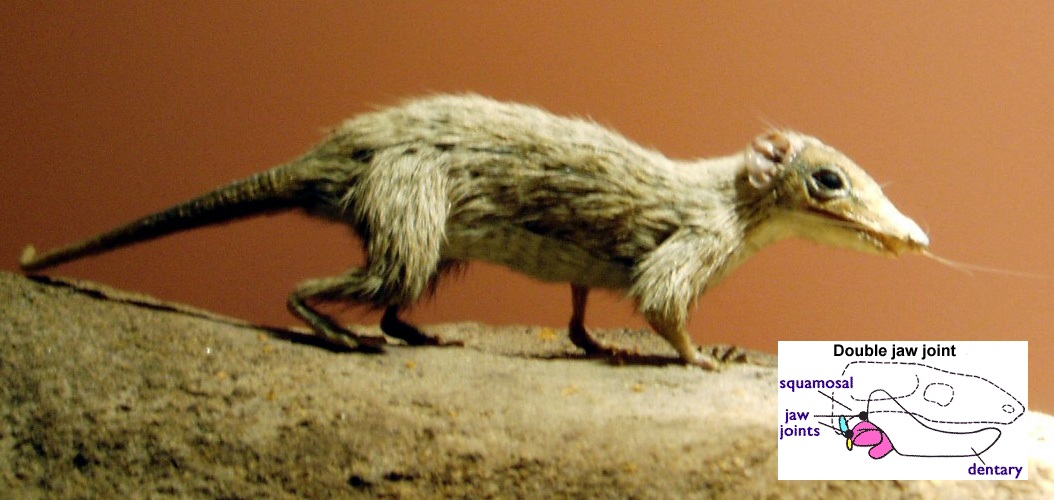
Mammals evolved from therapsids in the late Triassic period, as the earliest known mammal fossils are from the early Jurassic period, some 205 million years ago. One group of transitional mammals was the morganucodonts, small nocturnal insectivores. The jaws of morganucodonts were “transitional,” with features of both reptilian and mammalian jaws (Figure 29.39). Like modern mammals, the morganucodonts had differentiated teeth and were diphyodonts. Mammals first began to diversify in the Mesozoic era, from the Jurassic to the Cretaceous periods. Even some small gliding mammals appear in the fossil record during this time period. However, most of the Jurassic mammals were extinct by the end of the Mesozoic. During the Cretaceous period, another radiation of mammals began and continued through the Cenozoic era, about 65 million years ago.
英語のヒント
哺乳類は、三畳紀後期に獣弓類から進化した。知られている最古の哺乳類化石は、約2億500万年前のジュラ紀初期のものである。移行段階の哺乳類の一群に、小型で夜行性の食虫動物だったモルガヌコドン類がいた。その顎は「移行的」で、爬虫類と哺乳類の顎の両方の特徴をもっていた(図29.39)。現生哺乳類と同様、モルガヌコドン類の歯は分化しており、二生歯性だった。哺乳類は、中生代のジュラ紀から白亜紀にかけて、初めて多様化し始めた。この時期の化石記録には、小型の滑空する哺乳類さえ現れる。しかし、ジュラ紀の哺乳類の大部分は、中生代の終わりまでに絶滅した。白亜紀には、哺乳類の別の適応放散が始まり、約6500万年前の新生代へと続いた。
OpenStax, Rice University; Biology 2e. (Credit: By Nordelch [Megazostrodon Natural History Museum] Wikimedia Commons. Credit inset: Mod from Philcha. https://commons.wikimedia.org/w/index.php? curid=3631949) · CC BY 4.0 · Source出典
Figure 29.39図 29.39
A morganucodont. This morganucodont Megazotrodon, an extinct basal mammal, may have been nocturnal and insectivorous. Inset: Jaw of a morganucodont, showing a double hinge, one between the dentary and squamosal and one between the articular (yellow) and quadrate (blue) bones. In living mammals, the articular and quadrate bones have been incorporated into the middle ear. (Credit: By Nordelch [Megazostrodon Natural History Museum] Wikimedia Commons. Credit inset: Mod from Philcha. https://commons.wikimedia.org/w/index.php? curid=3631949)
モルガヌコドン類。このメガゾストロドンは、絶滅した基盤的な哺乳類で、夜行性かつ食虫性だった可能性がある。挿入図:モルガヌコドン類の顎。歯骨と鱗状骨の間、関節骨(黄色)と方形骨(青色)の間という、二重の関節を示す。現生哺乳類では、関節骨と方形骨は中耳に組み込まれている。(クレジット:Nordelch[Megazostrodon Natural History Museum]Wikimedia Commons。挿入図:Philcha の作品を改変。https://commons.wikimedia.org/w/index.php? curid=3631949)
Living Mammals現生の哺乳類
There are three major groups of living mammals: monotremes (prototheria), marsupials (metatheria), and placental (eutheria) mammals. The eutherians and the marsupials together comprise a clade of therian mammals, with the monotremes forming a sister clade to both metatherians and eutherians.
現生哺乳類には、単孔類(原獣類)、有袋類(後獣類)、有胎盤哺乳類(真獣類)という三つの主要な群がある。真獣類と有袋類は合わせて獣類という系統群を構成し、単孔類は、後獣類と真獣類を合わせた群の姉妹群となる。
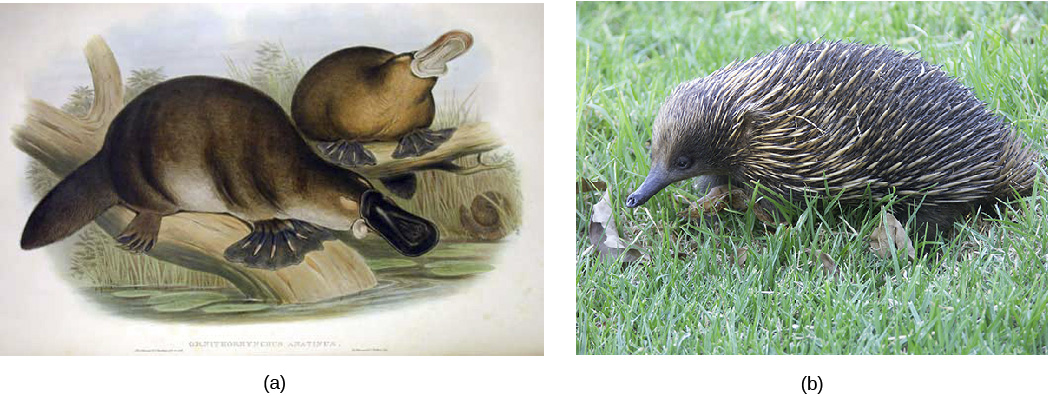
There are very few living species of monotremes: the platypus and four species of echidnas, or spiny anteaters. The leathery-beaked platypus belongs to the family Ornithorhynchidae (“bird beak”), whereas echidnas belong to the family Tachyglossidae (“sticky tongue”) (Figure 29.40). The platypus and one species of echidna are found in Australia, and the other species of echidna are found in New Guinea. Monotremes are unique among mammals because they lay eggs, rather than giving birth to live young. The shells of their eggs are not like the hard shells of birds, but have a leathery shell, similar to the shells of reptile eggs. Monotremes retain their eggs through about two-thirds of the developmental period, and then lay them in nests. A yolk-sac placenta helps support development. The babies hatch in a fetal state and complete their development in the nest, nourished by milk secreted by mammary glands opening directly to the skin. Monotremes, except for young platypuses, do not have teeth. Body temperature in the monotreme species is maintained at about 30°C, considerably lower than the average body temperature of marsupial and placental mammals, which are typically between 35 and 38°C.
英語のヒント
単孔類の現生種は非常に少なく、カモノハシと4種のハリモグラ類だけである。革のようなくちばしをもつカモノハシはカモノハシ科(Ornithorhynchidae、「鳥のくちばし」)に属し、ハリモグラ類はハリモグラ科(Tachyglossidae、「粘着性の舌」)に属する(図29.40)。カモノハシとハリモグラ1種はオーストラリアに、残るハリモグラ類はニューギニアに分布する。単孔類は、生きた子を産むのではなく卵を産む点で、哺乳類の中では独特である。その卵殻は、鳥の硬い殻とは異なり、爬虫類の卵殻に似た、革のような質感をもつ。単孔類は発生期間の約3分の2まで卵を体内に保持し、その後、巣に産む。卵黄嚢胎盤が発生を支える。子は胎児のような状態で孵化し、巣の中で発達を完了する。その間、皮膚に直接開口する乳腺から分泌される乳で養われる。若いカモノハシを除き、単孔類には歯がない。単孔類の体温は約30℃に保たれ、通常35〜38℃である有袋類や有胎盤類の平均体温より、かなり低い。
OpenStax, Rice University; Biology 2e. (credit b: modification of work by Barry Thomas) · CC BY 4.0 · Source出典
Figure 29.40図 29.40
Egg-laying mammals. (a) The platypus, a monotreme, possesses a leathery beak and lays eggs rather than giving birth to live young. (b) The echidna is another monotreme, with long hairs modified into spines. (credit b: modification of work by Barry Thomas)
卵を産む哺乳類。(a)単孔類のカモノハシは、革のようなくちばしをもち、生きた子を産む代わりに卵を産む。(b)ハリモグラも単孔類で、長い毛が棘に変化している。(クレジットb:Barry Thomas の作品を改変)
Over 2/3 of the approximately 330 living species of marsupials are found in Australia, New Guinea, and surrounding islands, with the rest, nearly all various types of opossum, found in the Americas, especially South America. Australian marsupials include the kangaroo, koala, bandicoot, Tasmanian devil (Figure 29.41), and several other species. Like monotremes, the embryos of marsupials are nourished during a short gestational period (about a month in kangaroos) by a yolk-sac placenta, but with no intervening egg shell. Some marsupial embryos can enter an embryonic diapause, and delay implantation, suspending development until implantation is completed. Marsupial young are also effectively fetal at birth. Most, but not all, species of marsupials possess a pouch in which the very premature young reside, receiving milk and continuing their development. In kangaroos, the young joeys continue to nurse for about a year and a half.
英語のヒント
有袋類の現生種は約330種あり、その3分の2以上が、オーストラリア、ニューギニア、周辺の島々に分布する。残りはほぼすべて、さまざまな種類のオポッサムで、南北アメリカ、特に南アメリカに分布する。オーストラリアの有袋類には、カンガルー、コアラ、バンディクート、タスマニアデビル(図29.41)などが含まれる。単孔類と同様、有袋類の胚は、短い妊娠期間(カンガルーでは約1か月)の間、卵黄嚢胎盤によって栄養を与えられるが、間に卵殻はない。一部の有袋類の胚は、胚休眠に入って着床を遅らせ、着床が完了するまで発生を中断できる。有袋類の子も、出生時には実質的に胎児の状態である。すべてではないが大部分の種には育児嚢があり、非常に未熟な子がその中で乳を受け取り、発達を続ける。カンガルーの子は、約1年半にわたって乳を飲み続ける。
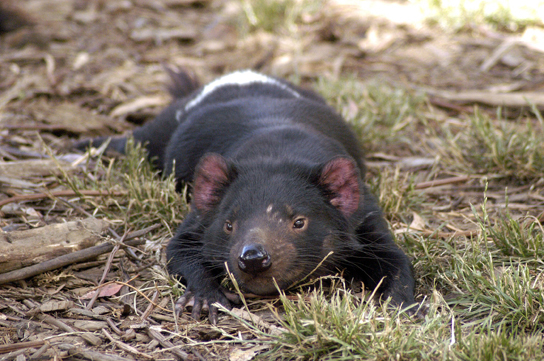


Figure 29.41図 29.41
A marsupial mammal. The Tasmanian devil is one of several marsupials native to Australia. (credit: Wayne McLean)
有袋類の哺乳動物。タスマニアデビルは、オーストラリアに在来する有袋類の一つである。(クレジット:Wayne McLean)
Eutherians (placentals) are the most widespread and numerous of the mammals, occurring throughout the world. Eutherian mammals are sometimes called “placental mammals” because all species possess a complex chorioallantoic placenta that connects a fetus to the mother, allowing for gas, fluid, and nutrient exchange. There are about 6,000 species of placental mammals in 18 to 20 orders with various adaptations for burrowing, flying, swimming, hunting, running, and climbing. In the evolutionary sense, they have been incredibly successful in form, diversity, and abundance. The eutherian mammals are classified in two major clades, the Atlantogenata and the Boreoeutheria. The Atlantogeneta include the Afrotheria (e.g., elephants, hyraxes, and manatees) and the Xenarthra (anteaters, armadillos, and sloths). The Boreoeutheria contain two large groups, the Euarchontoglires and the Laurasiatheria. Familiar orders in the Euarchontoglires are the Scandentia (tree shrews), Rodentia (rats, mice, squirrels, porcupines), Lagomorpha (rabbits and hares), and the Primates (including humans). Major Laurasiatherian orders include the Perissodactyla (e.g., horses and rhinos), the Cetartiodactyla (e.g., cows, giraffes, pigs, hippos, and whales), the Carnivora (e.g., cats, dogs, and bears), and the Chiroptera (bats and flying foxes). The two largest orders are the rodents (about 2,000 species) and bats (about 1,400 species), which together constitute almost 60 percent of all eutherian species.
英語のヒント
真獣類(有胎盤類)は、哺乳類の中で最も広く分布し、種数も最も多く、世界各地に生息する。真獣類は「有胎盤哺乳類」と呼ばれることがある。すべての種が、胎児と母体をつなぐ複雑な漿尿膜胎盤をもち、ガス、液体、栄養分を交換できるためである。有胎盤類は18〜20目、約6000種からなり、穴掘り、飛行、遊泳、狩り、走行、登攀に対するさまざまな適応をもつ。進化的な意味で、その形態、多様性、豊富さにおいて、驚くほど成功してきた。真獣類は、アトラントゲナータ(Atlantogenata)と北方真獣類(Boreoeutheria)という二つの主要な系統群に分類される。アトラントゲナータには、アフリカ獣類(ゾウ、ハイラックス、マナティーなど)と異節類(アリクイ、アルマジロ、ナマケモノ)が含まれる。北方真獣類には、真主齧類とローラシア獣類という二つの大きな群がある。真主齧類のよく知られた目には、登木目(ツパイ)、齧歯目(ラット、マウス、リス、ヤマアラシ)、兎形目(ウサギとノウサギ)、霊長目(ヒトを含む)がある。ローラシア獣類の主要な目には、奇蹄目(ウマ、サイなど)、鯨偶蹄目(ウシ、キリン、ブタ、カバ、クジラなど)、食肉目(ネコ、イヌ、クマなど)、翼手目(コウモリとオオコウモリ)がある。最大の二つの目は、齧歯類(約2000種)とコウモリ類(約1400種)で、合わせて真獣類の全種の約60%を占める。