第30章植物の形態と生理
30.6 Plant Sensory Systems and Responses30.6 植物の感覚系と応答
Learning Objectives学習目標
By the end of this section, you will be able to do the following:
この節を学ぶと、次のことができるようになる。
- Describe how red and blue light affect plant growth and metabolic activities赤色光と青色光が植物の成長や代謝活動に及ぼす影響を述べる。
- Discuss gravitropism重力屈性について論じる。
- Understand how hormones affect plant growth and developmentホルモンが植物の成長と発生にどう影響するかを理解する。
- Describe thigmotropism, thigmonastism, and thigmogenesis接触屈性、接触傾性、接触形態形成を説明する。
- Explain how plants defend themselves from predators and respond to wounds植物が捕食者から身を守り、傷に応答する仕組みを説明する。
Animals can respond to environmental factors by moving to a new location. Plants, however, are rooted in place and must respond to the surrounding environmental factors. Plants have sophisticated systems to detect and respond to light, gravity, temperature, and physical touch. Receptors sense environmental factors and relay the information to effector systems—often through intermediate chemical messengers—to bring about plant responses.
動物は別の場所へ移動することで、環境要因に対応できる。一方、植物はその場に根を張っており、周囲の環境要因に応答しなければならない。植物には、光、重力、温度、物理的な接触を検知して応答する高度な仕組みがある。受容体が環境要因を感知し、しばしば中間の化学的伝達物質を介して、その情報を効果器の系へ伝えることで、植物の応答が引き起こされる。
Plant Responses to Light光に対する植物の応答
Plants have a number of sophisticated uses for light that go far beyond their ability to photosynthesize low-molecular-weight sugars using only carbon dioxide, light, and water. Photomorphogenesis is the growth and development of plants in response to light. It allows plants to optimize their use of light and space. Photoperiodism is the ability to use light to track time. Plants can tell the time of day and time of year by sensing and using various wavelengths of sunlight. Phototropism is a directional response that allows plants to grow towards, or even away from, light.
植物の光の利用法は高度で多様であり、二酸化炭素、光、水だけを使って低分子量の糖を光合成する能力をはるかに超えている。光形態形成とは、光に応答して植物が成長・発生することである。これにより、植物は光と空間を最適に利用できる。光周性とは、光を利用して時間を把握する能力である。植物は太陽光のさまざまな波長を感知して利用することで、一日のうちの時刻や一年のうちの時期を知ることができる。光屈性は方向性をもつ応答で、植物を光に向かって、あるいは光から遠ざかるように成長させる。
The sensing of light in the environment is important to plants; it can be crucial for competition and survival. The response of plants to light is mediated by different photoreceptors, which are comprised of a protein covalently bonded to a light-absorbing pigment called a chromophore. Together, the two are called a chromoprotein.
英語のヒント
環境中の光を感知することは植物にとって重要であり、競争や生存を左右する場合もある。植物の光への応答は、さまざまな光受容体によって媒介される。光受容体は、発色団と呼ばれる光吸収色素がタンパク質に共有結合したものである。この二つが一体になったものを色素タンパク質という。
The red/far-red and violet-blue regions of the visible light spectrum trigger structural development in plants. Sensory photoreceptors absorb light in these particular regions of the visible light spectrum because of the quality of light available in the daylight spectrum. In terrestrial habitats, light absorption by chlorophylls peaks in the blue and red regions of the spectrum. As light filters through the canopy and the blue and red wavelengths are absorbed, the spectrum shifts to the far-red end, shifting the plant community to those plants better adapted to respond to far-red light. Blue-light receptors allow plants to gauge the direction and abundance of sunlight, which is rich in blue–green emissions. Water absorbs red light, which makes the detection of blue light essential for algae and aquatic plants.
英語のヒント
可視光スペクトルの赤色・遠赤色領域と紫色・青色領域の光は、植物の構造の発達を引き起こす。感覚を担う光受容体がこの特定の領域の光を吸収するのは、昼光のスペクトルに含まれる光の質による。陸上の生息環境では、クロロフィルによる光の吸収はスペクトルの青色領域と赤色領域で最大になる。光が林冠を通過し、青色と赤色の波長が吸収されるにつれて、スペクトルは遠赤色側へと偏る。それに伴い、植物群集も遠赤色光への応答によりよく適応した植物へと変化する。青色光受容体によって、植物は太陽光の方向と量を測ることができる。太陽光には青緑色の放射が豊富に含まれる。水は赤色光を吸収するため、藻類や水生植物にとっては青色光の検知が不可欠である。
The Phytochrome System and the Red/Far-Red Responseフィトクロム系と赤色光・遠赤色光への応答
The phytochromes are a family of chromoproteins with a linear tetrapyrrole chromophore, similar to the ringed tetrapyrrole light-absorbing head group of chlorophyll. Phytochromes have two photo-interconvertible forms: Pr and Pfr. Pr absorbs red light (~667 nm) and is immediately converted to Pfr. Pfr absorbs far-red light (~730 nm) and is quickly converted back to Pr. Absorption of red or far-red light causes a massive change to the shape of the chromophore, altering the conformation and activity of the phytochrome protein to which it is bound. Pfr is the physiologically active form of the protein; therefore, exposure to red light yields physiological activity. Exposure to far-red light inhibits phytochrome activity. Together, the two forms represent the phytochrome system (Figure 30.38).
英語のヒント
フィトクロムは、直鎖状のテトラピロール発色団をもつ色素タンパク質の一群である。この発色団は、クロロフィルの光を吸収する環状テトラピロールの頭部に似ている。フィトクロムには、光によって相互に変換される二つの型、Pr型とPfr型がある。Pr型は赤色光(約667 nm)を吸収し、直ちにPfr型へ変わる。Pfr型は遠赤色光(約730 nm)を吸収し、速やかにPr型へ戻る。赤色光または遠赤色光を吸収すると、発色団の形が大きく変化し、結合しているフィトクロムタンパク質の立体構造と活性が変わる。Pfr型はタンパク質の生理的な活性型である。そのため、赤色光を当てると生理活性が生じる。遠赤色光を当てると、フィトクロムの活性は抑えられる。この二つの型を合わせてフィトクロム系という(図30.38)。
The phytochrome system acts as a biological light switch. It monitors the level, intensity, duration, and color of environmental light. The effect of red light is reversible by immediately shining far-red light on the sample, which converts the chromoprotein to the inactive Pr form. Additionally, Pfr can slowly revert to Pr in the dark, or break down over time. In all instances, the physiological response induced by red light is reversed. The active form of phytochrome (Pfr) can directly activate other molecules in the cytoplasm, or it can be trafficked to the nucleus, where it directly activates or represses specific gene expression.
フィトクロム系は、生物学的な光スイッチとして働く。環境の光の量、強度、持続時間、色を監視する。赤色光を当てた直後に遠赤色光を試料へ当てると、色素タンパク質が不活性なPr型へ変わり、赤色光の効果を打ち消せる。また、暗所ではPfr型がゆっくりPr型へ戻ったり、時間とともに分解されたりする。いずれの場合も、赤色光によって誘導された生理応答は元に戻る。フィトクロムの活性型(Pfr)は、細胞質のほかの分子を直接活性化することができる。また、核へ輸送され、そこで特定の遺伝子の発現を直接活性化したり抑制したりすることもある。
Once the phytochrome system evolved, plants adapted it to serve a variety of needs. Unfiltered, full sunlight contains much more red light than far-red light. Because chlorophyll absorbs strongly in the red region of the visible spectrum, but not in the far-red region, any plant in the shade of another plant on the forest floor will be exposed to red-depleted, far-red-enriched light. The preponderance of far-red light converts phytochrome in the shaded leaves to the Pr (inactive) form, slowing growth. The nearest non-shaded (or even less-shaded) areas on the forest floor have more red light; leaves exposed to these areas sense the red light, which activates the Pfr form and induces growth. In short, plant shoots use the phytochrome system to grow away from shade and towards light. Because competition for light is so fierce in a dense plant community, the evolutionary advantages of the phytochrome system are obvious.
英語のヒント
フィトクロム系が進化すると、植物はそれをさまざまな用途に適応させた。何にも遮られない直射日光には、遠赤色光よりもはるかに多くの赤色光が含まれる。クロロフィルは可視スペクトルの赤色領域を強く吸収するが、遠赤色領域は吸収しない。そのため、林床でほかの植物の陰にある植物は、赤色光が少なく遠赤色光に富む光を受けることになる。遠赤色光が優勢になると、陰にある葉のフィトクロムは不活性なPr型へ変わり、成長が遅くなる。林床のすぐ近くにある日陰でない場所や、少し陰が薄い場所には、赤色光がより多い。そうした場所の光を受ける葉は赤色光を感知し、それによってPfr型が活性化され、成長が誘導される。つまり、植物のシュートはフィトクロム系を使って、陰から離れ、光のある方向へ成長する。密な植物群集では光をめぐる競争が非常に激しいため、この系が進化上有利であることは明らかである。
In seeds, the phytochrome system is not used to determine direction and quality of light (shaded versus unshaded). Instead, is it used merely to determine if there is any light at all. This is especially important in species with very small seeds, such as lettuce. Because of their size, lettuce seeds have few food reserves. Their seedlings cannot grow for long before they run out of fuel. If they germinated even a centimeter under the soil surface, the seedling would never make it into the sunlight and would die. In the dark, phytochrome is in the Pr (inactive form) and the seed will not germinate; it will only germinate if exposed to light at the surface of the soil. Upon exposure to light, Pr is converted to Pfr and germination proceeds.
英語のヒント
種子では、フィトクロム系は光の方向や質、つまり日陰かどうかの判定には使われない。代わりに、光が少しでも存在するかどうかを判定するためだけに使われる。これはレタスのように種子が非常に小さい種で、とくに重要である。レタスの種子は小さいので、貯蔵養分が少ない。実生は養分を使い果たすまで長く成長することができない。もし地表からわずか1 cm下で発芽したとしても、実生は日光の届くところまで達することができず、枯れてしまう。暗所ではフィトクロムが不活性なPr型になっており、種子は発芽しない。土の表面で光を受けた場合にだけ発芽する。光を受けるとPr型はPfr型に変わり、発芽が進む。
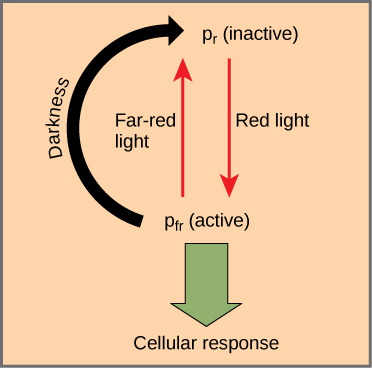

Figure 30.38図 30.38
The biologically inactive form of phytochrome (Pr) is converted to the biologically active form Pfr under illumination with red light. Far-red light and darkness convert the molecule back to the inactive form.
英語のヒント
生物学的に不活性なフィトクロムのPr型は、赤色光を照射されると活性型のPfr型に変わる。遠赤色光と暗所では、不活性型へ戻る。
Plants also use the phytochrome system to sense the change of season. Photoperiodism is a biological response to the timing and duration of day and night. It controls flowering, setting of winter buds, and vegetative growth. Detection of seasonal changes is crucial to plant survival. Although temperature and light intensity influence plant growth, they are not reliable indicators of season because they may vary from one year to the next. Day length is a better indicator of the time of year.
英語のヒント
植物は季節の変化を感知するためにもフィトクロム系を使う。光周性とは、昼と夜の時間帯や長さに対する生物の応答である。光周性は開花、冬芽の形成、栄養成長を制御する。季節の変化を検知することは、植物の生存に不可欠である。温度や光の強度は成長に影響するものの、年ごとに変動する可能性があるため、季節を示す信頼性の高い指標にはならない。一日の明るい時間の長さのほうが、一年のうちの時期を示す優れた指標となる。
As stated above, unfiltered sunlight is rich in red light but deficient in far-red light. Therefore, at dawn, all the phytochrome molecules in a leaf quickly convert to the active Pfr form, and remain in that form until sunset. In the dark, the Pfr form takes hours to slowly revert back to the Pr form. If the night is long (as in winter), all of the Pfr form reverts. If the night is short (as in summer), a considerable amount of Pfr may remain at sunrise. By sensing the Pr/Pfr ratio at dawn, a plant can determine the length of the day/night cycle. In addition, leaves retain that information for several days, allowing a comparison between the length of the previous night and the preceding several nights. Shorter nights indicate springtime to the plant; when the nights become longer, autumn is approaching. This information, along with sensing temperature and water availability, allows plants to determine the time of the year and adjust their physiology accordingly. Short-day (long-night) plants use this information to flower in the late summer and early fall, when nights exceed a critical length (often eight or fewer hours). Long-day (short-night) plants flower during the spring, when darkness is less than a critical length (often eight to 15 hours). Not all plants use the phytochrome system in this way. Flowering in day-neutral plants is not regulated by daylength.
前述のとおり、遮られていない太陽光には赤色光が多く、遠赤色光が少ない。そのため夜明けには、葉にあるフィトクロム分子がすべて速やかに活性型のPfr型へ変わり、日没までその型を保つ。暗所では、Pfr型が数時間かけてゆっくりPr型へ戻る。冬のように夜が長ければ、Pfr型はすべて元に戻る。夏のように夜が短ければ、日の出の時点でもかなりの量のPfr型が残っていることがある。夜明けのPr/Pfr比を感知することで、植物は昼夜周期の長さを判定できる。さらに、葉はその情報を数日間保持するので、直前の夜の長さと、それ以前の数夜の長さを比較できる。夜が短くなることは、植物にとって春の訪れを示す。夜が長くなっていれば、秋が近づいている。この情報に加えて温度や利用可能な水を感知することで、植物は一年のうちの時期を判定し、それに応じて生理機能を調整できる。短日植物(長夜植物)はこの情報を利用し、夜の長さが限界値(多くは8時間以下)を超える晩夏から初秋に開花する。長日植物(短夜植物)は、暗い時間が限界値(多くは8~15時間)より短くなる春に開花する。すべての植物がこのようにフィトクロム系を使うわけではない。中性植物の開花は、日長によって調節されない。