第30章植物の形態と生理
Translocation: Transport from Source to Sink転流:ソースからシンクへの輸送
Photosynthates, such as sucrose, are produced in the mesophyll cells of photosynthesizing leaves. From there they are translocated through the phloem to where they are used or stored. Mesophyll cells are connected by cytoplasmic channels called plasmodesmata. Photosynthates move through these channels to reach phloem sieve-tube elements (STEs) in the vascular bundles. From the mesophyll cells, the photosynthates are loaded into the phloem STEs. The sucrose is actively transported against its concentration gradient (a process requiring ATP) into the phloem cells using the electrochemical potential of the proton gradient. This is coupled to the uptake of sucrose with a carrier protein called the sucrose-H+ symporter.
英語のヒント
スクロースなどの光合成産物は、光合成を行う葉の葉肉細胞でつくられる。そこから師部を通って、利用または貯蔵される場所へ転流する。葉肉細胞は、原形質連絡という細胞質の通路でつながっている。光合成産物はこの通路を通り、維管束内の師管要素(STE)に達する。光合成産物は、葉肉細胞から師部の師管要素へ積み込まれる。スクロースは、プロトン勾配の電気化学ポテンシャルを使い、自身の濃度勾配に逆らって、師部細胞へ能動輸送される。この過程にはATPが必要である。これは、スクロース–H+共輸送体という担体タンパク質によるスクロースの取り込みと連動する。
Phloem STEs have reduced cytoplasmic contents, and are connected by a sieve plate with pores that allow for pressure-driven bulk flow, or translocation, of phloem sap. Companion cells are associated with STEs. They assist with metabolic activities and produce energy for the STEs (Figure 30.36).
英語のヒント
師部の師管要素では細胞質内容物が減っており、穴のある師板によってつながっている。その穴は、圧力に駆動される師部液の集団流、すなわち転流を可能にする。師管要素には伴細胞が伴い、代謝活動を助け、師管要素のためにエネルギーをつくる(図30.36)。
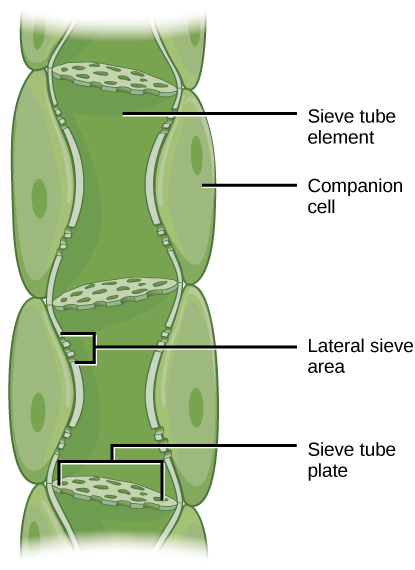
Figure 30.36図 30.36
Phloem is comprised of cells called sieve-tube elements. Phloem sap travels through perforations called sieve tube plates. Neighboring companion cells carry out metabolic functions for the sieve-tube elements and provide them with energy. Lateral sieve areas connect the sieve-tube elements to the companion cells.
師部は、師管要素という細胞からなる。師部液は、師板という穴のある部分を通って移動する。隣接する伴細胞は、師管要素のために代謝機能を果たし、エネルギーを供給する。側方の師域は、師管要素と伴細胞をつなぐ。
Once in the phloem, the photosynthates are translocated to the closest sink. Phloem sap is an aqueous solution that contains up to 30 percent sugar, minerals, amino acids, and plant growth regulators. The high percentage of sugar decreases Ψs, which decreases the total water potential and causes water to move by osmosis from the adjacent xylem into the phloem tubes, thereby increasing pressure. This increase in total water potential causes the bulk flow of phloem from source to sink (Figure 30.37). Sucrose concentration in the sink cells is lower than in the phloem STEs because the sink sucrose has been metabolized for growth, or converted to starch for storage or other polymers, such as cellulose, for structural integrity. Unloading at the sink end of the phloem tube occurs by either diffusion or active transport of sucrose molecules from an area of high concentration to one of low concentration. Water diffuses from the phloem by osmosis and is then transpired or recycled via the xylem back into the phloem sap.
英語のヒント
師部に入った光合成産物は、最も近いシンクへ転流する。師部液は、最大30%の糖、無機栄養分、アミノ酸、植物成長調節物質を含む水溶液である。高い糖含量はΨs,を下げ、それによって全水ポテンシャルが低下する。すると、隣の木部から師管へ水が浸透で移動し、圧力が上がる。この全水ポテンシャルの上昇によって、ソースからシンクへ師部液の集団流が生じる(図30.37)。シンクの細胞のスクロース濃度は、師部の師管要素より低い。シンクのスクロースが成長のために代謝されたり、貯蔵用のデンプンや、構造を保つセルロースなどの高分子へ変えられたりするためである。師管のシンク側では、スクロース分子が高濃度域から低濃度域へ、拡散または能動輸送によって移され、積み下ろしが起こる。水は浸透によって師部から拡散し、その後、蒸散するか、木部を経由して再び師部液へ戻される。
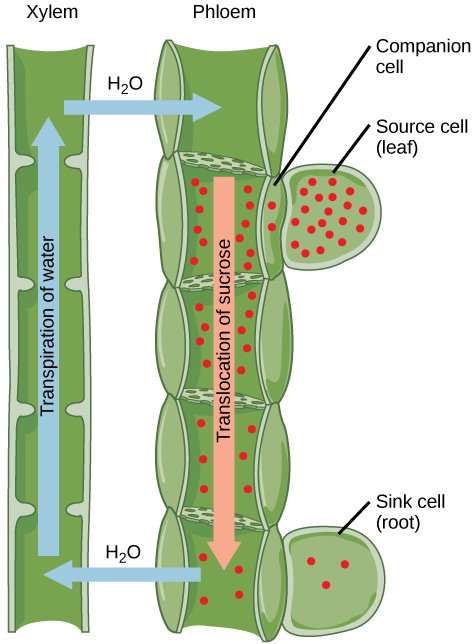


Figure 30.37図 30.37
Sucrose is actively transported from source cells into companion cells and then into the sieve-tube elements. This reduces the water potential, which causes water to enter the phloem from the xylem. The resulting positive pressure forces the sucrose-water mixture down toward the roots, where sucrose is unloaded. Transpiration causes water to return to the leaves through the xylem vessels.
スクロースは、ソース細胞から伴細胞へ、さらに師管要素へと能動輸送される。これが水ポテンシャルを下げ、木部から師部へ水を流入させる。その結果生じる正の圧力が、スクロースと水の混合物を根へ向けて下方へ押し、根でスクロースが積み下ろされる。蒸散によって、水は道管を通って葉へ戻る。
Section Summaryこの節のまとめ
Water potential (Ψ) is a measure of the difference in potential energy between a water sample and pure water. The water potential in plant solutions is influenced by solute concentration, pressure, gravity, and matric potential. Water potential and transpiration influence how water is transported through the xylem in plants. These processes are regulated by stomatal opening and closing. Photosynthates (mainly sucrose) move from sources to sinks through the plant’s phloem. Sucrose is actively loaded into the sieve-tube elements of the phloem. The increased solute concentration causes water to move by osmosis from the xylem into the phloem. The positive pressure that is produced pushes water and solutes down the pressure gradient. The sucrose is unloaded into the sink, and the water returns to the xylem vessels.
水ポテンシャル(Ψ)は、水試料と純水との間のポテンシャルエネルギー差の尺度である。植物内の溶液の水ポテンシャルは、溶質濃度、圧力、重力、マトリックポテンシャルの影響を受ける。水ポテンシャルと蒸散は、植物の木部を通る水輸送に影響し、これらの過程は気孔の開閉によって調節される。光合成産物(主にスクロース)は、師部を通り、ソースからシンクへ移動する。スクロースは、師部の師管要素へ能動的に積み込まれる。溶質濃度が上がると、水が木部から師部へ浸透で移動する。そこで生じた正の圧力が、圧力勾配に沿って水と溶質を押し流す。スクロースはシンクへ積み下ろされ、水は木部道管へ戻る。
Visual Connection Questions図を使った問題
Exercises 29–30練習問題 29–30
Exercise 29問題 29
Figure 30.32 Positive water potential is placed on the left side of the tube by increasing Ψp such that the water level rises on the right side. Could you equalize the water level on each side of the tube by adding solute, and if so, how?
図30.32 Ψpを増加させて管の左側に正の水ポテンシャルを与えると、右側の水位が上がる。溶質を加えることで左右の水位を等しくできるか。できるなら、どうすればよいか。
Solution解き方
Figure 30.32 Yes, you can equalize the water level by adding the solute to the left side of the tube such that water moves toward the left until the water levels are equal.
図30.32 できる。管の左側へ溶質を加えると、水位が等しくなるまで水が左へ移動し、左右の水位をそろえられる。
Exercise 30問題 30
Figure 30.34 Which of the following statements is false?
図30.34 次の説明のうち、誤っているものはどれか。
- Negative water potential draws water into the root hairs. Cohesion and adhesion draw water up the xylem. Transpiration draws water from the leaf.負の水ポテンシャルが水を根毛へ引き込む。凝集と付着が水を木部へ引き上げる。蒸散が葉から水を引き出す。
- Negative water potential draws water into the root hairs. Cohesion and adhesion draw water up the phloem. Transpiration draws water from the leaf.負の水ポテンシャルが水を根毛へ引き込む。凝集と付着が水を師部へ引き上げる。蒸散が葉から水を引き出す。
- Water potential decreases from the roots to the top of the plant.水ポテンシャルは、根から植物の頂部へ向かって低下する。
- Water enters the plants through root hairs and exits through stoma.水は根毛を通って植物に入り、気孔を通って出る。
Solution解き方
Figure 30.34 B.
図30.34 B。