第30章植物の形態と生理
The Blue Light Responses青色光への応答
Phototropism—the directional bending of a plant toward or away from a light source—is a response to blue wavelengths of light. Positive phototropism is growth towards a light source (Figure 30.39), while negative phototropism (also called skototropism) is growth away from light.
英語のヒント
光屈性とは、植物が光源に向かう、または光源から遠ざかる方向に曲がることであり、青色の波長の光への応答である。正の光屈性は光源に向かう成長(図30.39)であり、負の光屈性(暗屈性とも呼ばれる)は光から遠ざかる成長である。
The aptly-named phototropins are protein-based receptors responsible for mediating the phototropic response. Like all plant photoreceptors, phototropins consist of a protein portion and a light-absorbing portion, called the chromophore. In phototropins, the chromophore is a covalently-bound molecule of flavin; hence, phototropins belong to a class of proteins called flavoproteins.
英語のヒント
フォトトロピンは、その名のとおり光屈性応答を媒介するタンパク質性の受容体である。植物のほかのすべての光受容体と同様、フォトトロピンもタンパク質部分と、発色団と呼ばれる光吸収部分から構成される。フォトトロピンの発色団は、共有結合で結びついたフラビン分子である。このため、フォトトロピンはフラビンタンパク質と呼ばれるタンパク質群に属する。
Other responses under the control of phototropins are leaf opening and closing, chloroplast movement, and the opening of stomata. However, of all responses controlled by phototropins, phototropism has been studied the longest and is the best understood.
フォトトロピンに制御されるほかの応答には、葉の開閉、葉緑体の移動、気孔の開口がある。しかし、フォトトロピンに制御される応答のうち、もっとも長く研究され、もっともよく理解されているのは光屈性である。
In their 1880 treatise The Power of Movements in Plants, Charles Darwin and his son Francis first described phototropism as the bending of seedlings toward light. Darwin observed that light was perceived by the tip of the plant (the apical meristem), but that the response (bending) took place in a different part of the plant. They concluded that the signal had to travel from the apical meristem to the base of the plant.
英語のヒント
チャールズ・ダーウィンと息子のフランシスは、1880年の著書『植物の運動力』で、実生が光に向かって曲がる現象として光屈性を初めて記述した。ダーウィンは、光が植物の先端(頂端分裂組織)で感知される一方、その応答である屈曲は別の部位で起こることを観察した。二人は、頂端分裂組織から植物の基部へ信号が伝わるはずだと結論づけた。
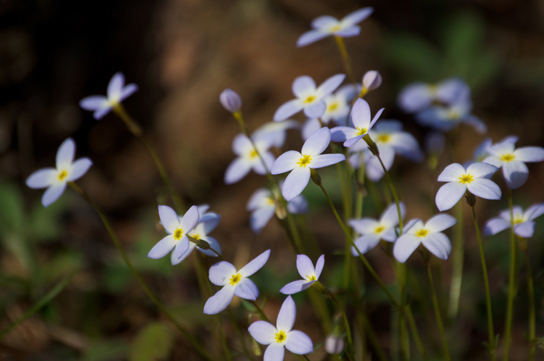

Figure 30.39図 30.39
Azure bluets (Houstonia caerulea) display a phototropic response by bending toward the light. (credit: Cory Zanker)
アズール・ブルーエット(Houstonia caerulea)は、光に向かって曲がる光屈性応答を示す。(クレジット:Cory Zanker)
In 1913, Peter Boysen-Jensen demonstrated that a chemical signal produced in the plant tip was responsible for the bending at the base. He cut off the tip of a seedling, covered the cut section with a layer of gelatin, and then replaced the tip. The seedling bent toward the light when illuminated. However, when impermeable mica flakes were inserted between the tip and the cut base, the seedling did not bend. A refinement of the experiment showed that the signal traveled on the shaded side of the seedling. When the mica plate was inserted on the illuminated side, the plant did bend towards the light. Therefore, the chemical signal was a growth stimulant because the phototropic response involved faster cell elongation on the shaded side than on the illuminated side. We now know that as light passes through a plant stem, it is diffracted and generates phototropin activation across the stem. Most activation occurs on the lit side, causing the plant hormone indole acetic acid (IAA) to accumulate on the shaded side. Stem cells elongate under influence of IAA.
英語のヒント
1913年、ピーター・ボイセン=イェンセンは、植物の先端で生じる化学信号が基部の屈曲を引き起こすことを示した。彼は実生の先端を切り取り、切断面をゼラチンの層で覆ってから、先端を元に戻した。光を当てると、実生は光のほうへ曲がった。しかし、先端と切り残した基部の間に不透過性の雲母片を挟むと、実生は曲がらなかった。実験をさらに工夫すると、信号は実生の陰側を通って伝わることが分かった。雲母板を光の当たる側へ挟んだ場合には、植物は確かに光のほうへ曲がった。光屈性応答では、光が当たる側よりも陰側で細胞が速く伸長する。したがって、この化学信号は成長を促す物質だった。現在では、光は植物の茎を通過する際に回折し、茎の各部でフォトトロピンを活性化することが分かっている。活性化は主に明るい側で起こり、その結果、植物ホルモンのインドール酢酸(IAA)が陰側に蓄積する。茎の細胞はIAAの影響で伸長する。
Cryptochromes are another class of blue-light absorbing photoreceptors that also contain a flavin-based chromophore. Cryptochromes set the plants' 24-hour activity cycle, also known as its circadian rhythm, using blue light cues. There is some evidence that cryptochromes work together with phototropins to mediate the phototropic response.
クリプトクロムは、青色光を吸収する別の種類の光受容体で、これもフラビン系の発色団を含む。クリプトクロムは青色光を手掛かりとして、概日リズムとも呼ばれる植物の24時間の活動周期を設定する。クリプトクロムがフォトトロピンと協働して光屈性応答を媒介することを示す証拠もある。
Plant Responses to Gravity重力に対する植物の応答
Whether or not they germinate in the light or in total darkness, shoots usually sprout up from the ground, and roots grow downward into the ground. A plant laid on its side in the dark will send shoots upward when given enough time. Gravitropism ensures that roots grow into the soil and that shoots grow toward sunlight. Growth of the shoot apical tip upward is called negative gravitropism, whereas growth of the roots downward is called positive gravitropism.
英語のヒント
明るい場所で発芽しても、完全な暗闇の中で発芽しても、シュートは通常、地面から上へ伸び、根は地中へ向かって下に伸びる。暗所で横倒しに置かれた植物も、十分な時間がたてばシュートを上向きに伸ばす。重力屈性によって、根は土中へ、シュートは日光のほうへ成長する。シュートの先端が上向きに成長することを負の重力屈性、根が下向きに成長することを正の重力屈性という。
Amyloplasts (also known as statoliths) are specialized plastids that contain starch granules and settle downward in response to gravity. Amyloplasts are found in shoots and in specialized cells of the root cap. When a plant is tilted, the statoliths drop to the new bottom cell wall. A few hours later, the shoot or root will show growth in the new vertical direction.
アミロプラスト(平衡石とも呼ばれる)は、デンプン粒を含む特殊な色素体であり、重力に応じて下方へ沈む。アミロプラストはシュートや、根冠の特殊な細胞に見られる。植物を傾けると、平衡石は新たに下側になった細胞壁へ落ちる。数時間後には、シュートや根が新たな鉛直方向へ成長を示す。
The mechanism that mediates gravitropism is reasonably well understood. When amyloplasts settle to the bottom of the gravity-sensing cells in the root or shoot, they physically contact the endoplasmic reticulum (ER), causing the release of calcium ions from inside the ER. This calcium signaling in the cells causes polar transport of the plant hormone IAA to the bottom of the cell. In roots, a high concentration of IAA inhibits cell elongation. The effect slows growth on the lower side of the root, while cells develop normally on the upper side. IAA has the opposite effect in shoots, where a higher concentration at the lower side of the shoot stimulates cell expansion, causing the shoot to grow up. After the shoot or root begin to grow vertically, the amyloplasts return to their normal position. Other hypotheses—involving the entire cell in the gravitropism effect—have been proposed to explain why some mutants that lack amyloplasts may still exhibit a weak gravitropic response.
重力屈性を媒介する仕組みは、かなりよく理解されている。根やシュートの重力感知細胞でアミロプラストが底へ沈むと、小胞体(ER)に物理的に接触し、ER内部からカルシウムイオンが放出される。この細胞内のカルシウムシグナルによって、植物ホルモンIAAが細胞の下側へ極性輸送される。根では、高濃度のIAAが細胞の伸長を抑える。そのため根の下側の成長が遅くなるが、上側では細胞が正常に発達する。シュートにおけるIAAの効果は逆である。シュートの下側で濃度が高くなると細胞の拡大が促され、シュートは上向きに成長する。シュートや根が鉛直方向へ成長し始めると、アミロプラストは通常の位置へ戻る。アミロプラストを欠く一部の変異体でも弱い重力屈性応答が見られる理由を説明するため、細胞全体がこの作用に関わるという別の仮説も提案されている。