第30章植物の形態と生理
Pressure Potential圧ポテンシャル
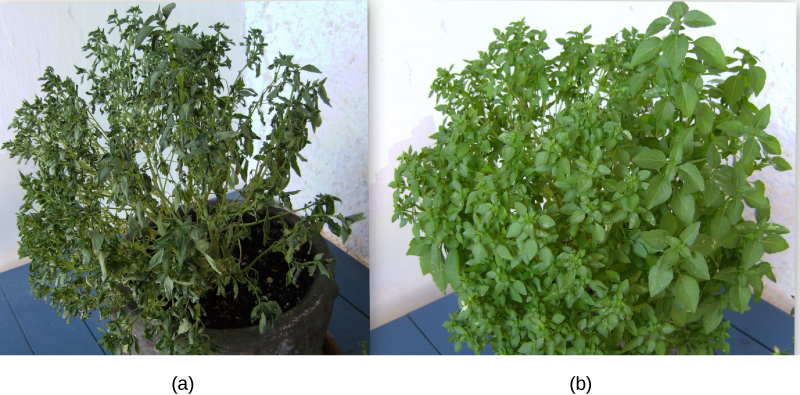
Pressure potential (Ψp), also called turgor potential, may be positive or negative (Figure 30.32). Because pressure is an expression of energy, the higher the pressure, the more potential energy in a system, and vice versa. Therefore, a positive Ψp (compression) increases Ψtotal, and a negative Ψp (tension) decreases Ψtotal. Positive pressure inside cells is contained by the cell wall, producing turgor pressure. Pressure potentials are typically around 0.6–0.8 MPa, but can reach as high as 1.5 MPa in a well-watered plant. A Ψp of 1.5 MPa equates to 210 pounds per square inch (1.5 MPa x 140 lb/in-2 MPa-1 = 210 lb/in-2). As a comparison, most automobile tires are kept at a pressure of 30–34 psi. An example of the effect of turgor pressure is the wilting of leaves and their restoration after the plant has been watered (Figure 30.33). Water is lost from the leaves via transpiration (approaching Ψp = 0 MPa at the wilting point) and restored by uptake via the roots.
英語のヒント
圧ポテンシャル(Ψp)は膨圧ポテンシャルとも呼ばれ、正にも負にもなりうる(図30.32)。圧力はエネルギーの表れなので、圧力が高いほど系のポテンシャルエネルギーは大きく、その逆も成り立つ。したがって、正のΨp(圧縮)はΨtotalを増やし、負のΨp(張力)はΨtotalを減らす。細胞内の正の圧力は細胞壁によって抑えられ、膨圧を生む。圧ポテンシャルは通常0.6〜0.8 MPaほどだが、十分に水を得た植物では1.5 MPaに達することもある。Ψpが1.5 MPaであることは、1平方インチ当たり210ポンドに相当する(1.5 MPa × 140 lb/in-2 MPa-1 = 210 lb/in-2)。比較すると、大部分の自動車のタイヤは30〜34 psiに保たれている。膨圧の影響の例は、葉のしおれと、水やり後の回復である(図30.33)。葉から水が蒸散で失われ、しおれる点ではΨp = 0 MPaに近づく。その後、根からの吸水で水が回復する。
A plant can manipulate Ψp via its ability to manipulate Ψs and by the process of osmosis. If a plant cell increases the cytoplasmic solute concentration, Ψs will decline, Ψtotal will decline, the ΔΨ between the cell and the surrounding tissue will decline, water will move into the cell by osmosis, and Ψp will increase. Ψp is also under indirect plant control via the opening and closing of stomata. Stomatal openings allow water to evaporate from the leaf, reducing Ψp and Ψtotal of the leaf and increasing Ψ between the water in the leaf and the petiole, thereby allowing water to flow from the petiole into the leaf.
植物は、Ψsを操作する能力と浸透の過程を通じて、Ψpを操作できる。植物細胞が細胞質の溶質濃度を高めると、Ψsが低下し、Ψtotalが低下し、細胞と周囲の組織の間のΔΨが低下する。水は浸透によって細胞内に移り、Ψpが上昇する。Ψpは、気孔の開閉によっても、植物の間接的な制御を受ける。気孔が開くと、葉から水が蒸発できるようになり、葉のΨpとΨtotalが低下し、葉と葉柄の水の間のΨが増加する。その結果、葉柄から葉へ水が流れる。
OpenStax, Rice University; Biology 2e. (credit: modification of work by Victor M. Vicente Selvas) · CC BY 4.0 · Source出典

Figure 30.33図 30.33
When (a) total water potential (Ψtotal) is lower outside the cells than inside, water moves out of the cells and the plant wilts. When (b) the total water potential is higher outside the plant cells than inside, water moves into the cells, resulting in turgor pressure (Ψp) and keeping the plant erect. (credit: modification of work by Victor M. Vicente Selvas)
(a)全水ポテンシャル(Ψtotal)が細胞内より細胞外で低いと、水は細胞から出て、植物はしおれる。(b)全水ポテンシャルが細胞内より細胞外で高いと、水は細胞内に入り、膨圧(Ψp)を生じて、植物を直立させる。(クレジット:Victor M. Vicente Selvas の作品を改変)
Gravity Potential重力ポテンシャル
Gravity potential (Ψg) is always negative to zero in a plant with no height. It always removes or consumes potential energy from the system. The force of gravity pulls water downwards to the soil, reducing the total amount of potential energy in the water in the plant (Ψtotal). The taller the plant, the taller the water column, and the more influential Ψg becomes. On a cellular scale and in short plants, this effect is negligible and easily ignored. However, over the height of a tall tree like a giant coastal redwood, the gravitational pull of –0.1 MPa m-1 is equivalent to an extra 10 MPa of resistance that must be overcome for water to reach the leaves of the tallest trees. Plants are unable to manipulate Ψg.
英語のヒント
重力ポテンシャル(Ψg)は常に負で、高さのない植物ではゼロとなる。これは常に、系からポテンシャルエネルギーを取り除く、または消費する。重力は水を土壌へ向けて引き下げ、植物内の水の全ポテンシャルエネルギー(Ψtotal)を減らす。植物が高いほど水柱も高くなり、Ψgの影響は大きくなる。細胞のスケールや背の低い植物では、この効果はごく小さく、容易に無視できる。しかし、巨大なセコイアのような高木の高さ全体では、−0.1 MPa m-1という重力による引き下げは、最も高い木の葉に水が届くまでに克服すべき、追加の10 MPaの抵抗に相当する。植物はΨgを操作できない。
Matric Potentialマトリックポテンシャル
Matric potential (Ψm) is always negative to zero. In a dry system, it can be as low as –2 MPa in a dry seed, and it is zero in a water-saturated system. The binding of water to a matrix always removes or consumes potential energy from the system. Ψm is similar to solute potential because it involves tying up the energy in an aqueous system by forming hydrogen bonds between the water and some other component. However, in solute potential, the other components are soluble, hydrophilic solute molecules, whereas in Ψm, the other components are insoluble, hydrophilic molecules of the plant cell wall. Every plant cell has a cellulosic cell wall and the cellulose in the cell walls is hydrophilic, producing a matrix for adhesion of water: hence the name matric potential. Ψm is very large (negative) in dry tissues such as seeds or drought-affected soils. However, it quickly goes to zero as the seed takes up water or the soil hydrates. Ψm cannot be manipulated by the plant and is typically ignored in well-watered roots, stems, and leaves.
英語のヒント
マトリックポテンシャル(Ψm)は常に負からゼロの値をとる。乾いた系、たとえば乾燥種子では−2 MPaほどまで低くなり、水で飽和した系ではゼロである。水がマトリックスに結合すると、常に系からポテンシャルエネルギーが取り除かれる、または消費される。Ψmは、水とほかの成分の間に水素結合をつくり、水系のエネルギーを拘束する点で、溶質ポテンシャルに似ている。しかし、溶質ポテンシャルでは相手は水に溶ける親水性の溶質分子であるのに対し、Ψmでは、植物細胞壁の、水に溶けない親水性分子である。すべての植物細胞はセルロース性の細胞壁をもち、そのセルロースは親水性で、水が付着するマトリックスをつくる。これが、マトリックポテンシャルという名の由来である。種子や干ばつに遭った土壌などの乾いた組織では、Ψmは負の方向に非常に大きい。しかし、種子が吸水したり土壌が水を含んだりすると、すぐにゼロへ近づく。Ψmは植物が操作できず、十分に水を得た根、茎、葉では、通常は無視される。
Movement of Water and Minerals in the Xylem木部における水と無機栄養分の移動
Solutes, pressure, gravity, and matric potential are all important for the transport of water in plants. Water moves from an area of higher total water potential (higher Gibbs free energy) to an area of lower total water potential. Gibbs free energy is the energy associated with a chemical reaction that can be used to do work. This is expressed as ΔΨ.
溶質、圧力、重力、マトリックポテンシャルは、いずれも植物の水輸送に重要である。水は、全水ポテンシャルの高い領域(ギブズ自由エネルギーの高い領域)から、低い領域へ移動する。ギブズ自由エネルギーは、化学反応に関連する、仕事に利用できるエネルギーである。これはΔΨとして表される。
Transpiration is the loss of water from the plant through evaporation at the leaf surface. It is the main driver of water movement in the xylem. Transpiration is caused by the evaporation of water at the leaf–atmosphere interface; it creates negative pressure (tension) equivalent to –2 MPa at the leaf surface. This value varies greatly depending on the vapor pressure deficit, which can be negligible at high relative humidity (RH) and substantial at low RH. Water from the roots is pulled up by this tension. At night, when stomata shut and transpiration stops, the water is held in the stem and leaf by the adhesion of water to the cell walls of the xylem vessels and tracheids, and the cohesion of water molecules to each other. This is called the cohesion–tension theory of sap ascent.
英語のヒント
蒸散は、葉の表面での蒸発によって植物から水が失われることであり、木部で水を動かす主な駆動力である。葉と大気の境界面で水が蒸発することで起こり、葉の表面に−2 MPa相当の負圧(張力)を生む。この値は飽差によって大きく異なる。飽差は、相対湿度(RH)が高ければ無視できるほど小さく、低ければ大きくなる。根の水は、この張力で引き上げられる。夜、気孔が閉じて蒸散が止まると、水は、道管や仮道管の細胞壁への付着と、水分子同士の凝集によって、茎や葉の中に保持される。これは、樹液上昇の凝集力・張力説と呼ばれる。
Inside the leaf at the cellular level, water on the surface of mesophyll cells saturates the cellulose microfibrils of the primary cell wall. The leaf contains many large intercellular air spaces for the exchange of oxygen for carbon dioxide, which is required for photosynthesis. The wet cell wall is exposed to this leaf internal air space, and the water on the surface of the cells evaporates into the air spaces, decreasing the thin film on the surface of the mesophyll cells. This decrease creates a greater tension on the water in the mesophyll cells (Figure 30.34), thereby increasing the pull on the water in the xylem vessels. The xylem vessels and tracheids are structurally adapted to cope with large changes in pressure. Rings in the vessels maintain their tubular shape, much like the rings on a vacuum cleaner hose keep the hose open while it is under pressure. Small perforations between vessel elements reduce the number and size of gas bubbles that can form via a process called cavitation. The formation of gas bubbles in xylem interrupts the continuous stream of water from the base to the top of the plant, causing a break termed an embolism in the flow of xylem sap. The taller the tree, the greater the tension forces needed to pull water, and the more cavitation events. In larger trees, the resulting embolisms can plug xylem vessels, making them nonfunctional.
英語のヒント
葉の内部を細胞レベルで見ると、葉肉細胞の表面の水が、一次細胞壁のセルロース微繊維を飽和させている。葉には、酸素と、光合成に必要な二酸化炭素を交換するための、大きな細胞間の空気の空間が多数ある。湿った細胞壁はこの内部空間に接しており、細胞表面の水がそこへ蒸発すると、葉肉細胞表面の薄い水膜が減る。水膜の減少は、葉肉細胞の水により大きな張力を生み(図30.34)、その結果、木部道管内の水を引く力を強める。道管や仮道管の構造は、大きな圧力変化に対応するよう適応している。道管の輪状の構造は、圧力がかかっていても掃除機のホースの輪が内腔を保つのと同じように、管の形を維持する。道管要素間の小さな穿孔は、キャビテーションという過程で生じうる気泡の数と大きさを減らす。木部に気泡ができると、植物の基部から頂部まで続く水の流れが途切れ、木部液の流れに、エンボリズムという閉塞が生じる。木が高いほど、水を引くために大きな張力が必要になり、キャビテーションも多くなる。大型の木では、その結果のエンボリズムが道管を塞ぎ、機能しなくなることがある。
Transpiration—the loss of water vapor to the atmosphere through stomata—is a passive process, meaning that metabolic energy in the form of ATP is not required for water movement. The energy driving transpiration is the difference in energy between the water in the soil and the water in the atmosphere. However, transpiration is tightly controlled.
英語のヒント
気孔を通じて大気へ水蒸気を失う蒸散は、受動的な過程である。つまり、水の移動にATPという形の代謝エネルギーは必要ない。蒸散を駆動するエネルギーは、土壌の水と大気中の水の間のエネルギー差である。ただし、蒸散は厳密に制御されている。