第30章植物の形態と生理
30.3 Roots30.3 根
Learning Objectives学習目標
By the end of this section, you will be able to do the following:
この節を学び終えると、次のことができるようになる。
- Identify the two types of root systems二種類の根系を挙げる。
- Describe the three zones of the root tip and summarize the role of each zone in root growth根端の三つの領域を説明し、根の成長における各領域の役割をまとめる。
- Describe the structure of the root根の構造を説明する。
- List and describe examples of modified roots変形した根の例を挙げ、説明する。
The roots of seed plants have three major functions: anchoring the plant to the soil, absorbing water and minerals and transporting them upwards, and storing the products of photosynthesis. Some roots are modified to absorb moisture and exchange gases. Most roots are underground. Some plants, however, also have adventitious roots, which emerge above the ground from the shoot.
英語のヒント
種子植物の根には、植物を土壌に固定すること、水と無機栄養分を吸収して上方へ運ぶこと、光合成産物を蓄えること、という三つの主要な機能がある。一部の根は、水分を吸収し、ガス交換するために変形している。大部分の根は地下にある。しかし、一部の植物には、地上でシュートから生じる不定根もある。
Types of Root Systems根系の種類
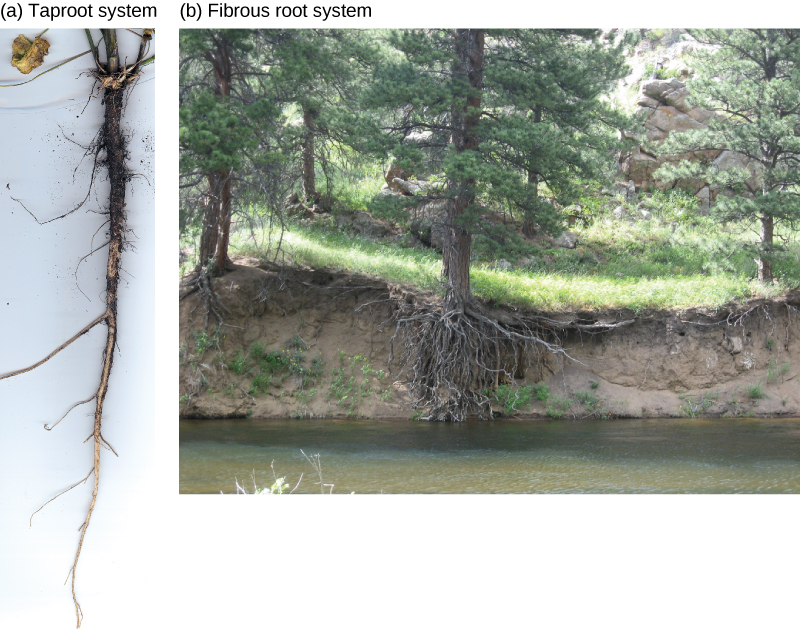
Root systems are mainly of two types (Figure 30.15). Dicots have a tap root system, while monocots have a fibrous root system. A tap root system has a main root that grows down vertically, and from which many smaller lateral roots arise. Dandelions are a good example; their tap roots usually break off when trying to pull these weeds, and they can regrow another shoot from the remaining root. A tap root system penetrates deep into the soil. In contrast, a fibrous root system is located closer to the soil surface, and forms a dense network of roots that also helps prevent soil erosion (lawn grasses are a good example, as are wheat, rice, and corn). Some plants have a combination of tap roots and fibrous roots. Plants that grow in dry areas often have deep root systems, whereas plants growing in areas with abundant water are likely to have shallower root systems.
英語のヒント
根系には、主に二つの型がある(図30.15)。双子葉植物は主根系、単子葉植物はひげ根系をもつ。主根系には、垂直に下へ伸びる主根があり、そこから多くの細い側根が生じる。タンポポがよい例である。抜こうとすると主根が途中で切れることが多く、残った根から新たなシュートを再生できる。主根系は土壌の深くへ入り込む。これに対し、ひげ根系は地表近くにあり、密な根の網をつくって土壌の浸食も防ぐ。芝草がよい例であり、コムギ、イネ、トウモロコシも同様である。一部の植物は、主根とひげ根を組み合わせてもつ。乾燥地域に育つ植物は深い根系をもつことが多く、水が豊富な地域の植物は、根系が浅い傾向がある。
OpenStax, Rice University; Biology 2e. (credit b: modification of work by “Austen Squarepants”/Flickr) · CC BY 4.0 · Source出典
Figure 30.15図 30.15
(a) Tap root systems have a main root that grows down, while (b) fibrous root systems consist of many small roots. (credit b: modification of work by “Austen Squarepants”/Flickr)
(a)主根系には、下へ伸びる主根がある。一方、(b)ひげ根系は、多くの細い根からなる。(クレジットb:「Austen Squarepants」/Flickr の作品を改変)
Root Growth and Anatomy根の成長と解剖構造
Root growth begins with seed germination. When the plant embryo emerges from the seed, the radicle of the embryo forms the root system. The tip of the root is protected by the root cap, a structure exclusive to roots and unlike any other plant structure. The root cap is continuously replaced because it gets damaged easily as the root pushes through soil. The root tip can be divided into three zones: a zone of cell division, a zone of elongation, and a zone of maturation and differentiation (Figure 30.16). The zone of cell division is closest to the root tip; it is made up of the actively dividing cells of the root meristem. The zone of elongation is where the newly formed cells increase in length, thereby lengthening the root. Beginning at the first root hair is the zone of cell maturation where the root cells begin to differentiate into special cell types. All three zones are in the first centimeter or so of the root tip.
英語のヒント
根の成長は、種子の発芽から始まる。植物の胚が種子から現れると、胚の幼根が根系をつくる。根の先端は、根に特有で、植物のほかの構造とは異なる根冠によって保護される。根が土壌を押し分けて進むと根冠は傷つきやすいため、絶えずつくり替えられる。根端は、細胞分裂帯、伸長帯、成熟・分化帯の三つの領域に分けられる(図30.16)。細胞分裂帯は根の先端に最も近く、根の分裂組織の活発に分裂する細胞からなる。伸長帯では、新しくできた細胞が長くなり、根を伸ばす。最初の根毛の位置から細胞成熟帯が始まり、ここで根の細胞は特定の細胞型へ分化し始める。三つの帯はすべて、根の先端からおよそ1 cm以内にある。
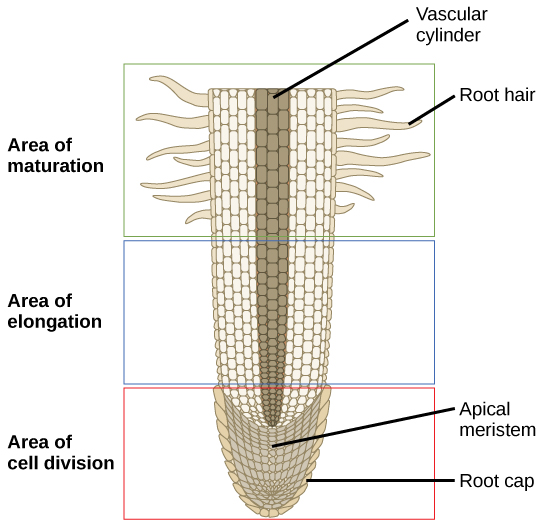
Figure 30.16図 30.16
A longitudinal view of the root reveals the zones of cell division, elongation, and maturation. Cell division occurs in the apical meristem.
根の縦断面には、細胞分裂帯、伸長帯、成熟帯が見える。細胞分裂は頂端分裂組織で起こる。
The root has an outer layer of cells called the epidermis, which surrounds areas of ground tissue and vascular tissue. The epidermis provides protection and helps in absorption. Root hairs, which are extensions of root epidermal cells, increase the surface area of the root, greatly contributing to the absorption of water and minerals.
英語のヒント
根の外側には表皮という細胞層があり、基本組織と維管束組織の領域を囲んでいる。表皮は保護を担い、吸収も助ける。根の表皮細胞が伸びたものである根毛は、根の表面積を増やし、水と無機栄養分の吸収に大きく寄与する。
Inside the root, the ground tissue forms two regions: the cortex and the pith (Figure 30.17). Compared to stems, roots have lots of cortex and little pith. Both regions include cells that store photosynthetic products. The cortex is between the epidermis and the vascular tissue, whereas the pith lies between the vascular tissue and the center of the root.
根の内部では、基本組織が皮層と髄の二つの領域をつくる(図30.17)。茎に比べ、根には皮層が多く、髄は少ない。どちらの領域にも、光合成産物を蓄える細胞がある。皮層は表皮と維管束組織の間にあり、髄は維管束組織と根の中心の間にある。
OpenStax, Rice University; Biology 2e. (credit: scale-bar data from Matt Russell) · CC BY 4.0 · Source出典
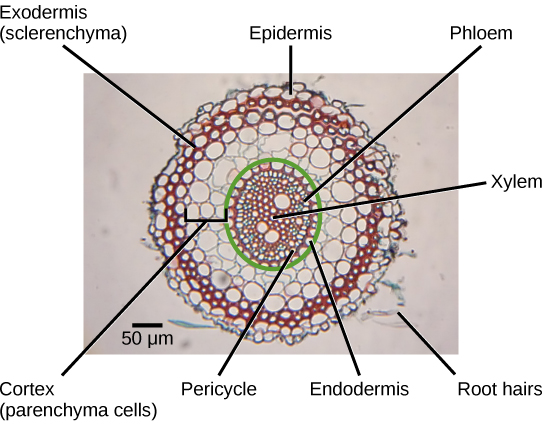
Figure 30.17図 30.17
Staining reveals different cell types in this light micrograph of a wheat (Triticum) root cross section. Sclerenchyma cells of the exodermis and xylem cells stain red, and phloem cells stain blue. Other cell types stain black. The stele, or vascular tissue, is the area inside endodermis (indicated by a green ring). Root hairs are visible outside the epidermis. (credit: scale-bar data from Matt Russell)
コムギ属(Triticum)の根の横断面の光学顕微鏡写真では、染色によって細胞型の違いがわかる。外皮の厚壁細胞と木部細胞は赤く、師部細胞は青く染まる。ほかの細胞型は黒く染まる。中心柱、すなわち維管束組織は、内皮の内側の領域であり、緑の輪で示される。表皮の外には根毛が見える。(クレジット:スケールバーのデータは Matt Russell)
The vascular tissue in the root is arranged in the inner portion of the root, which is called the stele (Figure 30.18). A layer of cells known as the endodermis separates the stele from the ground tissue in the outer portion of the root. The endodermis is exclusive to roots, and serves as a checkpoint for materials entering the root’s vascular system. A waxy substance called suberin is present on the walls of the endodermal cells. This waxy region, known as the Casparian strip, forces water and solutes to cross the plasma membranes of endodermal cells instead of slipping between the cells. This ensures that only materials required by the root pass through the endodermis, while toxic substances and pathogens are generally excluded. The outermost cell layer of the root’s vascular tissue is the pericycle, an area that can give rise to lateral roots. In dicot roots, the xylem and phloem of the stele are arranged alternately in an X shape, whereas in monocot roots, the vascular tissue is arranged in a ring around the pith.
英語のヒント
根の維管束組織は、中心柱と呼ばれる根の内側部分に配置される(図30.18)。内皮という細胞層が、中心柱と、根の外側の基本組織を隔てる。内皮は根だけに見られ、根の維管束系に入る物質の検問所として働く。内皮細胞の壁には、スベリンという蝋状物質がある。カスパリー線と呼ばれるこの蝋状の領域は、水や溶質が細胞の間をすり抜けるのを防ぎ、内皮細胞の細胞膜を通過させる。これにより、根が必要とする物質だけが内皮を通り、有毒物質や病原体は一般に排除される。根の維管束組織の最外細胞層は内鞘で、側根を生じることができる領域である。双子葉植物の根では、中心柱の木部と師部がX字形に交互に配置される。一方、単子葉植物の根では、維管束組織は髄の周囲に環状に並ぶ。
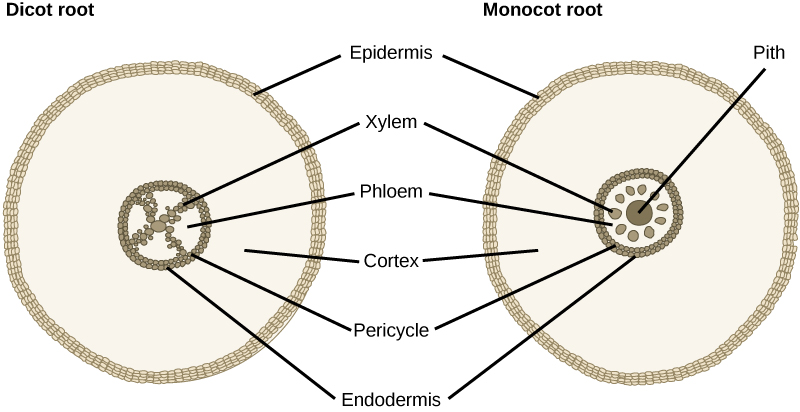


Figure 30.18図 30.18
In (left) typical dicots, the vascular tissue forms an X shape in the center of the root. In (right) typical monocots, the phloem cells and the larger xylem cells form a characteristic ring around the central pith.
典型的な双子葉植物(左)では、維管束組織は根の中心でX字形をつくる。典型的な単子葉植物(右)では、師部細胞と、より大きな木部細胞が、中央の髄の周りに特徴的な輪をつくる。