第30章植物の形態と生理
Growth in Stems茎の成長
Growth in plants occurs as the stems and roots lengthen. Some plants, especially those that are woody, also increase in thickness during their life span. The increase in length of the shoot and the root is referred to as primary growth, and is the result of cell division in the shoot apical meristem. Secondary growth is characterized by an increase in thickness or girth of the plant, and is caused by cell division in the lateral meristem. Figure 30.10 shows the areas of primary and secondary growth in a plant. Herbaceous plants mostly undergo primary growth, with hardly any secondary growth or increase in thickness. Secondary growth or “wood” is noticeable in woody plants; it occurs in some dicots, but occurs very rarely in monocots.
英語のヒント
植物は、茎と根が伸びることで成長する。特に木本植物など、一部の植物は、生涯の間に太さも増す。シュートと根が長くなることを一次成長といい、シュート頂端分裂組織での細胞分裂の結果として起こる。二次成長は、植物の太さや周囲が増すことを特徴とし、側方分裂組織での細胞分裂によって起こる。図30.10は、植物で一次成長と二次成長が起こる領域を示す。草本植物は主に一次成長を行い、二次成長や肥大はほとんどしない。二次成長、すなわち「木材」の形成は、木本植物で目立つ。一部の双子葉植物に見られるが、単子葉植物では非常にまれである。
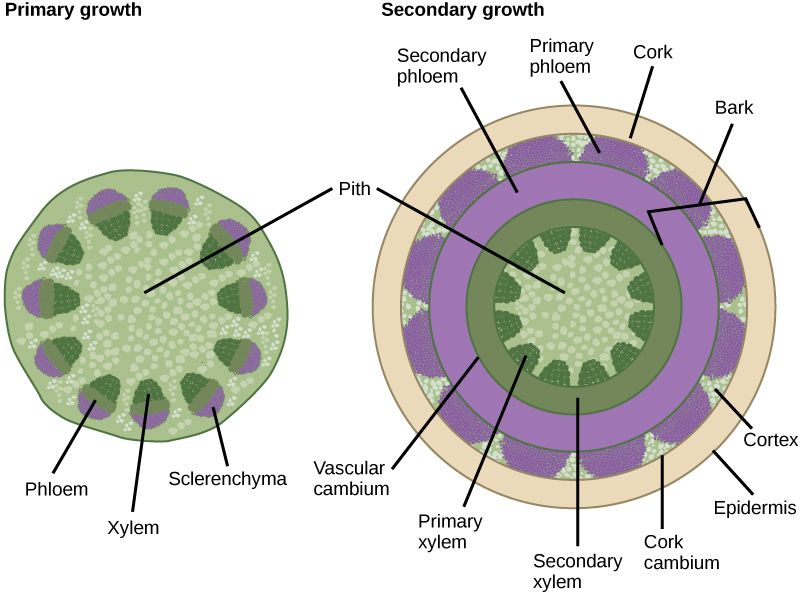
Figure 30.10図 30.10
In woody plants, primary growth is followed by secondary growth, which allows the plant stem to increase in thickness or girth. Secondary vascular tissue is added as the plant grows, as well as a cork layer. The bark of a tree extends from the vascular cambium to the epidermis.
木本植物では、一次成長に続いて二次成長が起こり、茎の太さや周囲が増す。植物の成長に伴い、二次維管束組織とコルク層が加わる。樹皮は、維管束形成層から表皮までの範囲に及ぶ。
Some plant parts, such as stems and roots, continue to grow throughout a plant’s life: a phenomenon called indeterminate growth. Other plant parts, such as leaves and flowers, exhibit determinate growth, which ceases when a plant part reaches a particular size.
英語のヒント
茎や根など、植物の一部の部分は、生涯を通じて成長し続ける。これは無限成長と呼ばれる現象である。一方、葉や花などは、その部分が特定の大きさに達すると止まる、有限成長を示す。
Primary Growth一次成長
Most primary growth occurs at the apices, or tips, of stems and roots. Primary growth is a result of rapidly dividing cells in the apical meristems at the shoot tip and root tip. Subsequent cell elongation also contributes to primary growth. The growth of shoots and roots during primary growth enables plants to continuously seek water (roots) or sunlight (shoots).
英語のヒント
一次成長の大部分は、茎と根の頂端、すなわち先端で起こる。シュート頂端と根端の頂端分裂組織で、細胞が速やかに分裂することによる。その後の細胞の伸長も一次成長に寄与する。一次成長によってシュートと根が伸びるため、植物は、根で水を、シュートで日光を、継続的に求めることができる。
The influence of the apical bud on overall plant growth is known as apical dominance, which diminishes the growth of axillary buds that form along the sides of branches and stems. Most coniferous trees exhibit strong apical dominance, thus producing the typical conical Christmas tree shape. If the apical bud is removed, then the axillary buds will start forming lateral branches. Gardeners make use of this fact when they prune plants by cutting off the tops of branches, thus encouraging the axillary buds to grow out, giving the plant a bushy shape.
英語のヒント
頂芽が植物全体の成長に及ぼす影響は、頂芽優勢として知られる。これは、枝や茎の側面にできる腋芽の成長を抑える。大部分の針葉樹は強い頂芽優勢を示し、そのため典型的なクリスマスツリーの円錐形になる。頂芽を取り除くと、腋芽が側枝を形成し始める。庭師はこの性質を利用し、枝の先端を切り落として剪定する。こうして腋芽の成長を促し、植物をこんもりした形にする。
Secondary Growth二次成長
The increase in stem thickness that results from secondary growth is due to the activity of the lateral meristems, which are lacking in herbaceous plants. Lateral meristems include the vascular cambium and, in woody plants, the cork cambium (see Figure 30.10). The vascular cambium is located just outside the primary xylem and to the interior of the primary phloem. The cells of the vascular cambium divide and form secondary xylem (tracheids and vessel elements) to the inside, and secondary phloem (sieve elements and companion cells) to the outside. The thickening of the stem that occurs in secondary growth is due to the formation of secondary phloem and secondary xylem by the vascular cambium, plus the action of cork cambium, which forms the tough outermost layer of the stem. The cells of the secondary xylem contain lignin, which provides hardiness and strength.
英語のヒント
二次成長による茎の肥大は、草本植物にはない側方分裂組織の活動によって起こる。側方分裂組織には、維管束形成層と、木本植物のコルク形成層が含まれる(図30.10参照)。維管束形成層は、一次木部のすぐ外側、一次師部の内側に位置する。その細胞が分裂すると、内側に二次木部(仮道管と道管要素)、外側に二次師部(師要素と伴細胞)が形成される。二次成長時の茎の肥大は、維管束形成層による二次師部・二次木部の形成に、茎の丈夫な最外層をつくるコルク形成層の働きが加わって起こる。二次木部の細胞にはリグニンが含まれ、丈夫さと強度を与える。
In woody plants, cork cambium is the outermost lateral meristem. It produces cork cells (bark) containing a waxy substance known as suberin that can repel water. The bark protects the plant against physical damage and helps reduce water loss. The cork cambium also produces a layer of cells known as phelloderm, which grows inward from the cambium. The cork cambium, cork cells, and phelloderm are collectively termed the periderm. The periderm substitutes for the epidermis in mature plants. In some plants, the periderm has many openings, known as lenticels, which allow the interior cells to exchange gases with the outside atmosphere (Figure 30.11). This supplies oxygen to the living and metabolically active cells of the cortex, xylem, and phloem.
英語のヒント
木本植物では、コルク形成層が最も外側の側方分裂組織である。これは、水をはじくことのできるスベリンという蝋状物質を含むコルク細胞(樹皮)をつくる。樹皮は植物を物理的な損傷から守り、水分の損失を減らすのを助ける。コルク形成層は、内側へ成長するコルク皮層という細胞層もつくる。コルク形成層、コルク細胞、コルク皮層を合わせて、周皮という。成熟した植物では、周皮が表皮に取って代わる。一部の植物の周皮には、皮目という多数の開口部がある。これにより、内部の細胞は外気とガスを交換できる(図30.11)。その結果、皮層、木部、師部にある、生きていて代謝の活発な細胞へ、酸素が供給される。
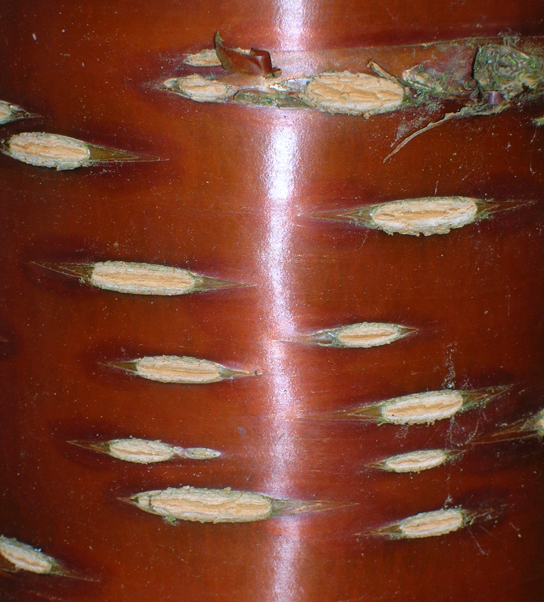


Figure 30.11図 30.11
Lenticels on the bark of this cherry tree enable the woody stem to exchange gases with the surrounding atmosphere. (credit: Roger Griffith)
このサクラの樹皮の皮目によって、木質の茎は周囲の大気とガス交換できる。(クレジット:Roger Griffith)