第30章植物の形態と生理
Leaf Structure and Function葉の構造と機能
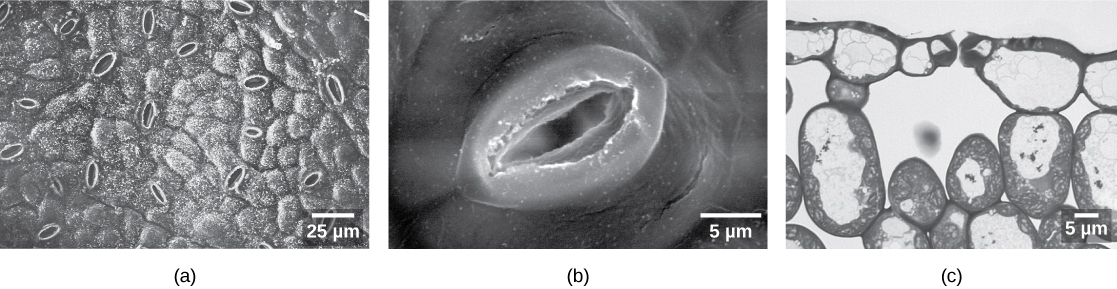
The outermost layer of the leaf is the epidermis; it is present on both sides of the leaf and is called the upper and lower epidermis, respectively. Botanists call the upper side the adaxial surface (or adaxis) and the lower side the abaxial surface (or abaxis). The epidermis helps in the regulation of gas exchange. It contains stomata (Figure 30.24): openings through which the exchange of gases takes place. Two guard cells surround each stoma, regulating its opening and closing.
英語のヒント
葉の最外層は表皮であり、葉の両面にあって、それぞれ上側表皮と下側表皮と呼ばれる。植物学者は、上面を向軸面、下面を背軸面と呼ぶ。表皮はガス交換の調節を助ける。表皮には、ガス交換が行われる開口部である気孔がある(図30.24)。それぞれの気孔を2個の孔辺細胞が囲み、開閉を調節する。
OpenStax, Rice University; Biology 2e. (credit: modification of work by Robert R. Wise; part c scale-bar data from Matt Russell) · CC BY 4.0 · Source出典

Figure 30.24図 30.24
Visualized at 500x with a scanning electron microscope, several stomata are clearly visible on (a) the surface of this sumac (Rhus glabra) leaf. At 5,000x magnification, the guard cells of (b) a single stoma from lyre-leaved sand cress (Arabidopsis lyrata) have the appearance of lips that surround the opening. In this (c) light micrograph cross-section of an A. lyrata leaf, the guard cell pair is visible along with the large, sub-stomatal air space in the leaf. (credit: modification of work by Robert R. Wise; part c scale-bar data from Matt Russell)
(a)ヌルデ属の Rhus glabra の葉の表面を、走査電子顕微鏡で500倍にすると、複数の気孔がはっきり見える。(b)Arabidopsis lyrata の一つの気孔を5000倍にすると、孔辺細胞は開口部を囲む唇のように見える。(c)A. lyrata の葉の横断面の光学顕微鏡写真では、対をなす孔辺細胞と、その下にある葉内の大きな気孔下腔が見える。(クレジット:Robert R. Wise の作品を改変。cのスケールバーのデータ:Matt Russell)
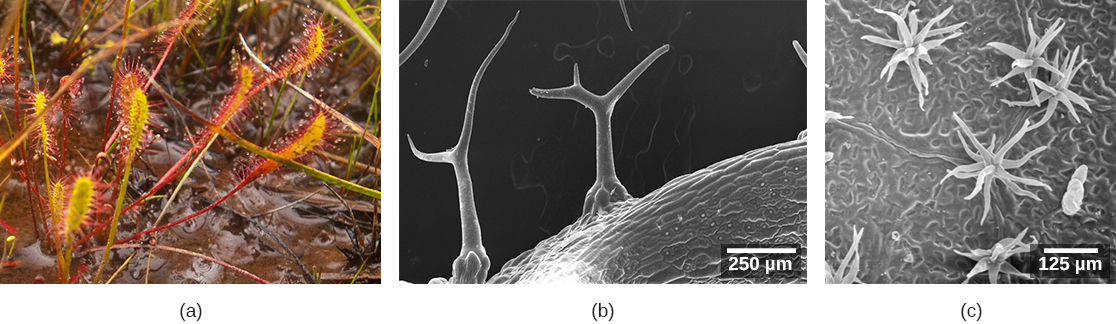
The epidermis is usually one cell layer thick; however, in plants that grow in very hot or very cold conditions, the epidermis may be several layers thick to protect against excessive water loss from transpiration. A waxy layer known as the cuticle covers the leaves of all plant species. The cuticle reduces the rate of water loss from the leaf surface. Other leaves may have small hairs (trichomes) on the leaf surface. Trichomes help to deter herbivory by restricting insect movements, or by storing toxic or bad-tasting compounds; they can also reduce the rate of transpiration by blocking air flow across the leaf surface (Figure 30.25).
英語のヒント
表皮は通常1細胞層の厚さだが、非常に暑い、または非常に寒い条件で育つ植物では、蒸散による過剰な水分損失を防ぐために、数層の厚さになることがある。すべての植物種の葉は、クチクラという蝋状の層で覆われる。クチクラは、葉の表面からの水分損失を遅くする。葉の表面に小さな毛(毛状突起)があるものもいる。毛状突起は、昆虫の動きを制限したり、有毒またはまずい味の化合物を蓄えたりすることで、植食を抑える。また、葉の表面を横切る空気の流れを妨げ、蒸散速度を下げることもできる(図30.25)。
OpenStax, Rice University; Biology 2e. (credit a: John Freeland; credit b, c: modification of work by Robert R. Wise; scale-bar data from Matt Russell) Embedded rights notice: Copyright 2011 John Freeland · CC BY 4.0 · Source出典

Figure 30.25図 30.25
Trichomes give leaves a fuzzy appearance as in this (a) sundew (Drosera sp.). Leaf trichomes include (b) branched trichomes on the leaf of Arabidopsis lyrata and (c) multibranched trichomes on a mature Quercus marilandica leaf. (credit a: John Freeland; credit b, c: modification of work by Robert R. Wise; scale-bar data from Matt Russell)
毛状突起は、(a)このモウセンゴケ属(Drosera)のように、葉を毛で覆われた外観にする。葉の毛状突起には、(b)Arabidopsis lyrata の葉にある分岐した毛状突起や、(c)成熟した Quercus marilandica の葉にある多分岐の毛状突起が含まれる。(クレジットa:John Freeland。b、c:Robert R. Wise の作品を改変。スケールバーのデータ:Matt Russell)
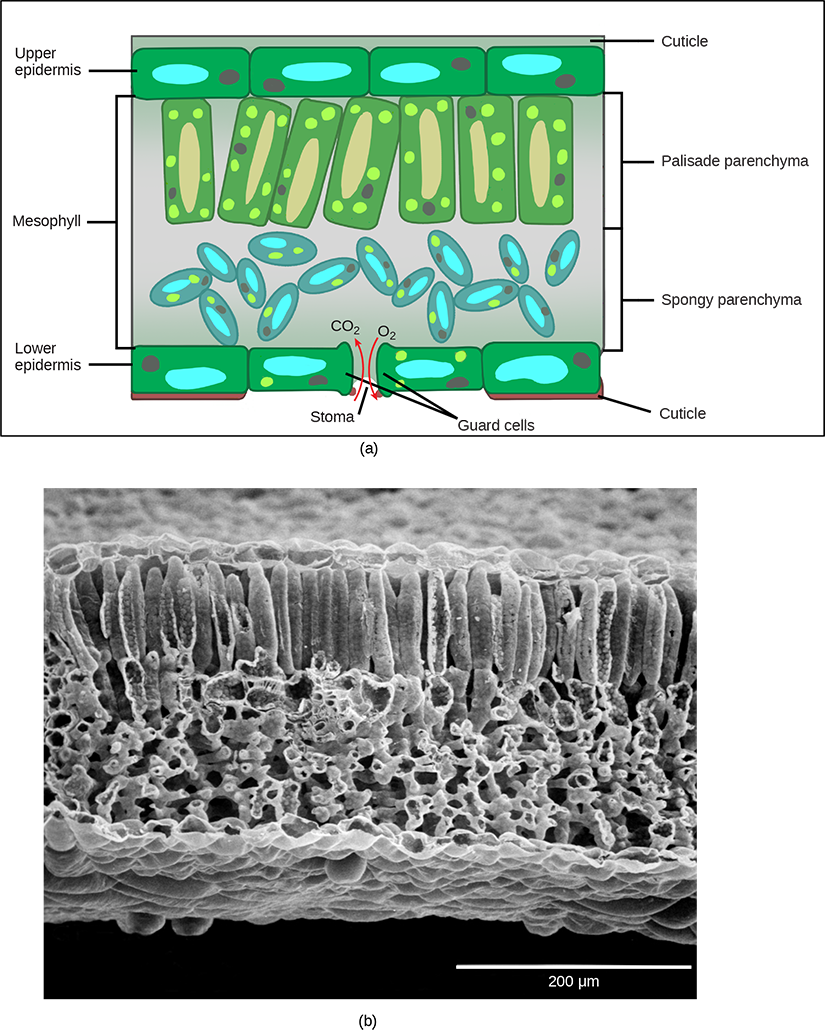
Below the epidermis of dicot leaves are layers of cells known as the mesophyll, or “middle leaf.” The mesophyll of most leaves typically contains two arrangements of parenchyma cells: the palisade parenchyma and spongy parenchyma (Figure 30.26). The palisade parenchyma (also called the palisade mesophyll) has column-shaped, tightly packed cells, and may be present in one, two, or three layers. Below the palisade parenchyma are loosely arranged cells of an irregular shape. These are the cells of the spongy parenchyma (or spongy mesophyll). The air space found between the spongy parenchyma cells allows gaseous exchange between the leaf and the outside atmosphere through the stomata. In aquatic plants, the intercellular spaces in the spongy parenchyma help the leaf float. Both layers of the mesophyll contain many chloroplasts. Guard cells are the only epidermal cells to contain chloroplasts.
英語のヒント
双子葉植物の葉の表皮の下には、葉肉、すなわち「葉の中央」と呼ばれる細胞層がある。大部分の葉の葉肉には通常、柔細胞の二つの配列、柵状柔組織と海綿状柔組織がある(図30.26)。柵状柔組織(柵状葉肉ともいう)は、密に詰まった柱状の細胞からなり、1〜3層あることがある。その下には、不規則な形の細胞が緩く並ぶ。これが、海綿状柔組織(海綿状葉肉)の細胞である。細胞間の空気の空間によって、葉は気孔を通じて外気とガス交換できる。水生植物では、この細胞間隙が葉を浮かせるのに役立つ。葉肉の両層には、多数の葉緑体がある。表皮細胞のうち葉緑体を含むのは、孔辺細胞だけである。
OpenStax, Rice University; Biology 2e. (credit b: modification of work by Robert R. Wise) · CC BY 4.0 · Source出典

Figure 30.26図 30.26
In the (a) leaf drawing, the central mesophyll is sandwiched between an upper and lower epidermis. The mesophyll has two layers: an upper palisade layer comprised of tightly packed, columnar cells, and a lower spongy layer, comprised of loosely packed, irregularly shaped cells. Stomata on the leaf underside allow gas exchange. A waxy cuticle covers all aerial surfaces of land plants to minimize water loss. These leaf layers are clearly visible in the (b) scanning electron micrograph. The numerous small bumps in the palisade parenchyma cells are chloroplasts. Chloroplasts are also present in the spongy parenchyma, but are not as obvious. The bumps protruding from the lower surface of the leave are glandular trichomes, which differ in structure from the stalked trichomes in Figure 30.25. (credit b: modification of work by Robert R. Wise)
(a)葉の図では、中央の葉肉が上下の表皮に挟まれている。葉肉は二層あり、上の柵状層は密に詰まった柱状細胞、下の海綿状層は緩く並んだ不規則な形の細胞からなる。葉の下面の気孔はガス交換を可能にする。陸上植物の地上の表面は、蝋状のクチクラで覆われ、水分損失が最小限に抑えられる。(b)走査電子顕微鏡写真には、これらの層がはっきり見える。柵状柔組織細胞の多数の小さな突起は葉緑体である。海綿状柔組織にも葉緑体はあるが、それほど目立たない。葉の下面から突き出る隆起は腺毛であり、図30.25の柄をもつ毛状突起とは構造が異なる。(クレジットb:Robert R. Wise の作品を改変)
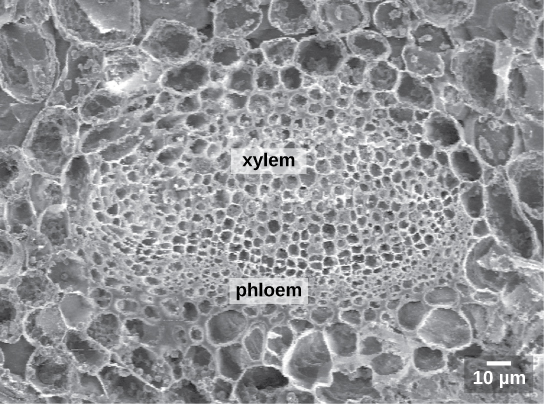
Like the stem, the leaf contains vascular bundles composed of xylem and phloem (Figure 30.27). The xylem consists of tracheids and vessels, which transport water and minerals to the leaves. The phloem transports the photosynthetic products from the leaf to the other parts of the plant. A single vascular bundle, no matter how large or small, always contains both xylem and phloem tissues.
英語のヒント
茎と同様、葉にも木部と師部からなる維管束がある(図30.27)。木部は仮道管と道管からなり、葉へ水と無機栄養分を運ぶ。師部は、葉から植物のほかの部分へ光合成産物を運ぶ。一つの維管束には、大きさにかかわらず、常に木部と師部の両方が含まれる。
OpenStax, Rice University; Biology 2e. (credit: modification of work by Robert R. Wise; scale-bar data from Matt Russell) · CC BY 4.0 · Source出典

Figure 30.27図 30.27
This scanning electron micrograph shows xylem and phloem in the leaf vascular bundle from the lyre-leaved sand cress (Arabidopsis lyrata). (credit: modification of work by Robert R. Wise; scale-bar data from Matt Russell)
この走査電子顕微鏡写真は、Arabidopsis lyrata の葉の維管束内の木部と師部を示す。(クレジット:Robert R. Wise の作品を改変。スケールバーのデータ:Matt Russell)