第30章植物の形態と生理
Annual Rings年輪
The activity of the vascular cambium gives rise to annual growth rings. During the spring growing season, cells of the secondary xylem have a large internal diameter and their primary cell walls are not extensively thickened. This is known as early wood, or spring wood. During the fall season, the secondary xylem develops thickened cell walls, forming late wood, or autumn wood, which is denser than early wood. This alternation of early and late wood is due largely to a seasonal decrease in the number of vessel elements and a seasonal increase in the number of tracheids. It results in the formation of an annual ring, which can be seen as a circular ring in the cross section of the stem (Figure 30.12). An examination of the number of annual rings and their nature (such as their size and cell wall thickness) can reveal the age of the tree and the prevailing climatic conditions during each season.
英語のヒント
維管束形成層の活動によって、年ごとの成長輪が生じる。春の成長期には、二次木部の細胞の内径が大きく、一次細胞壁はあまり厚くなっていない。これを早材、または春材という。秋には、二次木部の細胞壁が厚くなり、早材より密度の高い晩材、または秋材ができる。早材と晩材の交替は、主に、季節に伴って道管要素の数が減り、仮道管の数が増えることによる。その結果、茎の横断面で円形の輪として見える年輪ができる(図30.12)。年輪の数と、幅や細胞壁の厚さなどの性質を調べると、木の年齢や、各季節にどのような気候条件が続いたかを知ることができる。
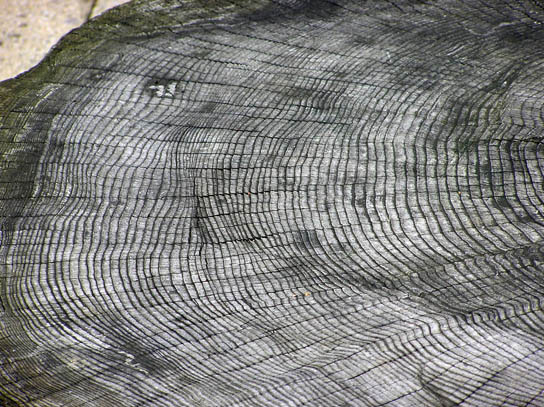

Figure 30.12図 30.12
The rate of wood growth increases in summer and decreases in winter, producing a characteristic ring for each year of growth. Seasonal changes in weather patterns can also affect the growth rate—note how the rings vary in thickness. (credit: Adrian Pingstone)
木材の成長速度は夏に増し、冬に低下するため、成長の1年ごとに特徴的な輪ができる。季節ごとの天候の変化も成長速度に影響する。輪の幅がどのように異なるかに注目しよう。(クレジット:Adrian Pingstone)
Stem Modifications茎の変形
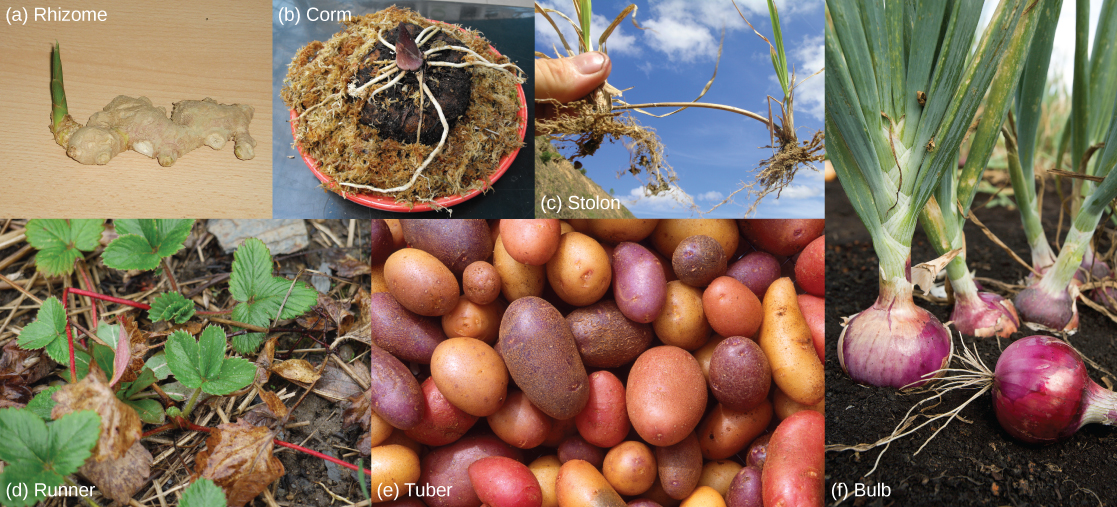
Some plant species have modified stems that are especially suited to a particular habitat and environment (Figure 30.13). A rhizome is a modified stem that grows horizontally underground and has nodes and internodes. Vertical shoots may arise from the buds on the rhizome of some plants, such as ginger and ferns. Corms are similar to rhizomes, except they are more rounded and fleshy (such as in gladiolus). Corms contain stored food that enables some plants to survive the winter. Stolons are stems that run almost parallel to the ground, or just below the surface, and can give rise to new plants at the nodes. Runners are a type of stolon that runs above the ground and produces new clone plants at nodes at varying intervals: strawberries are an example. Tubers are modified stems that may store starch, as seen in the potato (Solanum sp.). Tubers arise as swollen ends of stolons, and contain many adventitious or unusual buds (familiar to us as the “eyes” on potatoes). A bulb, which functions as an underground storage unit, is a modification of a stem that has the appearance of enlarged fleshy leaves emerging from the stem or surrounding the base of the stem, as seen in the iris.
英語のヒント
一部の植物種には、特定の生息地や環境によく適した変形茎がある(図30.13)。根茎は、地下を水平に成長する変形茎で、節と節間をもつ。ショウガやシダなどでは、根茎上の芽から、垂直に伸びるシュートが生じることがある。球茎は根茎に似るが、グラジオラスのように、より丸く多肉質である。球茎には養分が蓄えられ、一部の植物の越冬を可能にする。匍匐茎は、地表とほぼ平行、または地表のすぐ下を走る茎で、節から新しい植物を生じることができる。ランナーは地上を走る匍匐茎の一型で、さまざまな間隔にある節から、新しいクローン植物をつくる。イチゴがその例である。塊茎は、ジャガイモ(ナス属)に見られるように、デンプンを蓄えることのある変形茎である。匍匐茎の先端が膨らんででき、多くの不定芽、すなわち通常とは異なる位置の芽を含む。これは、ジャガイモの「目」としてなじみがある。鱗茎は地下の貯蔵器官として働く変形茎であり、アイリスに見られるように、肥大した多肉質の葉が茎から出たり、茎の基部を囲んだりする外観をもつ。
OpenStax, Rice University; Biology 2e. (credit a: modification of work by Maja Dumat; credit c: modification of work by Harry Rose; credit d: modification of work by Rebecca Siegel; credit e: modification of work by Scott Bauer, USDA ARS; credit f: modification of work by Stephen Ausmus, USDA ARS) · CC BY 4.0 · Source出典

Figure 30.13図 30.13
Stem modifications enable plants to thrive in a variety of environments. Shown are (a) ginger (Zingiber officinale) rhizomes, (b) a carrion flower (Amorphophallus titanum) corm, (c) Rhodes grass (Chloris gayana) stolons, (d) strawberry (Fragaria ananassa) runners, (e) potato (Solanum tuberosum) tubers, and (f) red onion (Allium) bulbs. (credit a: modification of work by Maja Dumat; credit c: modification of work by Harry Rose; credit d: modification of work by Rebecca Siegel; credit e: modification of work by Scott Bauer, USDA ARS; credit f: modification of work by Stephen Ausmus, USDA ARS)
茎の変形により、植物はさまざまな環境でよく生育できる。示しているのは、(a)ショウガ(Zingiber officinale)の根茎、(b)ショクダイオオコンニャク(Amorphophallus titanum)の球茎、(c)ローズグラス(Chloris gayana)の匍匐茎、(d)イチゴ(Fragaria ananassa)のランナー、(e)ジャガイモ(Solanum tuberosum)の塊茎、(f)赤タマネギ(Allium)の鱗茎である。(クレジットa:Maja Dumat、c:Harry Rose、d:Rebecca Siegel、e:Scott Bauer, USDA ARS、f:Stephen Ausmus, USDA ARS、それぞれの作品を改変)
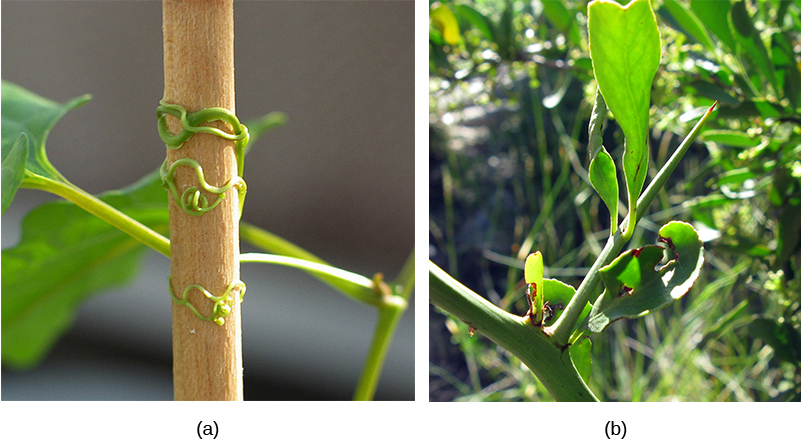
Some aerial modifications of stems are tendrils and thorns (Figure 30.14). Tendrils are slender, twining strands that enable a plant (like a vine or pumpkin) to seek support by climbing on other surfaces. Thorns are modified branches appearing as sharp outgrowths that protect the plant; common examples include roses, Osage orange, and devil’s walking stick.
英語のヒント
茎の地上での変形には、巻きひげと棘がある(図30.14)。巻きひげは、細く巻きつく糸状の構造で、つる植物やカボチャなどが、ほかの表面をよじ登って支えを得るのを可能にする。棘は、植物を守る鋭い突起となった変形した枝であり、一般的な例には、バラ、オーセージオレンジ、アメリカタラノキがある。
OpenStax, Rice University; Biology 2e. (credit a: modification of work by Christopher Meloche, USDA ARS; credit b: modification of work by "JonRichfield"/Wikimedia Commons) · CC BY 4.0 · Source出典

Figure 30.14図 30.14
Found in southeastern United States, (a) buckwheat vine (Brunnichia ovata) is a weedy plant that climbs with the aid of tendrils. This one is shown climbing up a wooden stake. (b) Thorns are modified branches. (credit a: modification of work by Christopher Meloche, USDA ARS; credit b: modification of work by "JonRichfield"/Wikimedia Commons)
米国南東部に見られる(a)ブルンニキア(Brunnichia ovata)は、巻きひげでよじ登る雑草性の植物である。ここでは木の杭を登っている。(b)棘は変形した枝である。(クレジットa:Christopher Meloche, USDA ARS の作品を改変。クレジットb:「JonRichfield」/Wikimedia Commons の作品を改変)
Section Summaryこの節のまとめ
The stem of a plant bears the leaves, flowers, and fruits. Stems are characterized by the presence of nodes (the points of attachment for leaves or branches) and internodes (regions between nodes).
植物の茎は、葉、花、果実をつける。茎は、節(葉や枝がつく場所)と節間(節と節の間の領域)をもつことを特徴とする。
Plant organs are made up of simple and complex tissues. The stem has three tissue systems: dermal, vascular, and ground tissue. Dermal tissue is the outer covering of the plant. It contains epidermal cells, stomata, guard cells, and trichomes. Vascular tissue is made up of xylem and phloem tissues and conducts water, minerals, and photosynthetic products. Ground tissue is responsible for photosynthesis and support and is composed of parenchyma, collenchyma, and sclerenchyma cells.
植物の器官は、単純組織と複合組織からできている。茎には、表皮系、維管束組織、基本組織という三つの組織系がある。表皮系は植物の外側の覆いで、表皮細胞、気孔、孔辺細胞、毛状突起を含む。維管束組織は木部と師部からなり、水、無機栄養分、光合成産物を運ぶ。基本組織は光合成と支持を担い、柔細胞、厚角細胞、厚壁細胞からなる。
Primary growth occurs at the tips of roots and shoots, causing an increase in length. Woody plants may also exhibit secondary growth, or increase in thickness. In woody plants, especially trees, annual rings may form as growth slows at the end of each season. Some plant species have modified stems that help to store food, propagate new plants, or discourage predators. Rhizomes, corms, stolons, runners, tubers, bulbs, tendrils, and thorns are examples of modified stems.
一次成長は、根とシュートの先端で起こり、長さを増す。木本植物では、二次成長、すなわち太さの増大も見られる。木本植物、特に樹木では、各季節の終わりに成長が遅くなることで、年輪ができることがある。一部の植物種には、養分の貯蔵、新たな植物の繁殖、捕食者の抑止に役立つ変形茎がある。根茎、球茎、匍匐茎、ランナー、塊茎、鱗茎、巻きひげ、棘は、その例である。