第30章植物の形態と生理
Growth Responses成長応答
A plant’s sensory response to external stimuli relies on chemical messengers (hormones). Plant hormones affect all aspects of plant life, from flowering to fruit setting and maturation, and from phototropism to leaf fall. Potentially every cell in a plant can produce plant hormones. They can act in their cell of origin or be transported to other portions of the plant body, with many plant responses involving the synergistic or antagonistic interaction of two or more hormones. In contrast, animal hormones are produced in specific glands and transported to a distant site for action, and they act alone.
外部刺激に対する植物の感覚応答は、化学的な伝達物質であるホルモンに依存する。植物ホルモンは、開花から結実と成熟まで、光屈性から落葉まで、植物の生活のあらゆる面に影響する。原理的には、植物のどの細胞も植物ホルモンを作ることができる。植物ホルモンは、作られた細胞で働くことも、植物体の別の部分へ運ばれることもある。多くの植物の応答には、二つ以上のホルモンの相乗的または拮抗的な相互作用が関わる。これに対し、動物ホルモンは特定の腺で作られ、離れた場所へ運ばれて作用し、単独で働く。
Plant hormones are a group of unrelated chemical substances that affect plant morphogenesis. Five major plant hormones are traditionally described: auxins (particularly IAA), cytokinins, gibberellins, ethylene, and abscisic acid. In addition, other nutrients and environmental conditions can be characterized as growth factors.
植物ホルモンは、植物の形態形成に影響する、互いに関連のない化学物質の集まりである。従来、主要な植物ホルモンとして、オーキシン(とくにIAA)、サイトカイニン、ジベレリン、エチレン、アブシシン酸の5種類が挙げられてきた。そのほかの栄養物質や環境条件も、成長因子として位置づけることができる。
Auxinsオーキシン
The term auxin is derived from the Greek word auxein, which means "to grow." Auxins are the main hormones responsible for cell elongation in phototropism and gravitropism. They also control the differentiation of meristem into vascular tissue, and promote leaf development and arrangement. While many synthetic auxins are used as herbicides, IAA is the only naturally occurring auxin that shows physiological activity. Apical dominance—the inhibition of lateral bud formation—is triggered by auxins produced in the apical meristem. Flowering, fruit setting and ripening, and inhibition of abscission (leaf falling) are other plant responses under the direct or indirect control of auxins. Auxins also act as a relay for the effects of the blue light and red/far-red responses.
英語のヒント
オーキシンという語は、「成長する」を意味するギリシャ語 auxein に由来する。オーキシンは、光屈性と重力屈性における細胞伸長を担う主要なホルモンである。また、分裂組織から維管束組織への分化を制御し、葉の発達と配置を促す。多くの合成オーキシンが除草剤として使われる一方、生理活性を示す天然のオーキシンはIAAだけである。側芽の形成が抑えられる頂芽優勢は、頂端分裂組織で作られるオーキシンによって引き起こされる。開花、結実と果実の成熟、離脱(落葉)の抑制も、オーキシンの直接または間接の制御下にある植物の応答である。オーキシンは、青色光応答と赤色光・遠赤色光応答の効果を中継する役割も果たす。
Commercial use of auxins is widespread in plant nurseries and for crop production. IAA is used as a rooting hormone to promote growth of adventitious roots on cuttings and detached leaves. Applying synthetic auxins to tomato plants in greenhouses promotes normal fruit development. Outdoor application of auxin promotes synchronization of fruit setting and dropping to coordinate the harvesting season. Fruits such as seedless cucumbers can be induced to set fruit by treating unfertilized plant flowers with auxins.
苗木の生産や作物栽培では、オーキシンが広く商業利用されている。IAAは発根ホルモンとして使われ、挿し木や切り離した葉での不定根の成長を促す。温室のトマトに合成オーキシンを与えると、正常な果実の発達が促進される。屋外でオーキシンを使うと、結実や落果の時期がそろい、収穫時期を調整できる。種なしキュウリなどでは、未受精の花をオーキシンで処理することで結実を誘導できる。
Cytokininsサイトカイニン
The effect of cytokinins was first reported when it was found that adding the liquid endosperm of coconuts to developing plant embryos in culture stimulated their growth. The stimulating growth factor was found to be cytokinin, a hormone that promotes cytokinesis (cell division). Almost 200 naturally occurring or synthetic cytokinins are known to date. Cytokinins are most abundant in growing tissues, such as roots, embryos, and fruits, where cell division is occurring. Cytokinins are known to delay senescence in leaf tissues, promote mitosis, and stimulate differentiation of the meristem in shoots and roots. Many effects on plant development are under the influence of cytokinins, either in conjunction with auxin or another hormone. For example, apical dominance seems to result from a balance between auxins that inhibit lateral buds, and cytokinins that promote bushier growth.
英語のヒント
サイトカイニンの効果は、培養中の発生途上の植物胚へココナッツの液状胚乳を加えると、その成長が促進されるという発見によって初めて報告された。この成長促進因子は、細胞質分裂(細胞分裂)を促すホルモン、サイトカイニンであることが分かった。現在までに、天然または合成のサイトカイニンが約200種類知られている。サイトカイニンは、根、胚、果実など、細胞分裂が起こっている成長中の組織にもっとも多い。葉の組織の老化を遅らせ、有糸分裂を促し、シュートや根の分裂組織の分化を刺激することが知られている。植物の発生の多くの面は、オーキシンやほかのホルモンと組み合わさったサイトカイニンの影響下にある。たとえば頂芽優勢は、側芽を抑えるオーキシンと、枝葉をより茂らせるサイトカイニンの均衡から生じると考えられる。
Gibberellinsジベレリン
Gibberellins (GAs) are a group of about 125 closely related plant hormones that stimulate shoot elongation, seed germination, and fruit and flower maturation. GAs are synthesized in the root and stem apical meristems, young leaves, and seed embryos. In urban areas, GA antagonists are sometimes applied to trees under power lines to control growth and reduce the frequency of pruning.
ジベレリン(GA)は、互いによく似た約125種類の植物ホルモンの一群で、シュートの伸長、種子の発芽、果実や花の成熟を刺激する。GAは根や茎の頂端分裂組織、若い葉、種子の胚で合成される。都市部では、成長を抑えて剪定の頻度を減らすため、電線の下の樹木にGAの拮抗物質を与えることがある。
GAs break dormancy (a state of inhibited growth and development) in the seeds of plants that require exposure to cold or light to germinate. Abscisic acid is a strong antagonist of GA action. Other effects of GAs include gender expression, seedless fruit development, and the delay of senescence in leaves and fruit. Seedless grapes are obtained through standard breeding methods and contain inconspicuous seeds that fail to develop. Because GAs are produced by the seeds, and because fruit development and stem elongation are under GA control, these varieties of grapes would normally produce small fruit in compact clusters. Maturing grapes are routinely treated with GA to promote larger fruit size, as well as looser bunches (longer stems), which reduces the instance of mildew infection (Figure 30.40).
GAは、発芽に低温や光を必要とする植物の種子で、休眠(成長や発生が抑えられた状態)を打ち破る。アブシシン酸は、GAの作用に対する強力な拮抗物質である。GAのほかの効果には、性の発現、種なし果実の発達、葉や果実の老化の遅延がある。種なしブドウは一般的な育種法で得られ、発達しない目立たない種子を含んでいる。GAは種子で作られ、果実の発達や茎の伸長はGAの制御下にある。そのため、こうした品種のブドウは通常なら、小さな実が密に集まった房をつける。成熟中のブドウには日常的にGA処理が行われ、果実を大きくするとともに、柄を長くして房の密集を緩める。これによって、かび病の発生が減る(図30.40)。
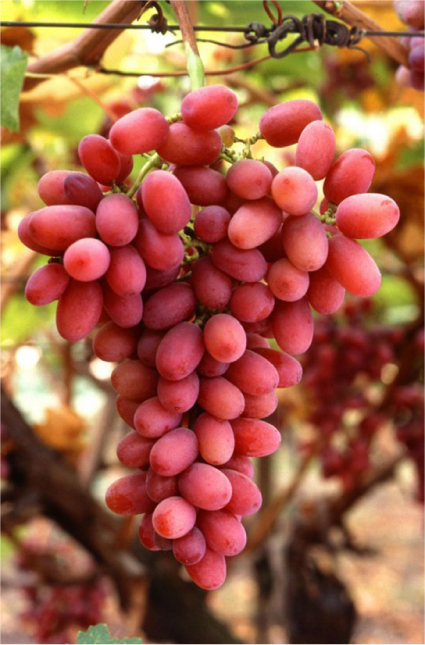

Figure 30.40図 30.40
In grapes, application of gibberellic acid increases the size of fruit and loosens clustering. (credit: Bob Nichols, USDA)
ブドウにジベレリン酸を与えると、果実が大きくなり、房の密集が緩む。(クレジット:Bob Nichols, USDA)