第30章植物の形態と生理
Dermal Tissue表皮系
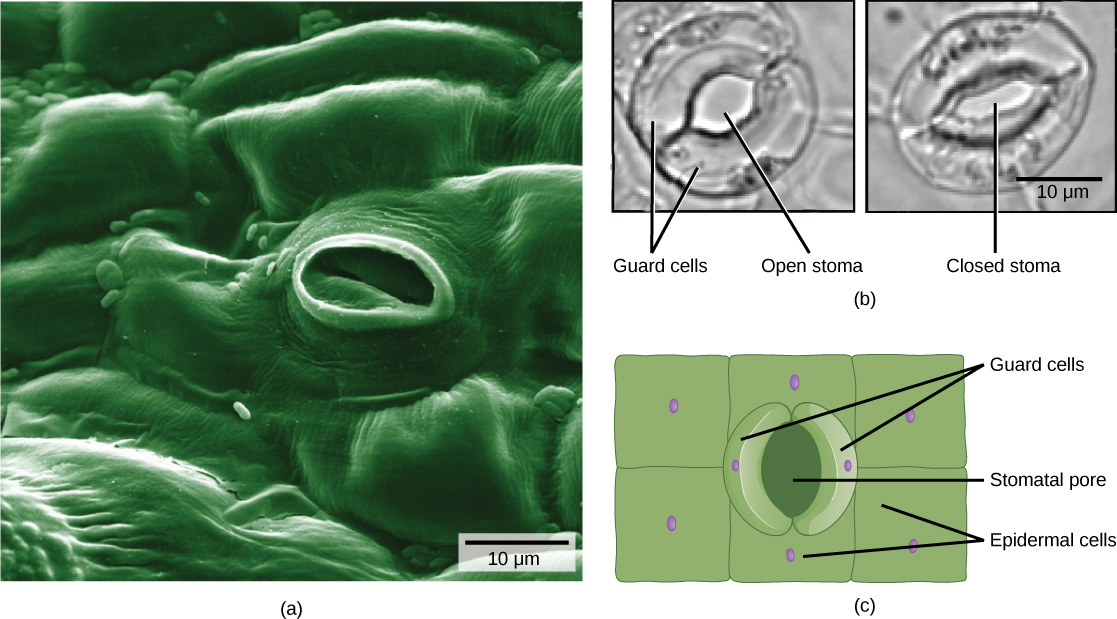
The dermal tissue of the stem consists primarily of epidermis, a single layer of cells covering and protecting the underlying tissue. Woody plants have a tough, waterproof outer layer of cork cells commonly known as bark, which further protects the plant from damage. Epidermal cells are the most numerous and least differentiated of the cells in the epidermis. The epidermis of a leaf also contains openings known as stomata, through which the exchange of gases takes place (Figure 30.8). Two cells, known as guard cells, surround each leaf stoma, controlling its opening and closing and thus regulating the uptake of carbon dioxide and the release of oxygen and water vapor. Trichomes are hair-like structures on the epidermal surface. They help to reduce transpiration (the loss of water by aboveground plant parts), increase solar reflectance, and store compounds that defend the leaves against predation by herbivores.
英語のヒント
茎の表皮系は、主に表皮からなる。表皮は1層の細胞でできており、下の組織を覆って保護する。木本植物では、コルク細胞からなる丈夫で水を通しにくい外層があり、一般に樹皮と呼ばれる。これが、植物を損傷からさらに守る。表皮の細胞の中では、表皮細胞が最も数が多く、分化の程度が最も低い。葉の表皮には、気孔という開口部もあり、そこを通してガス交換が行われる(図30.8)。それぞれの気孔は、孔辺細胞という2個の細胞に囲まれる。これらが開閉を制御することで、二酸化炭素の取り込みと、酸素や水蒸気の放出を調節する。毛状突起は、表皮表面の毛のような構造である。蒸散(植物の地上部分からの水分の損失)を減らし、太陽光の反射率を高め、草食動物による捕食から葉を守る化合物を蓄えるのに役立つ。
OpenStax, Rice University; Biology 2e. (credit a: modification of work by Louisa Howard, Rippel Electron Microscope Facility, Dartmouth College; credit b: modification of work by June Kwak, University of Maryland; scale-bar data from Matt Russell) · CC BY 4.0 · Source出典
Figure 30.8図 30.8
Openings called stomata (singular: stoma) allow a plant to take up carbon dioxide and release oxygen and water vapor. The (a) colorized scanning-electron micrograph shows a closed stoma of a dicot. Each stoma is flanked by two guard cells that regulate its (b) opening and closing. The (c) guard cells sit within the layer of epidermal cells. (credit a: modification of work by Louisa Howard, Rippel Electron Microscope Facility, Dartmouth College; credit b: modification of work by June Kwak, University of Maryland; scale-bar data from Matt Russell)
気孔(複数形 stomata、単数形 stoma)という開口部によって、植物は二酸化炭素を取り込み、酸素と水蒸気を放出できる。(a)着色した走査電子顕微鏡写真は、双子葉植物の閉じた気孔を示す。各気孔の両側には2個の孔辺細胞があり、(b)開閉を調節する。(c)孔辺細胞は、表皮細胞の層の中にある。(クレジットa:Louisa Howard, Rippel Electron Microscope Facility, Dartmouth College の作品を改変。クレジットb:June Kwak, University of Maryland の作品を改変。スケールバーのデータ:Matt Russell)
Vascular Tissue維管束組織
The xylem and phloem that make up the vascular tissue of the stem are arranged in distinct strands called vascular bundles, which run up and down the length of the stem. When the stem is viewed in cross section, the vascular bundles of dicot stems are arranged in a ring. In plants with stems that live for more than one year, the individual bundles grow together and produce the characteristic growth rings. In monocot stems, the vascular bundles are randomly scattered throughout the ground tissue (Figure 30.9).
英語のヒント
茎の維管束組織を構成する木部と師部は、維管束という明瞭な束にまとまり、茎の長さに沿って上下に走っている。茎の横断面を見ると、双子葉植物の維管束は環状に並ぶ。茎が1年以上生きる植物では、個々の維管束が成長してつながり、特徴的な成長輪をつくる。単子葉植物の茎では、維管束は基本組織全体に不規則に散在する(図30.9)。
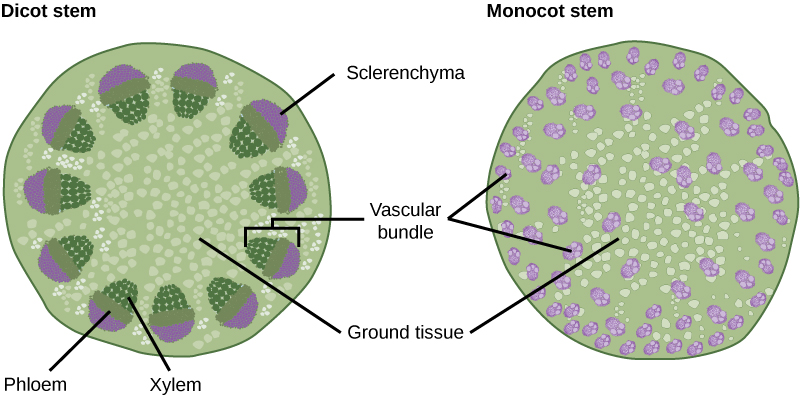


Figure 30.9図 30.9
In (a) dicot stems, vascular bundles are arranged around the periphery of the ground tissue. The xylem tissue is located toward the interior of the vascular bundle, and phloem is located toward the exterior. Sclerenchyma fibers cap the vascular bundles. In (b) monocot stems, vascular bundles composed of xylem and phloem tissues are scattered throughout the ground tissue.
(a)双子葉植物の茎では、維管束は基本組織の周辺に並ぶ。木部は維管束の内側、師部は外側に位置する。維管束の外側を厚壁繊維が覆う。(b)単子葉植物の茎では、木部と師部からなる維管束が、基本組織全体に散在する。
Xylem tissue has three types of cells: xylem parenchyma, tracheids, and vessel elements. The latter two types conduct water and are dead at maturity. Tracheids are xylem cells with thick secondary cell walls that are lignified. Water moves from one tracheid to another through regions on the side walls known as pits, where secondary walls are absent. Vessel elements are xylem cells with thinner walls; they are shorter than tracheids. Each vessel element is connected to the next by means of a perforation plate at the end walls of the element. Water moves through the perforation plates to travel up the plant.
英語のヒント
木部組織には、木部柔細胞、仮道管、道管要素という三種類の細胞がある。後ろの二種類は水を運び、成熟時には死んでいる。仮道管は、木化した厚い二次細胞壁をもつ木部細胞である。水は、側壁にある壁孔と呼ばれる領域を通って、隣の仮道管へ移る。壁孔には二次細胞壁がない。道管要素は、より薄い細胞壁をもつ木部細胞で、仮道管より短い。各道管要素は、端の壁にある穿孔板によって、次の道管要素につながる。水は穿孔板を通り、植物体を上へ移動する。
Phloem tissue is composed of sieve-tube cells, companion cells, phloem parenchyma, and phloem fibers. A series of sieve-tube cells (also called sieve-tube elements) are arranged end to end to make up a long sieve tube, which transports organic substances such as sugars and amino acids. The sugars flow from one sieve-tube cell to the next through perforated sieve plates, which are found at the end junctions between two cells. Although still alive at maturity, the nucleus and other cell components of the sieve-tube cells have disintegrated. Companion cells are found alongside the sieve-tube cells, providing them with metabolic support. The companion cells contain more ribosomes and mitochondria than the sieve-tube cells, which lack some cellular organelles.
英語のヒント
師部組織は、師管細胞、伴細胞、師部柔細胞、師部繊維からなる。一連の師管細胞(師管要素ともいう)が端と端をつないで並び、糖やアミノ酸などの有機物を運ぶ長い師管をつくる。糖は、二つの細胞の端の接合部にある、穴の開いた師板を通って、次の師管細胞へ流れる。師管細胞は成熟時にも生きているが、核やその他の細胞成分は崩壊している。師管細胞のそばには伴細胞があり、代謝を支えている。伴細胞は、一部の細胞小器官を欠く師管細胞より、多くのリボソームとミトコンドリアを含む。
Ground Tissue基本組織
Ground tissue is mostly made up of parenchyma cells, but may also contain collenchyma and sclerenchyma cells that help support the stem. The ground tissue towards the interior of the vascular tissue in a stem or root is known as pith, while the layer of tissue between the vascular tissue and the epidermis is known as the cortex.
英語のヒント
基本組織は主に柔細胞からなるが、茎を支えるのを助ける厚角細胞や厚壁細胞を含むこともある。茎や根で、維管束組織の内側にある基本組織を髄といい、維管束組織と表皮の間の組織層を皮層という。