第30章植物の形態と生理
Control of Transpiration蒸散の制御
The atmosphere to which the leaf is exposed drives transpiration, but also causes massive water loss from the plant. Up to 90 percent of the water taken up by roots may be lost through transpiration.
英語のヒント
葉が接する大気は蒸散を駆動する一方、植物から大量の水を失わせる。根が吸収した水の最大90%が、蒸散によって失われることがある。
Leaves are covered by a waxy cuticle on the outer surface that prevents the loss of water. Regulation of transpiration, therefore, is achieved primarily through the opening and closing of stomata on the leaf surface. Stomata are surrounded by two specialized cells called guard cells, which open and close in response to environmental cues such as light intensity and quality, leaf water status, and carbon dioxide concentrations. Stomata must open to allow air containing carbon dioxide and oxygen to diffuse into the leaf for photosynthesis and respiration. When stomata are open, however, water vapor is lost to the external environment, increasing the rate of transpiration. Therefore, plants must maintain a balance between efficient photosynthesis and water loss.
英語のヒント
葉の外表面は、水分の損失を防ぐ蝋状のクチクラで覆われる。そのため、蒸散の調節は主に、葉の表面の気孔の開閉を通じて行われる。気孔は孔辺細胞という2個の特殊化した細胞に囲まれ、光の強さや質、葉の水分状態、二酸化炭素濃度などの環境の手掛かりに応じて開閉する。光合成や呼吸のために、二酸化炭素と酸素を含む空気を葉内へ拡散させるには、気孔を開く必要がある。しかし、開いている間は水蒸気が外部環境へ失われ、蒸散速度が増す。したがって、植物は効率的な光合成と水分の損失の釣り合いを保たなければならない。
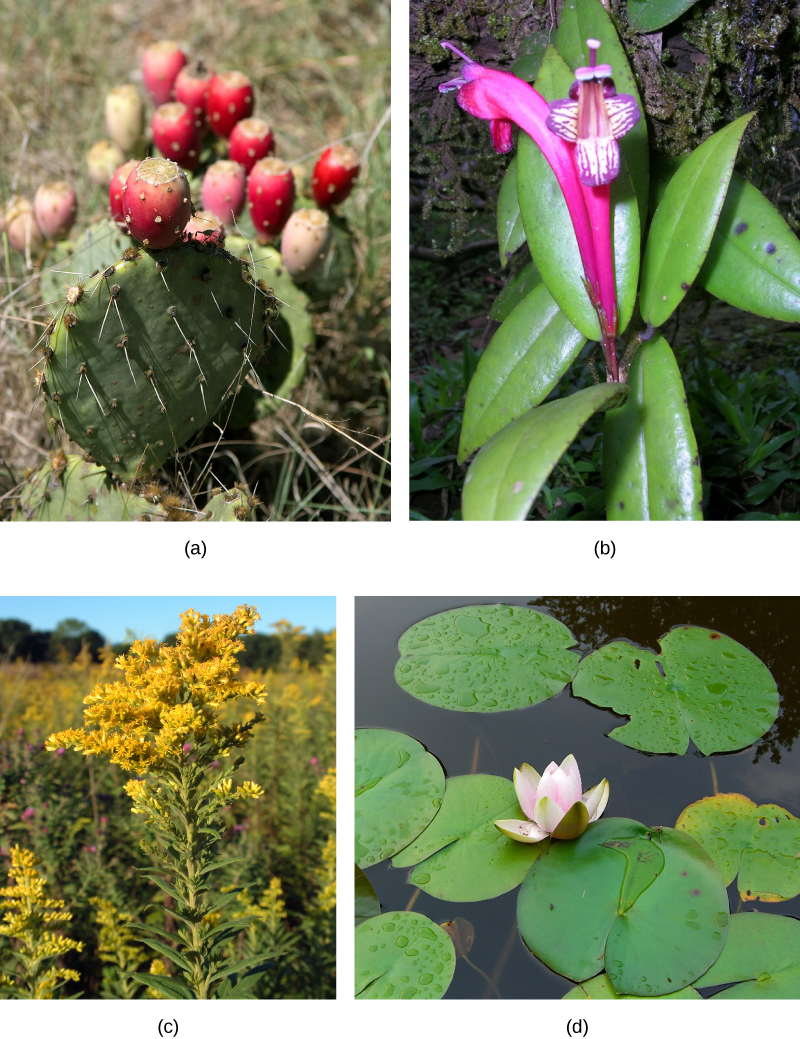
Plants have evolved over time to adapt to their local environment and reduce transpiration (Figure 30.35). Desert plant (xerophytes) and plants that grow on other plants (epiphytes) have limited access to water. Such plants usually have a much thicker waxy cuticle than those growing in more moderate, well-watered environments (mesophytes). Aquatic plants (hydrophytes) also have their own set of anatomical and morphological leaf adaptations.
英語のヒント
植物は時間をかけて進化し、地域の環境に適応して蒸散を減らしてきた(図30.35)。砂漠の植物(乾生植物)や、ほかの植物の上で育つ着生植物は、利用できる水が限られる。こうした植物は通常、より穏やかで水の十分な環境で育つ植物(中生植物)より、はるかに厚い蝋状のクチクラをもつ。水生植物にも、それぞれ独自の、解剖学的・形態学的な葉の適応がある。
OpenStax, Rice University; Biology 2e. (credit a: modification of work by Jon Sullivan; credit b: modification of work by L. Shyamal/Wikimedia Commons; credit c: modification of work by Huw Williams; credit d: modification of work by Jason Hollinger) · CC BY 4.0 · Source出典

Figure 30.35図 30.35
Plants are suited to their local environment. (a) Xerophytes, like this prickly pear cactus (Opuntia sp.) and (b) epiphytes such as this tropical Aeschynanthus perrottetii have adapted to very limited water resources. (a) The leaves of a prickly pear are modified into spines, which lowers the surface-to-volume ratio and reduces water loss. Photosynthesis takes place in the stem, which also stores water. (b) A. perottetii leaves have a waxy cuticle that prevents water loss. (c) Goldenrod (Solidago sp.) is a mesophyte, well suited for moderate environments. (d) Hydrophytes, like this fragrant water lily (Nymphaea odorata), are adapted to thrive in aquatic environments. (credit a: modification of work by Jon Sullivan; credit b: modification of work by L. Shyamal/Wikimedia Commons; credit c: modification of work by Huw Williams; credit d: modification of work by Jason Hollinger)
植物は地域の環境に適している。(a)このウチワサボテン属(Opuntia)のような乾生植物と、(b)熱帯の Aeschynanthus perrottetii のような着生植物は、非常に限られた水資源に適応している。(a)ウチワサボテンの葉は棘に変化し、表面積と体積の比を下げて、水分損失を減らす。光合成は茎で行われ、茎は水も蓄える。(b)A. perottetii の葉には、水分損失を防ぐ蝋状のクチクラがある。(c)アキノキリンソウ属(Solidago)は中生植物で、穏やかな環境によく適する。(d)ニオイスイレン(Nymphaea odorata)のような水生植物は、水中環境でよく育つよう適応している。(クレジットa:Jon Sullivan、b:L. Shyamal/Wikimedia Commons、c:Huw Williams、d:Jason Hollinger、それぞれの作品を改変)
Xerophytes and epiphytes often have a thick covering of trichomes or of stomata that are sunken below the leaf’s surface. Trichomes are specialized hair-like epidermal cells that secrete oils and substances. These adaptations impede air flow across the stomatal pore and reduce transpiration. Multiple epidermal layers are also commonly found in these types of plants.
英語のヒント
乾生植物や着生植物は、毛状突起で厚く覆われていたり、葉の表面より下に沈んだ気孔をもっていたりすることが多い。毛状突起は、油などの物質を分泌する、特殊化した毛状の表皮細胞である。これらの適応は、気孔を横切る空気の流れを妨げ、蒸散を減らす。こうした植物には、複数層の表皮もよく見られる。
Transportation of Photosynthates in the Phloem師部での光合成産物の輸送
Plants need an energy source to grow. In seeds and bulbs, food is stored in polymers (such as starch) that are converted by metabolic processes into sucrose for newly developing plants. Once green shoots and leaves are growing, plants are able to produce their own food by photosynthesizing. The products of photosynthesis are called photosynthates, which are usually in the form of simple sugars such as sucrose.
英語のヒント
植物は、成長するためにエネルギー源を必要とする。種子や鱗茎には、デンプンなどの高分子として養分が蓄えられ、新しく発達する植物のために、代謝過程を通じてスクロースへ変えられる。緑のシュートや葉が成長し始めると、植物は光合成によって自ら養分をつくれるようになる。光合成の生成物は光合成産物と呼ばれ、通常はスクロースなどの単純な糖の形をとる。
Structures that produce photosynthates for the growing plant are referred to as sources. Sugars produced in sources, such as leaves, need to be delivered to growing parts of the plant via the phloem in a process called translocation. The points of sugar delivery, such as roots, young shoots, and developing seeds, are called sinks. Seeds, tubers, and bulbs can be either a source or a sink, depending on the plant’s stage of development and the season.
英語のヒント
成長中の植物のために光合成産物をつくる構造を、ソース(供給源)という。葉などのソースでつくられた糖は、転流という過程によって、師部を通じて植物の成長部分へ届けられる必要がある。根、若いシュート、発達中の種子など、糖が届けられる場所を、シンク(受け入れ先)という。種子、塊茎、鱗茎は、植物の発達段階や季節によって、ソースにもシンクにもなりうる。
The products from the source are usually translocated to the nearest sink through the phloem. For example, the highest leaves will send photosynthates upward to the growing shoot tip, whereas lower leaves will direct photosynthates downward to the roots. Intermediate leaves will send products in both directions, unlike the flow in the xylem, which is always unidirectional (soil to leaf to atmosphere). The pattern of photosynthate flow changes as the plant grows and develops. Photosynthates are directed primarily to the roots early on, to shoots and leaves during vegetative growth, and to seeds and fruits during reproductive development. They are also directed to tubers for storage.
英語のヒント
ソースの産物は通常、師部を通って最も近いシンクへ転流する。たとえば、最上部の葉は、上方の成長中のシュート頂端へ光合成産物を送り、下方の葉は、下にある根へ送る。中間の葉は両方向へ産物を送る。これは、常に一方向(土壌から葉、大気へ)の木部の流れとは異なる。光合成産物の流れのパターンは、植物の成長・発達に伴って変化する。初期には主に根へ、栄養成長中にはシュートや葉へ、生殖器官の発達中には種子や果実へ送られる。また、貯蔵のために塊茎へも送られる。