第30章植物の形態と生理
30.5 Transport of Water and Solutes in Plants30.5 植物における水と溶質の輸送
Learning Objectives学習目標
By the end of this section, you will be able to do the following:
この節を学ぶと、次のことができるようになる。
- Define water potential and explain how it is influenced by solutes, pressure, gravity, and the matric potential水ポテンシャルを定義し、溶質、圧力、重力、マトリックポテンシャルがそれに及ぼす影響を説明する。
- Describe how water potential, evapotranspiration, and stomatal regulation influence how water is transported in plants水ポテンシャル、蒸発散、気孔の調節が、植物内の水の輸送にどう影響するかを述べる。
- Explain how photosynthates are transported in plants植物内で光合成産物がどのように輸送されるかを説明する。
The structure of plant roots, stems, and leaves facilitates the transport of water, nutrients, and photosynthates throughout the plant. The phloem and xylem are the main tissues responsible for this movement. Water potential, evapotranspiration, and stomatal regulation influence how water and nutrients are transported in plants. To understand how these processes work, we must first understand the energetics of water potential.
英語のヒント
植物の根、茎、葉の構造は、水、栄養分、光合成産物が植物全体へ運ばれるのを助ける。この移動を担う主な組織は、師部と木部である。植物内で水や栄養分がどのように運ばれるかには、水ポテンシャル、蒸発散、気孔の調節が影響する。これらの過程を理解するには、まず水ポテンシャルのエネルギー的な側面を理解しなければならない。
Water Potential水ポテンシャル
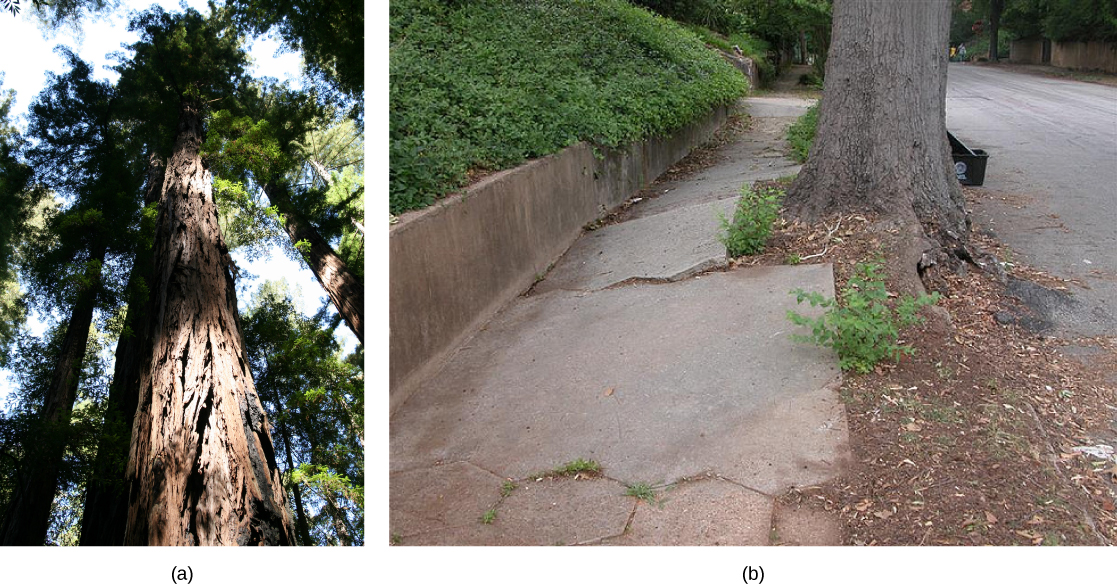
Plants are phenomenal hydraulic engineers. Using only the basic laws of physics and the simple manipulation of potential energy, plants can move water to the top of a 116-meter-tall tree (Figure 30.31a). Plants can also use hydraulics to generate enough force to split rocks and buckle sidewalks (Figure 30.31b). Plants achieve this because of water potential.
英語のヒント
OpenStax, Rice University; Biology 2e. (credit a: modification of work by Bernt Rostad; credit b: modification of work by Pedestrians Educating Drivers on Safety, Inc.) · CC BY 4.0 · Source出典

Figure 30.31図 30.31
With heights nearing 116 meters, (a) coastal redwoods (Sequoia sempervirens) are the tallest trees in the world. Plant roots can easily generate enough force to (b) buckle and break concrete sidewalks, much to the dismay of homeowners and city maintenance departments. (credit a: modification of work by Bernt Rostad; credit b: modification of work by Pedestrians Educating Drivers on Safety, Inc.)
(a)高さが116 m近くに達するセコイア(Sequoia sempervirens)は、世界で最も背の高い樹木である。植物の根は、(b)コンクリートの歩道を押し曲げて壊すほどの力を容易に生み、家の所有者や市の維持管理部門を大いに困らせる。(クレジットa:Bernt Rostad、b:Pedestrians Educating Drivers on Safety, Inc.、それぞれの作品を改変)
Water potential is a measure of the potential energy in water. Plant physiologists are not interested in the energy in any one particular aqueous system, but are very interested in water movement between two systems. In practical terms, therefore, water potential is the difference in potential energy between a given water sample and pure water (at atmospheric pressure and ambient temperature). Water potential is denoted by the Greek letter ψ (psi) and is expressed in units of pressure (pressure is a form of energy) called megapascals (MPa). The potential of pure water (Ψwpure H2O) is, by convenience of definition, designated a value of zero (even though pure water contains plenty of potential energy, that energy is ignored). Water potential values for the water in a plant root, stem, or leaf are therefore expressed relative to Ψwpure H2O.
英語のヒント
水ポテンシャルは、水のポテンシャルエネルギーを表す尺度である。植物生理学者が関心をもつのは、一つの特定の水系のエネルギーではなく、二つの系の間の水の移動である。したがって実用上、水ポテンシャルは、ある水試料と、大気圧・周囲温度にある純水との間の、ポテンシャルエネルギーの差である。水ポテンシャルはギリシャ文字ψ(プサイ)で表し、メガパスカル(MPa)という圧力の単位で示す。圧力はエネルギーの一形態である。純水のポテンシャル(Ψwpure H2O)は、定義上の便宜からゼロとする。純水にも多くのポテンシャルエネルギーがあるが、それは無視する。したがって、植物の根、茎、葉の水ポテンシャルは、Ψwpure H2Oを基準に表される。
The water potential in plant solutions is influenced by solute concentration, pressure, gravity, and factors called matrix effects. Water potential can be broken down into its individual components using the following equation:
植物内の溶液の水ポテンシャルは、溶質濃度、圧力、重力、そしてマトリックス効果と呼ばれる要因の影響を受ける。水ポテンシャルは、次の式で各成分に分けられる。
where Ψs, Ψp, Ψg, and Ψm refer to the solute, pressure, gravity, and matric potentials, respectively. “System” can refer to the water potential of the soil water (Ψsoil), root water (Ψroot), stem water (Ψstem), leaf water (Ψleaf) or the water in the atmosphere (Ψatmosphere): whichever aqueous system is under consideration. As the individual components change, they raise or lower the total water potential of a system. When this happens, water moves to equilibrate, moving from the system or compartment with a higher water potential to the system or compartment with a lower water potential. This brings the difference in water potential between the two systems (ΔΨ) back to zero (ΔΨ = 0). Therefore, for water to move through the plant from the soil to the air (a process called transpiration), Ψsoil must be > Ψroot > Ψstem > Ψleaf > Ψatmosphere.
英語のヒント
ここで、Ψs、Ψp、Ψg、Ψmは、それぞれ溶質、圧、重力、マトリックの各ポテンシャルを表す。「系」は、土壌水(Ψsoil)、根の水(Ψroot)、茎の水(Ψstem)、葉の水(Ψleaf)、大気中の水(Ψatmosphere)など、検討している任意の水系の水ポテンシャルを指す。各成分が変化すると、その系の全水ポテンシャルが上がったり下がったりする。すると、水は平衡に向かって移動し、水ポテンシャルの高い系や区画から、低い系や区画へ流れる。これによって、二つの系の水ポテンシャルの差(ΔΨ)はゼロに戻る(ΔΨ = 0)。したがって、土壌から植物を通って空気へ水が移動するには、すなわち蒸散が起こるには、Ψsoil > Ψroot > Ψstem > Ψleaf > Ψatmosphereでなければならない。
Water only moves in response to ΔΨ, not in response to the individual components. However, because the individual components influence the total Ψsystem, by manipulating the individual components (especially Ψs), a plant can control water movement.
水は各成分に個別に反応するのではなく、ΔΨだけに反応して移動する。しかし、各成分は全体のΨsystemに影響するため、植物は各成分、特にΨsを操作することで、水の移動を制御できる。
Solute Potential溶質ポテンシャル
Solute potential (Ψs), also called osmotic potential, is related to the solute concentration (in molarity). That relationship is given by the van 't Hoff equation: Ψs= –Mi RT; where M is the molar concentration of the solute, i is the van 't Hoff factor (the ratio of the amount of particles in the solution to amount of formula units dissolved), R is the ideal gas constant, and T is temperature in Kelvin degrees. The solute potential is negative in a plant cell and zero in distilled water. Typical values for cell cytoplasm are –0.5 to –1.0 MPa. Solutes reduce water potential (resulting in a negative Ψw) by consuming some of the potential energy available in the water. Solute molecules can dissolve in water because water molecules can bind to them via hydrogen bonds; a hydrophobic molecule like oil, which cannot bind to water, cannot go into solution. The energy in the hydrogen bonds between solute molecules and water is no longer available to do work in the system because it is tied up in the bond. In other words, the amount of available potential energy is reduced when solutes are added to an aqueous system. Thus, Ψ s decreases with increasing solute concentration. Because Ψs is one of the four components of Ψsystem or Ψtotal, a decrease in Ψs will cause a decrease in Ψtotal. The internal water potential of a plant cell is more negative than pure water because of the cytoplasm’s high solute content (Figure 30.32). Because of this difference in water potential water will move from the soil into a plant’s root cells via the process of osmosis. This is why solute potential is sometimes called osmotic potential.
英語のヒント
溶質ポテンシャル(Ψs)は、浸透ポテンシャルとも呼ばれ、モル濃度で表した溶質濃度と関係する。その関係はファントホッフの式、Ψs = −MiRTで与えられる。ここで、Mは溶質のモル濃度、iはファントホッフ係数(溶けた化学式単位の量に対する、溶液中の粒子の量の比)、Rは理想気体定数、Tはケルビンで表した温度である。溶質ポテンシャルは植物細胞では負、蒸留水ではゼロである。細胞質での典型的な値は、−0.5〜−1.0 MPaである。溶質は、水で利用できるポテンシャルエネルギーの一部を消費することで、水ポテンシャルを下げる。その結果、Ψwは負となる。溶質分子が水に溶けるのは、水分子が水素結合でそれらに結合できるためである。油のように水と結合できない疎水性分子は、溶液に入れない。溶質分子と水の間の水素結合のエネルギーは、結合に拘束されているため、その系で仕事をするためには使えなくなる。言い換えると、水系に溶質を加えると、利用できるポテンシャルエネルギーが減る。したがって、溶質濃度が上がるほどΨsは低下する。ΨsはΨsystemまたはΨtotalの四つの成分の一つなので、Ψsの低下はΨtotalの低下を引き起こす。植物細胞内の水ポテンシャルは、細胞質の溶質含量が高いため、純水より負の値が大きい(図30.32)。この水ポテンシャルの差によって、水は浸透という過程を通じて土壌から植物の根の細胞へ移る。これが、溶質ポテンシャルを浸透ポテンシャルとも呼ぶ理由である。
Plant cells can metabolically manipulate Ψs (and by extension, Ψtotal) by adding or removing solute molecules. Therefore, plants have control over Ψtotal via their ability to exert metabolic control over Ψs.
英語のヒント
植物細胞は、溶質分子を加えたり取り除いたりして、代謝によってΨs、ひいてはΨtotalを操作できる。したがって、Ψsを代謝的に制御する能力を通じて、植物はΨtotalを制御できる。