第30章植物の形態と生理
30.1 The Plant Body30.1 植物体
Learning Objectives学習目標
By the end of this section, you will be able to do the following:
この節を学び終えると、次のことができるようになる。
- Describe the shoot organ system and the root organ systemシュート系と根系という器官系を説明する。
- Distinguish between meristematic tissue and permanent tissue分裂組織と永久組織を区別する。
- Identify and describe the three regions where plant growth occurs植物の成長が起こる三つの領域を挙げ、説明する。
- Summarize the roles of dermal tissue, vascular tissue, and ground tissue表皮系、維管束組織、基本組織の役割をまとめる。
- Compare simple plant tissue with complex plant tissue植物の単純組織と複合組織を比較する。
Like animals, plants contain cells with organelles in which specific metabolic activities take place. Unlike animals, however, plants use energy from sunlight to form sugars during photosynthesis. In addition, plant cells have cell walls, plastids, and a large central vacuole: structures that are not found in animal cells. Each of these cellular structures plays a specific role in plant structure and function.
英語のヒント
動物と同様、植物の細胞にも、特定の代謝活動が行われる細胞小器官がある。しかし動物とは異なり、植物は光合成の際に日光のエネルギーを使って糖をつくる。さらに、植物細胞には、動物細胞には見られない構造である細胞壁、色素体、大きな中央液胞がある。これらの細胞構造はそれぞれ、植物の構造と機能において特定の役割を果たす。
Plant Organ Systems植物の器官系
In plants, just as in animals, similar cells working together form a tissue. When different types of tissues work together to perform a unique function, they form an organ; organs working together form organ systems. Vascular plants have two distinct organ systems: a shoot system, and a root system. The shoot system consists of two portions: the vegetative (non-reproductive) parts of the plant, such as the leaves and the stems, and the reproductive parts of the plant, which include flowers and fruits. The shoot system generally grows above ground, where it absorbs the light needed for photosynthesis. The root system, which supports the plants and absorbs water and minerals, is usually underground. Figure 30.2 shows the organ systems of a typical plant.
英語のヒント
植物でも動物と同様、似た細胞が協力して働くことで組織ができる。異なる種類の組織が協力し、特有の機能を果たすと器官になり、器官が協力して働くと器官系になる。維管束植物には、シュート系と根系という二つの異なる器官系がある。シュート系は、葉や茎などの栄養部分(生殖以外の部分)と、花や果実を含む生殖部分からなる。一般に地上で成長し、光合成に必要な光を吸収する。植物を支え、水や無機栄養分を吸収する根系は、通常は地下にある。図30.2は、典型的な植物の器官系を示す。
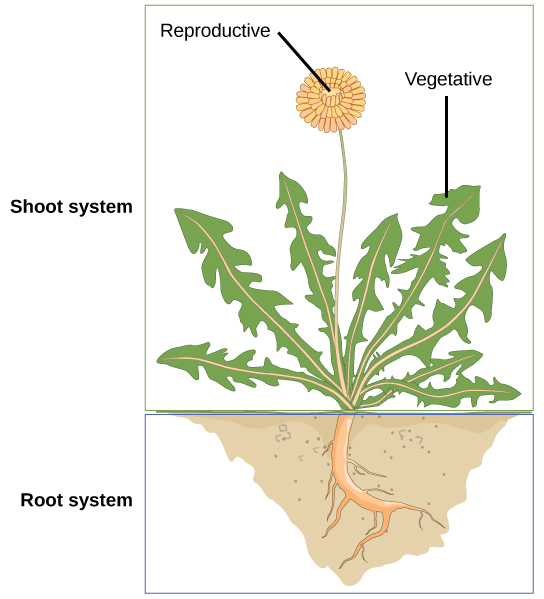

Figure 30.2図 30.2
The shoot system of a plant consists of leaves, stems, flowers, and fruits. The root system anchors the plant while absorbing water and minerals from the soil.
植物のシュート系は、葉、茎、花、果実からなる。根系は植物を固定しながら、土壌から水と無機栄養分を吸収する。
Plant Tissues植物の組織
Plants are multicellular eukaryotes with tissue systems made of various cell types that carry out specific functions. Plant tissue systems fall into one of two general types: meristematic tissue, and permanent (or non-meristematic) tissue. Cells of the meristematic tissue are found in meristems, which are plant regions of continuous cell division and growth. Meristematic tissue cells are either undifferentiated or incompletely differentiated, and they continue to divide and contribute to the growth of the plant. In contrast, permanent tissue consists of plant cells that are no longer actively dividing.
英語のヒント
植物は多細胞の真核生物で、特定の機能を果たすさまざまな種類の細胞からなる組織系をもつ。植物の組織系は、大きく分裂組織と永久組織(非分裂組織)の二種類に分かれる。分裂組織の細胞は、細胞分裂と成長が継続する領域にある。これらの細胞は未分化、または分化が不完全で、分裂を続けて植物の成長に寄与する。これに対して、永久組織は、もはや活発には分裂していない植物細胞からなる。
Meristematic tissues consist of three types, based on their location in the plant. Apical meristems contain meristematic tissue located at the tips of stems and roots, which enable a plant to extend in length. Lateral meristems facilitate growth in thickness or girth in a maturing plant. Intercalary meristems occur only in monocots, at the bases of leaf blades and at nodes (the areas where leaves attach to a stem). This tissue enables the monocot leaf blade to increase in length from the leaf base; for example, it allows lawn grass leaves to elongate even after repeated mowing.
英語のヒント
分裂組織は、植物内での位置に基づいて三種類に分かれる。頂端分裂組織は茎と根の先端にあり、植物を長さ方向に伸ばす。側方分裂組織は、成熟していく植物の太さや周囲の成長を促す。介在分裂組織は単子葉類にだけ見られ、葉身の基部や節(葉が茎につく部分)にある。この組織によって、単子葉類の葉身は葉の基部から長くなる。たとえば、芝生の葉は、繰り返し刈られた後でも伸びることができる。
Meristems produce cells that quickly differentiate, or specialize, and become permanent tissue. Such cells take on specific roles and lose their ability to divide further. They differentiate into three main types: dermal, vascular, and ground tissue. Dermal tissue covers and protects the plant, and vascular tissue transports water, minerals, and sugars to different parts of the plant. Ground tissue serves as a site for photosynthesis, provides a supporting matrix for the vascular tissue, and helps to store water and sugars.
英語のヒント
分裂組織が生み出す細胞は、すぐに分化、すなわち特殊化し、永久組織となる。そのような細胞は特定の役割を担い、さらに分裂する能力を失う。これらは、表皮系、維管束組織、基本組織という三つの主要な種類へ分化する。表皮系は植物を覆って保護し、維管束組織は、水、無機栄養分、糖を植物の各部へ運ぶ。基本組織は光合成の場となり、維管束組織を支える基盤を提供し、水や糖の貯蔵を助ける。
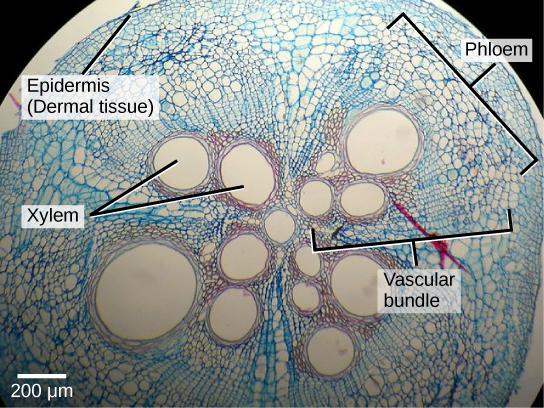
Secondary tissues are either simple (composed of similar cell types) or complex (composed of different cell types). Dermal tissue, for example, is a simple tissue that covers the outer surface of the plant and controls gas exchange. Vascular tissue is an example of a complex tissue, and is made of two specialized conducting tissues: xylem and phloem. Xylem tissue transports water and nutrients from the roots to different parts of the plant, and includes three different cell types: vessel elements and tracheids (both of which conduct water), and xylem parenchyma. Phloem tissue, which transports organic compounds from the site of photosynthesis to other parts of the plant, consists of four different cell types: sieve cells (which conduct photosynthates), companion cells, phloem parenchyma, and phloem fibers. Unlike xylem conducting cells, phloem conducting cells are alive at maturity. The xylem and phloem always lie adjacent to each other (Figure 30.3). In stems, the xylem and the phloem form a structure called a vascular bundle; in roots, this is termed the vascular stele or vascular cylinder.
英語のヒント
二次組織は、単純組織(似た種類の細胞からなる)か複合組織(異なる種類の細胞からなる)のいずれかである。たとえば、表皮系は、植物の外表面を覆い、ガス交換を調節する単純組織である。維管束組織は複合組織の一例で、木部と師部という、特殊化した二つの通導組織からなる。木部組織は、根から植物の各部へ水と栄養分を運び、三種類の細胞を含む。水を運ぶ道管要素と仮道管、そして木部柔細胞である。師部組織は、光合成が行われる場所から植物のほかの部分へ有機化合物を運び、四種類の細胞からなる。光合成産物を運ぶ師細胞、伴細胞、師部柔細胞、師部繊維である。木部の通導細胞とは異なり、師部の通導細胞は成熟時にも生きている。木部と師部は、常に隣り合っている(図30.3)。茎では、木部と師部が維管束という構造を形成する。根では、これを中心柱、または維管束柱と呼ぶ。
OpenStax, Rice University; Biology 2e. (credit: modification of work by "(biophotos)"/Flickr; scale-bar data from Matt Russell) · CC BY 4.0 · Source出典

Figure 30.3図 30.3
This light micrograph shows a cross section of a squash (Curcurbita maxima) root. Each teardrop-shaped vascular bundle consists of large xylem vessels toward the inside and smaller phloem cells toward the outside. Xylem cells, which transport water and nutrients from the roots to the rest of the plant, are dead at functional maturity. Phloem cells, which transport sugars and other organic compounds from photosynthetic tissue to the rest of the plant, are living. The vascular bundles are encased in ground tissue and surrounded by dermal tissue. (credit: modification of work by "(biophotos)"/Flickr; scale-bar data from Matt Russell)
この光学顕微鏡写真は、カボチャ(Curcurbita maxima)の根の横断面を示す。涙滴形の各維管束は、内側の大きな木部道管と、外側の小さな師部細胞からなる。根から植物のほかの部分へ水と栄養分を運ぶ木部細胞は、機能的に成熟した時点では死んでいる。光合成組織からほかの部分へ糖や有機化合物を運ぶ師部細胞は、生きている。維管束は基本組織に包まれ、表皮系に囲まれる。(クレジット:「(biophotos)」/Flickr の作品を改変。スケールバーのデータ:Matt Russell)