第30章植物の形態と生理
30.2 Stems30.2 茎
Learning Objectives学習目標
By the end of this section, you will be able to do the following:
この節を学び終えると、次のことができるようになる。
- Describe the main function and basic structure of stems茎の主要な機能と基本構造を説明する。
- Compare and contrast the roles of dermal tissue, vascular tissue, and ground tissue表皮系、維管束組織、基本組織の役割の共通点と相違点を比較する。
- Distinguish between primary growth and secondary growth in stems茎の一次成長と二次成長を区別する。
- Summarize the origin of annual rings年輪が生じる仕組みをまとめる。
- List and describe examples of modified stems変形茎の例を挙げ、説明する。
Stems are a part of the shoot system of a plant. They may range in length from a few millimeters to hundreds of meters, and also vary in diameter, depending on the plant type. Stems are usually above ground, although the stems of some plants, such as the potato, also grow underground. Stems may be herbaceous (soft) or woody in nature. Their main function is to provide support to the plant, holding leaves, flowers and buds; in some cases, stems also store food for the plant. A stem may be unbranched, like that of a palm tree, or it may be highly branched, like that of a magnolia tree. The stem of the plant connects the roots to the leaves, helping to transport absorbed water and minerals to different parts of the plant. It also helps to transport the products of photosynthesis, namely sugars, from the leaves to the rest of the plant.
英語のヒント
茎は、植物のシュート系の一部である。長さは数mmから数百mまで及び、直径も植物の種類によって異なる。茎は通常は地上にあるが、ジャガイモなど一部の植物では地下でも成長する。茎には、草質(柔らかいもの)と木質のものがある。主な機能は、葉、花、芽を保持して植物を支えることである。場合によっては、植物のために養分も蓄える。ヤシのように枝分かれしない茎もあれば、モクレンのように多数に枝分かれするものもある。茎は根と葉をつなぎ、吸収した水や無機栄養分を植物の各部へ運ぶのを助ける。また、光合成の産物、すなわち糖を、葉から植物のほかの部分へ運ぶのも助ける。
Plant stems, whether above or below ground, are characterized by the presence of nodes and internodes (Figure 30.4). Nodes are points of attachment for leaves, aerial roots, and flowers. The stem region between two nodes is called an internode. The stalk that extends from the stem to the base of the leaf is the petiole. An axillary bud is usually found in the axil—the area between the base of a leaf and the stem—where it can give rise to a branch or a flower. The apex (tip) of the shoot contains the apical meristem within the apical bud.
英語のヒント
植物の茎は、地上にあっても地下にあっても、節と節間をもつことを特徴とする(図30.4)。節は、葉、気根、花がつく場所である。二つの節の間の茎の領域を、節間という。茎から葉の付け根へ伸びる柄は、葉柄である。葉の付け根と茎の間の領域である葉腋には、通常、腋芽があり、そこから枝や花が生じる。シュートの頂端(先端)には頂芽があり、その内部に頂端分裂組織がある。
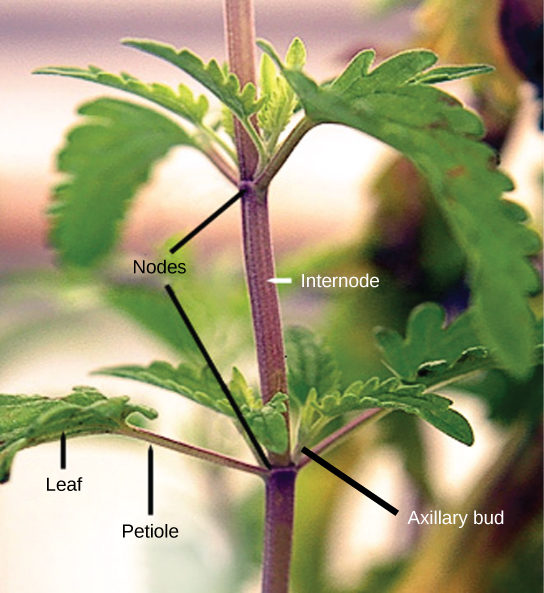
Figure 30.4図 30.4
Leaves are attached to the plant stem at areas called nodes. An internode is the stem region between two nodes. The petiole is the stalk connecting the leaf to the stem. The leaves just above the nodes arose from axillary buds.
葉は、節と呼ばれる領域で茎につく。節間は、二つの節の間の茎の領域である。葉柄は、葉と茎をつなぐ柄である。節のすぐ上の葉は、腋芽から生じた。
Stem Anatomy茎の解剖構造
The stem and other plant organs arise from the ground tissue, and are primarily made up of simple tissues formed from three types of cells: parenchyma, collenchyma, and sclerenchyma cells.
茎やその他の植物器官は基本組織から生じ、主として、柔細胞、厚角細胞、厚壁細胞という三種類の細胞からつくられる単純組織でできている。
Parenchyma cells are the most common plant cells (Figure 30.5). They are found in the stem, the root, the inside of the leaf, and the pulp of the fruit. Parenchyma cells are responsible for metabolic functions, such as photosynthesis, and they help repair and heal wounds. Some parenchyma cells also store starch.
英語のヒント
柔細胞は、最も一般的な植物細胞である(図30.5)。茎、根、葉の内部、果肉に見られる。柔細胞は光合成などの代謝機能を担い、傷の修復や治癒を助ける。一部の柔細胞はデンプンも貯蔵する。
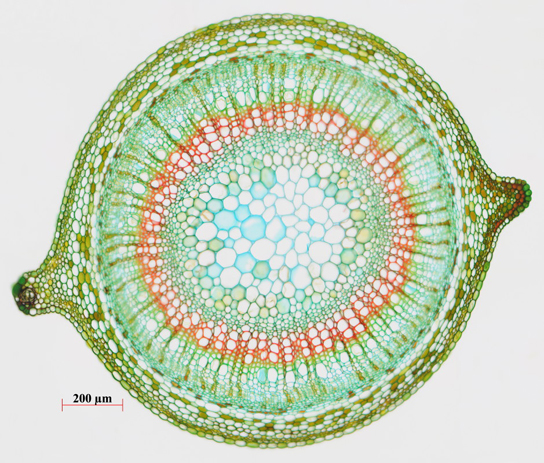


Figure 30.5図 30.5
The stem of common St John's Wort (Hypericum perforatum) is shown in cross section in this light micrograph. The central pith (greenish-blue, in the center) and peripheral cortex (narrow zone 3–5 cells thick just inside the epidermis) are composed of parenchyma cells. Vascular tissue composed of xylem (red) and phloem tissue (green, between the xylem and cortex) surrounds the pith. (credit: Rolf-Dieter Mueller)
この光学顕微鏡写真は、セイヨウオトギリ(Hypericum perforatum)の茎の横断面を示す。中央の髄(中心の緑がかった青色)と周辺の皮層(表皮のすぐ内側の、細胞3〜5層分の細い領域)は、柔細胞でできている。木部(赤)と師部(木部と皮層の間の緑色)からなる維管束組織が、髄を囲んでいる。(クレジット:Rolf-Dieter Mueller)
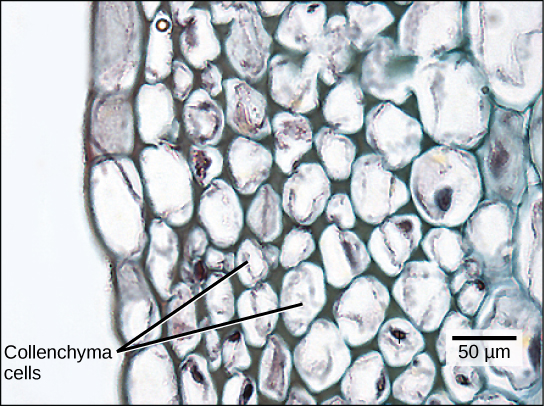
Collenchyma cells are elongated cells with unevenly thickened walls (Figure 30.6). They provide structural support, mainly to the stem and leaves. These cells are alive at maturity and are usually found below the epidermis. The “strings” of a celery stalk are an example of collenchyma cells.
英語のヒント
厚角細胞は、細胞壁が不均等に厚くなった細長い細胞である(図30.6)。主に茎と葉を構造的に支える。成熟時にも生きており、通常は表皮の下に見られる。セロリの葉柄の「筋」は、厚角細胞の一例である。
OpenStax, Rice University; Biology 2e. (credit: modification of work by Carl Szczerski; scale-bar data from Matt Russell) · CC BY 4.0 · Source出典

Figure 30.6図 30.6
Collenchyma cell walls are uneven in thickness, as seen in this light micrograph. They provide support to plant structures. (credit: modification of work by Carl Szczerski; scale-bar data from Matt Russell)
この光学顕微鏡写真に見られるように、厚角細胞の細胞壁は厚さが不均等である。植物の構造を支える。(クレジット:Carl Szczerski の作品を改変。スケールバーのデータ:Matt Russell)
Sclerenchyma cells also provide support to the plant, but unlike collenchyma cells, many of them are dead at maturity. There are two types of sclerenchyma cells: fibers and sclereids. Both types have secondary cell walls that are thickened with deposits of lignin, an organic compound that is a key component of wood. Fibers are long, slender cells; sclereids are smaller-sized. Sclereids give pears their gritty texture. Humans use sclerenchyma fibers to make linen and rope (Figure 30.7).
英語のヒント
厚壁細胞も植物を支えるが、厚角細胞とは異なり、その多くは成熟時に死んでいる。厚壁細胞には、繊維と石細胞という二種類がある。どちらも、木材の主要成分である有機化合物リグニンが沈着し、二次細胞壁が厚くなっている。繊維は長く細い細胞で、石細胞はより小さい。ナシのざらざらした食感は石細胞による。人間は厚壁繊維を使って、リネンやロープをつくる(図30.7)。
Like the rest of the plant, the stem has three tissue systems: dermal, vascular, and ground tissue. Each is distinguished by characteristic cell types that perform specific tasks necessary for the plant’s growth and survival.
植物のほかの部分と同様、茎には、表皮系、維管束組織、基本組織という三つの組織系がある。それぞれは、植物の成長と生存に必要な特定の仕事を行う、特徴的な細胞の種類によって区別される。