第35章神経系
35.5 Nervous System Disorders35.5 神経系の疾患
Learning Objectives学習目標
By the end of this section, you will be able to do the following:
この節を学び終えると、次のことができるようになる。
- Describe the symptoms, potential causes, and treatment of several examples of nervous system disorders神経系疾患のいくつかの例について、症状、考えられる原因、治療を説明する。
A nervous system that functions correctly is a fantastically complex, well-oiled machine—synapses fire appropriately, muscles move when needed, memories are formed and stored, and emotions are well regulated. Unfortunately, each year millions of people in the United States deal with some sort of nervous system disorder. While scientists have discovered potential causes of many of these diseases, and viable treatments for some, ongoing research seeks to find ways to better prevent and treat all of these disorders.
英語のヒント
正しく機能する神経系は、驚くほど複雑で、滑らかに動く機械のようなものである。シナプスは適切に活動し、筋肉は必要なときに動き、記憶は形成されて保存され、感情も適切に調節される。残念ながら、米国では毎年、数百万人が何らかの神経系の疾患に対処している。科学者は多くの疾患の原因候補を見いだし、一部には実用的な治療法も発見してきた。すべての疾患をよりよく予防し、治療する方法を探す研究が今も続いている。
Neurodegenerative Disorders神経変性疾患
Neurodegenerative disorders are illnesses characterized by a loss of nervous system functioning that are usually caused by neuronal death. These diseases generally worsen over time as more and more neurons die. The symptoms of a particular neurodegenerative disease are related to where in the nervous system the death of neurons occurs. Spinocerebellar ataxia, for example, leads to neuronal death in the cerebellum. The death of these neurons causes problems in balance and walking. Neurodegenerative disorders include Huntington’s disease, amyotrophic lateral sclerosis, Alzheimer’s disease and other types of dementia disorders, and Parkinson’s disease. Here, Alzheimer’s and Parkinson’s disease will be discussed in more depth.
神経変性疾患は、通常ニューロンの死によって起こり、神経系の機能が失われる病気である。死ぬニューロンが増えるにつれて、一般に時間とともに悪化する。症状は、神経系のどの場所でニューロンが死ぬかに関係する。たとえば脊髄小脳失調症では、小脳のニューロンが死ぬ。そのため、平衡感覚や歩行に問題が生じる。神経変性疾患には、ハンチントン病、筋萎縮性側索硬化症、アルツハイマー病などの認知症を引き起こす疾患、パーキンソン病がある。ここでは、アルツハイマー病とパーキンソン病を詳しく取り上げる。
Alzheimer’s Diseaseアルツハイマー病
Alzheimer’s disease is the most common cause of dementia in the elderly. In 2012, an estimated 5.4 million Americans suffered from Alzheimer’s disease, and payments for their care are estimated at $200 billion. Roughly one in every eight people age 65 or older has the disease. Due to the aging of the baby-boomer generation, there are projected to be as many as 13 million Alzheimer’s patients in the United States in the year 2050.
アルツハイマー病は、高齢者の認知症の最も一般的な原因である。2012年には、米国で推定540万人がこの病気を患い、ケアの費用は2,000億ドルと見積もられている。65歳以上では、およそ8人に1人にみられる。ベビーブーム世代の高齢化によって、2050年には米国のアルツハイマー病患者は1,300万人にもなると予測されている。
Symptoms of Alzheimer’s disease include disruptive memory loss, confusion about time or place, difficulty planning or executing tasks, poor judgment, and personality changes. Problems smelling certain scents can also be indicative of Alzheimer’s disease and may serve as an early warning sign. Many of these symptoms are also common in people who are aging normally, so it is the severity and longevity of the symptoms that determine whether a person is suffering from Alzheimer’s.
英語のヒント
アルツハイマー病の症状には、日常生活に支障をきたす記憶喪失、時間や場所の混乱、計画や作業遂行の困難、判断力の低下、人格の変化がある。特定のにおいがわかりにくくなることも病気を示唆し、早期の警告となりうる。こうした症状の多くは正常に加齢している人にもよくみられる。そのため、アルツハイマー病かどうかを左右するのは、症状の重さと持続期間である。
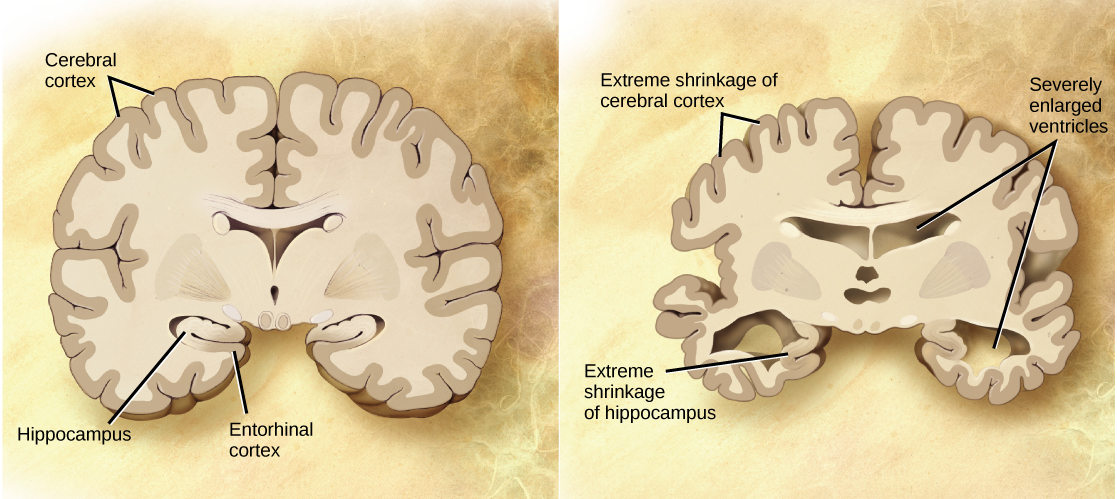
Alzheimer’s disease was named for Alois Alzheimer, a German psychiatrist who published a report in 1911 about a woman who showed severe dementia symptoms. Along with his colleagues, he examined the woman’s brain following her death and reported the presence of abnormal clumps, which are now called amyloid plaques, along with tangled brain fibers called neurofibrillary tangles. Amyloid plaques, neurofibrillary tangles, and an overall shrinking of brain volume are commonly seen in the brains of Alzheimer’s patients. Loss of neurons in the hippocampus is especially severe in advanced Alzheimer’s patients. Figure 35.29 compares a normal brain to the brain of an Alzheimer’s patient. Many research groups are examining the causes of these hallmarks of the disease.
英語のヒント
アルツハイマー病は、ドイツの精神科医アロイス・アルツハイマーにちなんで名づけられた。彼は1911年、重い認知症の症状を示した女性について報告した。女性の死後、同僚とともに脳を調べ、現在アミロイド斑と呼ばれる異常な塊と、神経原線維変化と呼ばれる、絡み合った脳の線維があると報告した。患者の脳では、アミロイド斑、神経原線維変化、脳全体の容積の減少がよくみられる。進行した患者では、特に海馬のニューロンの減少が著しい。図35.29は正常な脳と患者の脳を比較している。多くの研究グループが、この病気の特徴的な変化が起こる原因を調べている。
One form of the disease is usually caused by mutations in one of three known genes. This rare form of early onset Alzheimer’s disease affects fewer than five percent of patients with the disease and causes dementia beginning between the ages of 30 and 60. The more prevalent, late-onset form of the disease likely also has a genetic component. One particular gene, apolipoprotein E (APOE) has a variant (E4) that increases a carrier’s likelihood of getting the disease. Many other genes have been identified that might be involved in the pathology.
英語のヒント
この病気の一つの型は、既知の三つの遺伝子のいずれかの変異によって通常引き起こされる。このまれな早発型アルツハイマー病は患者全体の5%未満を占め、30~60歳で認知症が始まる。より一般的な遅発型にも、遺伝的要因が関わる可能性が高い。アポリポタンパク質E(APOE)遺伝子には、保有者の発症の可能性を高めるE4という変異型がある。ほかにも、病態に関わる可能性のある遺伝子が数多く見つかっている。
Unfortunately, there is no cure for Alzheimer’s disease. Current treatments focus on managing the symptoms of the disease. Because decrease in the activity of cholinergic neurons (neurons that use the neurotransmitter acetylcholine) is common in Alzheimer’s disease, several drugs used to treat the disease work by increasing acetylcholine neurotransmission, often by inhibiting the enzyme that breaks down acetylcholine in the synaptic cleft. Other clinical interventions focus on behavioral therapies like psychotherapy, sensory therapy, and cognitive exercises. Since Alzheimer’s disease appears to hijack the normal aging process, research into prevention is prevalent. Smoking, obesity, and cardiovascular problems may be risk factors for the disease, so treatments for those may also help to prevent Alzheimer’s disease. Some studies have shown that people who remain intellectually active by playing games, reading, playing musical instruments, and being socially active in later life have a reduced risk of developing the disease.
残念ながら、アルツハイマー病を完治させる方法はない。現在の治療は、症状の管理を中心としている。アルツハイマー病では、アセチルコリンを神経伝達物質として使うコリン作動性ニューロンの活動低下がよくみられる。そのため、いくつかの治療薬はアセチルコリンによる神経伝達を増やすことで働く。多くは、シナプス間隙でアセチルコリンを分解する酵素を阻害する。ほかの臨床的介入では、心理療法、感覚療法、認知訓練といった行動面の療法が中心となる。アルツハイマー病は正常な加齢過程を乗っ取るようにみえるため、予防研究も盛んである。喫煙、肥満、心血管系の問題が危険因子である可能性があり、それらへの対処が予防にも役立つかもしれない。晩年にもゲーム、読書、楽器演奏、社会活動によって知的な活動を保つ人では、発症リスクが低いことを示した研究もある。
OpenStax, Rice University; Biology 2e. (credit: modification of work by “Garrando”/Wikimedia Commons based on original images by ADEAR: "Alzheimer's Disease Education and Referral Center, a service of the National Institute on Aging”) · CC BY 4.0 · Source出典

Figure 35.29図 35.29
Compared to a normal brain (left), the brain from a patient with Alzheimer’s disease (right) shows a dramatic neurodegeneration, particularly within the ventricles and hippocampus. (credit: modification of work by “Garrando”/Wikimedia Commons based on original images by ADEAR: "Alzheimer's Disease Education and Referral Center, a service of the National Institute on Aging”)
正常な脳(左)と比べ、アルツハイマー病患者の脳(右)には、特に脳室と海馬で著しい神経変性がみられる。(出典:ADEAR〔米国国立老化研究所のAlzheimer’s Disease Education and Referral Center〕の原画像に基づく「Garrando」/Wikimedia Commonsの作品を改変)