第35章神経系
Parasympathetic Nervous System副交感神経系
While the sympathetic nervous system is activated in stressful situations, the parasympathetic nervous system allows an animal to “rest and digest.” One way to remember this is to think that during a restful situation like a picnic, the parasympathetic nervous system is in control (“picnic” and “parasympathetic” both start with “p”). Parasympathetic preganglionic neurons have cell bodies located in the brainstem and in the sacral (toward the bottom) spinal cord, as shown in Figure 35.26. The axons of the preganglionic neurons release acetylcholine on the postganglionic neurons, which are generally located very near the target organs. Most postganglionic neurons release acetylcholine onto target organs, although some release nitric oxide.
英語のヒント
交感神経系がストレスのかかる状況で活性化されるのに対し、副交感神経系は動物に「休息と消化」を可能にする。覚え方として、ピクニックのようにくつろいだ状況では副交感神経系が主導する、と考えるとよい。picnicもparasympathetic(副交感神経の)もpで始まる。図35.26に示すように、副交感神経系の節前ニューロンの細胞体は、脳幹と脊髄の仙髄部、すなわち下の方に位置する。節前ニューロンの軸索は節後ニューロンにアセチルコリンを放出する。節後ニューロンは一般に標的器官のすぐ近くにある。その大部分は標的器官にアセチルコリンを放出するが、一酸化窒素を放出するものもある。
The parasympathetic nervous system resets organ function after the sympathetic nervous system is activated (the common adrenaline dump you feel after a ‘fight-or-flight’ event). Effects of acetylcholine release on target organs include slowing of heart rate, lowered blood pressure, and stimulation of digestion.
英語のヒント
副交感神経系は、交感神経系が活性化された後に器官の機能を元に戻す。これは「闘争・逃走」を伴う出来事の後によく感じる、アドレナリンが一気に出た状態からの回復にあたる。標的器官へのアセチルコリン放出の作用には、心拍数の低下、血圧の低下、消化の促進がある。
Sensory-Somatic Nervous System感覚・体性神経系
The sensory-somatic nervous system is made up of cranial and spinal nerves and contains both sensory and motor neurons. Sensory neurons transmit sensory information from the skin, skeletal muscle, and sensory organs to the CNS. Motor neurons transmit messages about desired movement from the CNS to the muscles to make them contract. Without its sensory-somatic nervous system, an animal would be unable to process any information about its environment (what it sees, feels, hears, and so on) and could not control motor movements. Unlike the autonomic nervous system, which has two synapses between the CNS and the target organ, sensory and motor neurons have only one synapse—one ending of the neuron is at the organ and the other directly contacts a CNS neuron. Acetylcholine is the main neurotransmitter released at these synapses.
英語のヒント
感覚・体性神経系は脳神経と脊髄神経からなり、感覚ニューロンと運動ニューロンの両方を含む。感覚ニューロンは皮膚、骨格筋、感覚器から中枢神経系へ感覚情報を伝える。運動ニューロンは、目的とする運動についての指令を中枢神経系から筋肉へ送り、筋肉を収縮させる。感覚・体性神経系がなければ、動物は見えるもの、感じるもの、聞こえるものなど、環境に関する情報を処理できず、運動も制御できない。中枢神経系と標的器官の間に二つのシナプスがある自律神経系と異なり、感覚ニューロンと運動ニューロンには一つしかない。ニューロンの一端は器官にあり、他端は中枢神経系のニューロンと直接接触する。これらのシナプスで放出される主な神経伝達物質は、アセチルコリンである。
Humans have 12 cranial nerves, nerves that emerge from or enter the skull (cranium), as opposed to the spinal nerves, which emerge from the vertebral column. Each cranial nerve is accorded a name, which are detailed in Figure 35.27. Some cranial nerves transmit only sensory information. For example, the olfactory nerve transmits information about smells from the nose to the brainstem. Other cranial nerves transmit almost solely motor information. For example, the oculomotor nerve controls the opening and closing of the eyelid and some eye movements. Other cranial nerves contain a mix of sensory and motor fibers. For example, the glossopharyngeal nerve has a role in both taste (sensory) and swallowing (motor).
英語のヒント
ヒトには12本の脳神経がある。脊柱から出る脊髄神経とは異なり、脳神経は頭蓋から出る、あるいは頭蓋に入る神経である。それぞれに名称があり、図35.27に詳しく示されている。感覚情報だけを伝える脳神経もある。たとえば嗅神経は、においの情報を鼻から脳幹へ伝える。ほぼ運動情報だけを伝えるものもあり、動眼神経はまぶたの開閉や、一部の眼球運動を制御する。感覚線維と運動線維が混在するものもある。たとえば舌咽神経は、味覚という感覚と、嚥下という運動の両方に関わる。
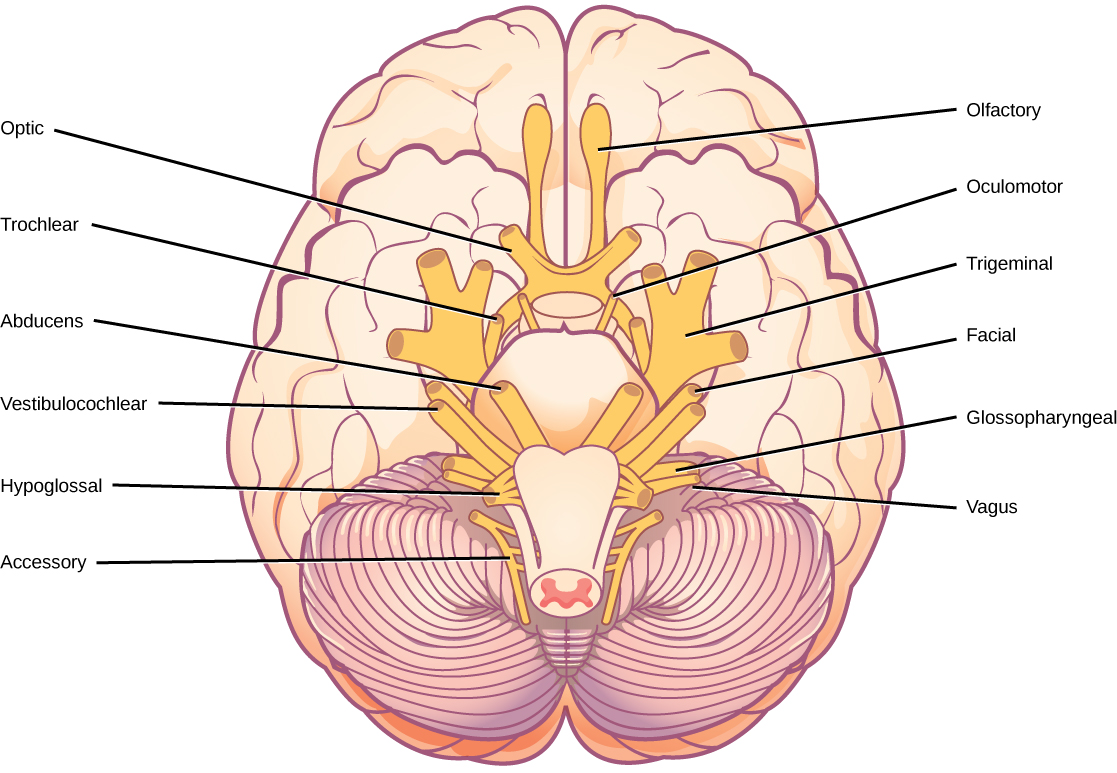
Figure 35.27図 35.27
The human brain contains 12 cranial nerves that receive sensory input and control motor output for the head and neck.
ヒトの脳には、頭頸部の感覚入力を受け取り、運動出力を制御する12本の脳神経がある。
Spinal nerves transmit sensory and motor information between the spinal cord and the rest of the body. Each of the 31 spinal nerves (in humans) contains both sensory and motor axons. The sensory neuron cell bodies are grouped in structures called dorsal root ganglia and are shown in Figure 35.28. Each sensory neuron has one projection—with a sensory receptor ending in skin, muscle, or sensory organs—and another that synapses with a neuron in the dorsal spinal cord. Motor neurons have cell bodies in the ventral gray matter of the spinal cord that project to muscle through the ventral root. These neurons are usually stimulated by interneurons within the spinal cord but are sometimes directly stimulated by sensory neurons.
英語のヒント
脊髄神経は、脊髄と体の他の部分の間で感覚情報と運動情報を伝える。ヒトでは31本あり、各神経が感覚軸索と運動軸索の両方を含む。感覚ニューロンの細胞体は、図35.28に示す後根神経節という構造に集まっている。各感覚ニューロンには、皮膚、筋肉、感覚器の感覚受容器で終わる突起と、脊髄背側のニューロンにシナプスをつくる突起がある。運動ニューロンの細胞体は脊髄腹側の灰白質にあり、そこから前根を通って筋肉へ投射する。これらのニューロンは通常、脊髄内の介在ニューロンに刺激されるが、感覚ニューロンに直接刺激されることもある。
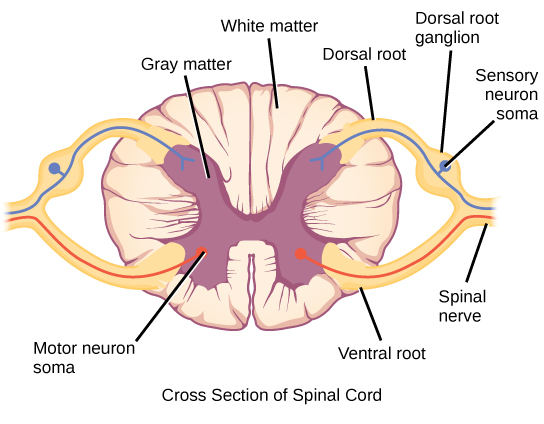


Figure 35.28図 35.28
Spinal nerves contain both sensory and motor axons. The somas of sensory neurons are located in dorsal root ganglia. The somas of motor neurons are found in the ventral portion of the gray matter of the spinal cord.
脊髄神経には感覚軸索と運動軸索の両方が含まれる。感覚ニューロンの細胞体は後根神経節に、運動ニューロンの細胞体は脊髄の灰白質の腹側にある。
Section Summary節のまとめ
The peripheral nervous system contains both the autonomic and sensory-somatic nervous systems. The autonomic nervous system provides unconscious control over visceral functions and has two divisions: the sympathetic and parasympathetic nervous systems. The sympathetic nervous system is activated in stressful situations to prepare the animal for a “fight or flight” response. The parasympathetic nervous system is active during restful periods. The sensory-somatic nervous system is made of cranial and spinal nerves that transmit sensory information from skin and muscle to the CNS and motor commands from the CNS to the muscles.
末梢神経系には、自律神経系と感覚・体性神経系が含まれる。自律神経系は内臓機能を無意識に制御し、交感神経系と副交感神経系に分かれる。交感神経系はストレスのかかる状況で活性化し、動物を「闘争・逃走」反応に備えさせる。副交感神経系は休息時に活動する。感覚・体性神経系は脳神経と脊髄神経からなる。これらは皮膚や筋肉から中枢神経系へ感覚情報を、中枢神経系から筋肉へ運動指令を伝える。