第35章神経系
Parts of a Neuronニューロンの各部
Like other cells, each neuron has a cell body (or soma) that contains a nucleus, smooth and rough endoplasmic reticulum, Golgi apparatus, mitochondria, and other cellular components. Neurons also contain unique structures, illustrated in Figure 35.3 for receiving and sending the electrical signals that make neuronal communication possible. Dendrites are tree-like structures that extend away from the cell body to receive messages from other neurons at specialized junctions called synapses. Although some neurons do not have any dendrites, some types of neurons have multiple dendrites. Dendrites can have small protrusions called dendritic spines, which further increase surface area for possible synaptic connections.
英語のヒント
他の細胞と同様、各ニューロンには細胞体(ソーマ)があり、核、滑面小胞体、粗面小胞体、ゴルジ体、ミトコンドリア、その他の細胞構成要素を含む。ニューロンにはさらに、図35.3に示す独特の構造があり、ニューロン間の情報伝達を可能にする電気信号を受信・送信する。樹状突起は、細胞体から伸びる木の枝のような構造で、シナプスと呼ばれる特殊な接合部で他のニューロンから情報を受け取る。樹状突起をまったく持たないニューロンもある一方、複数持つ種類もある。樹状突起には、樹状突起スパインという小さな突出部があることがあり、シナプス結合ができる表面積をさらに増やす。
Once a signal is received by the dendrite, it then travels passively to the cell body. The cell body contains a specialized structure, the axon hillock that integrates signals from multiple synapses and serves as a junction between the cell body and an axon. An axon is a tube-like structure that propagates the integrated signal to specialized endings called axon terminals. These terminals in turn synapse on other neurons, muscle, or target organs. Chemicals released at axon terminals allow signals to be communicated to these other cells. Neurons usually have one or two axons, but some neurons, like amacrine cells in the retina, do not contain any axons. Some axons are covered with myelin, which acts as an insulator to minimize dissipation of the electrical signal as it travels down the axon, greatly increasing the speed of conduction. This insulation is important as the axon from a human motor neuron can be as long as a meter—from the base of the spine to the toes. The myelin sheath is not actually part of the neuron. Myelin is produced by glial cells. Along the axon there are periodic gaps in the myelin sheath. These gaps are called nodes of Ranvier and are sites where the signal is “recharged” as it travels along the axon.
英語のヒント
樹状突起が信号を受け取ると、信号は受動的に細胞体へ伝わる。細胞体には軸索丘という特殊な構造があり、複数のシナプスからの信号を統合するとともに、細胞体と軸索の接合部となる。軸索は、統合された信号を、軸索終末という特殊な末端へ伝える管状の構造である。軸索終末はさらに、他のニューロン、筋、標的器官にシナプスを形成する。終末から放出される化学物質によって、これらの細胞へ信号が伝えられる。通常、ニューロンには一本または二本の軸索があるが、網膜のアマクリン細胞など、軸索をまったく持たないものもある。一部の軸索はミエリンで覆われる。ミエリンは絶縁体として働き、軸索を伝わる電気信号の散逸を最小限にし、伝導速度を大幅に上げる。ヒトの運動ニューロンの軸索は、脊柱の下部から足の指まで1mにもなることがあり、この絶縁は重要である。髄鞘は実際にはニューロンの一部ではなく、ミエリンはグリア細胞によってつくられる。軸索に沿って髄鞘には一定間隔で隙間があり、これをランビエ絞輪という。信号が軸索を進む間に「再充電」される場所である。
It is important to note that a single neuron does not act alone—neuronal communication depends on the connections that neurons make with one another (as well as with other cells, like muscle cells). Dendrites from a single neuron may receive synaptic contact from many other neurons. For example, dendrites from a Purkinje cell in the cerebellum are thought to receive contact from as many as 200,000 other neurons.
一つのニューロンは単独で働くわけではない。ニューロンの情報伝達は、ニューロンどうし、また筋細胞などの他の細胞との結合に依存する。一つのニューロンの樹状突起は、多数の他のニューロンからシナプス接触を受けることがある。例えば、小脳のプルキンエ細胞の樹状突起は、最大20万個もの他のニューロンから接触を受けると考えられている。
Types of Neuronsニューロンの種類
There are different types of neurons, and the functional role of a given neuron is intimately dependent on its structure. There is an amazing diversity of neuron shapes and sizes found in different parts of the nervous system (and across species), as illustrated by the neurons shown in Figure 35.4.
英語のヒント
ニューロンにはさまざまな種類があり、個々のニューロンが果たす機能的役割は、その構造に密接に依存する。図35.4のニューロンが示すように、神経系の場所によっても、種によっても、ニューロンの形や大きさには驚くほどの多様性がある。
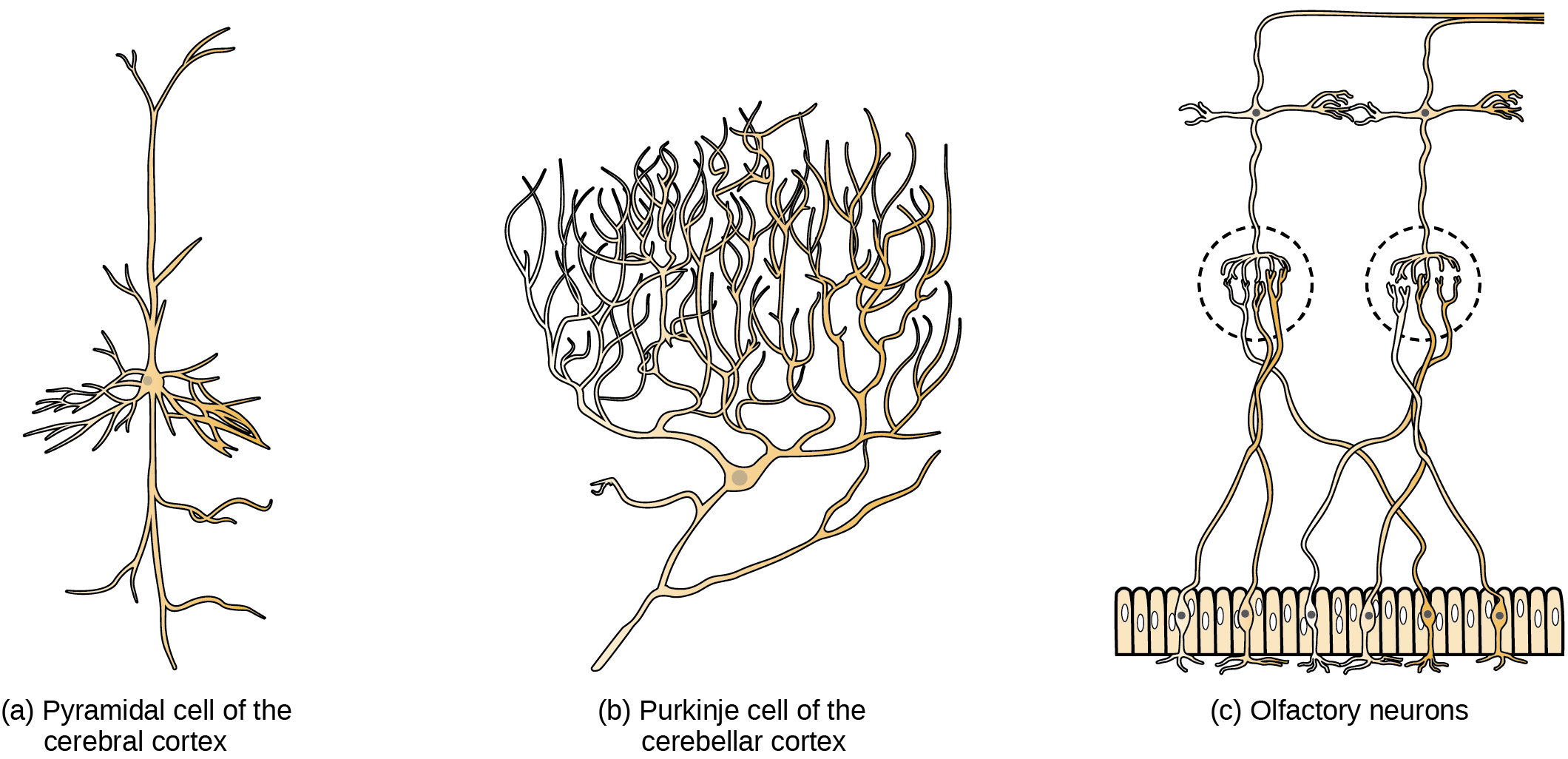
Figure 35.4図 35.4
There is great diversity in the size and shape of neurons throughout the nervous system. Examples include (a) a pyramidal cell from the cerebral cortex, (b) a Purkinje cell from the cerebellar cortex, and (c) olfactory cells from the olfactory epithelium and olfactory bulb.
神経系全体で、ニューロンの大きさと形は非常に多様である。例として、(a)大脳皮質の錐体細胞、(b)小脳皮質のプルキンエ細胞、(c)嗅上皮と嗅球の嗅細胞を示す。
While there are many defined neuron cell subtypes, neurons are broadly divided into four basic types: unipolar, bipolar, multipolar, and pseudounipolar. Figure 35.5 illustrates these four basic neuron types. Unipolar neurons have only one structure that extends away from the soma. These neurons are not found in vertebrates but are found in insects where they stimulate muscles or glands. A bipolar neuron has one axon and one dendrite extending from the soma. An example of a bipolar neuron is a retinal bipolar cell, which receives signals from photoreceptor cells that are sensitive to light and transmits these signals to ganglion cells that carry the signal to the brain. Multipolar neurons are the most common type of neuron. Each multipolar neuron contains one axon and multiple dendrites. Multipolar neurons can be found in the central nervous system (brain and spinal cord). An example of a multipolar neuron is a Purkinje cell in the cerebellum, which has many branching dendrites but only one axon. Pseudounipolar cells share characteristics with both unipolar and bipolar cells. A pseudounipolar cell has a single process that extends from the soma, like a unipolar cell, but this process later branches into two distinct structures, like a bipolar cell. Most sensory neurons are pseudounipolar and have an axon that branches into two extensions: one connected to dendrites that receive sensory information and another that transmits this information to the spinal cord.
英語のヒント
ニューロンには多くの細胞亜型が定義されているが、大きくは単極性、双極性、多極性、偽単極性という四つの基本型に分けられる。図35.5にこれら四型を示す。単極性ニューロンは、細胞体から伸びる構造を一つだけ持つ。脊椎動物には見られず、昆虫に見られ、筋や腺を刺激する。双極性ニューロンは、細胞体から伸びる一本の軸索と一本の樹状突起を持つ。例は網膜の双極細胞で、光に反応する光受容細胞から信号を受け取り、脳へ信号を運ぶ神経節細胞へ伝える。多極性ニューロンは最も一般的な種類で、それぞれ一本の軸索と複数の樹状突起を持つ。中枢神経系(脳と脊髄)に見られ、例として、多くの枝分かれした樹状突起と一本だけの軸索を持つ、小脳のプルキンエ細胞がある。偽単極細胞は単極細胞と双極細胞の両方の特徴を持つ。単極細胞のように細胞体から一本の突起が伸びるが、その突起は先で二つの異なる構造へ分かれ、双極細胞のようになる。感覚ニューロンの大半は偽単極性で、軸索が二つの枝に分かれる。一方は感覚情報を受け取る樹状突起につながり、もう一方はその情報を脊髄へ伝える。
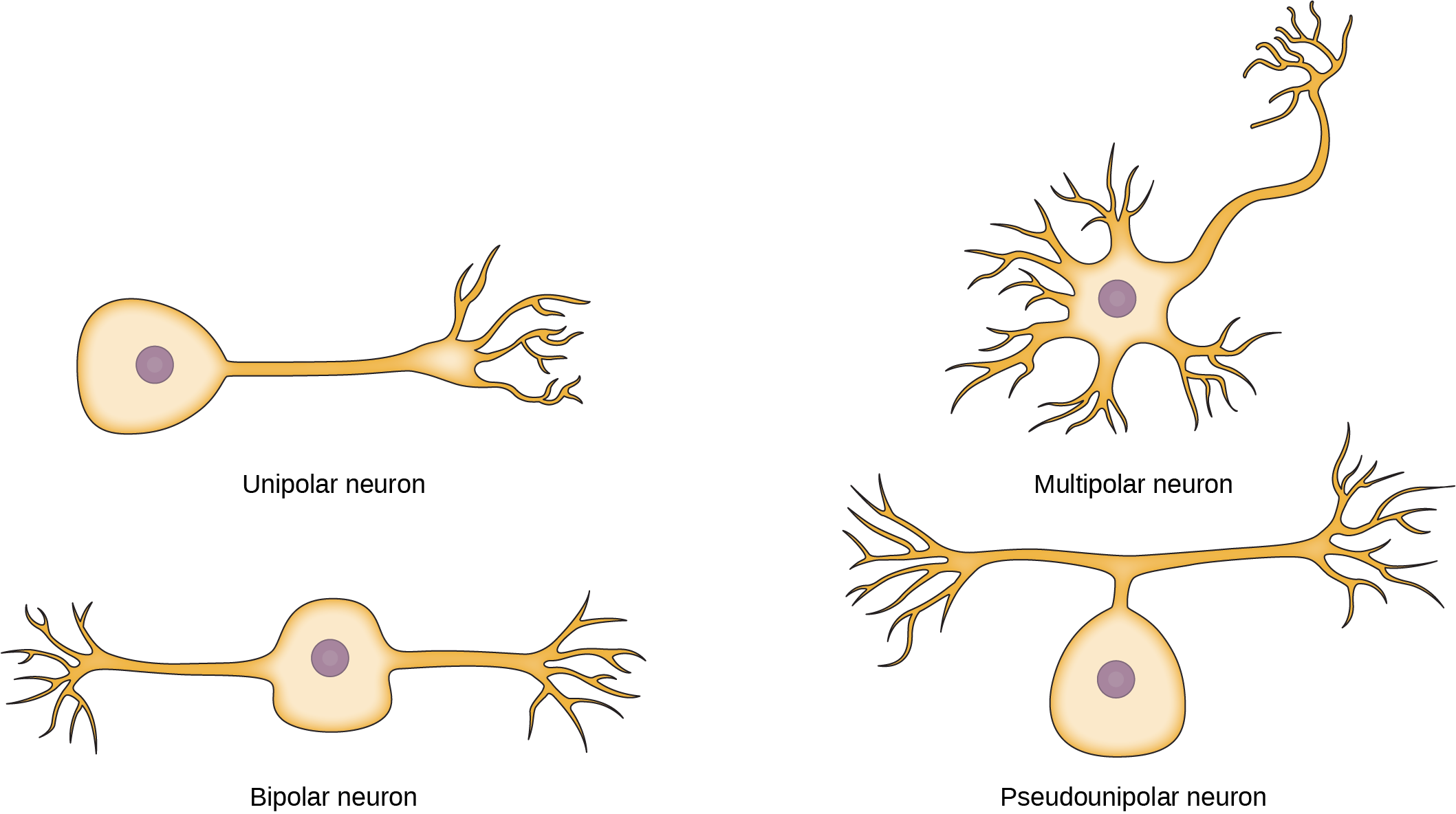


Figure 35.5図 35.5
Neurons are broadly divided into four main types based on the number and placement of axons: (1) unipolar, (2) bipolar, (3) multipolar, and (4) pseudounipolar.
ニューロンは、軸索の数と配置に基づいて、(1)単極性、(2)双極性、(3)多極性、(4)偽単極性という四つの主な種類に分けられる。