第35章神経系
35.1 Neurons and Glial Cells35.1 ニューロンとグリア細胞
Learning Objectives学習目標
By the end of this section, you will be able to do the following:
この節を学ぶと、次のことができるようになる。
- List and describe the functions of the structural components of a neuronニューロンを構成する構造を列挙し、その機能を説明する。
- List and describe the four main types of neuronsニューロンの主な四種類を挙げ、説明する。
- Compare the functions of different types of glial cellsさまざまなグリア細胞の機能を比較する。
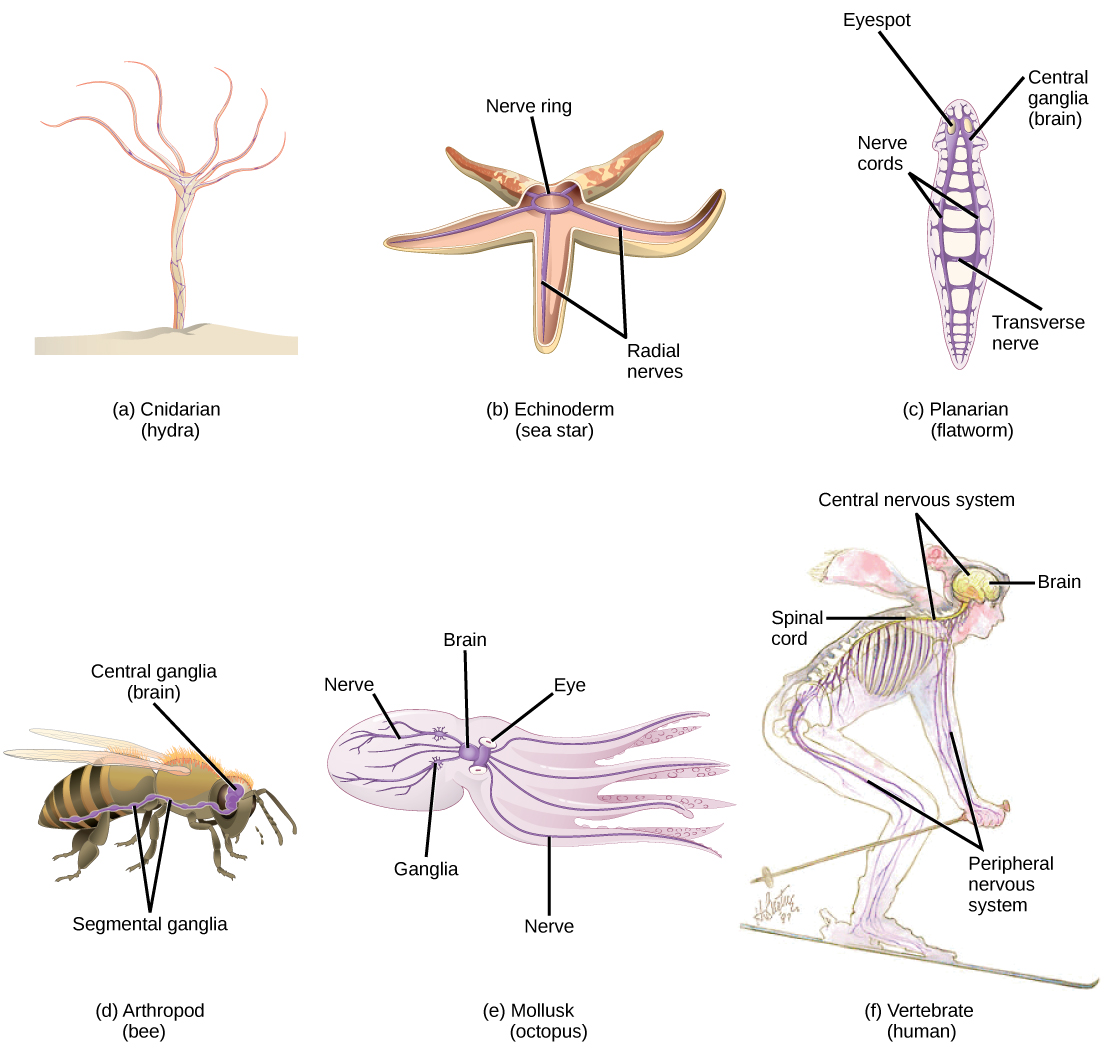
Nervous systems throughout the animal kingdom vary in structure and complexity, as illustrated by the variety of animals shown in Figure 35.2. Some organisms, like sea sponges, lack a true nervous system. Others, like jellyfish, lack a true brain and instead have a system of separate but connected nerve cells (neurons) called a “nerve net.” Echinoderms such as sea stars have nerve cells that are bundled into fibers called nerves. Flatworms of the phylum Platyhelminthes have both a central nervous system (CNS), made up of a small “brain” and two nerve cords, and a peripheral nervous system (PNS) containing a system of nerves that extend throughout the body. The insect nervous system is more complex but also fairly decentralized. It contains a brain, ventral nerve cord, and ganglia (clusters of connected neurons). These ganglia can control movements and behaviors without input from the brain. Octopi may have the most complicated of invertebrate nervous systems—they have neurons that are organized in specialized lobes and eyes that are structurally similar to vertebrate species.
英語のヒント
図35.2のさまざまな動物が示すように、動物界の神経系は構造と複雑さが多様である。海綿のように、真の神経系を持たない生物もいる。クラゲなどは真の脳を持たず、代わりに、個々に分かれながら互いにつながる神経細胞(ニューロン)からなる「神経網」を持つ。ヒトデなどの棘皮動物では、神経細胞が束ねられて、神経と呼ばれる線維になっている。扁形動物門の動物には、小さな「脳」と二本の神経索からなる中枢神経系(CNS)と、全身へ伸びる神経の系を含む末梢神経系(PNS)がある。昆虫の神経系はより複雑だが、かなり分散している。脳、腹側神経索、神経節(つながったニューロンの集まり)を含み、神経節は脳からの入力がなくても運動や行動を制御できる。タコは無脊椎動物の中で最も複雑な神経系を持つかもしれない。ニューロンは特化した葉に組織化されており、目は脊椎動物のものと構造的に似ている。
OpenStax, Rice University; Biology 2e. (credit e: modification of work by Michael Vecchione, Clyde F.E. Roper, and Michael J. Sweeney, NOAA; credit f: modification of work by NIH) · CC BY 4.0 · Source出典

Figure 35.2図 35.2
Nervous systems vary in structure and complexity. In (a) cnidarians, nerve cells form a decentralized nerve net. In (b) echinoderms, nerve cells are bundled into fibers called nerves. In animals exhibiting bilateral symmetry such as (c) planarians, neurons cluster into an anterior brain that processes information. In addition to a brain, (d) arthropods have clusters of nerve cell bodies, called peripheral ganglia, located along the ventral nerve cord. Mollusks such as squid and (e) octopi, which must hunt to survive, have complex brains containing millions of neurons. In (f) vertebrates, the brain and spinal cord comprise the central nervous system, while neurons extending into the rest of the body comprise the peripheral nervous system. (credit e: modification of work by Michael Vecchione, Clyde F.E. Roper, and Michael J. Sweeney, NOAA; credit f: modification of work by NIH)
神経系の構造と複雑さは多様である。(a)刺胞動物では、神経細胞が分散した神経網をつくる。(b)棘皮動物では、神経細胞が束ねられ、神経と呼ばれる線維になる。(c)プラナリアのような左右相称の動物では、ニューロンが前方の脳に集まり、情報を処理する。(d)節足動物には脳に加え、腹側神経索に沿って末梢神経節という神経細胞体の集まりがある。生きるために狩りをしなければならないイカや(e)タコなどの軟体動物には、数百万のニューロンを含む複雑な脳がある。(f)脊椎動物では、脳と脊髄が中枢神経系を構成し、体の他の部分へ伸びるニューロンが末梢神経系を構成する。(クレジットe:Michael Vecchione、Clyde F.E. Roper、Michael J. Sweeney、NOAAの作品を改変、f:NIHの作品を改変)
Compared to invertebrates, vertebrate nervous systems are more complex, centralized, and specialized. While there is great diversity among different vertebrate nervous systems, they all share a basic structure: a CNS that contains a brain and spinal cord and a PNS made up of peripheral sensory and motor nerves. One interesting difference between the nervous systems of invertebrates and vertebrates is that the nerve cords of many invertebrates are located ventrally whereas the vertebrate spinal cords are located dorsally. There is debate among evolutionary biologists as to whether these different nervous system plans evolved separately or whether the invertebrate body plan arrangement somehow “flipped” during the evolution of vertebrates.
英語のヒント
無脊椎動物に比べ、脊椎動物の神経系は複雑で、集中化と特殊化が進んでいる。脊椎動物の神経系どうしにも大きな多様性があるが、基本構造は共通する。脳と脊髄を含む中枢神経系と、末梢の感覚神経および運動神経からなる末梢神経系である。無脊椎動物と脊椎動物の神経系の興味深い違いは、多くの無脊椎動物の神経索が腹側にあるのに対し、脊椎動物の脊髄は背側にあることである。進化生物学者の間では、これらの異なる神経系の体制が別々に進化したのか、それとも脊椎動物の進化の過程で、無脊椎動物の体制の配置が何らかの形で「反転」したのか、議論されている。
The nervous system is made up of neurons, specialized cells that can receive and transmit chemical or electrical signals, and glia, cells that provide support functions for the neurons by playing an information processing role that is complementary to neurons. A neuron can be compared to an electrical wire—it transmits a signal from one place to another. Glia can be compared to the workers at the electric company who make sure wires go to the right places, maintain the wires, and take down wires that are broken. Although glia have been compared to workers, recent evidence suggests that they also usurp some of the signaling functions of neurons.
英語のヒント
神経系はニューロンとグリアからなる。ニューロンは化学的または電気的な信号を受け取り、伝えることができる特殊化した細胞である。グリアはニューロンを補完する情報処理の役割を果たすことで、ニューロンを支える細胞である。ニューロンは電線にたとえられる。ある場所から別の場所へ信号を伝えるからである。グリアは電力会社の作業員にたとえられ、電線が正しい場所へつながっていることを確認し、維持し、壊れた電線を取り除く。グリアは作業員にたとえられてきたが、近年の証拠は、ニューロンの信号伝達機能の一部も引き受けることを示唆している。
There is great diversity in the types of neurons and glia that are present in different parts of the nervous system. There are four major types of neurons, and they share several important cellular components.
神経系の各部に存在するニューロンとグリアの種類は、非常に多様である。ニューロンには四つの主な種類があり、いくつかの重要な細胞構成要素を共有している。
Neuronsニューロン
The nervous system of the common laboratory fly, Drosophila melanogaster, contains around 100,000 neurons, the same number as a lobster. This number compares to 75 million in the mouse and 300 million in the octopus. A human brain contains around 86 billion neurons. Despite these very different numbers, the nervous systems of these animals control many of the same behaviors—from basic reflexes to more complicated behaviors like finding food and courting mates. The ability of neurons to communicate with each other as well as with other types of cells underlies all of these behaviors.
英語のヒント
実験によく使われるキイロショウジョウバエ(Drosophila melanogaster)の神経系には、ロブスターと同程度の約10万個のニューロンがある。これに対し、マウスは7500万個、タコは3億個である。ヒトの脳には約860億個のニューロンがある。数はこれほど異なるが、これらの動物の神経系は、基本的な反射から、食物を見つける、求愛するといったより複雑な行動まで、多くの同じ行動を制御する。ニューロンが互いに、また他の種類の細胞とも情報をやり取りする能力が、これらすべての行動の基礎にある。
Most neurons share the same cellular components. But neurons are also highly specialized—different types of neurons have different sizes and shapes that relate to their functional roles.
ほとんどのニューロンは同じ細胞構成要素を持つ。しかしニューロンは高度に特殊化してもおり、種類によって、その機能的役割に関わる大きさや形が異なる。