第35章神経系
Parkinson’s Diseaseパーキンソン病
Like Alzheimer’s disease, Parkinson’s disease is a neurodegenerative disease. It was first characterized by James Parkinson in 1817. Each year, 50,000-60,000 people in the United States are diagnosed with the disease. Parkinson’s disease causes the loss of dopamine neurons in the substantia nigra, a midbrain structure that regulates movement. Loss of these neurons causes many symptoms including tremor (shaking of fingers or a limb), slowed movement, speech changes, balance and posture problems, and rigid muscles. The combination of these symptoms often causes a characteristic slow hunched shuffling walk, illustrated in Figure 35.30. Patients with Parkinson’s disease can also exhibit psychological symptoms, such as dementia or emotional problems.
英語のヒント
パーキンソン病も、アルツハイマー病と同じく神経変性疾患である。1817年にジェームズ・パーキンソンが初めてその特徴を記述した。米国では毎年5万~6万人が診断される。この病気では、運動を調節する中脳の構造である黒質のドーパミンニューロンが失われる。その結果、振戦(指や手足の震え)、動作の遅さ、話し方の変化、平衡や姿勢の問題、筋肉の硬直などが起こる。症状が組み合わさると、図35.30に示すような、前かがみで足を引きずる特有の遅い歩き方がよく現れる。認知症や感情の問題など、心理面の症状を示すこともある。
Although some patients have a form of the disease known to be caused by a single mutation, for most patients the exact causes of Parkinson’s disease remain unknown: the disease likely results from a combination of genetic and environmental factors (similar to Alzheimer’s disease). Post-mortem analysis of brains from Parkinson’s patients shows the presence of Lewy bodies—abnormal protein clumps—in dopaminergic neurons. The prevalence of these Lewy bodies often correlates with the severity of the disease.
英語のヒント
単一の変異で起こるとわかっている型の患者もいるが、大多数では、パーキンソン病の正確な原因は不明である。アルツハイマー病と同様、遺伝的要因と環境要因の組合せから生じる可能性が高い。患者の脳を死後に分析すると、ドーパミン作動性ニューロンに、異常なタンパク質の塊であるレビー小体がみられる。その広がりの程度は、しばしば病気の重さと相関する。
There is no cure for Parkinson’s disease, and treatment is focused on easing symptoms. One of the most commonly prescribed drugs for Parkinson’s is L-DOPA, which is a chemical that is converted into dopamine by neurons in the brain. This conversion increases the overall level of dopamine neurotransmission and can help compensate for the loss of dopaminergic neurons in the substantia nigra. Other drugs work by inhibiting the enzyme that breaks down dopamine.
英語のヒント
パーキンソン病を完治させる方法はなく、治療は症状の緩和を中心とする。最もよく処方される薬の一つがL-DOPAで、脳のニューロンによってドーパミンに変換される化合物である。この変換はドーパミンによる神経伝達全体を増やし、黒質のドーパミン作動性ニューロンが失われた影響を補うのに役立つ。ドーパミンを分解する酵素を阻害する薬もある。
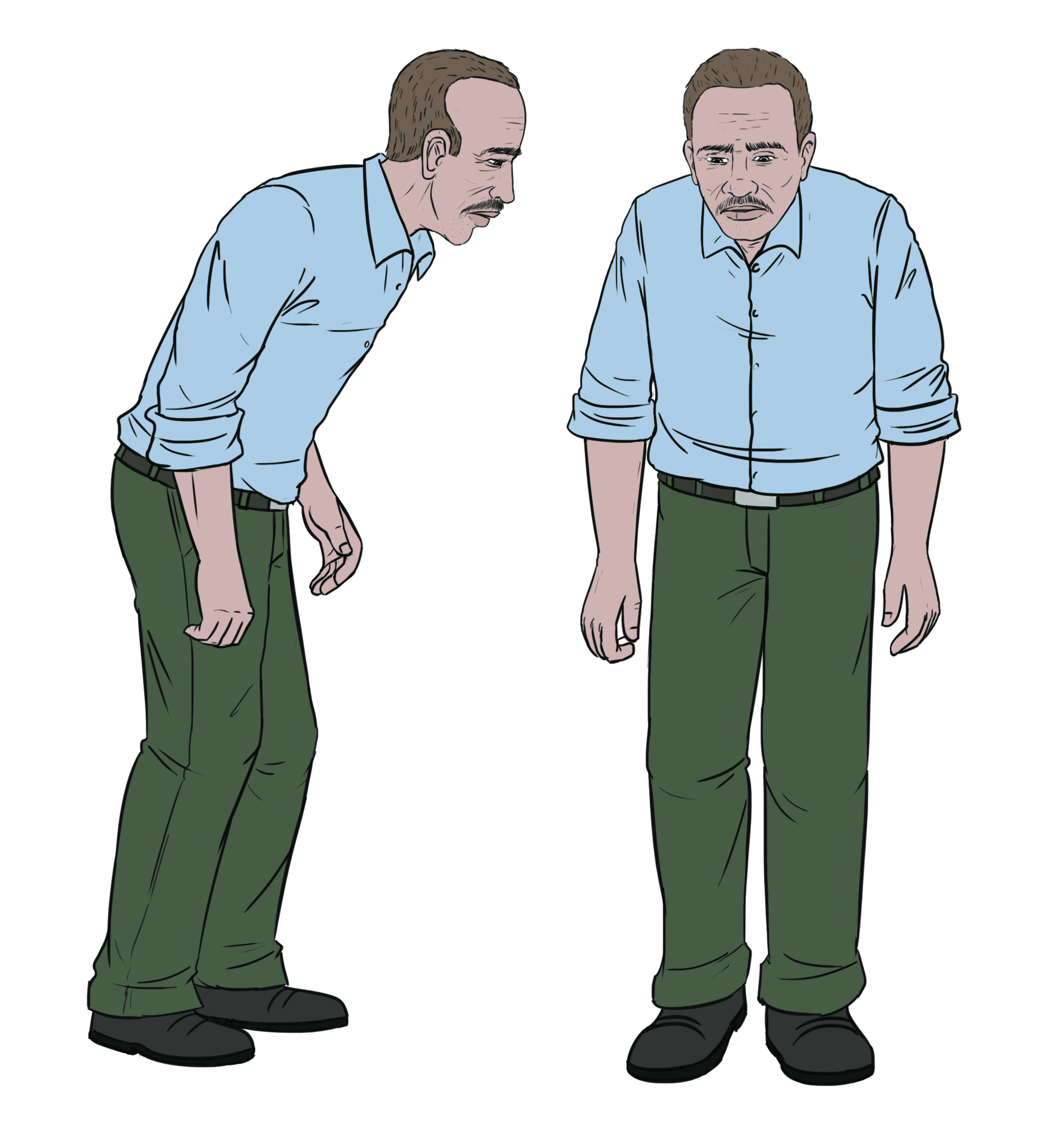

Figure 35.30図 35.30
Parkinson’s patients often have a characteristic hunched walk.
パーキンソン病患者には、特有の前かがみの歩き方がよくみられる。
Neurodevelopmental Disorders神経発達症
Neurodevelopmental disorders occur when the development of the nervous system is disturbed. There are several different classes of neurodevelopmental disorders. Some, like Down Syndrome, cause intellectual deficits. Others specifically affect communication, learning, or the motor system. Some disorders like autism spectrum disorder and attention deficit/hyperactivity disorder have complex symptoms.
神経発達症は、神経系の発達が妨げられると起こる。いくつかの種類があり、ダウン症候群のように知的な機能の低下を伴うものや、コミュニケーション、学習、運動系に特に影響するものがある。自閉スペクトラム症や注意欠如・多動症などは、複雑な症状を示す。
Autism自閉症
Autism spectrum disorder (ASD) is a neurodevelopmental disorder. Its severity differs from person to person. Estimates for the prevalence of the disorder have changed rapidly in the past few decades. Current estimates suggest that one in 88 children will develop the disorder. ASD is four times more prevalent in males than females.
自閉スペクトラム症(ASD)は神経発達症の一つで、重症度は人によって異なる。有病率の推定値は過去数十年で急速に変化してきた。現在の推定では、子どもの88人に1人が発症するとされる。ASDは女性より男性に4倍多い。
A characteristic symptom of ASD is impaired social skills. Children with autism may have difficulty making and maintaining eye contact and reading social cues. They also may have problems feeling empathy for others. Other symptoms of ASD include repetitive motor behaviors (such as rocking back and forth), preoccupation with specific subjects, strict adherence to certain rituals, and unusual language use. Up to 30 percent of patients with ASD develop epilepsy, and patients with some forms of the disorder (like Fragile X) also have intellectual disability. Because it is a spectrum disorder, other ASD patients are very functional and have good-to-excellent language skills. Many of these patients do not feel that they suffer from a disorder and instead think that their brains just process information differently.
英語のヒント
ASDに特徴的な症状の一つは、対人関係の技能に難しさがあることである。自閉症の子どもは、目を合わせ続けたり、対人場面の手がかりを読み取ったりすることが難しい場合がある。他者への共感を感じにくいこともある。ほかの症状には、体を前後に揺らすなどの反復的な運動、特定の事柄への強い没頭、決まった儀式的行動への厳格なこだわり、通常とは異なる言葉の使い方がある。ASD患者の最大30%がてんかんを発症し、脆弱X症候群のような一部の型では知的障害もある。一方、スペクトラムをなす障害なので、日常生活によく適応し、言語能力も良好から優秀な人がいる。こうした人の多くは、自分が障害に苦しんでいるとは感じず、脳が情報を処理する方法が異なるだけだと考えている。
Except for some well-characterized, clearly genetic forms of autism (like Fragile X and Rett’s Syndrome), the causes of ASD are largely unknown. Variants of several genes correlate with the presence of ASD, but for any given patient, many different mutations in different genes may be required for the disease to develop. At a general level, ASD is thought to be a disease of “incorrect” wiring. Accordingly, brains of some ASD patients lack the same level of synaptic pruning that occurs in non-affected people. In the 1990s, a research paper linked autism to a common vaccine given to children. This paper was retracted when it was discovered that the author falsified data, and follow-up studies showed no connection between vaccines and autism.
英語のヒント
脆弱X症候群やレット症候群など、特徴がよく解明され、明らかな遺伝性をもつ一部の型を除くと、ASDの原因は大部分が不明である。複数の遺伝子の変異型がASDの存在と相関するが、個々の患者が発症するには、異なる遺伝子のさまざまな変異が必要なのかもしれない。大まかには、ASDは神経の「誤った」配線の疾患と考えられる。それに対応して、一部のASD患者の脳では、ASDでない人と同程度のシナプスの刈り込みがみられない。1990年代には、自閉症を、子どもによく接種されるワクチンと関連づけた論文が発表された。著者によるデータの捏造が判明したため、この論文は撤回された。その後の追試でも、ワクチンと自閉症の関連は認められなかった。
Treatment for autism usually combines behavioral therapies and interventions, along with medications to treat other disorders common to people with autism (depression, anxiety, obsessive compulsive disorder). Although early interventions can help mitigate the effects of the disease, there is currently no cure for ASD.
自閉症の治療では通常、行動療法や介入を組み合わせ、うつ病、不安、強迫症など、併存しやすい他の疾患に対する薬物療法も行う。早期介入で影響を軽減できることはあるが、現在、ASDを完治させる方法はない。