第35章神経系
Long-term Potentiation (LTP)長期増強(LTP)
Long-term potentiation (LTP) is a persistent strengthening of a synaptic connection. LTP is based on the Hebbian principle: cells that fire together wire together. There are various mechanisms, none fully understood, behind the synaptic strengthening seen with LTP. One known mechanism involves a type of postsynaptic glutamate receptor, called NMDA (N-Methyl-D-aspartate) receptors, shown in Figure 35.18. These receptors are normally blocked by magnesium ions; however, when the postsynaptic neuron is depolarized by multiple presynaptic inputs in quick succession (either from one neuron or multiple neurons), the magnesium ions are forced out allowing Ca2+ ions to pass into the postsynaptic cell. Next, Ca2+ ions entering the cell initiate a signaling cascade that causes a different type of glutamate receptor, called AMPA (α-amino-3-hydroxy-5-methyl-4-isoxazolepropionic acid) receptors, to be inserted into the postsynaptic membrane, since activated AMPA receptors allow positive ions to enter the cell. So, the next time glutamate is released from the presynaptic membrane, it will have a larger excitatory effect (EPSP) on the postsynaptic cell because the binding of glutamate to these AMPA receptors will allow more positive ions into the cell. The insertion of additional AMPA receptors strengthens the synapse and means that the postsynaptic neuron is more likely to fire in response to presynaptic neurotransmitter release. Some drugs of abuse co-opt the LTP pathway, and this synaptic strengthening can lead to addiction.
英語のヒント
長期増強(LTP)とは、シナプス結合が持続的に強まることである。LTPは、「一緒に発火する細胞は一緒につながる」というヘッブ則に基づく。LTPによるシナプス強化の背後にはさまざまな仕組みがあるが、完全に理解されたものはない。知られている一つの仕組みには、図35.18のNMDA(N-メチル-D-アスパラギン酸)受容体という、シナプス後グルタミン酸受容体の一種が関わる。通常、この受容体はマグネシウムイオンで塞がれている。しかし、一個または複数のニューロンから短い間隔で複数のシナプス前入力があり、シナプス後ニューロンが脱分極すると、マグネシウムが押し出され、Ca2+がシナプス後細胞へ入れるようになる。次に、流入したCa2+がシグナル伝達の連鎖を始める。その結果、AMPA(α-アミノ-3-ヒドロキシ-5-メチル-4-イソオキサゾールプロピオン酸)受容体という別のグルタミン酸受容体が、シナプス後膜へ挿入される。活性化されたAMPA受容体は、正のイオンを細胞内へ通す。したがって次にシナプス前膜からグルタミン酸が放出されると、これらのAMPA受容体への結合によってさらに多くの正のイオンが入り、シナプス後細胞への興奮性効果(EPSP)が大きくなる。AMPA受容体の追加はシナプスを強くし、シナプス前からの神経伝達物質放出に応じて、シナプス後ニューロンが発火しやすくなることを意味する。乱用される薬物の一部はLTP経路を利用し、このシナプスの強化が依存につながることがある。
Long-term Depression (LTD)長期抑圧(LTD)
Long-term depression (LTD) is essentially the reverse of LTP: it is a long-term weakening of a synaptic connection. One mechanism known to cause LTD also involves AMPA receptors. In this situation, calcium that enters through NMDA receptors initiates a different signaling cascade, which results in the removal of AMPA receptors from the postsynaptic membrane, as illustrated in Figure 35.18. The decrease in AMPA receptors in the membrane makes the postsynaptic neuron less responsive to glutamate released from the presynaptic neuron. While it may seem counterintuitive, LTD may be just as important for learning and memory as LTP. The weakening and pruning of unused synapses allows for unimportant connections to be lost and makes the synapses that have undergone LTP that much stronger by comparison.
英語のヒント
長期抑圧(LTD)は、基本的にLTPの逆であり、シナプス結合が長期的に弱まることである。LTDを起こす既知の仕組みの一つにも、AMPA受容体が関与する。この場合、NMDA受容体を通って入るカルシウムが別のシグナル伝達連鎖を始め、その結果、図35.18のようにシナプス後膜からAMPA受容体が取り除かれる。膜のAMPA受容体が減ると、シナプス前ニューロンから放出されるグルタミン酸への応答性が低下する。直感に反するように思えるかもしれないが、LTDは学習と記憶にとってLTPと同じくらい重要かもしれない。使われないシナプスを弱めて刈り込むことで、重要でない結合が失われ、LTPを受けたシナプスが相対的にその分強くなる。
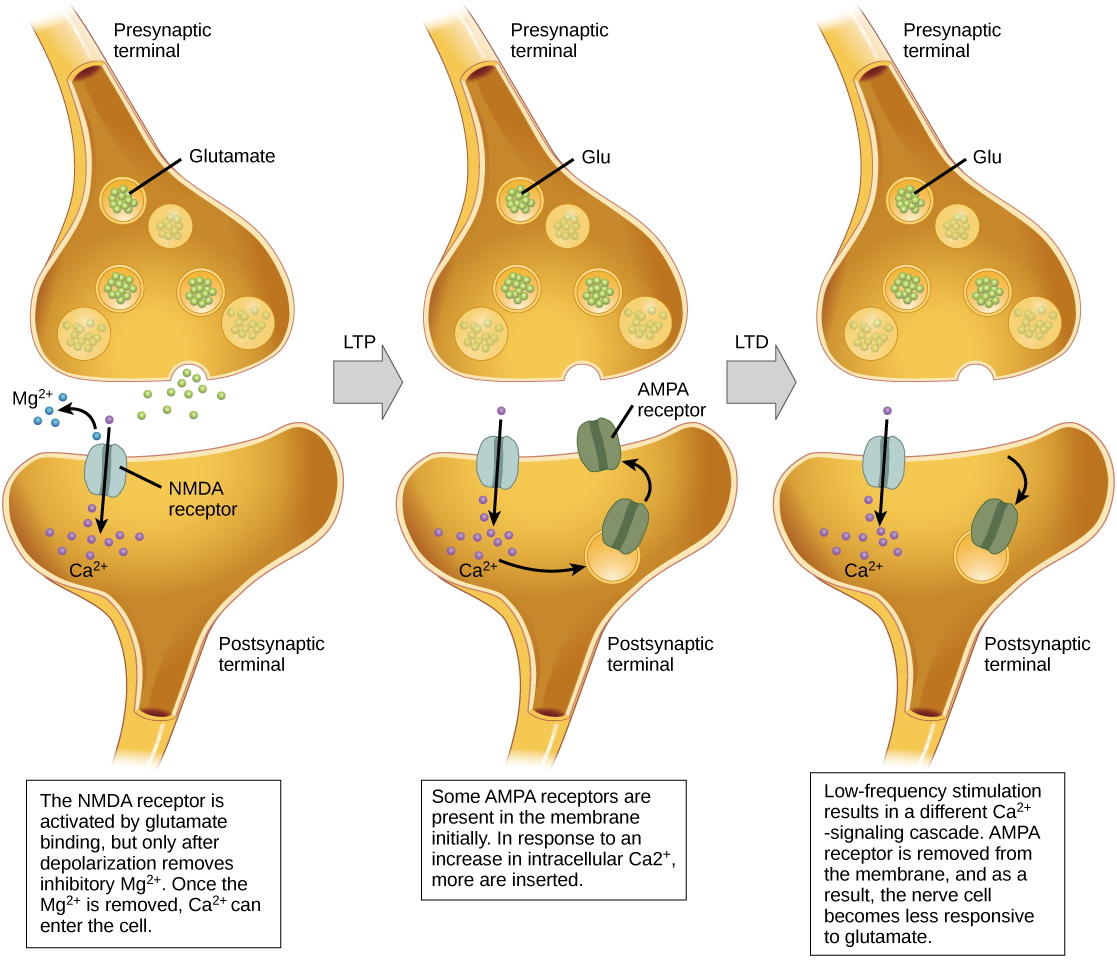

Figure 35.18図 35.18
Calcium entry through postsynaptic NMDA receptors can initiate two different forms of synaptic plasticity: long-term potentiation (LTP) and long-term depression (LTD). LTP arises when a single synapse is repeatedly stimulated. This stimulation causes a calcium- and CaMKII-dependent cellular cascade, which results in the insertion of more AMPA receptors into the postsynaptic membrane. The next time glutamate is released from the presynaptic cell, it will bind to both NMDA and the newly inserted AMPA receptors, thus depolarizing the membrane more efficiently. LTD occurs when few glutamate molecules bind to NMDA receptors at a synapse (due to a low firing rate of the presynaptic neuron). The calcium that does flow through NMDA receptors initiates a different calcineurin and protein phosphatase 1-dependent cascade, which results in the endocytosis of AMPA receptors. This makes the postsynaptic neuron less responsive to glutamate released from the presynaptic neuron.
シナプス後NMDA受容体を通るカルシウム流入は、長期増強(LTP)と長期抑圧(LTD)という二種類のシナプス可塑性を始動させうる。一つのシナプスが繰り返し刺激されるとLTPが生じる。この刺激は、カルシウムとCaMKIIに依存する細胞内の反応連鎖を引き起こし、シナプス後膜により多くのAMPA受容体を挿入する。次にシナプス前細胞からグルタミン酸が放出されると、NMDA受容体と新たなAMPA受容体の両方に結合し、膜をより効率よく脱分極させる。シナプス前ニューロンの発火頻度が低いため、NMDA受容体に結合するグルタミン酸分子が少ないとLTDが起こる。それでもNMDA受容体を通って入るカルシウムは、カルシニューリンとタンパク質ホスファターゼ1に依存する別の連鎖を始め、AMPA受容体のエンドサイトーシスを引き起こす。これによって、シナプス後ニューロンは、シナプス前ニューロンから放出されるグルタミン酸に反応しにくくなる。
Section Summary節のまとめ
Neurons have charged membranes because there are different concentrations of ions inside and outside of the cell. Voltage-gated ion channels control the movement of ions into and out of a neuron. When a neuronal membrane is depolarized to at least the threshold of excitation, an action potential is fired. The action potential is then propagated along a myelinated axon to the axon terminals. In a chemical synapse, the action potential causes release of neurotransmitter molecules into the synaptic cleft. Through binding to postsynaptic receptors, the neurotransmitter can cause excitatory or inhibitory postsynaptic potentials by depolarizing or hyperpolarizing, respectively, the postsynaptic membrane. In electrical synapses, the action potential is directly communicated to the postsynaptic cell through gap junctions—large channel proteins that connect the pre-and postsynaptic membranes. Synapses are not static structures and can be strengthened and weakened. Two mechanisms of synaptic plasticity are long-term potentiation and long-term depression.
ニューロンの膜は、細胞内外のイオン濃度が異なるため帯電している。電位依存性イオンチャネルが、ニューロンへのイオンの出入りを制御する。膜が少なくとも興奮閾値まで脱分極すると活動電位が発火し、その後、髄鞘化された軸索に沿って軸索終末まで伝わる。化学シナプスでは、活動電位がシナプス間隙への神経伝達物質の放出を起こす。神経伝達物質はシナプス後受容体への結合を通じて、後膜を脱分極または過分極させ、それぞれ興奮性または抑制性のシナプス後電位を起こしうる。電気シナプスでは、前膜と後膜をつなぐ大きなチャネルタンパク質であるギャップ結合を通じ、活動電位がシナプス後細胞へ直接伝えられる。シナプスは固定された構造ではなく、強くも弱くもなれる。シナプス可塑性の二つの仕組みが、長期増強と長期抑圧である。
Visual Connection Questions図を使った問題
Exercises 9練習問題 9
Exercise 9問題 9
Figure 35.11 Potassium channel blockers, such as amiodarone and procainamide, which are used to treat abnormal electrical activity in the heart, called cardiac dysrhythmia, impede the movement of K+ through voltage-gated K+ channels. Which part of the action potential would you expect potassium channels to affect?
図35.11 アミオダロンやプロカインアミドなどのカリウムチャネル遮断薬は、不整脈と呼ばれる心臓の異常な電気活動の治療に使われ、電位依存性K+チャネルを通るK+の移動を妨げる。カリウムチャネルは活動電位のどの部分に影響すると予想されるか。
Solution解き方
Figure 35.11 Potassium channel blockers slow the repolarization phase, but have no effect on depolarization.
図35.11 カリウムチャネル遮断薬は再分極相を遅らせるが、脱分極には影響しない。