第35章神経系
Gliaグリア
While glia are often thought of as the supporting cast of the nervous system, the number of glial cells in the brain actually outnumbers the number of neurons by a factor of ten. Neurons would be unable to function without the vital roles that are fulfilled by these glial cells. Glia guide developing neurons to their destinations, buffer ions and chemicals that would otherwise harm neurons, and provide myelin sheaths around axons. Scientists have recently discovered that they also play a role in responding to nerve activity and modulating communication between nerve cells. When glia do not function properly, the result can be disastrous—most brain tumors are caused by mutations in glia.
英語のヒント
グリアは神経系の脇役と考えられがちだが、実際には脳内のグリア細胞の数はニューロンの10倍である。グリア細胞が果たす不可欠な役割がなければ、ニューロンは機能できない。グリアは発生中のニューロンを目的地へ導き、そのままではニューロンを傷つけるイオンや化学物質を緩衝し、軸索の周りに髄鞘をつくる。近年、グリアが神経活動に応答し、神経細胞間の情報伝達を調節する役割も持つと分かった。グリアが正常に機能しないと、結果は深刻になりうる。脳腫瘍の大半は、グリアの突然変異によって起こる。
Types of Gliaグリアの種類
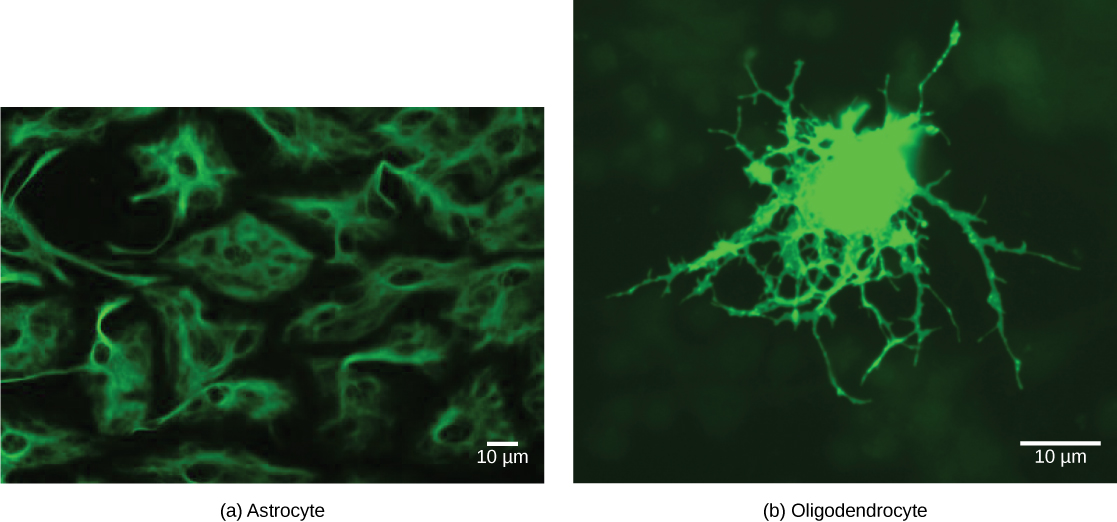
There are several different types of glia with different functions, two of which are shown in Figure 35.7. Astrocytes, shown in Figure 35.8a make contact with both capillaries and neurons in the CNS. They provide nutrients and other substances to neurons, regulate the concentrations of ions and chemicals in the extracellular fluid, and provide structural support for synapses. Astrocytes also form the blood-brain barrier—a structure that blocks entrance of toxic substances into the brain. Astrocytes, in particular, have been shown through calcium imaging experiments to become active in response to nerve activity, transmit calcium waves between astrocytes, and modulate the activity of surrounding synapses. Satellite glia provide nutrients and structural support for neurons in the PNS. Microglia scavenge and degrade dead cells and protect the brain from invading microorganisms. Oligodendrocytes, shown in Figure 35.8b form myelin sheaths around axons in the CNS. One axon can be myelinated by several oligodendrocytes, and one oligodendrocyte can provide myelin for multiple neurons. This is distinctive from the PNS where a single Schwann cell provides myelin for only one axon as the entire Schwann cell surrounds the axon. Radial glia serve as scaffolds for developing neurons as they migrate to their end destinations. Ependymal cells line fluid-filled ventricles of the brain and the central canal of the spinal cord. They are involved in the production of cerebrospinal fluid, which serves as a cushion for the brain, moves the fluid between the spinal cord and the brain, and is a component for the choroid plexus.
英語のヒント
グリアには機能の異なる複数の種類があり、そのうち二つを図35.7に示す。図35.8aのアストロサイト(星状膠細胞)は、中枢神経系の毛細血管とニューロンの両方に接触する。ニューロンに栄養素やその他の物質を供給し、細胞外液のイオン・化学物質濃度を調節し、シナプスを構造的に支える。また、有毒物質の脳への侵入を遮る構造である血液脳関門も形成する。特にアストロサイトについては、カルシウムイメージング実験により、神経活動に応じて活性化し、アストロサイト間でカルシウム波を伝え、周囲のシナプスの活動を調節することが示されている。衛星グリアは、末梢神経系のニューロンに栄養と構造的な支持を与える。ミクログリア(小膠細胞)は死んだ細胞を回収・分解し、侵入する微生物から脳を守る。図35.8bのオリゴデンドロサイト(希突起膠細胞)は、中枢神経系の軸索の周りに髄鞘をつくる。一本の軸索が複数のオリゴデンドロサイトによって髄鞘化され、一個のオリゴデンドロサイトが複数のニューロンにミエリンを供給することもある。これは末梢神経系と異なる。末梢では一個のシュワン細胞全体が軸索を囲むため、一個のシュワン細胞は一本の軸索だけにミエリンを供給する。放射状グリアは、発生中のニューロンが最終目的地へ移動する際の足場となる。上衣細胞は、液体で満たされた脳室と脊髄の中心管を裏打ちする。脳脊髄液の産生に関与し、この液は脳のクッションとして働き、脊髄と脳の間で液体を動かし、脈絡叢の構成要素となる。
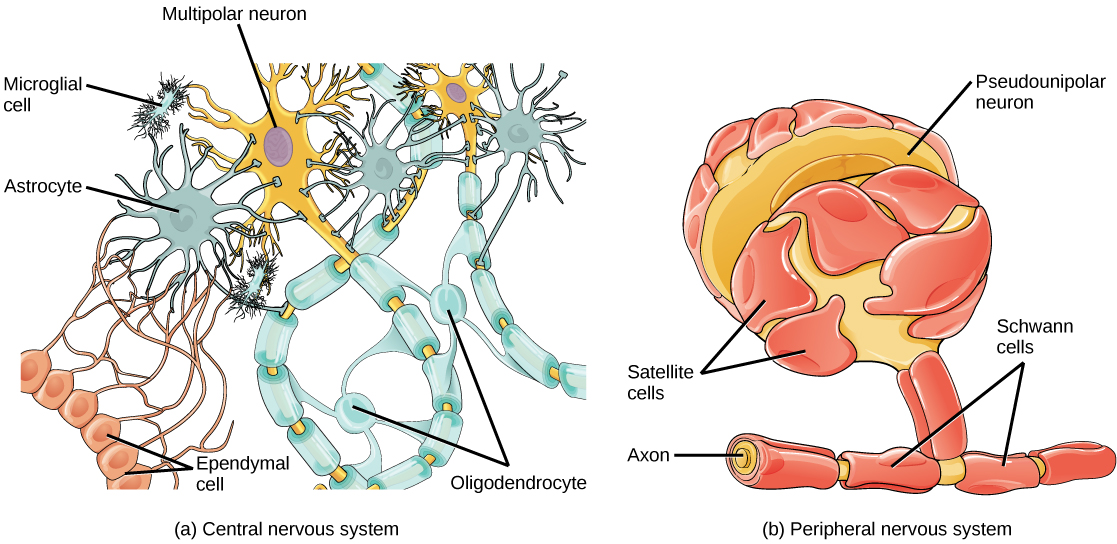

Figure 35.7図 35.7
Glial cells support neurons and maintain their environment. Glial cells of the (a) central nervous system include oligodendrocytes, astrocytes, ependymal cells, and microglial cells. Oligodendrocytes form the myelin sheath around axons. Astrocytes provide nutrients to neurons, maintain their extracellular environment, and provide structural support. Microglia scavenge pathogens and dead cells. Ependymal cells produce cerebrospinal fluid that cushions the neurons. Glial cells of the (b) peripheral nervous system include Schwann cells, which form the myelin sheath, and satellite cells, which provide nutrients and structural support to neurons.
グリア細胞はニューロンを支え、その環境を維持する。(a)中枢神経系のグリアには、オリゴデンドロサイト、アストロサイト、上衣細胞、ミクログリアがある。オリゴデンドロサイトは軸索の周囲に髄鞘をつくる。アストロサイトはニューロンに栄養を供給し、細胞外環境を維持し、構造的に支える。ミクログリアは病原体や死んだ細胞を回収する。上衣細胞はニューロンのクッションとなる脳脊髄液をつくる。(b)末梢神経系のグリアには、髄鞘をつくるシュワン細胞と、ニューロンに栄養と構造的支持を与える衛星細胞がある。
OpenStax, Rice University; Biology 2e. (credit a: modification of work by Uniformed Services University; credit b: modification of work by Jurjen Broeke; scale-bar data from Matt Russell) · CC BY 4.0 · Source出典

Figure 35.8図 35.8
(a) Astrocytes and (b) oligodendrocytes are glial cells of the central nervous system. (credit a: modification of work by Uniformed Services University; credit b: modification of work by Jurjen Broeke; scale-bar data from Matt Russell)
英語のヒント
(a)アストロサイトと(b)オリゴデンドロサイトは、中枢神経系のグリア細胞である。(クレジットa:Uniformed Services Universityの作品を改変、b:Jurjen Broekeの作品を改変、スケールバーのデータ:Matt Russell)
Section Summary節のまとめ
The nervous system is made up of neurons and glia. Neurons are specialized cells that are capable of sending electrical as well as chemical signals. Most neurons contain dendrites, which receive these signals, and axons that send signals to other neurons or tissues. There are four main types of neurons: unipolar, bipolar, multipolar, and pseudounipolar neurons. Glia are non-neuronal cells in the nervous system that support neuronal development and signaling. There are several types of glia that serve different functions.
神経系はニューロンとグリアからなる。ニューロンは、電気信号と化学信号の両方を送れる特殊化した細胞である。ほとんどのニューロンには、信号を受け取る樹状突起と、他のニューロンや組織へ信号を送る軸索がある。ニューロンの主な種類は、単極性、双極性、多極性、偽単極性の四つである。グリアは神経系にあるニューロン以外の細胞で、ニューロンの発達と信号伝達を支える。グリアには、異なる機能を果たす複数の種類がある。
Visual Connection Questions図を使った問題
Exercises 1練習問題 1
Exercise 1問題 1
Figure 35.3 Which of the following statements is false?
図35.3 次の記述のうち、誤っているものはどれか。
- The soma is the cell body of a nerve cell.ソーマは神経細胞の細胞体である。
- Myelin sheath provides an insulating layer to the dendrites.髄鞘は樹状突起に絶縁層をつくる。
- Axons carry the signal from the soma to the target.軸索は細胞体から標的へ信号を運ぶ。
- Dendrites carry the signal to the soma.樹状突起は細胞体へ信号を運ぶ。
Solution解き方
図35.3 B
Review Questions確認問題
Exercises 2–5練習問題 2–5
Exercise 2問題 2
Neurons contain ________, which can receive signals from other neurons.
ニューロンには、他のニューロンから信号を受け取れる________がある。
- axons軸索
- mitochondriaミトコンドリア
- dendrites樹状突起
- Golgi bodiesゴルジ体
Solution解き方
C
C
Exercise 3問題 3
A(n) ________ neuron has one axon and one dendrite extending directly from the cell body.
________ニューロンは、細胞体から直接伸びる一本の軸索と一本の樹状突起を持つ。
- unipolar単極性
- bipolar双極性
- multipolar多極性
- pseudounipolar偽単極性
Solution解き方
B
B
Exercise 4問題 4
Glia that provide myelin for neurons in the brain are called ________.
脳内のニューロンにミエリンを供給するグリアを________という。
- Schwann cellsシュワン細胞
- oligodendrocytesオリゴデンドロサイト
- microgliaミクログリア
- astrocytesアストロサイト
Solution解き方
B
B
Exercise 5問題 5
Meningitis is a viral or bacterial infection of the brain. Which cell type is the first to have its function disrupted during meningitis?
髄膜炎は、脳のウイルス感染または細菌感染である。髄膜炎で最初に機能を妨げられる細胞の種類はどれか。
- astrocytesアストロサイト
- microgliaミクログリア
- neuronsニューロン
- satellite glia衛星グリア
Solution解き方
A
A