第35章神経系
Action Potential活動電位
A neuron can receive input from other neurons and, if this input is strong enough, send the signal to downstream neurons. Transmission of a signal between neurons is generally carried by a chemical called a neurotransmitter. Transmission of a signal within a neuron (from dendrite to axon terminal) is carried by a brief reversal of the resting membrane potential called an action potential. When neurotransmitter molecules bind to receptors located on a neuron’s dendrites, ion channels open. At excitatory synapses, this opening allows positive ions to enter the neuron and results in depolarization of the membrane—a decrease in the difference in voltage between the inside and outside of the neuron. A stimulus from a sensory cell or another neuron depolarizes the target neuron to its threshold potential (-55 mV). Na+ channels in the axon hillock open, allowing positive ions to enter the cell (Figure 35.10 and Figure 35.11). Once the sodium channels open, the neuron completely depolarizes to a membrane potential of about +40 mV. Action potentials are considered an "all-or nothing" event, in that, once the threshold potential is reached, the neuron always completely depolarizes. Once depolarization is complete, the cell must now "reset" its membrane voltage back to the resting potential. To accomplish this, the Na+ channels close and cannot be opened. This begins the neuron's refractory period, in which it cannot produce another action potential because its sodium channels will not open. At the same time, voltage-gated K+ channels open, allowing K+ to leave the cell. As K+ ions leave the cell, the membrane potential once again becomes negative and repolarizes. The diffusion of K+ out of the cell actually continues for a short period of time past the time of the achievement of the resting potential, and the membrane hyperpolarizes, in that the membrane potential becomes more negative than the cell's normal resting potential. This is the result of the slow closing of the K+ channels. At this point, the sodium channels will return to their resting state, meaning they are ready to open again if the membrane potential again exceeds the threshold potential. Eventually all the K+ channels close, and the cell returns back to its resting membrane potential.
英語のヒント
ニューロンは他のニューロンから入力を受け取り、それが十分強ければ下流のニューロンへ信号を送ることができる。ニューロン間の信号伝達は一般に、神経伝達物質という化学物質が担う。ニューロン内部(樹状突起から軸索終末まで)の信号伝導は、静止膜電位が短時間反転する活動電位によって行われる。神経伝達物質分子がニューロンの樹状突起上の受容体に結合すると、イオンチャネルが開く。興奮性シナプスでは、これによって正のイオンがニューロンへ入り、膜が脱分極する。脱分極とは、ニューロンの内外の電位差が小さくなることである。感覚細胞や別のニューロンからの刺激により、標的ニューロンが閾値電位(−55mV)まで脱分極する。軸索丘のNa+チャネルが開き、正のイオンが細胞へ入る(図35.10、図35.11)。ナトリウムチャネルが開くと、ニューロンは約+40mVまで完全に脱分極する。閾値に達すると必ず完全に脱分極するため、活動電位は「全か無か」の現象とされる。脱分極が終わると、細胞は膜電位を静止電位へ「リセット」しなければならない。そのためNa+チャネルが閉じ、開けない状態になる。これにより不応期が始まる。この間はナトリウムチャネルが開かないため、別の活動電位を生じられない。同時に電位依存性K+チャネルが開き、K+が細胞から出る。K+が出るにつれ、膜電位は再び負になり、再分極する。K+の細胞外への拡散は、静止電位に達した後も短時間続き、膜電位が通常の静止電位より負になる過分極を起こす。これはK+チャネルがゆっくり閉じるためである。この時点でナトリウムチャネルは静止状態に戻り、膜電位が再び閾値を超えれば開けるようになる。最終的にすべてのK+チャネルが閉じ、細胞は静止膜電位へ戻る。
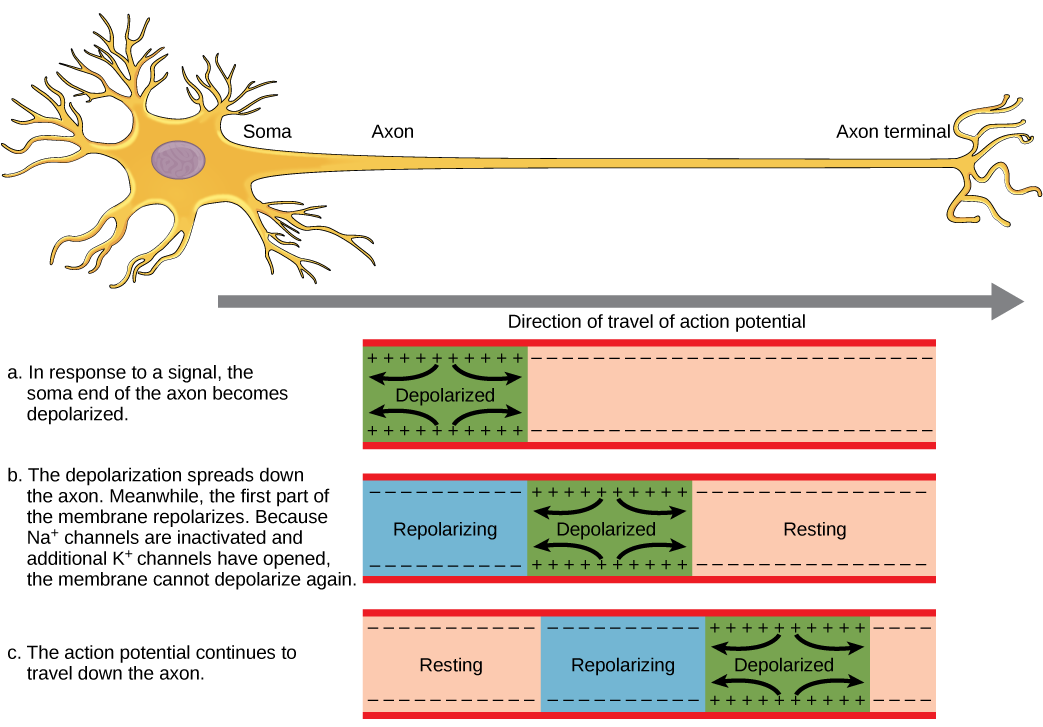
Figure 35.12図 35.12
The action potential is conducted down the axon as the axon membrane depolarizes, then repolarizes.
軸索膜が脱分極し、次いで再分極するにつれ、活動電位は軸索に沿って伝導する。
Myelin and the Propagation of the Action Potentialミエリンと活動電位の伝導
For an action potential to communicate information to another neuron, it must travel along the axon and reach the axon terminals where it can initiate neurotransmitter release. The speed of conduction of an action potential along an axon is influenced by both the diameter of the axon and the axon’s resistance to current leak. Myelin acts as an insulator that prevents current from leaving the axon; this increases the speed of action potential conduction. In demyelinating diseases like multiple sclerosis, action potential conduction slows because current leaks from previously insulated axon areas. The nodes of Ranvier, illustrated in Figure 35.13 are gaps in the myelin sheath along the axon. These unmyelinated spaces are about one micrometer long and contain voltage-gated Na+ and K+ channels. Flow of ions through these channels, particularly the Na+ channels, regenerates the action potential over and over again along the axon. This ‘jumping’ of the action potential from one node to the next is called saltatory conduction. If nodes of Ranvier were not present along an axon, the action potential would propagate very slowly since Na+ and K+ channels would have to continuously regenerate action potentials at every point along the axon instead of at specific points. Nodes of Ranvier also save energy for the neuron since the channels only need to be present at the nodes and not along the entire axon.
英語のヒント
活動電位が他のニューロンに情報を伝えるには、軸索を伝わって軸索終末へ達し、そこで神経伝達物質の放出を開始しなければならない。軸索に沿う活動電位の伝導速度は、軸索の直径と、電流の漏れに対する軸索の抵抗の両方に影響される。ミエリンは電流が軸索から漏れるのを防ぐ絶縁体として働き、伝導速度を上げる。多発性硬化症のような脱髄性疾患では、以前は絶縁されていた軸索の部分から電流が漏れるため、活動電位の伝導が遅くなる。図35.13のランビエ絞輪は、軸索に沿って存在する髄鞘の隙間である。ミエリンのないこの空間は約1マイクロメートルの長さで、電位依存性Na+チャネルとK+チャネルがある。これら、特にNa+チャネルを通るイオンの流れが、軸索に沿って活動電位を繰り返し再生する。活動電位が一つの絞輪から次へ「跳ぶ」ことを、跳躍伝導という。もし軸索に沿ってランビエ絞輪がなければ、特定の点ではなく軸索上のあらゆる点でNa+チャネルとK+チャネルが活動電位を再生し続ける必要があり、伝導は非常に遅くなるだろう。チャネルは軸索全体ではなく絞輪だけにあればよいため、ランビエ絞輪はニューロンのエネルギー節約にもなる。
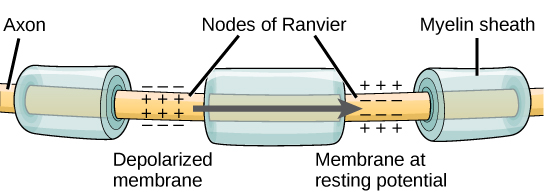


Figure 35.13図 35.13
Nodes of Ranvier are gaps in myelin coverage along axons. Nodes contain voltage-gated K+ and Na+ channels. Action potentials travel down the axon by jumping from one node to the next.
ランビエ絞輪は、軸索を覆うミエリンの隙間である。ここには電位依存性K+チャネルとNa+チャネルがある。活動電位は、一つの絞輪から次へ跳ぶことで軸索を伝わる。