第43章動物の生殖と発生
43.2 Fertilization43.2 受精
Learning Objectives学習目標
By the end of this section, you will be able to do the following:
この節を学ぶと、次のことができるようになる。
- Discuss internal and external methods of fertilization体内受精と体外受精の方法を論じる。
- Describe the methods used by animals for development of offspring during gestation動物が妊娠中に子を発育させる方法を説明する。
- Describe the anatomical adaptations that occurred in animals to facilitate reproduction生殖を促進するために動物に生じた解剖学的な適応を説明する。
Sexual reproduction starts with the combination of a sperm and an egg in a process called fertilization. This can occur either inside (internal fertilization) or outside (external fertilization) the body of the female. Humans provide an example of the former whereas seahorse reproduction is an example of the latter.
英語のヒント
有性生殖は、受精という過程で精子と卵が結合することから始まる。これは雌の体内で起こる場合(体内受精)と、体外で起こる場合(体外受精)がある。人間は前者の例であり、タツノオトシゴの生殖は後者の例である。
External Fertilization体外受精
External fertilization usually occurs in aquatic environments where both eggs and sperm are released into the water. After the sperm reaches the egg, fertilization takes place. Most external fertilization happens during the process of spawning where one or several females release their eggs and the male(s) release sperm in the same area, at the same time. The release of the reproductive material may be triggered by water temperature or the length of daylight. Nearly all fish spawn, as do crustaceans (such as crabs and shrimp), mollusks (such as oysters), squid, and echinoderms (such as sea urchins and sea cucumbers). Figure 43.6 shows salmon spawning in a shallow stream. Frogs, like those shown in Figure 43.7, also spawn.
英語のヒント
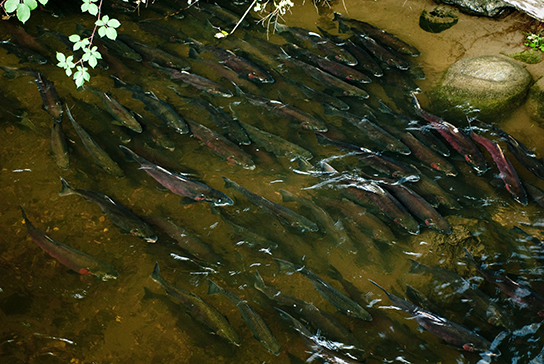
Figure 43.6図 43.6
Salmon reproduce through spawning. (credit: Dan Bennett)
サケは放卵・放精によって繁殖する。(出典:Dan Bennett)
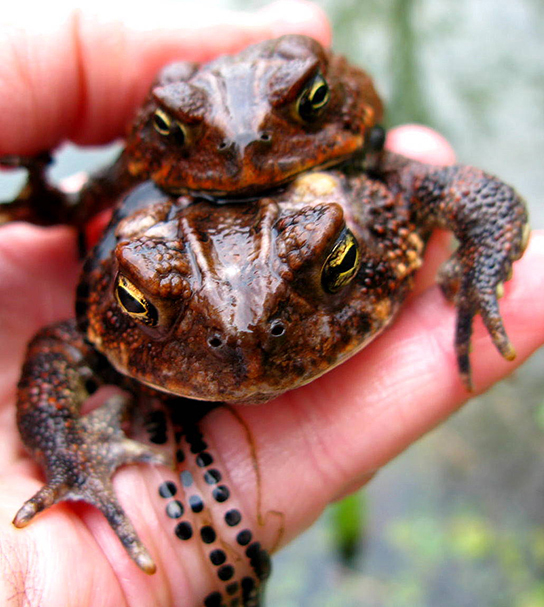


Figure 43.7図 43.7
During sexual reproduction in toads, the male grasps the female from behind and externally fertilizes the eggs as they are deposited. (credit: "OakleyOriginals"/Flickr)
ヒキガエルの有性生殖では、雄が雌を後ろから抱え、産み出される卵を体外で受精させる。(出典:「OakleyOriginals」/Flickr)
Pairs of fish that are not broadcast spawners may exhibit courtship behavior. This allows the female to select a particular male. The trigger for egg and sperm release (spawning) causes the egg and sperm to be placed in a small area, enhancing the possibility of fertilization.
英語のヒント
卵や精子を広範囲に放出しない魚では、つがいが求愛行動を示す場合がある。これによって雌は特定の雄を選べる。卵と精子の放出(放卵・放精)のきっかけが生じると、卵と精子が狭い範囲に集まり、受精の可能性が高まる。
External fertilization in an aquatic environment protects the eggs from drying out. Broadcast spawning can result in a greater mixture of the genes within a group, leading to higher genetic diversity and a greater chance of species survival in a hostile environment. For sessile aquatic organisms like sponges, broadcast spawning is the only mechanism for fertilization and colonization of new environments. The presence of the fertilized eggs and developing young in the water provides opportunities for predation resulting in a loss of offspring. Therefore, millions of eggs must be produced by individuals, and the offspring produced through this method must mature rapidly. The survival rate of eggs produced through broadcast spawning is low.
英語のヒント
水中での体外受精は、卵を乾燥から守る。卵や精子を広範囲に放出すると、集団内で遺伝子がよりよく混ざり合い、遺伝的多様性が高まって、厳しい環境で種が存続する可能性が高まる。海綿のような固着性の水生生物にとっては、こうした放出が、受精し新しい環境へ定着する唯一の仕組みである。受精卵や発育中の子が水中にいると、捕食される機会が生じ、子が失われる。そのため、個体は数百万個の卵を作らなければならず、この方法で生まれた子は素早く成熟しなければならない。広範囲の放卵によって生じる卵の生存率は低い。
Internal Fertilization体内受精
Internal fertilization occurs most often in land-based animals, although some aquatic animals also use this method. There are three ways that offspring are produced following internal fertilization. In oviparity, fertilized eggs are laid outside the parent’s body and develop there, receiving nourishment from the yolk that is a part of the egg. This occurs in most bony fish, many reptiles, some cartilaginous fish, most amphibians, two mammals, and all birds. Reptiles and insects produce leathery eggs, while birds and turtles produce eggs with high concentrations of calcium carbonate in the shell, making them hard. Chicken eggs are an example of this second type.
英語のヒント
体内受精は陸上動物に最も多く見られるが、一部の水生動物もこの方法を用いる。体内受精の後に子が生じる仕方には、3つの種類がある。卵生では、受精卵が親の体外に産み出され、そこで発生する。栄養は卵の一部である卵黄から受け取る。ほとんどの硬骨魚類、多くの爬虫類、一部の軟骨魚類、ほとんどの両生類、2種の哺乳類、およびすべての鳥類で見られる。爬虫類や昆虫は革のような卵を作り、鳥類やカメは殻に高濃度の炭酸カルシウムを含む硬い卵を作る。ニワトリの卵は、この後者の例である。
In ovoviviparity, fertilized eggs are retained in the parent (usually the female), but the embryo obtains its nourishment from the egg’s yolk and the young are fully developed when they are hatched. This occurs in some bony fish (like the guppy Lebistes reticulatus), some sharks, some lizards, some snakes (such as the garter snake Thamnophis sirtalis), some vipers, and some invertebrate animals (like the Madagascar hissing cockroach Gromphadorhina portentosa).
英語のヒント
卵胎生では、受精卵は親(通常は雌)の体内に保持されるが、胚は卵黄から栄養を得る。子は孵化するときには十分に発育している。グッピーLebistes reticulatusのような一部の硬骨魚類、一部のサメ、トカゲ、ヘビ(ガーターヘビThamnophis sirtalisなど)、クサリヘビ類、および無脊椎動物(マダガスカルゴキブリGromphadorhina portentosaなど)で見られる。
In viviparity the young develop within the female, receiving nourishment from the parent’s blood through a placenta. The offspring develops in the female and is born alive. This occurs in most mammals, some cartilaginous fish, and a few reptiles.
英語のヒント
胎生では、子は雌の体内で発育し、胎盤を通じて親の血液から栄養を受け取る。雌の体内で発育した子が、生きた状態で産まれる。ほとんどの哺乳類、一部の軟骨魚類、および少数の爬虫類で見られる。
Internal fertilization has the advantage of protecting the fertilized egg from dehydration on land. The embryo is isolated within the female, which limits predation on the young. Internal fertilization enhances the fertilization of eggs by a specific male. Fewer offspring are produced through this method, but their survival rate is higher than that for external fertilization.
英語のヒント
体内受精には、陸上で受精卵を脱水から守る利点がある。胚は雌の体内に隔離されているので、子への捕食が抑えられる。また、特定の雄による卵の受精が起こりやすくなる。この方法で生じる子の数は少ないが、生存率は体外受精の場合よりも高い。