第43章動物の生殖と発生
43.1 Reproduction Methods43.1 生殖の方法
Learning Objectives学習目標
By the end of this section, you will be able to do the following:
この節を学ぶと、次のことができるようになる。
- Describe advantages and disadvantages of asexual and sexual reproduction無性生殖と有性生殖の利点と欠点を説明する。
- Discuss asexual reproduction methods無性生殖の方法を論じる。
- Discuss sexual reproduction methods有性生殖の方法を論じる。
Animals produce offspring through asexual and/or sexual reproduction. Both methods have advantages and disadvantages. Asexual reproduction produces offspring that are genetically identical to the parent because the offspring are all clones of the original parent. A single individual can produce offspring asexually and large numbers of offspring can be produced quickly. In a stable or predictable environment, asexual reproduction is an effective means of reproduction because all the offspring will be adapted to that environment. In an unstable or unpredictable environment asexually-reproducing species may be at a disadvantage because all the offspring are genetically identical and may not have the genetic variation to survive in new or different conditions. On the other hand, the rapid rates of asexual reproduction may allow for a speedy response to environmental changes if individuals have mutations. An additional advantage of asexual reproduction is that colonization of new habitats may be easier when an individual does not need to find a mate to reproduce.
英語のヒント
動物は無性生殖や有性生殖によって子を作る。どちらの方法にも利点と欠点がある。無性生殖で生じる子は、すべて元の親のクローンなので、親と遺伝的に同一である。1個体だけで無性生殖でき、短時間に多数の子を作れる。安定した、または予測できる環境では、無性生殖は効率的な方法である。すべての子がその環境に適応しているためである。不安定な、または予測できない環境では、無性生殖する種は不利になり得る。子がすべて遺伝的に同一で、新しい、または異なる条件で生き残るための遺伝的変異をもたないかもしれないからである。一方、個体に突然変異があれば、無性生殖の速さによって環境変化に素早く応答できる場合もある。もう1つの利点は、生殖のために相手を探す必要がないので、新しい生息地への定着が容易になり得ることである。
During sexual reproduction the genetic material of two individuals is combined to produce genetically diverse offspring that differ from their parents. The genetic diversity of sexually produced offspring is thought to give species a better chance of surviving in an unpredictable or changing environment. Species that reproduce sexually must maintain two different types of individuals, males and females, which can limit the ability to colonize new habitats as both sexes must be present.
英語のヒント
有性生殖では、2個体の遺伝物質が組み合わされ、親とは異なる、遺伝的に多様な子が生じる。この遺伝的多様性は、予測できない環境や変化する環境で、種が生き残る可能性を高めると考えられている。有性生殖する種は、雄と雌という2種類の個体を維持しなければならない。両方の性が存在する必要があるため、新しい生息地へ定着する能力が制限されることがある。
Asexual Reproduction無性生殖
Asexual reproduction occurs in prokaryotic microorganisms (bacteria) and in some eukaryotic single-celled and multi-celled organisms. There are a number of ways that animals reproduce asexually.
英語のヒント
無性生殖は、原核微生物(細菌)と、一部の単細胞および多細胞の真核生物で起こる。動物が無性生殖する方法には、いくつもの種類がある。
Fission分裂
Fission, also called binary fission, occurs in prokaryotic microorganisms and in some invertebrate, multi-celled organisms. After a period of growth, an organism splits into two separate organisms. Some unicellular eukaryotic organisms undergo binary fission by mitosis. In other organisms, part of the individual separates and forms a second individual. This process occurs, for example, in many asteroid echinoderms through splitting of the central disk. Some sea anemones and some coral polyps (Figure 43.2) also reproduce through fission.
英語のヒント
分裂は二分裂とも呼ばれ、原核微生物と、一部の多細胞の無脊椎動物で起こる。ある程度成長した後、生物は2つの別々の個体に分かれる。一部の単細胞真核生物は、有糸分裂によって二分裂する。ほかの生物では、個体の一部が分離して第2の個体を作る。例えば、多くのヒトデ類の棘皮動物では、中央盤が分かれることでこの過程が起こる。一部のイソギンチャクやサンゴのポリプ(図43.2)も、分裂によって生殖する。
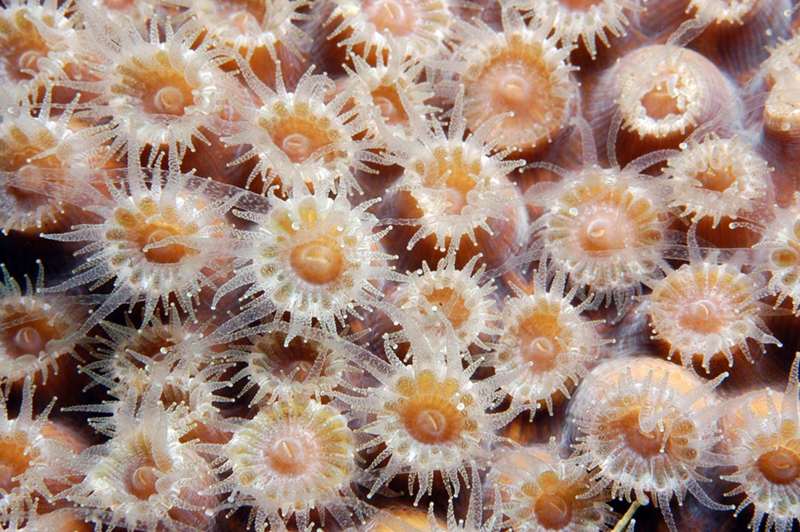
OpenStax, Rice University; Biology 2e. (credit: G. P. Schmahl, NOAA FGBNMS Manager) Embedded rights notice: This image is in the public domain and cannot be copyrighted. · CC BY 4.0 · Source出典
Figure 43.2図 43.2
Coral polyps reproduce asexually by fission. (credit: G. P. Schmahl, NOAA FGBNMS Manager)
サンゴのポリプは分裂によって無性生殖する。(出典:G. P. Schmahl、NOAA FGBNMS Manager)
Budding出芽
Budding is a form of asexual reproduction that results from the outgrowth of a part of a cell or body region leading to a separation from the original organism into two individuals. Budding occurs commonly in some invertebrate animals such as corals and hydras. In hydras, a bud forms that develops into an adult and breaks away from the main body, as illustrated in Figure 43.3, whereas in coral budding, the bud does not detach and multiplies as part of a new colony.
英語のヒント
出芽は、細胞や体の一部が突き出して成長し、元の個体から分かれて2個体となる無性生殖の一形態である。サンゴやヒドラなど、一部の無脊椎動物によく見られる。ヒドラでは芽ができ、それが成体へ発達して、図43.3のように本体から離れる。一方、サンゴの出芽では芽が離れず、新しい群体の一部として増殖する。
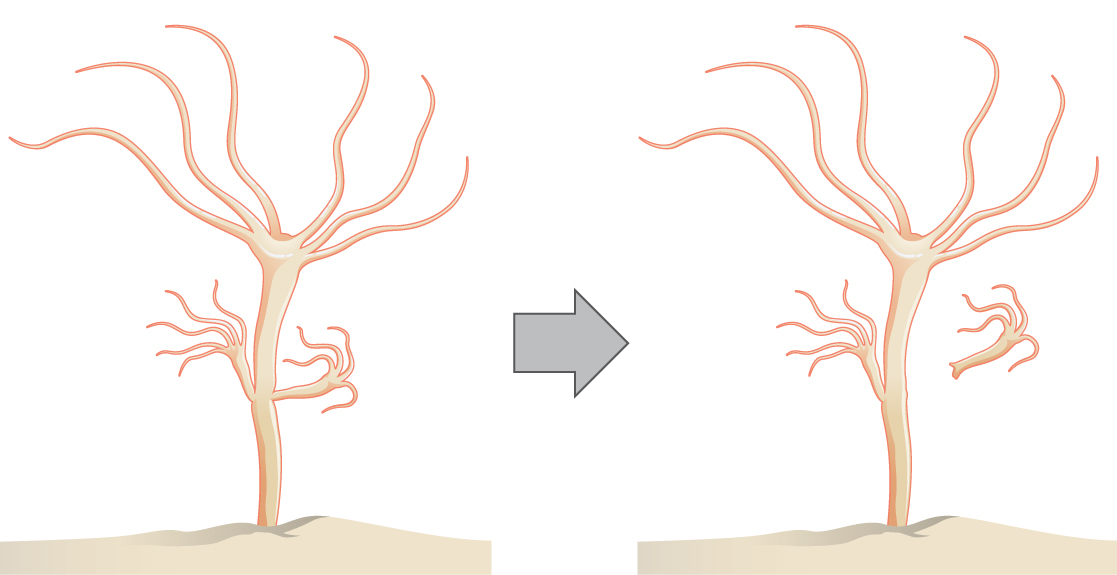
Figure 43.3図 43.3
Hydra reproduce asexually through budding.
ヒドラは出芽によって無性生殖する。
Fragmentation断片化
Fragmentation is the breaking of the body into two parts with subsequent regeneration. If the animal is capable of fragmentation, and the part is big enough, a separate individual will regrow.
英語のヒント
断片化は、体が2つの部分に分かれ、その後に再生が起こることである。その動物が断片化でき、分かれた部分が十分に大きければ、別の個体が再生する。
For example, in many sea stars, asexual reproduction is accomplished by fragmentation. Figure 43.4 illustrates a sea star for which an arm of the individual is broken off and regenerates a new sea star. Fisheries workers have been known to try to kill the sea stars eating their clam or oyster beds by cutting them in half and throwing them back into the ocean. Unfortunately for the workers, the two parts can each regenerate a new half, resulting in twice as many sea stars to prey upon the oysters and clams. Fragmentation also occurs in annelid worms, turbellarians, and poriferans.
英語のヒント
例えば、多くのヒトデは断片化によって無性生殖する。図43.4は、個体から切り離された腕が再生して、新たなヒトデとなる様子を示す。貝やカキの養殖床を食い荒らすヒトデを殺そうと、漁業従事者がそれを半分に切って海へ戻した例が知られている。しかし残念なことに、2つの部分はそれぞれ新しい半分を再生できるため、カキや貝を捕食するヒトデが2倍になってしまう。断片化は環形動物、渦虫類、海綿動物でも起こる。
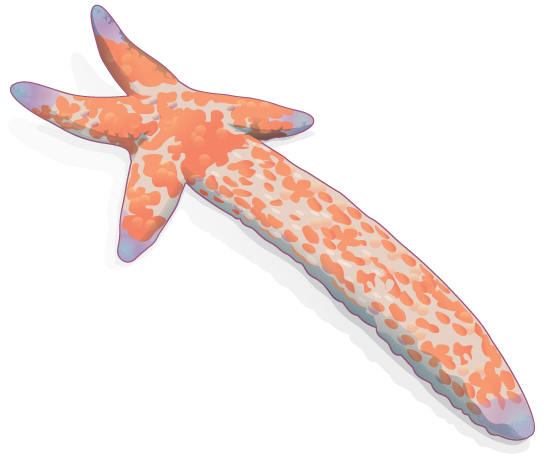


Figure 43.4図 43.4
Sea stars can reproduce through fragmentation. The large arm, a fragment from another sea star, is developing into a new individual.
ヒトデは断片化によって生殖できる。別のヒトデの断片である大きな腕が、新しい個体へ発達している。
Note that in fragmentation, there is generally a noticeable difference in the size of the individuals, whereas in fission, two individuals of approximately the same size are formed.
英語のヒント
断片化では、一般に個体の大きさに目立った違いがあるのに対し、分裂では、およそ同じ大きさの2個体ができる点に注意しよう。