第47章保全生物学と生物多様性
Limitations on Preserves保護区の限界
Some of the limitations on preserves as conservation tools are evident from the discussion of preserve design. Political and economic pressures typically make preserves smaller, rather than larger, so setting aside areas that are large enough is difficult. If the area set aside is sufficiently large, there may not be sufficient area to create a buffer around the preserve. In this case, an area on the outer edges of the preserve inevitably becomes a riskier suboptimal habitat for the species in the preserve. Enforcement of protections is also a significant issue in countries without the resources or political will to prevent poaching and illegal resource extraction.
英語のヒント
保全手段としての保護区の限界の一部は、設計の議論から明らかである。政治的・経済的圧力は通常、保護区を大きくするより小さくする方向へ働くため、十分な面積の確保が難しい。十分に広い区域を確保しても、その周囲に緩衝地帯を作る土地が足りない場合がある。その場合、外縁部は必然的に、保護区内の種にとってリスクの高い、最適より劣る生息地となる。密猟や違法採取を防ぐ資源や政治的意思のない国では、保護の執行も大きな課題である。
Climate change will create inevitable problems with the location of preserves. The species within them may migrate to higher latitudes as the habitat of the preserve becomes less favorable. Scientists are planning for the effects of global warming on future preserves and striving to predict the need for new preserves to accommodate anticipated changes to habitats; however, the end effectiveness is tenuous since these efforts are prediction based.
英語のヒント
気候変動は、保護区の位置に避けられない問題を生む。生息地が適さなくなるにつれ、種がより高緯度へ移る可能性がある。科学者は将来の保護区に温暖化が及ぼす影響を考慮し、予想される生息地変化に対応するため、新しい保護区の必要性を予測しようとしている。しかし、これらは予測に基づくため、最終的な有効性は不確かである。
Finally, an argument can be made that conservation preserves indicate that humans are growing more separate from nature, and that humans only operate in ways that do damage to biodiversity. Creating preserves may reduce the pressure on humans outside the preserve to be sustainable and non-damaging to biodiversity. On the other hand, properly managed, high quality preserves present opportunities for humans to witness nature in a less damaging way, and preserves may present some financial benefits to local economies. Ultimately, the economic and demographic pressures on biodiversity are unlikely to be mitigated by preserves alone. In order to fully benefit from biodiversity, humans will need to alter activities that damage it.
英語のヒント
最後に、保護区は、人間が自然からいっそう切り離され、行動が多様性を損なうものばかりになっていることを示す、と論じることもできる。保護区を作ることで、その外の人間に、持続可能で多様性を損なわない行動を求める圧力が弱まるかもしれない。一方、適切に管理された質の高い保護区は、人間がより少ない害で自然を観察する機会を与え、地域経済にも利益をもたらしうる。究極的には、多様性への経済的・人口的圧力が、保護区だけで軽減されるとは考えにくい。多様性の恩恵を十分に受けるには、人間はそれを損なう活動を変える必要がある。
Habitat Restoration生息地の復元
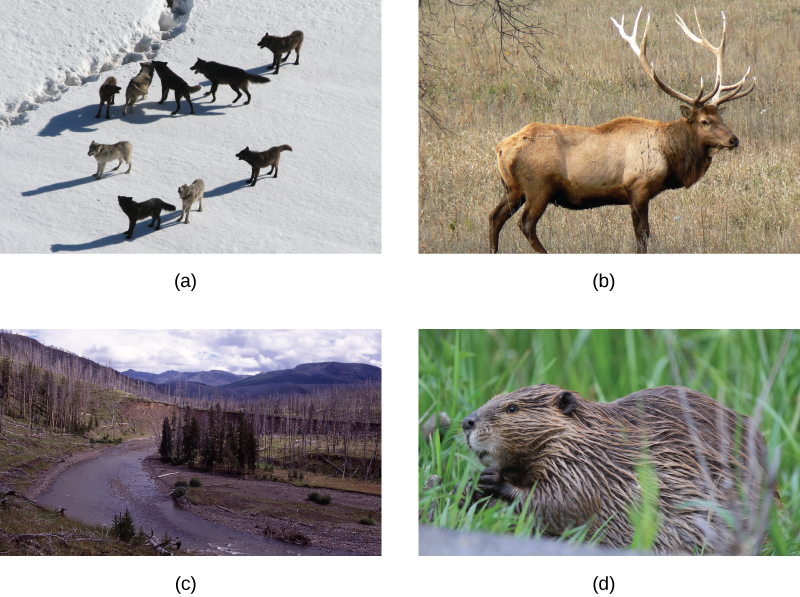
Habitat restoration holds considerable promise as a mechanism for restoring and maintaining biodiversity. Of course, once a species has become extinct, its restoration is impossible. However, restoration can improve the biodiversity of degraded ecosystems. Reintroducing wolves, a top predator, to Yellowstone National Park in 1995 led to dramatic changes in the ecosystem that increased biodiversity. The wolves (Figure 47.17) function to suppress elk and coyote populations and provide more abundant resources to the guild of carrion eaters. Reducing elk populations has allowed revegetation of riparian areas, which has increased the diversity of species in that habitat. Decreasing the coyote population has increased the populations of species that were previously suppressed by this predator. The number of species of carrion eaters has increased because of the predatory activities of the wolves. In this habitat, the wolf is a keystone species, meaning a species that is instrumental in maintaining diversity in an ecosystem. Removing a keystone species from an ecological community may cause a collapse in diversity. The results from the Yellowstone experiment suggest that restoring a keystone species can have the effect of restoring biodiversity in the community. Ecologists have argued for the identification of keystone species where possible and for focusing protection efforts on those species; likewise, it also makes sense to attempt to return them to their ecosystem if they have been removed.
英語のヒント
生息地の復元は、生物多様性を回復・維持する仕組みとして大きな可能性をもつ。もちろん、絶滅した種そのものは復元できない。しかし、劣化した生態系の多様性は改善できる。1995年にイエローストーン国立公園へ頂点捕食者のオオカミを再導入すると、生態系が大きく変わり、多様性が高まった。オオカミ(図47.17)は、ワピチとコヨーテの個体数を抑え、死肉食動物のギルドに豊富な資源を与える。ワピチが減ると河畔の植生が回復し、その生息地の種多様性が高まった。コヨーテの減少は、それまで捕食で抑えられていた種の個体数を増やした。オオカミの捕食活動によって、死肉を食べる種の数も増えた。この生息地ではオオカミはキーストーン種、すなわち生態系の多様性維持に重要な役割を果たす種である。その除去は、群集の多様性の崩壊を招きうる。イエローストーンの結果は、キーストーン種を戻すことが群集の多様性回復につながりうると示す。生態学者は、可能ならキーストーン種を特定し、保護を集中させるべきだと論じる。同様に、除去されていたなら生態系へ戻そうとすることにも意味がある。
OpenStax, Rice University; Biology 2e. (credit a: modification of work by Doug Smith, NPS; credit c: modification of work by Jim Peaco, NPS; credit d: modification of work by “Shiny Things”/Flickr) · CC BY 4.0 · Source出典

Figure 47.17図 47.17
(a) The Gibbon wolf pack in Yellowstone National Park, March 1, 2007, represents a keystone species. The reintroduction of wolves into Yellowstone National Park in 1995 led to a change in the grazing behavior of (b) elk. To avoid predation, the elk no longer grazed exposed stream and riverbeds, such as (c) the Lamar Riverbed in Yellowstone. This allowed willow and cottonwood seedlings to grow and recolonized large areas. The seedlings decreased erosion and provided shading to the creek, which improved fish habitat. A new colony of (d) beaver may also have benefited from the habitat change. (credit a: modification of work by Doug Smith, NPS; credit c: modification of work by Jim Peaco, NPS; credit d: modification of work by “Shiny Things”/Flickr)
(a)2007年3月1日、イエローストーン国立公園のギボン・オオカミ群。オオカミはキーストーン種の例である。1995年の再導入によって、(b)ワピチの採食行動が変わった。捕食を避けるため、(c)ラマー川の川床のような、身を隠せない河川沿いでは草を食べなくなった。その結果、ヤナギやポプラの実生が成長し、広い地域に再び定着した。実生は侵食を減らして小川に日陰を作り、魚の生息地を改善した。(d)ビーバーの新しいコロニーも、生息地の変化の恩恵を受けた可能性がある。(a:Doug Smith、NPSの作品を改変。c:Jim Peaco、NPSの作品を改変。d:「Shiny Things」/Flickrの作品を改変)
Other large-scale restoration experiments underway involve dam removal, which is a national movement that is accelerating in importance. In the United States, since the mid-1980s, many aging dams are being considered for removal rather than replacement because of shifting beliefs about the ecological value of free-flowing rivers and because many dams no longer provide the benefit and functions that they did when they were first built. The measured benefits of dam removal include restoration of naturally fluctuating water levels (the purpose of dams is frequently to reduce variation in river flows), which leads to increased fish diversity and improved water quality. In the Pacific Northwest, dam removal projects are expected to increase populations of salmon, which is considered a keystone species because it transports key nutrients to inland ecosystems during its annual spawning migrations. In other regions such as the Atlantic coast, dam removal has allowed the return of spawning anadromous fish species (species that are born in fresh water, live most of their lives in salt water, and return to fresh water to spawn). Some of the largest dam removal projects have yet to occur or have happened too recently for the consequences to be measured. The large-scale ecological experiments that these removal projects constitute will provide valuable data for other dam projects slated either for removal or construction.
英語のヒント
進行中のほかの大規模な復元実験には、ダム撤去がある。その重要性は全国的な運動として高まっている。米国では1980年代半ば以降、老朽化した多くのダムで、建て替えより撤去が検討されている。自由に流れる川の生態的価値への認識が変わり、多くのダムが建設当初の利益と機能をもはや果たさないためである。測定された撤去の利点には、自然に変動する水位の回復がある。ダムの目的はしばしば流量変動の抑制だが、その変動が戻ると魚の多様性と水質が改善する。太平洋岸北西部では、撤去によるサケ個体群の増加が期待される。サケは、毎年の産卵回遊で重要な栄養分を内陸生態系へ運ぶため、キーストーン種と見なされる。大西洋岸などでは、撤去によって遡河回遊魚が産卵のために戻れるようになった。これは淡水で生まれ、生活の大半を海水中で過ごし、産卵のため淡水へ戻る魚である。最大級の撤去事業の一部はまだ行われていないか、実施から日が浅く、結果を測れない。これらの大規模な生態学的実験は、撤去または建設が予定されるほかのダム事業に有用なデータをもたらすだろう。