第47章保全生物学と生物多様性
Types of Biodiversity生物多様性の種類
Scientists generally accept that the term biodiversity describes the number and kinds of species and their abundance in a given location or on the planet. Species can be difficult to define, but most biologists still feel comfortable with the concept and are able to identify and count eukaryotic species in most contexts. Biologists have also identified alternate measures of biodiversity, some of which are important for planning how to preserve biodiversity.
英語のヒント
生物多様性とは、ある場所または地球全体における種の数と種類、その個体数を表すという理解が、科学者の間で一般的に受け入れられている。種を定義するのは難しいこともあるが、大半の生物学者はこの概念を引き続き有用と考え、多くの状況で真核生物の種を識別して数えられる。また、生物多様性の別の尺度も見いだされており、その一部は保全計画を立てるのに重要である。
Genetic diversity is one of those alternate concepts. Genetic diversity, or genetic variation defines the raw material for evolution and adaptation in a species. A species’ future potential for adaptation depends on the genetic diversity held in the genomes of the individuals in populations that make up the species. The same is true for higher taxonomic categories. A genus with very different types of species will have more genetic diversity than a genus with species that are genetically similar and have similar ecologies. If there were a choice between one of these genera of species being preserved, the one with the greatest potential for subsequent evolution is the most genetically diverse one.
英語のヒント
遺伝的多様性は、そのような別の概念の1つである。遺伝的多様性、すなわち遺伝的変異は、種の進化と適応の素材をなす。将来の適応の可能性は、その種を構成する個体群内の各個体のゲノムに保たれた遺伝的多様性によって決まる。より高い分類階級にも同じことが当てはまる。大きく異なる種類の種を含む属は、遺伝的に似ていて生態も似た種を含む属より、遺伝的多様性が高い。どちらかの属を保全する選択を迫られたなら、その後の進化の可能性が最も大きいのは、遺伝的に最も多様な属である。
Many genes code for proteins, which in turn carry out the metabolic processes that keep organisms alive and reproducing. Genetic diversity can be measured as chemical diversity in that different species produce a variety of chemicals in their cells, both the proteins as well as the products and byproducts of metabolism. This chemical diversity has potential benefit for humans as a source of pharmaceuticals, so it provides one way to measure diversity that is important to human health and welfare.
英語のヒント
多くの遺伝子はタンパク質をコードし、そのタンパク質が、生物を生き続けさせ繁殖させる代謝過程を担う。種によって細胞内にさまざまなタンパク質や代謝産物・副産物が作られるため、遺伝的多様性は化学的多様性として測ることもできる。この化学的多様性は医薬品の供給源として人間に役立つ可能性があるので、人間の健康と福祉に重要な多様性を測る方法の1つとなる。
Humans have generated diversity in domestic animals, plants, and fungi, among many other organisms. This diversity is also suffering losses because of migration, market forces, and increasing globalism in agriculture, especially in densely populated regions such as China, India, and Japan. The human population directly depends on this diversity as a stable food source, and its decline is troubling biologists and agricultural scientists.
英語のヒント
人間は、家畜、栽培植物、菌類をはじめ、多くの生物に多様性を生み出してきた。この多様性も、人の移住、市場の力、農業のグローバル化の進展によって失われつつある。特に中国、インド、日本のような人口密度の高い地域で顕著である。人類は安定した食料源としてこの多様性に直接依存しており、その減少を生物学者や農学者は懸念している。
It is also useful to define ecosystem diversity, meaning the number of different ecosystems on the planet or within a given geographic area (Figure 47.2). Whole ecosystems can disappear even if some of the species might survive by adapting to other ecosystems. The loss of an ecosystem means the loss of interactions between species, the loss of unique features of coadaptation, and the loss of biological productivity that an ecosystem is able to create. An example of a largely extinct ecosystem in North America is the prairie ecosystem. Prairies once spanned central North America from the boreal forest in northern Canada down into Mexico. They are now all but gone, replaced by crop fields, pasture lands, and suburban sprawl. Many of the species survive elsewhere, but the hugely productive ecosystem that was responsible for creating the most productive agricultural soils in the United States is now gone. As a consequence, native soils are disappearing or must be maintained and enhanced at great expense.
英語のヒント
生態系多様性、すなわち地球全体やある地理的範囲に存在する、異なる生態系の数を定義することも有用である(図47.2)。一部の種がほかの生態系に適応して生き残っても、生態系全体が消えることはある。生態系の喪失は、種間の相互作用、共適応の独特な特徴、その生態系が生み出せる生物生産力の喪失を意味する。北米で大部分が失われた生態系の例は、プレーリーである。かつてはカナダ北部の北方林からメキシコまで、北米中央部を広がっていた。現在はほぼ消失し、耕地、牧草地、無秩序に拡大する郊外に置き換わった。多くの種はほかの場所で生き残っているが、米国で最も生産的な農地の土壌を作った、極めて生産力の高い生態系は、今では失われた。その結果、本来の土壌は失われつつあるか、多大な費用をかけて維持・改良しなければならなくなっている。
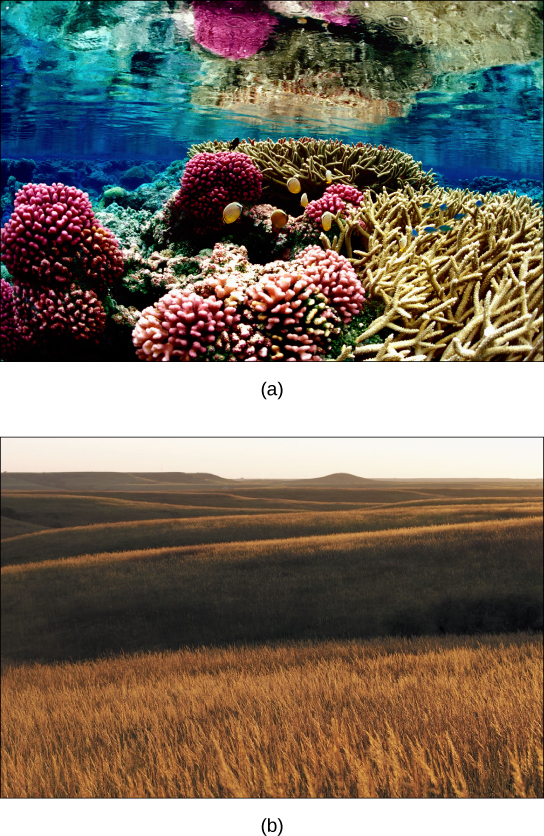
OpenStax, Rice University; Biology 2e. (credit a: modification of work by Jim Maragos, USFWS; credit b: modification of work by Jim Minnerath, USFWS) · CC BY 4.0 · Source出典

Figure 47.2図 47.2
The variety of ecosystems on Earth—from (a) coral reef to (b) prairie—enables a great diversity of species to exist. (credit a: modification of work by Jim Maragos, USFWS; credit b: modification of work by Jim Minnerath, USFWS)
(a)サンゴ礁から(b)プレーリーまで、地球上のさまざまな生態系が、多様な種の存在を可能にしている。(a:Jim Maragos、USFWSの作品を改変。b:Jim Minnerath、USFWSの作品を改変)
Current Species Diversity現在の種多様性
Despite considerable effort, knowledge of the species that inhabit the planet is limited and always will be because of a continuing lack of financial resources and political willpower. A recent estimate suggests that the eukaryote species for which science has names, about 1.5 million species, account for less than 20 percent of the total number of eukaryote species present on the planet (8.7 million species, by one estimate). Estimates of numbers of prokaryotic species are largely guesses, but biologists agree that science has only begun to catalog their diversity. Even with what is known, there is no central repository of names or samples of the described species; therefore, there is no way to be sure that the 1.5 million descriptions is an accurate accounting. It is a best guess based on the opinions of experts in different taxonomic groups. Given that Earth is losing species at an accelerating pace, science is very much in the place it was with the Lake Victoria cichlids: knowing little about what is being lost. Table 47.1 presents recent estimates of biodiversity in different groups.
英語のヒント
多大な努力にもかかわらず、地球にすむ種についての知識は限られている。資金と政治的な意思の不足が続くため、今後もそうだろう。近年の推定では、科学的な名前がある真核生物は約150万種で、地球に存在する真核生物の総種数の20%未満に当たる。総種数を870万種とする推定もある。原核生物の種数の推定は大部分が推測だが、その多様性の目録化はまだ始まったばかりだという点で、生物学者は一致している。既知の種についても、記載された種の名前や標本を集めた中央の保管場所はない。そのため、150万という記載数が正確かどうかを確かめる方法はない。これは、各分類群の専門家の見解に基づく最善の推定である。地球から種が加速的に失われていることを考えると、科学はビクトリア湖のシクリッドを調べていたときとよく似た状況にある。何が失われているのか、ほとんど分かっていない。表47.1に、各分類群の生物多様性に関する近年の推定を示す。
Estimates of the Numbers of Described and Predicted Species by Taxonomic Group 分類群別の記載済み種数と予測種数の推定 |
||||||
|---|---|---|---|---|---|---|
Mora et al. 2011 Mora Camilo et al., “How Many Species Are There on Earth and in the Ocean?” PLoS Biology (2011), doi:10.1371/journal.pbio.1001127. Moraほか(2011)。Mora Camilo et al., “How Many Species Are There on Earth and in the Ocean?” PLoS Biology (2011), doi:10.1371/journal.pbio.1001127. |
Chapman 2009 Arthur D. Chapman, Numbers of Living Species in Australia and the World, 2nd ed. (Canberra, AU: Australian Biological Resources Study, 2009). https://www.environment.gov.au/system/files/pages/2ee3f4a1-f130-465b-9c7a-79373680a067/files/nlsaw-2nd-complete.pdf/. Chapman(2009)。Arthur D. Chapman, Numbers of Living Species in Australia and the World, 第2版(Canberra, AU: Australian Biological Resources Study, 2009)。https://www.environment.gov.au/system/files/pages/2ee3f4a1-f130-465b-9c7a-79373680a067/files/nlsaw-2nd-complete.pdf/。 |
Groombridge & Jenkins 2002 Brian Groombridge and Martin D. Jenkins. World Atlas of Biodiversity: Earth’s Living Resources in the 21st Century. Berkeley: University of California Press, 2002. GroombridgeとJenkins(2002)。Brian Groombridge and Martin D. Jenkins. 『世界生物多様性アトラス:21世紀の地球の生物資源』。Berkeley: University of California Press, 2002. |
||||
Described 記載済み |
Predicted 予測 |
Described 記載済み |
Predicted 予測 |
Described 記載済み |
Predicted 予測 |
|
Animalia 動物界 |
1,124,516 |
9,920,000 |
1,424,153 |
6,836,330 |
1,225,500 |
10,820,000 |
Chromista クロミスタ界 |
17,892 |
34,900 |
25,044 |
200,500 |
— |
— |
Fungi 菌界 |
44,368 |
616,320 |
98,998 |
1,500,000 |
72,000 |
1,500,000 |
Plantae 植物界 |
224,244 |
314,600 |
310,129 |
390,800 |
270,000 |
320,000 |
Protozoa 原生動物 |
16,236 |
72,800 |
28,871 |
1,000,000 |
80,000 |
600,000 |
Prokaryotes 原核生物 |
— |
— |
10,307 |
1,000,000 |
10,175 |
— |
Total 合計 |
1,438,769 |
10,960,000 |
1,897,502 |
10,897,630 |
1,657,675 |
13,240,000 |
There are various initiatives to catalog described species in accessible ways, and the internet is facilitating that effort. Nevertheless, it has been pointed out that at the current rate of new species descriptions (which according to the State of Observed Species Report is 17,000 to 20,000 new species per year), it will take close to 500 years to finish describing life on this planet. International Institute for Species Exploration (IISE), 2011 State of Observed Species (SOS). Tempe, AZ: IISE, 2011. Accessed May, 20, 2012. http://www.esf.edu/species/. Over time, the task becomes both increasingly difficult and increasingly easier as extinction removes species from the planet.
英語のヒント
記載された種を利用しやすい形で目録化する取り組みがいくつもあり、インターネットがそれを促進している。それでも、現在の新種記載の速度では、地球上の生命を記載し終えるまでに500年近くかかると指摘されている。「観察された種の現状報告」によると、新種の記載は年間17,000〜20,000種である。International Institute for Species Exploration(IISE), 2011 State of Observed Species(SOS). Tempe, AZ: IISE, 2011. 2012年5月20日閲覧。http://www.esf.edu/species/。時間とともに絶滅が地球から種を取り去るため、この仕事はますます難しくなると同時に、ますます容易にもなる。
Naming and counting species may seem like an unimportant pursuit given the other needs of humanity, but determining biodiversity it is not simply an accounting of species. Describing a species is a complex process through which biologists determine an organism’s unique characteristics and whether or not that organism belongs to any other described species or genus. It allows biologists to find and recognize the species after the initial discovery, and allows them to follow up on questions about its biology. In addition, the unique characteristics of each species make it potentially valuable to humans or other species on which humans depend.
英語のヒント
人類のほかの必要を考えると、種に名前を付けて数えることは重要でない仕事に思えるかもしれない。しかし、生物多様性の把握は単なる種の集計ではない。種を記載することは、その生物に固有の特徴と、すでに記載された別の種や属に属するかどうかを、生物学者が判断する複雑な過程である。記載によって、最初の発見後にもその種を見つけて識別し、その生物学的な性質についての疑問を追究できるようになる。また、種ごとの固有の特徴は、人間や、人間が依存するほかの種にとって価値をもつ可能性がある。