第47章保全生物学と生物多様性
Conservation of Biodiversity生物多様性の保全
In 1988, British environmentalist Norman Myers developed a conservation concept to identify areas rich in species and at significant risk for species loss: biodiversity hotspots. Biodiversity hotspots are geographical areas that contain high numbers of endemic species. The purpose of the concept was to identify important locations on the planet for conservation efforts, a kind of conservation triage. By protecting hotspots, governments are able to protect a larger number of species. The original criteria for a hotspot included the presence of 1500 or more endemic plant species and 70 percent of the area disturbed by human activity. There are now 34 biodiversity hotspots (Figure 47.4) containing large numbers of endemic species, which include half of Earth’s endemic plants.
英語のヒント
1988年、英国の環境保護活動家ノーマン・マイヤーズは、種が豊富で、かつ種を失う危険が大きい地域を特定する保全概念として、生物多様性ホットスポットを考案した。これは、多数の固有種を含む地理的な地域である。この概念の目的は、地球上で保全活動に重要な場所を特定することにあり、一種の保全の優先順位付けだった。政府はホットスポットを守ることで、より多くの種を保護できる。当初の基準には、固有植物が1,500種以上存在することと、面積の70%が人間活動で攪乱されていることが含まれた。現在、34か所のホットスポットがあり(図47.4)、多数の固有種が生息し、地球の固有植物の半数を含む。
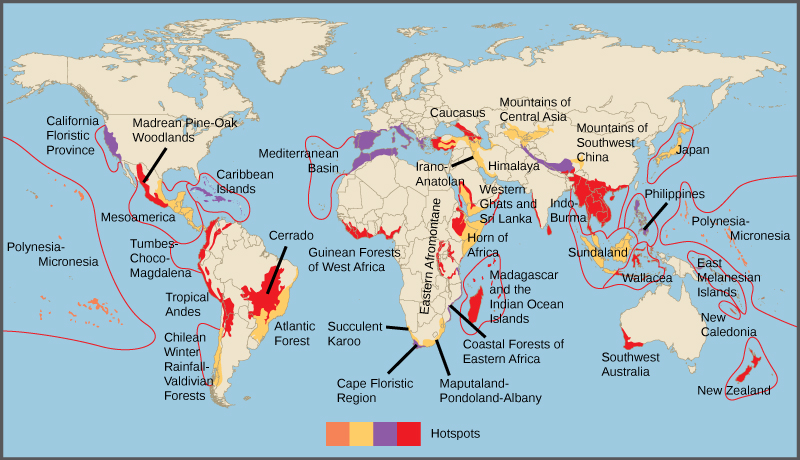
Figure 47.4図 47.4
Conservation International has identified 34 biodiversity hotspots, which cover only 2.3 percent of the Earth’s surface but have endemic to them 42 percent of the terrestrial vertebrate species and 50 percent of the world’s plants.
コンサベーション・インターナショナルは34か所の生物多様性ホットスポットを特定している。その面積は地球表面のわずか2.3%だが、陸生脊椎動物の42%と世界の植物の50%が、これらの場所の固有種である。
Biodiversity Change through Geological Time地質時代を通じた生物多様性の変化
The number of species on the planet, or in any geographical area, is the result of an equilibrium of two evolutionary processes that are continuously ongoing: speciation and extinction. Both are natural “birth” and “death” processes of macroevolution. When speciation rates begin to outstrip extinction rates, the number of species will increase; likewise, the number of species will decrease when extinction rates begin to overtake speciation rates. Throughout Earth’s history, these two processes have fluctuated—sometimes leading to dramatic changes in the number of species on Earth as reflected in the fossil record (Figure 47.5).
英語のヒント
地球全体や、ある地域の種数は、絶えず進む2つの進化過程、種分化と絶滅の釣り合いによって決まる。どちらも、大進化における自然な「誕生」と「死」の過程である。種分化の速度が絶滅速度を上回り始めると種数は増え、逆に絶滅速度が種分化を上回り始めると減る。地球の歴史を通して、この2つの過程は変動してきた。ときには地球の種数を劇的に変え、その様子は化石記録に表れている(図47.5)。
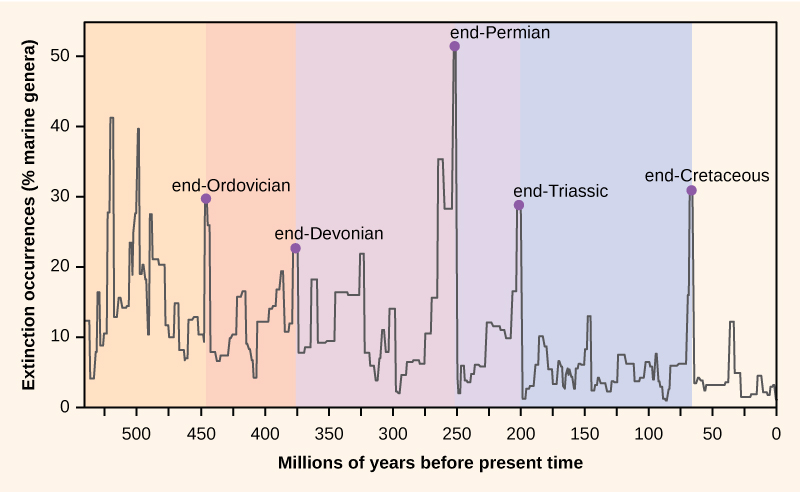


Figure 47.5図 47.5
Percent extinction occurrences of marine genera as reflected in the fossil record have fluctuated throughout Earth’s history. Sudden and dramatic losses of biodiversity, called mass extinctions, have occurred five times.
化石記録に表れる海洋生物の属の絶滅割合は、地球の歴史を通して変動してきた。大量絶滅と呼ばれる、急激で大規模な生物多様性の喪失が5回起きている。
Paleontologists have identified five strata in the fossil record that appear to show sudden and dramatic (between 25–55% of genera and greater than half of all extant species disappearing from the fossil record) losses in biodiversity. These are called mass extinctions. There are many lesser, yet still dramatic, extinction events, but the five mass extinctions have attracted the most research. An argument can be made that the five mass extinctions are only the five most extreme events in a continuous series of large extinction events throughout the Phanerozoic (since 542 million years ago). In most cases, the hypothesized causes are still controversial; however, the most recent mass extinction event seems clear.
英語のヒント
古生物学者は化石記録の中に、生物多様性が急激かつ大幅に失われたように見える5つの地層を見いだした。属の25〜55%と、当時生存していた全種の半数以上が化石記録から消えている。これらを大量絶滅と呼ぶ。規模がこれより小さくても大きな絶滅は多数あるが、5回の大量絶滅が最も多く研究されてきた。この5回は、顕生代(5億4,200万年前以降)を通して続く、一連の大規模な絶滅のうち、最も極端な5回にすぎない、とも論じられる。多くの場合、推定される原因にはまだ議論があるが、最も最近の大量絶滅の原因は明らかなようである。
The Five Mass Extinctions5回の大量絶滅
The fossil record of the mass extinctions was the basis for defining periods of geological history, so they typically occur at the transition point between geological periods. The transition in fossils from one period to another reflects the dramatic loss of species and the gradual origin of new species. These transitions can be seen in the rock strata. Table 47.2 provides data on the five mass extinctions.
英語のヒント
大量絶滅の化石記録は、地質時代の区分を定める基準となった。そのため、大量絶滅は通常、地質時代の移り変わりの地点に位置する。ある時代から次の時代への化石の変化は、種の劇的な喪失と、新しい種が徐々に生じることを反映している。この変化は岩石の地層に見られる。表47.2に、5回の大量絶滅のデータを示す。
Mass Extinctions 大量絶滅 |
||
|---|---|---|
Geological Period 地質時代 |
Mass Extinction Name 大量絶滅の名称 |
Time (millions of years ago) 時期(百万年前) |
Ordovician–Silurian オルドビス紀〜シルル紀 |
end-Ordovician O–S オルドビス紀末 O–S |
450–440 |
Late Devonian デボン紀後期 |
end-Devonian デボン紀末 |
375–360 |
Permian–Triassic ペルム紀〜三畳紀 |
end-Permian ペルム紀末 |
251 |
Triassic–Jurassic 三畳紀〜ジュラ紀 |
end-Triassic 三畳紀末 |
205 |
Cretaceous–Paleogene 白亜紀〜古第三紀 |
end-Cretaceous K–Pg (K–T) 白亜紀末 K–Pg(K–T) |
65.5 |
The Ordovician-Silurian extinction event is the first recorded mass extinction and the second largest. During this period, about 85 percent of marine species (few species lived outside the oceans) became extinct. The main hypothesis for its cause is a period of glaciation and then warming. The extinction event actually consists of two extinction events separated by about 1 million years. The first event was caused by cooling, and the second event was due to the subsequent warming. The climate changes affected temperatures and sea levels. Some researchers have suggested that a gamma-ray burst, caused by a nearby supernova, was a possible cause of the Ordovician-Silurian extinction. The gamma-ray burst would have stripped away the Earth’s protective ozone layer, allowing intense ultraviolet radiation from the sun to reach the surface of the earth—and may account for climate changes observed at the time. The hypothesis is very speculative, and extraterrestrial influences on Earth’s history are an active line of research. Recovery of biodiversity after the mass extinction took from 5 to 20 million years, depending on the location.
英語のヒント
オルドビス紀〜シルル紀の絶滅は、記録された最初の大量絶滅であり、規模は2番目に大きい。この時期、海洋種の約85%が絶滅した。当時、海の外にすむ種は少なかった。原因の主要な仮説は、氷期と、その後の温暖化である。実際には約100万年を隔てた2回の絶滅からなり、最初は寒冷化、次はその後の温暖化によって生じた。気候変化は気温と海水準に影響した。一部の研究者は、近くの超新星によるガンマ線バーストが原因となった可能性を提案している。ガンマ線バーストは地球を守るオゾン層を剥ぎ取り、太陽の強い紫外線が地表へ届くようにしたはずであり、当時の気候変化を説明できるかもしれない。この仮説は推測の要素が強く、地球史への地球外からの影響は活発に研究されている。大量絶滅後に生物多様性が回復するまでには、場所によって500万〜2,000万年かかった。
The late Devonian extinction may have occurred over a relatively long period of time. It appears to have mostly affected marine species and not so much the plants or animals inhabiting terrestrial habitats. During this time 75 percent of all species became extinct. The causes of this extinction are poorly understood.
英語のヒント
デボン紀後期の絶滅は、比較的長い期間にわたって起こった可能性がある。主に海洋種に影響し、陸上の生息地の動植物への影響はそれほど大きくなかったようである。この時期、全種の75%が絶滅した。原因はよく分かっていない。
The end-Permian extinction was the largest in the history of life. Indeed, an argument could be made that Earth became nearly devoid of life during this extinction event. Estimates are that 96 percent of all marine species and 70 percent of all terrestrial species were lost. It was at this time, for example, that the trilobites, a group that survived the Ordovician–Silurian extinction, became extinct. The causes for this mass extinction are not clear, but the leading suspect is extended and widespread volcanic activity that led to a runaway global-warming event. The oceans became largely anoxic, suffocating marine life. Terrestrial tetrapod diversity took 30 million years to recover after the end-Permian extinction. The Permian extinction dramatically altered Earth’s biodiversity makeup and the course of evolution.
英語のヒント
ペルム紀末の絶滅は、生命史上最大だった。地球から生命がほとんど失われた、と論じることもできる。推定では、全海洋種の96%と全陸生種の70%が失われた。たとえば、オルドビス紀〜シルル紀の絶滅を生き延びた三葉虫が絶滅したのは、このときである。原因は明らかでないが、最も有力な候補は、長く広範囲に続く火山活動が、暴走的な地球温暖化を引き起こしたというものである。海洋の大部分が無酸素となり、海洋生物は窒息した。陸上の四肢動物の多様性が回復するまでには、3,000万年かかった。ペルム紀の絶滅は、地球の生物多様性の構成と進化の道筋を劇的に変えた。
The causes of the Triassic–Jurassic extinction event are not clear, and researchers argue hypotheses including climate change, asteroid impact, and volcanic eruptions. The extinction event occurred just before the breakup of the supercontinent Pangaea, although recent scholarship suggests that the extinctions may have occurred more gradually throughout the Triassic. During this time 76 to 80 percent of all species became extinct.
英語のヒント
三畳紀〜ジュラ紀の絶滅の原因は明らかでなく、気候変動、小惑星衝突、火山噴火などの仮説が議論されている。絶滅は超大陸パンゲアの分裂直前に起こったが、近年の研究は、三畳紀を通じてより徐々に進んだ可能性を示している。この時期、全種の76〜80%が絶滅した。
The causes of the end-Cretaceous extinction event are the ones that are best understood. It was during this extinction event about 65 million years ago that the majority of the dinosaurs, the dominant vertebrate group for millions of years, disappeared from the planet (with the exception of a theropod clade that gave rise to birds). Overall, during this time period about 75 percent of all species became extinct.
英語のヒント
白亜紀末の絶滅の原因は、最もよく理解されている。数百万年にわたって優勢だった脊椎動物群、恐竜の大半が地球から姿を消したのは、約6,500万年前のこの絶滅のときだった。ただし、鳥類を生み出した獣脚類の系統群は例外である。この時期、全体では全種の約75%が絶滅した。
The cause of this extinction is now understood to be the result of a cataclysmic impact of a large meteorite, or asteroid, off the coast of what is now the Yucatán Peninsula. This hypothesis, proposed first in 1980, was a radical explanation based on a sharp spike in the levels of iridium (which enters our atmosphere from meteors at a fairly constant rate but is otherwise absent on Earth’s surface) in the rock stratum that marks the boundary between the Cretaceous and Paleogene periods (Figure 47.6). This boundary marked the disappearance of the dinosaurs in fossils as well as many other taxa. The researchers who discovered the iridium spike interpreted it as a rapid influx of iridium from space to the atmosphere (in the form of a large asteroid) rather than a slowing in the deposition of sediments during that period. It was a radical explanation, but the report of an appropriately aged and sized impact crater in 1991 made the hypothesis more believable. Now an abundance of geological evidence supports the theory. Recovery times for biodiversity after the end-Cretaceous extinction are shorter, in geological time, than for the end-Permian extinction, on the order of 10 million years.
英語のヒント
この絶滅の原因は、現在のユカタン半島の沖に、大きな隕石または小惑星が激突したことだと理解されている。1980年に初めて提案されたこの仮説は、白亜紀と古第三紀の境界を示す地層で、イリジウム濃度が鋭く上昇することに基づく、大胆な説明だった(図47.6)。イリジウムは隕石からほぼ一定の割合で大気に入るが、それ以外では地表にほとんど存在しない。この境界では、恐竜と多くのほかの分類群が化石から姿を消している。イリジウムの急増を発見した研究者たちは、当時の堆積速度が低下したという説明ではなく、大きな小惑星という形で、宇宙から大気へイリジウムが急激に流入したと解釈した。大胆な説明だったが、1991年に適切な年代と大きさの衝突クレーターが報告され、仮説の信頼性が増した。今では豊富な地質学的証拠がこの説を支持する。白亜紀末の絶滅後、生物多様性の回復にかかった時間は、地質学的にはペルム紀末の後より短く、1,000万年程度である。
Another possibility, perhaps coincidental with the impact of the Yucatan asteroid, was extensive volcanism that began forming about 66 million years ago, about the same time as the Yucatan asteroid impact, at the end of the Cretaceous. The lava flows covered over 50 percent of what is now India. The release of volcanic gases, particularly sulfur dioxide, during the extensive eruptions contributed to climate change, which may have induced the mass extinction.
英語のヒント
別の可能性は、ユカタンの小惑星衝突と同時だったかもしれない、大規模な火山活動である。これは、白亜紀末の約6,600万年前、衝突とほぼ同じ時期に始まった。溶岩流は、現在のインドの50%以上を覆った。広範囲の噴火による火山ガス、とりわけ二酸化硫黄の放出が気候変動に寄与し、それが大量絶滅を引き起こした可能性がある。