第47章保全生物学と生物多様性
Overharvesting過剰採取
Overharvesting is a serious threat to many species, but particularly to aquatic (both marine and freshwater) species. Despite regulation and monitoring, there are recent examples of fishery collapse. The western Atlantic cod fishery is the among the most significant. While it was a hugely productive fishery for 400 years, the introduction of modern factory trawlers in the 1980s caused it to become unsustainable. Fisheries collapse as a result of both economic and political factors. Fisheries are managed as a shared international resource even when the fishing territory lies within an individual country’s territorial waters. Common resources are subject to an economic pressure known as the tragedy of the commons, in which essentially no fisher has a motivation to exercise restraint in harvesting a fishery when it is not owned by that fisher. Overexploitation is a common outcome. This overexploitation is exacerbated when access to the fishery is open and unregulated and when technology gives fishers the ability to overfish. In a few fisheries, the biological growth of the resource is less than the potential growth of the profits made from fishing if that time and money were invested elsewhere. In these cases—whales are an example—economic forces will always drive toward fishing the population to extinction.
英語のヒント
過剰採取は多くの種、特に海水・淡水の水生種に深刻な脅威となる。規制と監視があっても、近年に漁業資源が崩壊した例はある。最も重大な例の1つは、西大西洋のタラ漁である。400年間、極めて生産的な漁場だったが、1980年代に近代的な加工設備付きトロール船が導入され、持続不可能になった。漁業は経済的・政治的要因の両方によって崩壊する。漁場が1国の領海内にあっても、漁業資源は国際的な共有資源として管理される。共有資源には「共有地の悲劇」と呼ばれる経済的圧力が働く。基本的に、資源を自分が所有していない漁業者には、漁獲を抑える動機がない。過剰利用が一般的な結果となる。漁場への参入が自由で規制されず、技術が乱獲を可能にすると、過剰利用はさらに悪化する。一部の漁業資源では、時間と資金をほかに投じた場合の潜在的な利益の伸びが、資源の生物学的な増加を上回る。クジラのようなこうした事例では、経済的な力は常に、個体群を絶滅するまで捕る方向へ働く。
For the most part, fishery extinction is not equivalent to biological extinction—the last fish of a species is rarely fished out of the ocean. At the same time, fishery extinction is still harmful to fish species and their ecosystems. There are some instances in which true extinction is a possibility. Whales have slow-growing populations due to low reproductive rates, and therefore are at risk of complete extinction through hunting. There are some species of sharks with restricted distributions that are at risk of extinction. The groupers are another population of generally slow-growing fishes that, in the Caribbean, includes a number of species that are at risk of extinction from overfishing.
英語のヒント
多くの場合、漁業資源の消滅は生物学的な絶滅と同じではない。その種の最後の1匹まで海から捕り尽くすことはまれである。それでも、魚とその生態系に有害であることは変わらない。実際の絶滅が起こりうる場合もある。クジラは繁殖率が低く、個体群の増加が遅いため、捕獲による完全な絶滅の危険がある。分布が限られるサメの中にも、絶滅の危険がある種がいる。ハタ類も一般に成長の遅い魚の集団で、カリブ海には乱獲による絶滅の危険にある種がいくつも含まれる。
Coral reefs are extremely diverse marine ecosystems that face immediate peril from several processes. Reefs are home to 1/3 of the world’s marine fish species—about 4,000 species—despite making up only 1 percent of marine habitat. Most home marine aquaria are stocked with wild-caught organisms, not cultured organisms. Although no species is known to have been driven extinct by the pet trade in marine species, there are studies showing that populations of some species have declined in response to harvesting, indicating that the harvest is not sustainable at those levels. There are concerns about the effect of the pet trade on some terrestrial species such as turtles, amphibians, birds, plants, and even the orangutan.
英語のヒント
サンゴ礁は極めて多様な海洋生態系だが、いくつもの過程によって目前の危機に直面している。海洋生息地のわずか1%を占めるだけなのに、世界の海水魚の3分の1、約4,000種がすむ。家庭の海水水槽の多くは、養殖ではなく野生で採集された生物で満たされる。海洋生物のペット取引で絶滅したと確認された種はないが、採集に伴う個体数の減少を示す研究はあり、その採集水準が持続不可能であることを示している。カメ、両生類、鳥、植物、さらにはオランウータンなどの陸生種にも、ペット取引の影響が懸念される。
Bush meat is the generic term used for wild animals killed for food. Hunting is practiced throughout the world, but hunting practices, particularly in equatorial Africa and parts of Asia, are believed to threaten a number of species with extinction. Traditionally, bush meat in Africa was hunted to feed families directly; however, recent commercialization of the practice now has bush meat available in grocery stores, which has increased harvest rates to the level of unsustainability. Additionally, human population growth has increased the need for protein foods that are not being met from agriculture. Species threatened by the bush meat trade are mostly mammals including many primates living in the Congo basin.
英語のヒント
ブッシュミートとは、食用に捕らえられた野生動物の総称である。狩猟は世界中で行われるが、特に赤道付近のアフリカとアジアの一部では、多くの種を絶滅の危険にさらしていると考えられる。アフリカでは伝統的に、家族を直接養うために狩られていた。しかし近年の商業化によって食料品店でも売られるようになり、捕獲速度が持続不可能な水準へ高まった。また、人口増加がタンパク質食品への需要を増やし、その需要は農業では満たされていない。取引によって脅かされるのは主に哺乳類で、コンゴ盆地の多くの霊長類も含まれる。
Exotic Species外来種
Exotic species are species that have been intentionally or unintentionally introduced into an ecosystem in which they did not evolve. For example, Kudzu (Pueraria lobata), which is native to Japan, was introduced in the United States in 1876. It was later planted for soil conservation. Problematically, it grows too well in the southeastern United States—up to a foot a day. It is now an invasive pest species and covers over 7 million acres in the southeastern United States. If an introduced species is able to survive in its new habitat, that introduction is now reflected in the observed range of the species. Human transportation of people and goods, including the intentional transport of organisms for trade, has dramatically increased the introduction of species into new ecosystems, sometimes at distances that are well beyond the capacity of the species to ever travel itself and outside the range of the species’ natural predators.
英語のヒント
外来種とは、自らが進化した場所ではない生態系へ、意図的または非意図的に持ち込まれた種である。たとえば日本原産のクズ(Pueraria lobata)は、1876年に米国へ導入され、後に土壌保全のため植えられた。しかし米国南東部では1日に最大1フィートも伸びるほどよく育ちすぎる。今では侵略的な有害種となり、700万エーカーを超える地域を覆う。導入された種が新しい生息地で生き残れると、その導入は観察される分布域に反映される。売買のための生物の意図的な輸送を含む、人や物の移動は、新たな生態系への種の導入を劇的に増やした。ときには、その種が自力では到底移動できない距離を越え、天敵の自然分布域の外まで運ばれる。
Most exotic species introductions probably fail because of the low number of individuals introduced or poor adaptation to the ecosystem they enter. Some species, however, possess pre-adaptations that can make them especially successful in a new ecosystem. These exotic species often undergo dramatic population increases in their new habitat and reset the ecological conditions in the new environment, threatening the species that exist there. For this reason, exotic species are also called invasive species. Exotic species can threaten other species through competition for resources, predation, or disease. For example, the Eurasian star thistle, also called spotted knapweed, has invaded and rendered useless some of the open prairies of the western states. However, it is a great nectar-bearing flower for the production of honey and supports numerous pollinating insects, including migrating monarch butterflies in the north-central states such as Michigan.
英語のヒント
外来種の導入の大半は、個体数の少なさや、入った生態系への適応不足によって失敗すると考えられる。しかし一部の種は、新しい生態系で特にうまく生きられる前適応をもつ。そうした種は新しい生息地で急増し、生態学的な条件を変えて、もともとの種を脅かすことが多い。このため、外来種は侵略的外来種とも呼ばれる。外来種は資源競争、捕食、病気によって他種を脅かす。たとえばスポッテッド・ナップウィードとも呼ばれるユーラシア産のスターシスルは、米国西部の開けたプレーリーの一部へ侵入し、利用できなくした。一方、この植物は蜂蜜生産に適した豊富な蜜をもつ花でもあり、多くの送粉昆虫を支える。ミシガンなど北中部の州では、渡りをするオオカバマダラも含まれる。
Lakes and islands are particularly vulnerable to extinction threats from introduced species. In Lake Victoria, as mentioned earlier, the intentional introduction of the Nile perch was largely responsible for the extinction of about 200 species of endemic cichlids. The accidental introduction of the brown tree snake via aircraft (Figure 47.12) from the Solomon Islands to Guam in 1950 has led to the extinction of three species of birds and three to five species of reptiles endemic to the island. Several other species are still threatened. The brown tree snake is adept at exploiting human transportation as a means to migrate; one was even found on an aircraft arriving in Corpus Christi, Texas. Constant vigilance on the part of airport, military, and commercial aircraft personnel is required to prevent the snake from moving from Guam to other islands in the Pacific, especially Hawaii. Islands do not make up a large area of land on the globe, but they do contain a disproportionate number of endemic species because of their isolation from mainland ancestors.
英語のヒント
湖と島は、導入種による絶滅の脅威を特に受けやすい。ビクトリア湖では、前述のとおり、ナイルパーチの意図的導入が、約200種の固有シクリッドの絶滅の大きな原因となった。1950年、ソロモン諸島からグアムへ、航空機に紛れてミナミオオガシラが持ち込まれた(図47.12)。その結果、島固有の鳥3種と爬虫類3〜5種が絶滅し、ほかの数種も今なお脅かされる。このヘビは、人間の輸送手段を利用して移動するのが得意で、テキサス州コーパスクリスティへ到着した航空機でも見つかった。グアムから太平洋のほかの島、とりわけハワイへ移るのを防ぐには、空港、軍、民間航空の職員による絶え間ない警戒が必要である。島の陸地面積は地球全体では小さいが、本土の祖先から隔離されてきたため、面積に比して非常に多くの固有種をもつ。
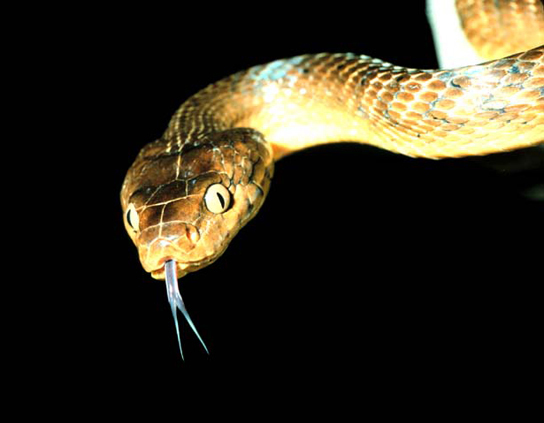
Figure 47.12図 47.12
The brown tree snake, Boiga irregularis, is an exotic species that has caused numerous extinctions on the island of Guam since its accidental introduction in 1950. (credit: NPS)
ミナミオオガシラ(Boiga irregularis)は、1950年に偶然持ち込まれて以来、グアム島で多数の絶滅を引き起こした外来種である。(出典:NPS)
It now appears that the global decline in amphibian species recognized in the 1990s is, in some part, caused by the fungus Batrachochytrium dendrobatidis, which causes the disease chytridiomycosis (Figure 47.13). There is evidence that the fungus is native to Africa and may have been spread throughout the world by transport of a commonly used laboratory and pet species: the African clawed toad (Xenopus laevis). It may well be that biologists themselves are responsible for spreading this disease worldwide. The North American bullfrog, Rana catesbeiana, which has also been widely introduced as a food animal but which easily escapes captivity, survives most infections of Batrachochytrium dendrobatidis, and can act as a reservoir for the disease. It also is a voracious predator in freshwater lakes.
英語のヒント
1990年代に認識された両生類の世界的な減少は、一部にはツボカビ症を起こす菌類Batrachochytrium dendrobatidisによると考えられる(図47.13)。この菌はアフリカ原産で、実験動物やペットとしてよく使われるアフリカツメガエル(Xenopus laevis)の輸送によって、世界中に広がった可能性を示す証拠がある。生物学者自身が、この病気を世界へ広めたのかもしれない。北米のウシガエル(Rana catesbeiana)も、食用として広く導入され、飼育場所から容易に逃げ出す。この菌に感染しても大半は生き延び、病原体の保有宿主となりうる。淡水湖では貪欲な捕食者でもある。
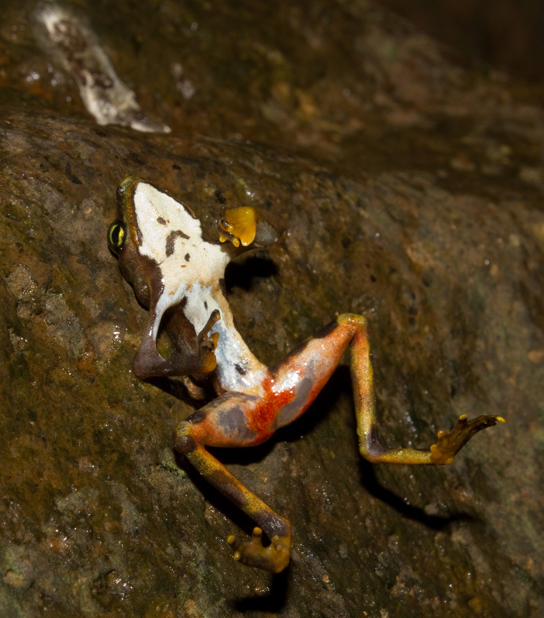
Figure 47.13図 47.13
This Limosa Harlequin Frog (Atelopus limosus), an endangered species from Panama, died from a fungal disease called chytridiomycosis. The red lesions are symptomatic of the disease. (credit: Brian Gratwicke)
パナマの絶滅危惧種リモーサハーレクインフロッグ(Atelopus limosus)は、菌類によるツボカビ症で死んだ。赤い病変はこの病気の症状である。(出典:Brian Gratwicke)
Early evidence suggests that another fungal pathogen, Geomyces destructans, introduced from Europe is responsible for white-nose syndrome, which infects cave-hibernating bats in eastern North America and has spread from a point of origin in western New York State (Figure 47.14). The disease has decimated bat populations and threatens extinction of species already listed as endangered: the Indiana bat, Myotis sodalis, and potentially the Virginia big-eared bat, Corynorhinus townsendii virginianus. How the fungus was introduced is unclear, but one logical presumption would be that recreational cavers unintentionally brought the fungus on clothes or equipment from Europe.
英語のヒント
初期の証拠は、ヨーロッパから持ち込まれた別の病原菌類Geomyces destructansが、白鼻症候群の原因であることを示唆する。この病気は、北米東部で洞窟冬眠するコウモリに感染し、ニューヨーク州西部を起点に広がった(図47.14)。コウモリ個体群を激減させ、すでに絶滅危惧種のインディアナホオヒゲコウモリ(Myotis sodalis)を絶滅の危険にさらしている。バージニアオオミミコウモリ(Corynorhinus townsendii virginianus)にもその可能性がある。菌がどう持ち込まれたかは不明だが、洞窟探検を楽しむ人が、ヨーロッパから衣服や装備に付けて、意図せず運んだという推測は理にかなっている。
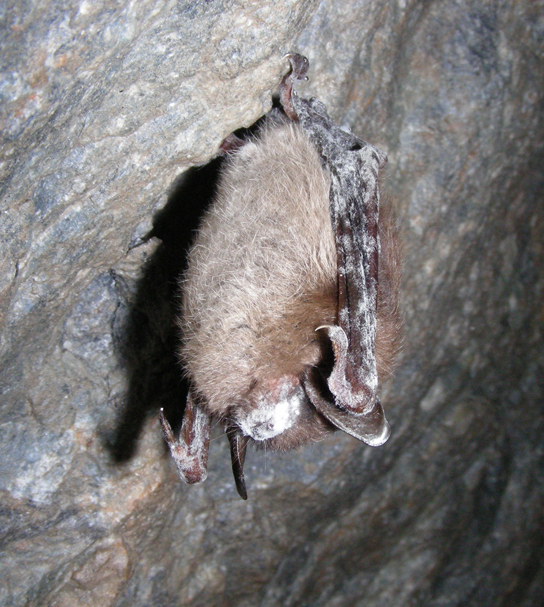


Figure 47.14図 47.14
This little brown bat in Greeley Mine, Vermont, March 26, 2009, was found to have white-nose syndrome. (credit: Marvin Moriarty, USFWS)
2009年3月26日、バーモント州グリーリー鉱山で見つかった、このリトルブラウンバットは白鼻症候群にかかっていた。(出典:Marvin Moriarty、USFWS)