第47章保全生物学と生物多様性
Patterns of Biodiversity生物多様性の分布パターン
Biodiversity is not evenly distributed on Earth. Lake Victoria contained almost 500 species of cichlids alone, ignoring the other fish families present in the lake. All of these species were found only in Lake Victoria; therefore, the 500 species of cichlids were endemic. Endemic species are found in only one location. Endemics with highly restricted distributions are particularly vulnerable to extinction. Higher taxonomic levels, such as genera and families, can also be endemic. Lake Michigan contains about 79 species of fish, many of which are found in other lakes in North America. What accounts for the difference in fish diversity in these two lakes? Lake Victoria is an ancient tropical lake, while Lake Michigan is a recently formed temperate lake. Lake Michigan in its present form is only about 7,000 years old, while Lake Victoria in its present form is about 15,000 years old, although its basin is about 400,000 years in age. Biogeographers have suggested these two factors, latitude and age, are two of several hypotheses to explain biodiversity patterns on the planet.
英語のヒント
生物多様性は地球上に均等に分布していない。ビクトリア湖には、ほかの魚の科を除いても、シクリッドだけで約500種がいた。これらはすべてビクトリア湖でしか見られない固有種だった。固有種とは、1つの場所だけに存在する種である。分布が極めて限られた固有種は、特に絶滅しやすい。属や科のような高い分類階級も、固有であることがある。ミシガン湖には約79種の魚がいるが、その多くは北米のほかの湖にも見られる。この2つの湖の魚の多様性の違いは、何で説明できるだろうか。ビクトリア湖は古い熱帯の湖であり、ミシガン湖は比較的新しくできた温帯の湖である。ミシガン湖が現在の形になったのは約7,000年前にすぎない。一方、ビクトリア湖は現在の形で約15,000年、湖盆自体は約40万年の歴史をもつ。生物地理学者は、緯度と年代というこの2要因を、地球の多様性分布を説明するいくつかの仮説の中に挙げている。
One of the oldest observed patterns in ecology is that species biodiversity in almost every taxonomic group increases as latitude declines. In other words, biodiversity increases closer to the equator (Figure 47.3).
英語のヒント
生態学で最も古くから観察されてきたパターンの1つは、ほぼすべての分類群で、緯度が低くなるほど種の多様性が高まることである。つまり、赤道に近づくほど生物多様性が増す(図47.3)。
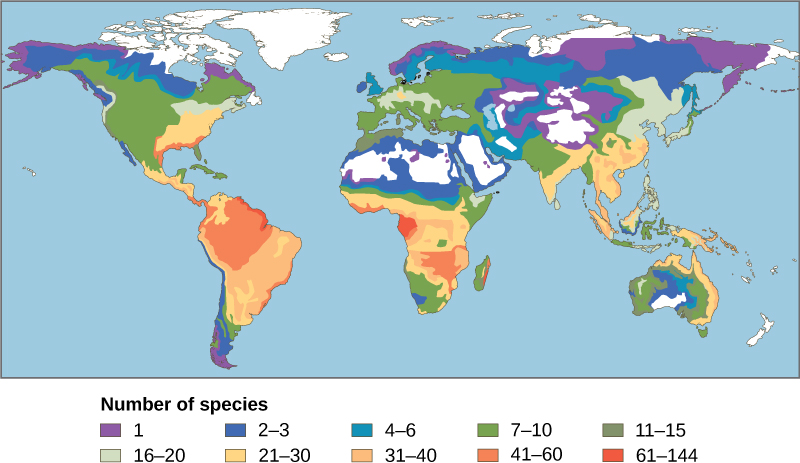

Figure 47.3図 47.3
This map illustrates the number of amphibian species across the globe and shows the trend toward higher biodiversity at lower latitudes. A similar pattern is observed for most taxonomic groups. The white areas indicate a lack of data in this particular study.
世界の両生類の種数を示す地図。低緯度ほど生物多様性が高い傾向が分かる。大半の分類群に同様のパターンが見られる。白い地域は、この研究でデータがなかったことを示す。
It is not yet clear why biodiversity increases closer to the equator, but scientists have several hypotheses. One factor may be the greater age of the ecosystems in the tropics versus those in temperate regions; the temperate regions were largely devoid of life or were drastically reduced during the last glaciation. The idea is that greater age provides more time for speciation. Another possible explanation is the increased direct energy the tropics receive from the sun versus the decreased intensity of the solar energy that temperate and polar regions receive. Tropical ecosystem complexity may promote speciation by increasing the heterogeneity, or number of ecological niches, in the tropics relative to higher latitudes. The greater heterogeneity provides more opportunities for coevolution, specialization, and perhaps greater selection pressures leading to population differentiation. However, this hypothesis suffers from some circularity—ecosystems with more species encourage speciation, but how did they get more species to begin with?
英語のヒント
赤道に近いほど生物多様性が高まる理由は、まだ明らかでないが、いくつかの仮説がある。1つの要因は、熱帯の生態系が温帯のものより古いことかもしれない。温帯では、最後の氷期に生物の多くが失われたか、大幅に減少した。長い歴史が種分化のための時間をより多く与えた、という考えである。別の説明は、温帯や極地では太陽エネルギーの強さが弱まるのに対し、熱帯は太陽からより多くの直接的なエネルギーを受けることである。熱帯の生態系の複雑さは、高緯度地域より不均一性、つまり生態的ニッチの数を増やすことで、種分化を促す可能性がある。不均一性が高まると、共進化、特殊化、そして個体群の分化をもたらす強い選択圧の機会が増えるかもしれない。しかし、この仮説には循環論法の面がある。種の多い生態系が種分化を促すとしても、最初にどうして種が多くなったのだろうか。
The tropics have been perceived as being more stable than temperate regions, which have a pronounced climate and day-length seasonality. The tropics have their own forms of seasonality, such as rainfall, but they are generally assumed to be more stable environments and this stability might promote speciation into highly specialized niches.
英語のヒント
熱帯は、気候と日長に顕著な季節変化がある温帯より安定していると考えられてきた。熱帯にも降雨のような独自の季節性はあるが、一般には、より安定した環境と見なされる。この安定性が、高度に特殊化したニッチへの種分化を促す可能性がある。
Regardless of the mechanisms, it is certainly true that all levels of biodiversity are greatest in the tropics. Additionally, the rate of endemism is highest, and there are more biodiversity “hotspots.” However, this richness of diversity also means that knowledge of species is unfortunately very low, and there is a high potential for biodiversity loss.
英語のヒント
どの仕組みによるにせよ、あらゆる段階の生物多様性が熱帯で最大であることは確かである。固有種の割合も最も高く、生物多様性の「ホットスポット」も多い。しかし、この豊かさは、残念ながら種についての知識が非常に乏しく、多様性を失う危険性が高いことも意味する。