第37章内分泌系
Adrenal Medulla副腎髄質
The adrenal medulla contains large, irregularly shaped cells that are closely associated with blood vessels. These cells are innervated by preganglionic autonomic nerve fibers from the central nervous system.
英語のヒント
副腎髄質には、血管と密接に関係する、大きく不規則な形の細胞がある。中枢神経系から来る節前自律神経線維の支配を受ける。
The adrenal medulla contains two types of secretory cells: one that produces epinephrine (adrenaline) and another that produces norepinephrine (noradrenaline). Epinephrine is the primary adrenal medulla hormone accounting for 75 to 80 percent of its secretions. Epinephrine and norepinephrine increase heart rate, breathing rate, cardiac muscle contractions, blood pressure, and blood glucose levels. They also accelerate the breakdown of glucose in skeletal muscles and stored fats in adipose tissue.
英語のヒント
副腎髄質には、エピネフリン(アドレナリン)をつくる細胞と、ノルエピネフリン(ノルアドレナリン)をつくる細胞の二種類がある。主なホルモンはエピネフリンで、分泌物の75〜80%を占める。両ホルモンは心拍数、呼吸数、心筋収縮、血圧、血糖値を増加させる。骨格筋のグルコース分解と、脂肪組織に蓄えられた脂肪の分解も速める。
The release of epinephrine and norepinephrine is stimulated by neural impulses from the sympathetic nervous system. Secretion of these hormones is stimulated by acetylcholine release from preganglionic sympathetic fibers innervating the adrenal medulla. These neural impulses originate from the hypothalamus in response to stress to prepare the body for the fight-or-flight response.
英語のヒント
エピネフリンとノルエピネフリンの放出は、交感神経系の神経インパルスによって促される。副腎髄質を支配する節前交感神経線維からのアセチルコリン放出が、分泌を刺激する。これらの神経インパルスは、ストレスに応じて視床下部から発し、体を闘争・逃走反応に備えさせる。
Pancreas膵臓
The pancreas, illustrated in Figure 37.19, is an elongated organ that is located between the stomach and the proximal portion of the small intestine. It contains both exocrine cells that excrete digestive enzymes and endocrine cells that release hormones. It is sometimes referred to as a heterocrine gland because it has both endocrine and exocrine functions.
英語のヒント
図37.19の膵臓は、胃と小腸の近位部の間にある細長い器官である。消化酵素を分泌する外分泌細胞と、ホルモンを放出する内分泌細胞の両方を含む。内分泌と外分泌の両機能をもつため、混合腺と呼ばれることもある。
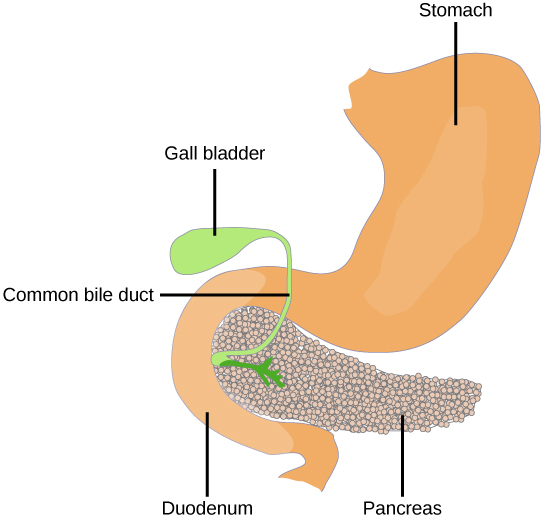

Figure 37.19図 37.19
The pancreas is found underneath the stomach and points toward the spleen. (credit: modification of work by NCI)
膵臓は胃の下にあり、脾臓の方向へ伸びる。(出典:NCIの作品を改変)
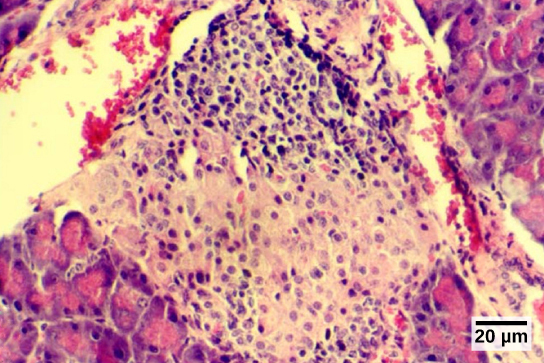
The endocrine cells of the pancreas form clusters called pancreatic islets or the islets of Langerhans, as visible in the micrograph shown in Figure 37.20. The pancreatic islets contain two primary cell types: alpha cells, which produce the hormone glucagon, and beta cells, which produce the hormone insulin. These hormones regulate blood glucose levels. As blood glucose levels decline, alpha cells release glucagon to raise the blood glucose levels by increasing rates of glycogen breakdown and glucose release by the liver. When blood glucose levels rise, such as after a meal, beta cells release insulin to lower blood glucose levels by increasing the rate of glucose uptake in most body cells, and by increasing glycogen synthesis in skeletal muscles and the liver. Together, glucagon and insulin regulate blood glucose levels.
膵臓の内分泌細胞は、膵島またはランゲルハンス島という集団をつくる。図37.20の顕微鏡写真で確認できる。主な細胞は、グルカゴンをつくるα細胞と、インスリンをつくるβ細胞の二種類であり、これらのホルモンが血糖値を調節する。血糖が下がるとα細胞はグルカゴンを放出する。グリコーゲン分解と肝臓からのグルコース放出を速め、血糖を上げる。食後などに血糖が上がると、β細胞はインスリンを放出する。多くの体細胞へのグルコース取り込みと、骨格筋・肝臓でのグリコーゲン合成を速め、血糖を下げる。グルカゴンとインスリンが協働して血糖値を調節する。
OpenStax, Rice University; Biology 2e. (credit: modification of work by Muhammad T. Tabiin, Christopher P. White, Grant Morahan, and Bernard E. Tuch; scale-bar data from Matt Russell) · CC BY 4.0 · Source出典

Figure 37.20図 37.20
The islets of Langerhans are clusters of endocrine cells found in the pancreas; they stain lighter than surrounding cells. (credit: modification of work by Muhammad T. Tabiin, Christopher P. White, Grant Morahan, and Bernard E. Tuch; scale-bar data from Matt Russell)
ランゲルハンス島は膵臓にある内分泌細胞の集団で、周囲の細胞より淡く染まる。(出典:Muhammad T. Tabiin、Christopher P. White、Grant Morahan、Bernard E. Tuchの作品を改変。スケールバーのデータ:Matt Russell)
Pineal Gland松果体
The pineal gland produces melatonin. The rate of melatonin production is affected by the photoperiod. Collaterals from the visual pathways innervate the pineal gland. During the day photoperiod, little melatonin is produced; however, melatonin production increases during the dark photoperiod (night). In some mammals, melatonin has an inhibitory effect on reproductive functions by decreasing production and maturation of sperm, oocytes, and reproductive organs. Melatonin is an effective antioxidant, protecting the CNS from free radicals such as nitric oxide and hydrogen peroxide. Lastly, melatonin is involved in biological rhythms, particularly circadian rhythms such as the sleep-wake cycle and eating habits.
英語のヒント
松果体はメラトニンをつくる。産生速度は光周期の影響を受け、視覚経路から分岐する側枝が松果体を神経支配する。明期、すなわち昼には産生が少なく、暗期である夜には増える。一部の哺乳類では、メラトニンは精子、卵母細胞、生殖器官の形成と成熟を減らすことで、生殖機能を抑える。メラトニンは有効な抗酸化物質でもあり、一酸化窒素や過酸化水素などのフリーラジカルから中枢神経系を守る。また、生体リズム、とくに睡眠・覚醒周期や摂食習慣などの概日リズムに関わる。
Gonads性腺
The gonads—the testes and ovaries—produce steroid hormones. The testes produce androgens, testosterone being the most prominent, which allow for the growth and development of the testes and penis, increased skeletal and muscular growth, enlargement of the larynx, increased growth and redistribution of body hair, and the production of sperm cells. The ovaries produce estradiol and progesterone, which cause secondary sex characteristics and prepare the body for childbirth.
精巣と卵巣という性腺は、ステロイドホルモンをつくる。精巣はテストステロンを主とするアンドロゲンをつくり、精巣と陰茎の成長・発達、骨格と筋肉の成長促進、喉頭の拡大、体毛の増加と分布変化、精子産生を可能にする。卵巣はエストラジオールとプロゲステロンをつくり、二次性徴を生じさせ、体を出産に備えさせる。
Endocrine Glands and their Associated Hormones 内分泌腺と関連するホルモン |
||
|---|---|---|
Endocrine Gland 内分泌腺 |
Associated Hormones 関連するホルモン |
Effect 作用 |
Hypothalamus 視床下部 |
releasing and inhibiting hormones 放出ホルモンと抑制ホルモン |
regulate hormone release from pituitary gland; produce oxytocin; produce uterine contractions and milk secretion in breast tissue 下垂体からのホルモン放出を調節する。オキシトシンをつくる。子宮収縮と乳房組織の乳汁分泌を起こす。 |
antidiuretic hormone (ADH) 抗利尿ホルモン(ADH) |
water reabsorption from kidneys; vasoconstriction to increase blood pressure 腎臓での水の再吸収。血管収縮による血圧上昇。 |
|
Pituitary (Anterior) 下垂体(前葉) |
growth hormone (GH) 成長ホルモン(GH) |
promotes growth of body tissues, protein synthesis; metabolic functions 体組織の成長とタンパク質合成を促す。代謝機能に関わる。 |
prolactin (PRL) プロラクチン(PRL) |
promotes milk production 乳汁産生を促す。 |
|
thyroid stimulating hormone (TSH) 甲状腺刺激ホルモン(TSH) |
stimulates thyroid hormone release 甲状腺ホルモンの放出を促す。 |
|
adrenocorticotropic hormone (ACTH) 副腎皮質刺激ホルモン(ACTH) |
stimulates hormone release by adrenal cortex, glucocorticoids 副腎皮質からのホルモン、糖質コルチコイドの放出を促す。 |
|
follicle-stimulating hormone (FSH) 卵胞刺激ホルモン(FSH) |
stimulates gamete production (both ova and sperm); secretion of estradiol 卵と精子の両方の配偶子産生、エストラジオール分泌を促す。 |
|
luteinizing hormone (LH) 黄体形成ホルモン(LH) |
stimulates androgen production by gonads; ovulation, secretion of progesterone 性腺のアンドロゲン産生、排卵、プロゲステロン分泌を促す。 |
|
melanocyte-stimulating hormone (MSH) メラノサイト刺激ホルモン(MSH) |
stimulates melanocytes of the skin increasing melanin pigment production. 皮膚のメラノサイトを刺激し、メラニン色素の産生を増やす。 |
|
Pituitary (Posterior) 下垂体(後葉) |
antidiuretic hormone (ADH) 抗利尿ホルモン(ADH) |
stimulates water reabsorption by kidneys 腎臓での水の再吸収を促す。 |
oxytocin オキシトシン |
stimulates uterine contractions during childbirth; milk ejection; stimulates ductus deferens and prostate gland contraction during emission 出産時の子宮収縮、射乳、精液排出時の精管と前立腺の収縮を促す。 |
|
Thyroid 甲状腺 |
thyroxine, triiodothyronine チロキシン、トリヨードチロニン |
stimulate and maintain metabolism; growth and development 代謝を促進・維持する。成長と発達に関わる。 |
calcitonin カルシトニン |
reduces blood Ca2+ levels 血中Ca2+を減らす。 |
|
Parathyroid 副甲状腺 |
parathyroid hormone (PTH) 副甲状腺ホルモン(PTH) |
increases blood Ca2+ levels 血中Ca2+ を増やす。 |
Adrenal (Cortex) 副腎(皮質) |
aldosterone アルドステロン |
increases blood Na+ levels; increases K+ secretion 血中Na+を増やす。K+の分泌を増やす。 |
cortisol, corticosterone, cortisone コルチゾール、コルチコステロン、コルチゾン |
increase blood glucose levels; anti-inflammatory effects 血糖を上げる。抗炎症作用。 |
|
Adrenal (Medulla) 副腎(髄質) |
epinephrine, norepinephrine エピネフリン、ノルエピネフリン |
stimulate fight-or-flight response; increase blood glucose levels; increase metabolic activities 闘争・逃走反応を促す。血糖と代謝活動を高める。 |
Pancreas 膵臓 |
insulin インスリン |
reduces blood glucose levels 血糖を下げる。 |
glucagon グルカゴン |
increases blood glucose levels 血糖を上げる。 |
|
Pineal gland 松果体 |
melatonin メラトニン |
regulates some biological rhythms and protects CNS from free radicals 一部の生体リズムを調節し、中枢神経系をフリーラジカルから守る。 |
Testes 精巣 |
androgens アンドロゲン |
regulate, promote, increase or maintain sperm production; a suite of characteristics including growth and development of the testes and penis, increased skeletal and muscular growth, enlargement of the larynx, and increased growth and redistribution of body hair 精子産生を調節・促進・増加・維持する。精巣と陰茎の成長・発達、骨格と筋肉の成長促進、喉頭の拡大、体毛の増加と分布変化という一連の特徴に関わる。 |
Ovaries 卵巣 |
estrogen エストロゲン |
promotes uterine lining growth; a suite of characteristics including increased development of breast tissue, redistribution of fat towards hips, legs, and breast, and the maturation of the uterus and vagina 子宮内膜の成長を促す。乳房組織の発達、臀部・脚・乳房への脂肪分布の変化、子宮と腟の成熟という一連の特徴に関わる。 |
progestins プロゲスチン |
promote and maintain uterine lining growth 子宮内膜の成長を促進・維持する。 |
|