第37章内分泌系
37.3 Regulation of Body Processes37.3 体の過程の調節
Learning Objectives学習目標
By the end of this section, you will be able to do the following:
この節を学ぶと、次のことができるようになる。
- Explain how hormones regulate the excretory systemホルモンによる排泄系の調節を説明する。
- Discuss the role of hormones in the reproductive system生殖系におけるホルモンの役割を論じる。
- Describe how hormones regulate metabolismホルモンによる代謝の調節を述べる。
- Explain the role of hormones in different diseases各種疾患におけるホルモンの役割を説明する。
Hormones have a wide range of effects and modulate many different body processes. The key regulatory processes that will be examined here are those affecting the excretory system, the reproductive system, metabolism, blood calcium concentrations, growth, and the stress response.
ホルモンの作用は広範囲に及び、体のさまざまな過程を調節する。ここでは、排泄系、生殖系、代謝、血中カルシウム濃度、成長、ストレス応答に関わる主要な調節を取り上げる。
Hormonal Regulation of the Excretory System排泄系のホルモン調節
Maintaining a proper water balance in the body is important to avoid dehydration or over-hydration (hyponatremia). The water concentration of the body is monitored by osmoreceptors in the hypothalamus, which detect the concentration of electrolytes in the extracellular fluid. The concentration of electrolytes in the blood rises when there is water loss caused by excessive perspiration, inadequate water intake, or low blood volume due to blood loss. An increase in blood electrolyte levels results in a neuronal signal being sent from the osmoreceptors in hypothalamic nuclei. The pituitary gland has two components: anterior and posterior. The anterior pituitary is composed of glandular cells that secrete protein hormones. The posterior pituitary is an extension of the hypothalamus. It is composed largely of neurons that are continuous with the hypothalamus.
英語のヒント
脱水や水分過剰(低ナトリウム血症)を避けるには、体内の水分バランスを適切に保つことが重要である。視床下部の浸透圧受容器は、細胞外液の電解質濃度を検出し、体内の水分濃度を監視する。多すぎる発汗、水分摂取の不足、出血による血液量の減少で水が失われると、血中電解質濃度は上昇する。これにより、視床下部の神経核にある浸透圧受容器から神経信号が送られる。下垂体は前葉と後葉からなる。前葉はタンパク質ホルモンを分泌する腺細胞からできている。後葉は視床下部の延長で、主に視床下部と連続するニューロンからなる。
The hypothalamus produces a polypeptide hormone known as antidiuretic hormone (ADH), which is transported to and released from the posterior pituitary gland. The principal action of ADH is to regulate the amount of water excreted by the kidneys. As ADH (which is also known as vasopressin) causes direct water reabsorption from the kidney tubules, salts and wastes are concentrated in what will eventually be excreted as urine. The hypothalamus controls the mechanisms of ADH secretion, either by regulating blood volume or the concentration of water in the blood. Dehydration or physiological stress can cause an increase of osmolarity above 300 mOsm/L, which in turn, raises ADH secretion and causes water to be retained, causing an increase in blood pressure. ADH travels in the bloodstream to the kidneys. Once at the kidneys, ADH changes the kidneys to become more permeable to water by temporarily inserting water channels, aquaporins, into the kidney tubules. Water moves out of the kidney tubules through the aquaporins, reducing urine volume. The water is reabsorbed into the capillaries lowering blood osmolarity back toward normal. As blood osmolarity decreases, a negative feedback mechanism reduces osmoreceptor activity in the hypothalamus, and ADH secretion is reduced. ADH release can be reduced by certain substances, including alcohol, which can cause increased urine production and dehydration.
英語のヒント
視床下部は、抗利尿ホルモン(ADH)というポリペプチドホルモンをつくる。ADHは下垂体後葉へ運ばれ、そこから放出される。主な作用は、腎臓から排泄する水の量の調節である。バソプレシンとも呼ばれ、尿細管からの水の直接的な再吸収を起こす。そのため、最終的に尿として排泄される液体に、塩類と老廃物が濃縮される。視床下部は、血液量または血液中の水分濃度を調節してADH分泌の仕組みを制御する。脱水や生理的ストレスで浸透圧濃度が300 mOsm/Lを超えると、ADH分泌が増え、水が保持され、血圧が上がる。ADHは血流で腎臓へ達し、尿細管に水チャネルであるアクアポリンを一時的に組み込ませ、水を通しやすくする。水はアクアポリンを通って尿細管から出るため、尿量が減る。水は毛細血管へ再吸収され、血液の浸透圧濃度が正常値へ向かって下がる。浸透圧濃度が下がると、負のフィードバックで視床下部の浸透圧受容器の活動が減り、ADH分泌も減少する。アルコールなどの物質もADH放出を減らし、尿の増加や脱水を引き起こすことがある。
Chronic underproduction of ADH or a mutation in the ADH receptor results in diabetes insipidus. If the posterior pituitary does not release enough ADH, water cannot be retained by the kidneys and is lost as urine. This causes increased thirst, but water taken in is lost again and must be continually consumed. If the condition is not severe, dehydration may not occur, but severe cases can lead to electrolyte imbalances due to dehydration.
英語のヒント
ADHの慢性的な産生不足や、ADH受容体の変異は尿崩症を起こす。下垂体後葉が十分なADHを放出しなければ、腎臓は水を保持できず、尿として失う。口渇が強くなるが、飲んだ水は再び失われるため、絶えず飲む必要がある。軽症なら脱水にならないこともあるが、重症では脱水により電解質の不均衡が生じうる。
Another hormone responsible for maintaining electrolyte concentrations in extracellular fluids is aldosterone, a steroid hormone that is produced by the adrenal cortex. In contrast to ADH, which promotes the reabsorption of water to maintain proper water balance, aldosterone maintains proper water balance by enhancing Na+ reabsorption and K+ secretion from extracellular fluid of the cells in kidney tubules. Because it is produced in the cortex of the adrenal gland and affects the concentrations of minerals Na+ and K+, aldosterone is referred to as a mineralocorticoid, a corticosteroid that affects ion and water balance. Aldosterone release is stimulated by a decrease in blood sodium levels, blood volume, or blood pressure, or an increase in blood potassium levels. It also prevents the loss of Na+ from sweat, saliva, and gastric juice. The reabsorption of Na+ also results in the osmotic reabsorption of water, which alters blood volume and blood pressure.
細胞外液の電解質濃度を保つもう一つのホルモンが、副腎皮質でつくられるステロイドホルモン、アルドステロンである。ADHが水の再吸収を促して水分バランスを保つのに対し、アルドステロンは、尿細管の細胞における細胞外液からのNa+再吸収とK+分泌を高める。副腎皮質で産生され、ミネラルであるNa+ とK+の濃度に作用するため、アルドステロンは鉱質コルチコイドと呼ばれる。これはイオンと水分のバランスに作用する副腎皮質ステロイドである。放出を刺激するのは、血中ナトリウム濃度、血液量、血圧の低下、または血中カリウム濃度の上昇である。汗、唾液、胃液からのNa+の喪失も防ぐ。Na+の再吸収は、浸透による水の再吸収も引き起こし、血液量と血圧を変える。
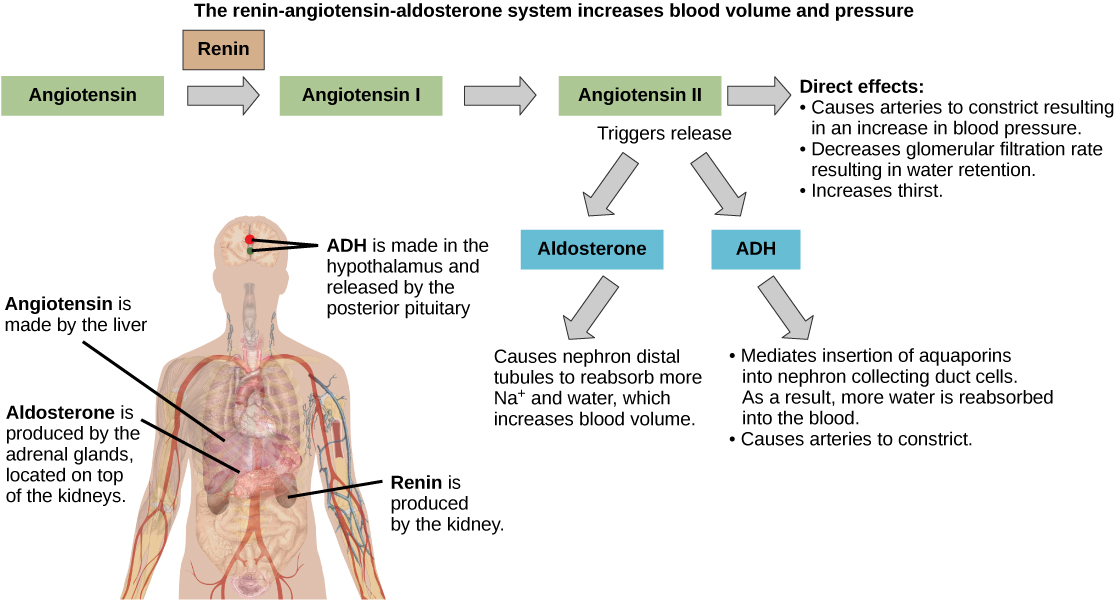
Aldosterone production can be stimulated by low blood pressure, which triggers a sequence of chemical release, as illustrated in Figure 37.7. When blood pressure drops, the renin-angiotensin-aldosterone system (RAAS) is activated. Cells in the juxtaglomerular apparatus, which regulates the functions of the nephrons of the kidney, detect this and release renin. Renin, an enzyme, circulates in the blood and reacts with a plasma protein produced by the liver called angiotensinogen. When angiotensinogen is cleaved by renin, it produces angiotensin I, which is then converted into angiotensin II in the lungs. Angiotensin II functions as a hormone and then causes the release of the hormone aldosterone by the adrenal cortex, resulting in increased Na+ reabsorption, water retention, and an increase in blood pressure. Angiotensin II in addition to being a potent vasoconstrictor also causes an increase in ADH and increased thirst, both of which help to raise blood pressure.
英語のヒント
低血圧は、図37.7のような化学物質放出の連鎖を起こし、アルドステロン産生を刺激できる。血圧が下がると、レニン・アンジオテンシン・アルドステロン系(RAAS)が活性化する。腎単位の機能を調節する傍糸球体装置の細胞が低下を検出し、レニンを放出する。レニンは酵素で、血中を循環し、肝臓でつくられる血漿タンパク質アンジオテンシノーゲンに作用する。レニンによる切断でアンジオテンシンIができ、肺でアンジオテンシンIIへ変換される。アンジオテンシンIIはホルモンとして働き、副腎皮質からアルドステロンを放出させる。その結果、Na+の再吸収、水分保持、血圧が増加する。また強力な血管収縮物質であるだけでなく、ADHを増やし、口渇を強める。これらも血圧を上げるのに役立つ。
OpenStax, Rice University; Biology 2e. (credit: modification of work by Mikael Häggström) · CC BY 4.0 · Source出典

Figure 37.7図 37.7
ADH and aldosterone increase blood pressure and volume. Angiotensin II stimulates release of these hormones. Angiotensin II, in turn, is formed when renin cleaves angiotensinogen. (credit: modification of work by Mikael Häggström)
ADHとアルドステロンは、血圧と血液量を増やす。アンジオテンシンIIはこれらの放出を刺激する。アンジオテンシンIIは、レニンがアンジオテンシノーゲンを切断することで形成される。(出典:Mikael Häggströmの作品を改変)