第37章内分泌系
Hormonal Regulation of Growth成長のホルモン調節
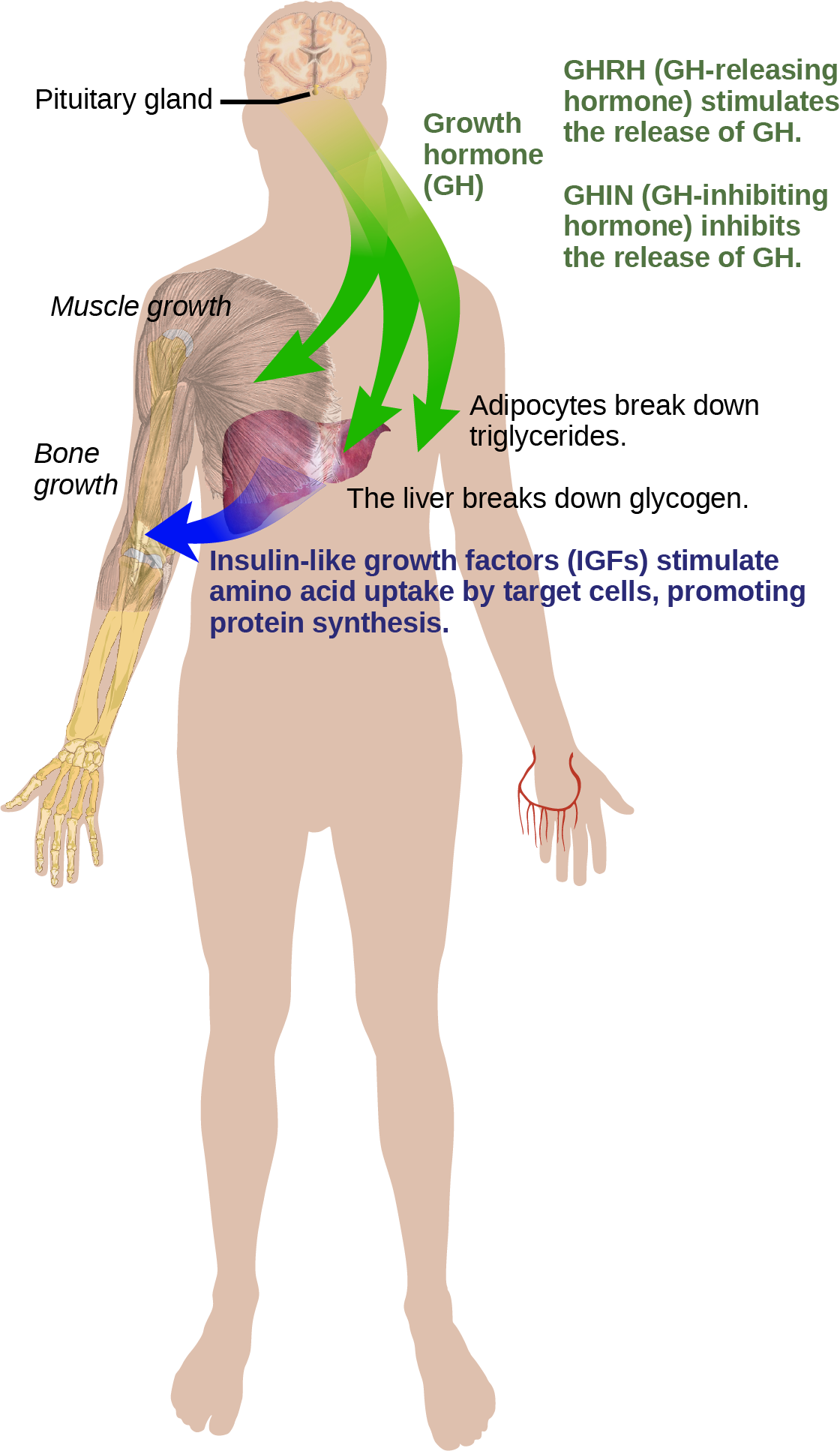
Hormonal regulation is required for the growth and replication of most cells in the body. Growth hormone (GH), produced by the anterior portion of the pituitary gland, accelerates the rate of protein synthesis, particularly in skeletal muscle and bones. Growth hormone has direct and indirect mechanisms of action. The first direct action of GH is stimulation of triglyceride breakdown (lipolysis) and release into the blood by adipocytes. This results in a switch by most tissues from utilizing glucose as an energy source to utilizing fatty acids. This process is called a glucose-sparing effect. In another direct mechanism, GH stimulates glycogen breakdown in the liver; the glycogen is then released into the blood as glucose. Blood glucose levels increase as most tissues are utilizing fatty acids instead of glucose for their energy needs. The GH mediated increase in blood glucose levels is called a diabetogenic effect because it is similar to the high blood glucose levels seen in diabetes mellitus.
英語のヒント
体の大部分の細胞の成長と増殖には、ホルモンによる調節が必要である。下垂体前葉でつくられる成長ホルモン(GH)は、とくに骨格筋と骨でタンパク質合成を速める。作用には直接的な機構と間接的な機構がある。GHの第一の直接作用は、脂肪細胞でのトリグリセリドの分解(脂肪分解)と血中への放出を促すことである。すると大部分の組織は、エネルギー源をグルコースから脂肪酸へ切り替える。これをグルコース節約作用という。もう一つの直接作用では、GHは肝臓でのグリコーゲン分解を促す。グリコーゲンはグルコースとなって血中へ放出される。大部分の組織は必要なエネルギーにグルコースではなく脂肪酸を使うため、血糖値が上がる。GHによる血糖上昇は、糖尿病でみられる高血糖に似ているため、糖尿病誘発作用と呼ばれる。
The indirect mechanism of GH action is mediated by insulin-like growth factors (IGFs) or somatomedins, which are a family of growth-promoting proteins produced by the liver, which stimulates tissue growth. IGFs stimulate the uptake of amino acids from the blood, allowing the formation of new proteins, particularly in skeletal muscle cells, cartilage cells, and other target cells, as shown in Figure 37.13. This is especially important after a meal, when glucose and amino acid concentration levels are high in the blood. GH levels are regulated by two hormones produced by the hypothalamus. GH release is stimulated by growth hormone-releasing hormone (GHRH) and is inhibited by growth hormone-inhibiting hormone (GHIH), also called somatostatin.
英語のヒント
GHの間接作用を仲介するのは、インスリン様成長因子(IGF)、別名ソマトメジンである。肝臓でつくられる成長促進タンパク質群であり、組織の成長を促す。IGFは血中からのアミノ酸取り込みを促し、図37.13のように、とくに骨格筋細胞、軟骨細胞などの標的細胞で、新しいタンパク質の形成を可能にする。血中のグルコースとアミノ酸の濃度が高い食後には、これがとくに重要となる。GHの濃度は視床下部の二つのホルモンが調節する。成長ホルモン放出ホルモン(GHRH)がGH放出を促し、ソマトスタチンとも呼ばれる成長ホルモン放出抑制ホルモン(GHIH)が抑える。
OpenStax, Rice University; Biology 2e. (credit: modification of work by Mikael Häggström) · CC BY 4.0 · Source出典

Figure 37.13図 37.13
Growth hormone directly accelerates the rate of protein synthesis in skeletal muscle and bones. Insulin-like growth factor 1 (IGF-1) is activated by growth hormone and also allows formation of new proteins in muscle cells and bone. (credit: modification of work by Mikael Häggström)
成長ホルモンは骨格筋と骨のタンパク質合成を直接速める。インスリン様成長因子1(IGF-1)は成長ホルモンによって活性化され、筋細胞と骨で新しいタンパク質の形成を可能にする。(出典:Mikael Häggströmの作品を改変)
A balanced production of growth hormone is critical for proper development. Underproduction of GH in adults does not appear to cause any abnormalities, but in children it can result in pituitary dwarfism, resulting in abnormally short stature with normal body proportions. The height of such individuals is most frequently less than 4 feet (122 cm) in height. Oversecretion of growth hormone can lead to gigantism in children, causing excessive growth. In some documented cases, individuals can reach heights of over eight feet. In adults, excessive GH can lead to acromegaly, a condition in which there is enlargement of bones in the face, hands, and feet that are still capable of growth.
英語のヒント
適切な発達には、釣り合いの取れた成長ホルモン産生が欠かせない。成人ではGHの産生不足による異常はみられないようだが、小児では下垂体性低身長症を起こす場合がある。体の比率は正常なまま、身長が著しく低くなる。多くは身長4フィート(122 cm)未満となる。成長ホルモンの過剰分泌は、小児では過度の成長を起こす巨人症につながる。記録された例の中には、身長8フィートを超えるものもある。成人ではGH過剰により先端巨大症が起こりうる。成長能力が残る顔、手、足の骨が大きくなる状態である。
Hormonal Regulation of Stressストレスのホルモン調節
When a threat or danger is perceived, the body responds by releasing hormones that will ready it for the “fight-or-flight” response. The effects of this response are familiar to anyone who has been in a stressful situation: increased heart rate, dry mouth, and hair standing up.
英語のヒント
脅威や危険を感じると、体は「闘争・逃走」反応に備えるためのホルモンを放出する。心拍の増加、口の渇き、毛が逆立つことなど、この反応の作用はストレスのかかる状況を経験した人にはなじみ深い。
The sympathetic nervous system regulates the stress response via the hypothalamus. Stressful stimuli cause the hypothalamus to signal the adrenal medulla (which mediates short-term stress responses) via nerve impulses, and the adrenal cortex, which mediates long-term stress responses, via the hormone adrenocorticotropic hormone (ACTH), which is produced by the anterior pituitary.
交感神経系は、視床下部を通してストレス反応を調節する。ストレスとなる刺激を受けると、視床下部は神経インパルスを介して、短期のストレス反応を仲介する副腎髄質へ信号を送る。また下垂体前葉のつくる副腎皮質刺激ホルモン(ACTH)を介して、長期のストレス反応を仲介する副腎皮質へ信号を送る。